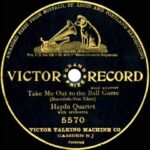
 “Take Me Out To The Ball Game” already feels familiar before the first note lands, as if it exists somewhere deeper than memory, wired into instinct. When the Haydn Quartet recorded the song in 1908, it wasn’t yet the ritual centerpiece it would become, but the seeds were all there: the communal melody, the easy rhythm, the sense that this was music designed not just to be heard, but to be shared. In the Haydn Quartet’s hands, the song emerges as something bright, orderly, and irresistibly inviting, a snapshot of popular music at a moment when America was still figuring out how it wanted to sing together.
The Haydn Quartet were specialists in clarity and balance, and their approach to “Take Me Out To The Ball Game” reflects that precision. The harmonies are clean and carefully blended, each voice distinct but never competing. There’s a formality to the performance that feels natural for the era, yet it doesn’t drain the song of warmth. Instead, it frames the tune like a well-kept photograph, preserving its optimism and making its structure easy to follow. You hear the melody exactly as it was meant to be heard, unclouded and confident.
What stands out immediately is how theatrical the song feels, even in this early recording. “Take Me Out To The Ball Game” was written by Tin Pan Alley songwriters Jack Norworth and Albert Von Tilzer, and it carries the DNA of vaudeville and musical theater. The Haydn Quartet lean into that lineage, delivering the lyrics with a sense of storytelling rather than casual familiarity. Each phrase feels slightly elevated, as if the singers are presenting the idea of the ballpark to an audience that’s still learning how to imagine it.
There’s a fascinating tension between subject and style here. The song celebrates something informal and communal, yet the performance itself is polished and refined. That contrast reflects the time in which it was recorded. Baseball was becoming a mass pastime, but recorded music was still rooted in parlor culture and formal presentation. The Haydn Quartet bridge that gap, translating the rowdy joy of the stands into something suitable for home listening without stripping away the fun.
Lyrically, the song is charmingly direct. It doesn’t dwell on the mechanics of the game or the drama of competition. Instead, it focuses on the experience of being there, surrounded by people, food, noise, and anticipation. The famous refrain about peanuts and Cracker Jack isn’t just a catchy detail; it’s a grounding one. It places the listener firmly in the moment, emphasizing that the pleasure comes from participation, not just observation. The Haydn Quartet deliver these lines with a gentle enthusiasm that suggests genuine affection for the scene being described.
Musically, the tune is built for memory. Its simple, ascending melody invites repetition, and the steady rhythm makes it easy to follow along, even if you’re hearing it for the first time. In the Haydn Quartet’s version, that accessibility is front and center. There’s no attempt to complicate or modernize the song. Instead, they trust the composition to do its work. The result is a performance that feels sturdy, like a foundation being laid.
Listening closely, you can hear how the quartet uses harmony to reinforce the song’s communal spirit. No single voice dominates for long. The emphasis is on blend and unity, a sonic representation of togetherness. That choice feels especially fitting for a song about shared experience. Even before it became a crowd tradition, “Take Me Out To The Ball Game” carried the idea that its power came from many voices joining as one.
The recording also captures the optimism of early twentieth-century America. There’s a sense of forward motion in the performance, a belief that simple pleasures could bind people together across differences. Baseball, in this context, isn’t just a sport; it’s a meeting place. The Haydn Quartet don’t spell that out explicitly, but their warm, orderly delivery suggests trust in the idea that shared rituals matter.
What’s particularly interesting is how the song’s later history can overshadow its original tone. Today, it’s often associated with spontaneous, imperfect group singing, off-key voices blending in the open air. The Haydn Quartet’s version is almost the opposite: controlled, rehearsed, and precise. Yet hearing it this way reveals the song’s adaptability. Its core is strong enough to survive endless reinterpretation, from formal quartet harmonies to thousands of fans singing in unison between innings.
There’s also a subtle humor in the song that the Haydn Quartet handle delicately. Lines about rooting for the home team “if they don’t win, it’s a shame” carry a light irony, an understanding that disappointment is part of the game. The quartet don’t exaggerate this humor; they let it sit naturally within the lyric. That restraint keeps the song from tipping into novelty and helps explain why it endured long after many other Tin Pan Alley tunes faded away.
The recording’s sound, with its early acoustic-era limitations, adds to its charm. The slightly compressed dynamics and focused vocal blend give the performance a cozy, intimate feel. It’s easy to imagine this record spinning in a living room, bringing the idea of the ballpark into spaces far removed from the field itself. In that sense, the Haydn Quartet helped extend baseball’s reach, carrying its spirit into everyday life.
Emotionally, the song taps into anticipation more than excitement. It’s about the promise of a good time rather than the thrill of a dramatic moment. The Haydn Quartet emphasize that anticipation, letting the melody unfold at a comfortable pace. There’s no rush, no urgency. The pleasure comes from the buildup, from imagining what’s about to happen. That quality makes the song endlessly repeatable, always ready to reset and begin again.
Over time, “Take Me Out To The Ball Game” became inseparable from baseball itself, but the Haydn Quartet’s version reminds us that it started as a pop song, crafted and performed with intention. Hearing it this way reconnects the tune to its roots, highlighting the skill and care behind something that can now feel automatic. It’s a reminder that traditions are built, not born, and that someone has to sing the first note before a crowd can take over.
In the end, the Haydn Quartet’s “Take Me Out To The Ball Game” feels like the moment before a ritual becomes a ritual. It captures the song at a stage when it was still being introduced, still finding its place. The performance is confident but open, polished but welcoming. More than a historical curiosity, it’s a glimpse of American popular culture in formation, discovering how music, sport, and shared experience could come together in a single, unforgettable chorus.