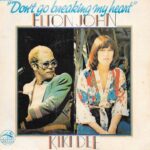
 There are songs that define a season, and then there are songs that feel like a permanent state of sunshine. “Don’t Go Breaking My Heart” belongs to the latter category—a glittering, effervescent duet that captures the unfiltered joy of two artists clearly having the time of their lives.
When Elton John teamed up with Kiki Dee for this 1976 smash, they didn’t set out to craft an introspective epic or a sweeping ballad. Instead, they created something deceptively simple: a retro-flavored pop duet bursting with charm, chemistry, and unapologetic exuberance.
Nearly five decades later, “Don’t Go Breaking My Heart” remains one of the most recognizable duets in pop history—a reminder that sometimes the most powerful musical statement is pure happiness.
A Retro Throwback in Real Time
By the mid-1970s, Elton John was already a global superstar. Albums like Goodbye Yellow Brick Road had cemented his status as one of the most inventive and commercially successful artists of the era. He could deliver sprawling ballads, theatrical rockers, and introspective piano epics with equal confidence.
So when “Don’t Go Breaking My Heart” arrived, it felt refreshingly lightweight—in the best way.
The song is essentially a loving homage to the Motown and Philly soul duets of the 1960s. Think Marvin Gaye and Tammi Terrell energy. Call-and-response vocals. Playful flirtation. A rhythm section that bounces instead of broods.
Elton and longtime lyricist Bernie Taupin even credited the song to playful pseudonyms (Ann Orson and Carte Blanche), further signaling that this wasn’t meant to be taken too seriously. It was an exercise in fun.
And that sense of fun radiates through every note.
The Sound: Bright, Buoyant, and Built to Sing Along
From the opening piano chords, the track establishes its tone. The rhythm is upbeat but not frantic. The bassline grooves smoothly. Handclaps and backing vocals add a celebratory sparkle.
There’s a slight disco sheen in the production—unsurprising given the era—but it never overwhelms the song’s pop core. The arrangement leaves plenty of space for the interplay between Elton and Kiki Dee, which is the heart of the record.
This isn’t a song about musical complexity. It’s about chemistry.
The Chemistry: Playful and Effortless
What makes “Don’t Go Breaking My Heart” timeless is the conversational dynamic between the two vocalists.
Elton’s voice is warm, slightly theatrical, brimming with personality. Kiki Dee’s tone is bright and steady, with just enough grit to match his energy. When they trade lines—“Nobody knows it…” / “Nobody knows…”—it feels spontaneous, almost improvised.
There’s flirtation in the phrasing. A wink in the harmonies.
Unlike some duets that sound stitched together in the studio, this one feels organic. The back-and-forth builds naturally, culminating in a chorus that practically demands group participation.
You don’t just listen to “Don’t Go Breaking My Heart.” You sing along.
A Career Milestone
For Elton John, the single marked another commercial triumph. It soared to number one in multiple countries, including the United States and the United Kingdom—his first UK number one in nearly a decade.
For Kiki Dee, it was transformative. While she had already built a respectable career (and had the distinction of being the first British female artist signed to Motown’s Tamla Records), this duet catapulted her into global recognition.
The collaboration also showcased Elton’s generosity as a performer. At the height of his fame, he didn’t need to share the spotlight. But he did—and the result was electric.
Lyrical Simplicity as Strength
The lyrics of “Don’t Go Breaking My Heart” are straightforward. They don’t dive into existential angst or poetic abstraction.
They’re direct:
“Don’t go breaking my heart
I couldn’t if I tried…”
It’s the kind of sentiment that might seem almost naïve on paper. But that simplicity is precisely what gives the song its power.
There’s no cynicism. No irony. No hidden subtext.
Just affection.
In an era often marked by complex singer-songwriter introspection, this track stands out for its clarity. It celebrates mutual devotion without complication.
The ’70s Context: Escapism and Glitter
The mid-1970s were a fascinating cultural moment. Disco was emerging. Glam rock still shimmered. Radio was filled with bold personalities and big hooks.
Elton John, with his flamboyant stage costumes and oversized glasses, was already an icon of theatrical pop. “Don’t Go Breaking My Heart” fits seamlessly into that landscape.
It’s easy to imagine the song blasting from car radios on summer afternoons, or lighting up dance floors beneath mirrored disco balls.
At a time when the world grappled with political uncertainty and economic challenges, pop music offered escape. This track delivered it in bright, unapologetic color.
The Video and Visual Energy
Though music videos as we know them wouldn’t dominate until the MTV era, performances of “Don’t Go Breaking My Heart” became visual spectacles.
Elton’s glittering outfits and Kiki Dee’s confident stage presence amplified the song’s joyful tone. Their body language mirrored the music—loose, playful, engaged.
Even decades later, live renditions capture that same spark. The song thrives in front of an audience, where the chorus becomes communal celebration.
A Template for Pop Duets
“Don’t Go Breaking My Heart” set a template that countless artists would follow:
-
Two strong vocal personalities.
-
Clear call-and-response structure.
-
A chorus designed for mass participation.
-
Production that enhances chemistry rather than overshadows it.
You can hear its influence in later pop duets across genres—from adult contemporary to dance-pop.
What makes this one stand out, though, is how unforced it feels. There’s no dramatic tension or narrative conflict. It’s simply two voices blending in shared delight.
Longevity and Reinvention
The song has enjoyed multiple revivals over the years. Elton even re-recorded it in the 1990s with other vocal partners, proving its adaptability.
But the original remains definitive.
Why? Because it captures a moment when pop music embraced joy without apology. There’s no attempt to update or modernize the core formula. The melody and structure are timeless enough to transcend trends.
You can play it at a wedding, a karaoke bar, a retro dance party, or a stadium concert—and it still works.
Elton’s Dual Identity
One of the fascinating aspects of Elton John’s catalog is its range. On one hand, he delivered emotionally devastating ballads like “Sorry Seems to Be the Hardest Word.” On the other, he gave us something as buoyant as “Don’t Go Breaking My Heart.”
That duality is part of his genius.
The same artist capable of introspective melancholy could also craft a duet so joyous it feels almost weightless. It underscores his versatility—and his understanding of pop as entertainment as much as art.
Why It Still Resonates
In today’s musical landscape, where irony and self-awareness often dominate, “Don’t Go Breaking My Heart” feels refreshingly sincere.
There’s no wink to the audience suggesting we shouldn’t take it seriously. The joy is real. The affection is genuine.
That authenticity resonates.
Listeners return to the song not because it’s groundbreaking in structure, but because it captures an emotional state we all crave: uncomplicated happiness.
Final Reflection
“Don’t Go Breaking My Heart” isn’t meant to be dissected like a progressive rock epic or analyzed like a confessional ballad.
It’s meant to be felt.
It’s the sound of two artists leaning into pop tradition and elevating it through chemistry and charisma. It’s glitter without guilt. Romance without melodrama. Nostalgia without stagnation.
In the vast and varied catalog of Elton John, this duet with Kiki Dee stands as a sparkling reminder that sometimes, the most enduring songs are the ones that make us smile instantly.
No heavy themes.
No grand statements.
Just groove, harmony, and the kind of chorus that makes the whole room sing.