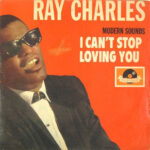
 “I Can’t Stop Loving You” arrives with a gravity that is immediate and unshakable. Ray Charles’ 1962 recording transforms Don Gibson’s 1957 country ballad into a sweeping statement of longing, surrender, and emotional honesty that transcends genre. From the very first note, it is clear that this isn’t just a song; it’s a confession set to music, a full-hearted admission of devotion so complete it leaves no room for pretense. Charles approaches it not with restraint but with a careful control that lets the emotion speak through every nuance of his voice, every swell of the orchestra behind him.
The opening chords establish a tone both solemn and rich, a canvas for Charles’ vocal performance. Strings, softly yet insistently, underscore the song, providing a sense of inevitability, as though the feeling described has been building long before the first lyric is sung. Charles’ piano enters subtly, not dominating but punctuating the emotional landscape, a gentle heartbeat beneath the melody that allows the listener to lean into the story unfolding. The arrangement, lush yet restrained, frames the voice rather than competing with it, letting every phrase carry the weight it demands.
Ray Charles’ voice on this track is extraordinary in its clarity and power. He possesses an uncanny ability to balance control and abandon, making it feel as though the words are pouring out spontaneously even as they are perfectly measured. When he sings “I can’t stop loving you,” there is a palpable sense of inevitability, a total surrender to the feeling that neither time nor circumstance can diminish. It’s a performance that demands attention not through volume or theatrics but through intimacy. The listener is drawn into a private, almost sacred moment, sharing in an unguarded confession that is at once personal and universal.
The emotional arc of the song is as compelling as the technical mastery. The verses slowly build, layering yearning upon longing, creating a crescendo of feeling that Charles rides with impeccable timing. By the time he reaches the soaring choruses, the listener feels the depth of devotion, the kind that endures beyond reason or consequence. There is both vulnerability and authority in his delivery: vulnerability because the sentiment is raw and exposed, authority because Charles inhabits the emotion fully and unflinchingly, making it undeniably real.
One of the remarkable aspects of this recording is its genre-defying nature. The song originated as a country ballad, yet Charles’ interpretation melds elements of gospel, rhythm and blues, and pop orchestration, producing a hybrid that broadens its reach without losing its emotional core. His background in gospel infuses the performance with spiritual resonance; there is a church-like weight to the phrasing, a sense that the declaration of love is both earthly and transcendent. The orchestral arrangement adds sweep and elegance, lending a cinematic quality to the heartbreak and devotion described in the lyrics. This fusion of styles not only elevates the song but sets a template for crossover success that Charles would continue to explore throughout his career.
The pacing of the song contributes significantly to its impact. There is a measured deliberateness in the way Charles approaches each line. He allows pauses and breath to become part of the music, letting the words settle in the listener’s mind. Every modulation of tone, every slight delay before a phrase, emphasizes the weight of the sentiment. Unlike more hurried or ornamented vocal performances, Charles’ phrasing makes the emotion feel lived-in. It is not a fleeting infatuation; it is enduring, relentless, unavoidable.
The lyrics themselves are deceptively simple, yet in Charles’ hands, they become deeply resonant. The repeated refrain—“I can’t stop loving you”—is transformed from a declarative statement into a meditation on devotion, loss, and the impossibility of moving on. There is no bitterness or recrimination here; only the recognition of love’s inescapable pull. The universality of the sentiment allows listeners to project their own experiences of attachment, regret, and longing onto the performance, which is why the song remains emotionally potent decades after its release.
Ray Charles’ interpretation also highlights the contrast between joy and sorrow inherent in love. While the lyrics dwell on unfulfilled or impossible longing, there is a warmth in the vocal timbre and a subtle uplift in the orchestration that suggests the beauty in devotion itself. Charles does not present heartbreak as purely painful; he presents it as something dignified, enduring, and even transformative. The listener feels both the ache and the affirmation, a duality that is rare in popular music of the era.
In addition, the song’s production demonstrates Charles’ innovative approach to studio recording. The balance between orchestra, piano, and voice is carefully calibrated to maximize emotional resonance. There is space in the mix that allows the listener to focus on Charles’ vocal nuances—the subtle quiver in a note, the crescendo of emotion, the moments of delicate restraint. These elements would influence countless artists, both in soul and pop music, illustrating how technical choices in recording can enhance, rather than overshadow, emotional impact.
“Good I Can’t Stop Loving You” also benefits from Charles’ interpretive instinct. He approaches the song as a storyteller as much as a singer, allowing phrases to linger, to bend, to swell in ways that evoke narrative without changing the words. It is a performance that inhabits time, stretching moments of tension and release to make the listener feel the arc of the singer’s devotion. In doing so, Charles elevates a simple song into an experience of shared human emotion, a rare combination of artistry and empathy.
The cultural significance of this recording cannot be overstated. At a time when racial divisions shaped much of the music industry, Charles brought gospel-infused R&B into the mainstream, and in the process, he reshaped the perception of popular music itself. “I Can’t Stop Loving You” stands as a testament to his ability to transcend genre and audience, reaching listeners who may have never engaged with his earlier rhythm-and-blues work. It is both a commercial success and an artistic milestone, demonstrating that emotional truth can bridge societal divides.
Listening to the song today, the recording retains its immediacy. Charles’ performance does not feel dated because its foundation is human feeling rather than trend. The orchestration, while characteristic of early 1960s studio techniques, supports rather than dominates the vocal, allowing the core sentiment to shine. It is a masterclass in emotional storytelling, demonstrating that simplicity, when paired with interpretive genius, can be more compelling than complexity.
In the end, Ray Charles’ “I Can’t Stop Loving You” is a triumph of emotional resonance, musical elegance, and interpretive mastery. It turns a country ballad into a universal declaration of enduring devotion, employing voice, orchestration, and timing to transform the simple lyric into something monumental. Charles does not merely sing the words; he inhabits them, allowing the listener to feel the irresistible pull of love that cannot be denied. Every note, every pause, every subtle flourish contributes to the sense that what is being expressed is essential, unavoidable, and wholly human. The recording endures because it captures a truth that is eternal: the way love can hold sway over heart and mind, leaving no space for escape. In Ray Charles’ hands, “I Can’t Stop Loving You” is more than a song; it is a living, breathing testament to the power of feeling, a reminder that some emotions are too deep to be ignored and too profound to be expressed any way but fully.