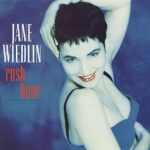
 “Rush Hour” sounds exactly like its title feels. It’s jittery, sharp-edged, anxious, and oddly exhilarating—a song that captures the sensory overload of urban life in the mid-’80s and turns it into a tightly wound pop statement. Released in 1988 as the lead single from Fur, Jane Wiedlin’s second solo album, “Rush Hour” stands as one of the most underrated gems of late–New Wave pop: a track that fuses nervous energy, melodic intelligence, and a distinctly feminine point of view without ever softening its bite.
Wiedlin was already a familiar name by the time “Rush Hour” arrived. As a founding member of The Go-Go’s, she had helped define early ’80s pop-rock with songs that blended punk attitude, pop hooks, and West Coast sunshine. But her solo work was never about recreating that sound. Instead, Jane Wiedlin carved out a space that was more angular, more experimental, and more psychologically tuned-in. “Rush Hour” is the clearest expression of that vision—a song that trades carefree fun for tightly controlled tension.
From the opening moments, “Rush Hour” establishes its mood with precision. The rhythm is brisk but stiff, almost claustrophobic, driven by sharp drum programming and staccato synth patterns that feel boxed in rather than expansive. This isn’t music that breathes easily. It presses forward, creating the sonic equivalent of crowded streets, honking horns, and internal monologues racing faster than the traffic lights can change.
The production is quintessentially late ’80s, but not in the glossy, overstuffed way that defined much of the era. Instead, it’s lean and focused. Synths are used more for texture and tension than for lush atmosphere. The bass line is taut and repetitive, reinforcing the sense of being stuck in a loop. Everything about the arrangement mirrors the song’s emotional core: motion without progress.
Lyrically, “Rush Hour” is deceptively clever. On the surface, it describes the daily grind of commuting—crowds, pressure, impatience—but it quickly becomes clear that Wiedlin is using rush hour as a metaphor for emotional overload. Lines about being pushed, pulled, and overwhelmed resonate far beyond traffic jams. The song captures the feeling of being surrounded by people yet emotionally isolated, of being in constant motion while feeling strangely stuck.
What makes the lyrics especially effective is their conversational tone. Wiedlin doesn’t dramatize her frustration or frame herself as a victim. Instead, she observes, reacts, and internalizes. There’s a wry self-awareness running through the song, a recognition that this chaos is both external and internal. The rush hour isn’t just happening on the street—it’s happening in her head.
Jane Wiedlin’s vocal performance is central to the song’s impact. Her voice is cool, controlled, and slightly detached, which paradoxically makes the tension more palpable. She doesn’t shout or strain; she keeps everything just below the boiling point. That restraint feels intentional, as if losing control would mean losing the song’s entire emotional balance. Her delivery conveys stress not through volume, but through pacing and phrasing.
Unlike many pop songs about frustration or anxiety, “Rush Hour” never explodes into catharsis. There’s no massive release, no emotional payoff that resolves the tension. Instead, the song sustains its nervous energy from start to finish. That choice is what makes it feel honest. Real-life pressure rarely resolves itself neatly, and Wiedlin understands that. The song ends not with closure, but with continuation—just like another commute, another day, another cycle.
Musically, “Rush Hour” sits at an interesting crossroads between New Wave and late-’80s pop. It has the sleekness and accessibility needed for radio, but it retains the nervous DNA of post-punk and early synth-pop. There’s a subtle art-school sensibility at work, a sense that every sound is placed deliberately to serve the song’s concept rather than to chase trends.
The chorus is particularly effective in this regard. It’s catchy without being comforting, memorable without being warm. The melody rises, but it doesn’t soar. Instead, it tightens, reinforcing the idea that even moments of emphasis are constrained. It’s pop music that understands irony—not in a sarcastic way, but in the sense that form and content are constantly in dialogue.
“Rush Hour” also stands out because of its perspective. Pop music has long been filled with songs about movement—cars, highways, escape—but Wiedlin flips that trope. This isn’t about freedom or adventure. It’s about congestion, pressure, and sensory overload. And coming from a female artist in a genre often dominated by male perspectives on urban life, the song feels quietly subversive. It acknowledges vulnerability without leaning into melodrama.
In the broader context of Jane Wiedlin’s solo career, “Rush Hour” represents a moment of clarity. While her debut solo album leaned more heavily into playful pop, Fur showcased a more mature, nuanced songwriter. The album explored themes of identity, independence, and emotional friction, and “Rush Hour” served as its perfect introduction—immediate, intelligent, and emotionally precise.
Despite its strengths, “Rush Hour” never achieved the level of mainstream recognition it deserved. It charted modestly and became a cult favorite rather than a defining hit. But that relative obscurity has worked in its favor over time. The song hasn’t been overplayed or diluted by nostalgia. When listeners rediscover it today, it still feels sharp, relevant, and emotionally accurate.
In a modern context, “Rush Hour” arguably resonates even more strongly. The anxiety it captures feels prophetic in an age of constant notifications, crowded digital spaces, and perpetual motion. Replace traffic jams with inboxes and social feeds, and the song’s emotional core remains intact. That adaptability is a sign of truly strong songwriting.
What ultimately makes “Rush Hour” endure is its honesty. Jane Wiedlin doesn’t try to solve the problem she’s describing. She doesn’t offer escapism or false optimism. Instead, she documents a feeling with precision and style, trusting the listener to recognize themselves in it. The song becomes a mirror rather than a message.
“Rush Hour” may not be the most famous track in Jane Wiedlin’s catalog, but it is one of her most revealing. It captures an artist unafraid to sit with discomfort, to find melody in tension, and to turn everyday stress into something expressive and meaningful. In doing so, it stands as a quietly powerful statement—one that proves pop music doesn’t have to relax to be relatable. Sometimes, it just has to keep moving.
This post has already been read 37386 times!