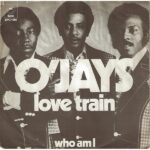
 Few songs have captured the spirit of hope, togetherness, and unshakable optimism quite like “Love Train” by The O’Jays. Released in 1972 on the album Back Stabbers, the track quickly became more than just a chart-topping hit—it evolved into a cultural anthem, a musical declaration that love, community, and shared humanity can transcend division. Written by the prolific team of Kenneth Gamble and Leon Huff, “Love Train” is the embodiment of Philadelphia soul at its finest: smooth, melodic, yet infused with unstoppable energy and a social consciousness that resonates as strongly today as it did over fifty years ago.
From the first beat, “Love Train” establishes momentum. The bass line is steady and commanding, acting like the engine of a train that won’t be stopped. Layered above it are lush strings, buoyant horns, and vibrant percussion, creating a sound that is simultaneously warm, inviting, and propulsive. This is not merely a song to listen to—it’s a song to move to. From the opening measure, you feel the rhythmic insistence of the “train” leaving the station, beckoning listeners to climb aboard and join a journey toward unity and joy.
The O’Jays’ vocal delivery is key to the song’s enduring appeal. Eddie Levert’s lead vocals are impassioned yet smooth, carrying a sense of earnestness and excitement. He sings with a clarity and warmth that conveys the song’s message as both instruction and invitation: a call to participate, to love, and to connect. Backing harmonies from Walter Williams and William Powell swell in perfect synchrony, creating the signature rich, layered sound of The O’Jays. The voices together emulate a chorus of collective human voices, symbolizing the very unity the lyrics champion.
Lyrically, “Love Train” is simple, direct, and powerful. The chorus—“People all over the world / Join hands / Start a love train, love train”—is a mantra, repeated with a sense of urgency and inevitability. The repetition reinforces the song’s central message: love is an action, and it is accessible to everyone, everywhere. In an era marked by political turmoil, racial strife, and social upheaval, this song offered both a balm and a rallying cry. It didn’t shy away from idealism; it embraced it fully, encouraging listeners to believe that collective human action could produce meaningful change.
The genius of Gamble and Huff’s songwriting shines in the way they combine this message with irresistible musicality. The groove is infectious, anchored by a walking bass line and syncopated drums, while horns and strings lift the melody, giving it a sense of uplift and celebration. This combination of rhythmic drive and melodic elegance ensures that the song’s positive message isn’t merely heard—it’s felt, embodied in the movement of the body as well as the mind.
Philadelphia soul, or Philly soul, was defined by its smooth orchestration and socially conscious lyrics, and “Love Train” exemplifies both aspects. The production is polished but never sterile. Each instrument has space to breathe, each vocal harmony shines, and the entire arrangement builds a sense of communal joy. Unlike many songs of the era that were either politically heavy or musically light, “Love Train” achieves a perfect balance: the message is weighty, but the music makes it accessible and celebratory.
The timing of the song’s release added to its impact. The early 1970s in America were a time of division, marked by the aftermath of the civil rights movement, the ongoing Vietnam War, and increasing societal polarization. Against this backdrop, “Love Train” offered a vision of hope, inclusivity, and action. Its message wasn’t abstract; it was actionable. Listeners were invited to “join hands,” to participate in a symbolic—and literal—train toward unity. It was optimism paired with agency, a rare combination in popular music at the time.
Musically, “Love Train” demonstrates the O’Jays’ exceptional ability to balance emotion and groove. The song builds incrementally: percussion lays the foundation, bass and guitar provide motion, and the horns and strings add both energy and sophistication. The call-and-response vocal sections further reinforce the theme of communal participation. The listener isn’t just an observer; they are part of the chorus, joining in the joyful, inclusive spirit of the song.
The song’s appeal has proven remarkably enduring. Beyond its initial commercial success—topping the Billboard Hot 100 and solidifying The O’Jays’ place in the pantheon of soul music—“Love Train” has continued to resonate with new generations. It has appeared in films, commercials, and modern media, often as a shorthand for hope, togetherness, and celebration. Its central theme—universal love as a unifying force—remains as relevant in today’s fractured social landscape as it was five decades ago.
Live performances of “Love Train” reveal its full power. The O’Jays often close concerts with this song, turning audiences into participants. The choreography of hands held high, feet moving in sync, and voices joining together embodies the song’s spirit. In these moments, the metaphorical train becomes literal, a communal journey that brings listeners together in a shared emotional and physical experience.
What makes “Love Train” especially remarkable is the way it fuses simplicity with sophistication. Its lyrical message is straightforward, its musical arrangement complex yet accessible, and its emotional impact immediate. Few songs manage to be both socially meaningful and commercially irresistible, but “Love Train” accomplishes both with ease. It’s a testament to the artistry of The O’Jays and the Philadelphia International label, which consistently prioritized music that could move hearts as well as feet.
The song’s influence extends beyond soul and R&B. Its template of socially conscious lyrics paired with danceable grooves paved the way for future generations of artists who sought to marry message with movement. From disco to modern pop and dance music, the idea that a track can be politically aware and irresistibly catchy owes much to songs like “Love Train.”
Even decades after its release, the song’s energy remains infectious. There’s an irresistible optimism embedded in the arrangement, the vocals, and the lyrical insistence. The “train” metaphor works on multiple levels: as a vehicle of love, as a symbol of progress, and as a communal rhythm that binds participants together. It’s a concept as timeless as it is powerful, and the song itself continues to serve as both inspiration and celebration.
Ultimately, “Love Train” endures because it captures a universal longing: the desire to connect, to participate in something larger than oneself, and to affirm the power of collective action. It’s music that transcends generations, cultures, and even musical trends. Its brilliance lies in its duality: it is both joyous and meaningful, simple and sophisticated, celebratory and socially aware.
The O’Jays created more than a hit single; they created a musical manifesto. “Love Train” is a reminder that music can serve as a force for unity, that it can inspire hope, and that it can move both hearts and bodies simultaneously. It’s a song that urges listeners to participate, to “join hands,” and to believe in a better, more connected world.
Even fifty years after its release, the train keeps rolling. Its rhythm remains compelling, its message remains urgent, and its emotional resonance remains intact. “Love Train” is more than a song; it is an invitation, a celebration, and a movement—all wrapped into one unforgettable piece of music.
It is proof that, sometimes, the simplest gestures—joining hands, singing together, moving in rhythm—can carry the most profound meaning. And as long as listeners heed that call, the “Love Train” will never stop.
This post has already been read 13501 times!