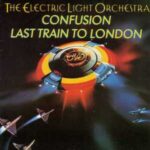
 Few songs capture the late-’70s blend of pop sophistication and disco fever quite like Electric Light Orchestra’s “Last Train to London.” Released in 1979 on the album Discovery, it represents ELO at a crossroads—melding their orchestral rock roots with the irresistible pulse of the dance floor. It’s a track that manages to be both polished and playful, a snapshot of an era where lush production, catchy hooks, and disco rhythms collided in joyous harmony. Over forty years later, the song remains a testament to Jeff Lynne’s uncanny ability to combine technical mastery with pure pop appeal.
From the first note, “Last Train to London” signals its intent. The driving piano riff, crisp hi-hat, and pulsing bass immediately establish a sense of motion, like the very train referenced in the title rolling down the tracks. The arrangement is precise but never mechanical; ELO’s trademark strings float above the groove, adding elegance and a sense of expansiveness. It’s a song that balances the physicality of disco—urging your feet to move—with the melodic sophistication of rock.
Jeff Lynne’s vocals are smooth and understated, perfectly suited to the song’s narrative. Unlike the bombastic delivery often associated with disco divas or arena rock singers, Lynne’s voice is intimate, conversational, and warm. He tells the story of a fleeting romance on a train ride with gentle urgency, inviting the listener along without overstatement. Lines like “I said goodbye to the love of my life / For a girl I just met at the station” carry a narrative charm that grounds the song’s glossy production in human experience.
Lyrically, the song’s story is simple but effective. It captures a romantic encounter that is both transient and thrilling—the excitement of meeting someone new, paired with the bittersweet awareness that the moment is temporary. That theme resonates universally: there’s a particular magic to chance encounters in liminal spaces like train stations, where time feels suspended and possibilities abound. The song’s chorus, with its repeated plea and melodic hook, amplifies that excitement and embeds it firmly in the listener’s memory.
The disco influence is unmistakable and fully embraced. The bassline is nimble and syncopated, driving the rhythm without overpowering it. The hi-hats and snare provide a steady, danceable pulse, while subtle handclaps and background vocals add texture and dimension. ELO’s orchestral flourishes—synthesizer strings and electric violins—sit atop this foundation, giving the song a distinctive sophistication. It’s a reminder that disco need not be simplistic; it can be layered, refined, and even cinematic.
One of the song’s most remarkable qualities is its sense of cinematic movement. The arrangement evokes the sensation of the train itself: accelerating, steady, and inexorably forward. Strings swoop like passing scenery, percussion mimics the rhythm of wheels on rails, and the layering of vocals suggests both the intimacy of a personal moment and the grandeur of a communal experience. In essence, “Last Train to London” doesn’t just describe a journey—it makes the listener feel like they’re on it.
Jeff Lynne’s songwriting genius lies in his ability to synthesize disparate elements. He fuses rock’s melodic sensibilities, disco’s kinetic energy, and ELO’s symphonic textures into a cohesive, infectious package. That synthesis is particularly evident in the bridge, where tension builds subtly, layering harmonies and instrumental flourishes before resolving back into the chorus. It’s a masterclass in timing and pacing, showing that dance music can be structurally complex without sacrificing its accessibility.
Contextually, the song arrived at a time when disco dominated the charts, but it also faced backlash from rock purists. For a band like ELO, which had built its reputation on blending rock and classical influences, incorporating disco elements was both a risk and a statement of versatility. “Last Train to London” proved that Lynne could embrace contemporary trends without losing his signature sound. The result is a track that feels timeless: immediately of its moment yet enduringly appealing decades later.
The track’s success was fueled by its accessibility. It appealed to rock audiences familiar with ELO’s earlier work, disco enthusiasts drawn to its danceable groove, and pop listeners captivated by its melody and storytelling. Its performance on international charts reflected that crossover appeal, cementing ELO’s status as one of the era’s most innovative and versatile acts.
Production-wise, the song exemplifies meticulous craftsmanship. Every element is precisely balanced: the strings don’t overwhelm the rhythm section, the vocals sit comfortably atop the instrumentation, and the harmonic layering never feels cluttered. Lynne’s production approach—clean, detailed, and polished—ensures that the song’s complexity never becomes a barrier to enjoyment. It’s music that rewards attentive listening while remaining immediately engaging on the first spin.
Beyond its technical mastery, “Last Train to London” resonates emotionally. It captures the thrill of movement, both literal and metaphorical. Trains are natural metaphors for transition, for the passage from one state to another, and the song uses that metaphor to explore fleeting romance, chance, and spontaneity. The energy of the music mirrors the excitement of the encounter, while the lyrical reflection on impermanence adds emotional depth. It’s dance music with a heart.
ELO’s ability to merge narrative, groove, and orchestration makes the song endlessly adaptable. Over the decades, “Last Train to London” has appeared in compilations, nostalgic radio sets, and even modern playlists, proving its versatility. Its themes—movement, fleeting connection, and joyful anticipation—remain relatable to new generations of listeners. The song doesn’t rely on nostalgia alone; it succeeds on its musical merits, ensuring its continued relevance.
The song also demonstrates ELO’s talent for storytelling within a compact format. At just over four minutes, it conveys a complete emotional arc: introduction, rising tension, peak excitement, and reflective resolution. Few pop songs manage to achieve such narrative clarity without sacrificing groove or melody, and that balance is part of what makes “Last Train to London” exceptional.
Ultimately, “Last Train to London” endures because it captures a feeling that transcends time: the exhilaration of movement, the thrill of fleeting connection, and the joy of music that makes you want to move. It reminds listeners that pop music can be both sophisticated and irresistible, that disco can be elegant, and that a simple story—set to the right groove—can become unforgettable.
Decades after its release, the opening piano, the driving bass, and the soaring strings still evoke motion and emotion. When the chorus hits, you feel carried along the rails, swept up in a journey that is equal parts physical and emotional. In the end, “Last Train to London” isn’t just a disco track or a pop hit—it’s a masterful blend of craft, feeling, and movement, a musical journey that invites listeners aboard and never lets go.
It’s a reminder that, sometimes, the best adventures happen in motion, and that great music has the power to make the ride unforgettable.
This post has already been read 711 times!