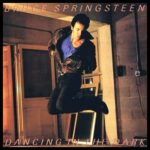
 There’s a restless, kinetic pulse that courses through Bruce Springsteen’s “Dancing In The Dark,” a song that feels both intensely personal and universally relatable. Released in 1984 as the lead single from Born in the U.S.A., it quickly became one of Springsteen’s defining tracks, a song that transformed the way the world saw him and in many ways expanded the boundaries of his musical persona. While Bruce had always been the working-class poet of the American experience, “Dancing In The Dark” revealed a side of him that could embrace the pop charts without losing the emotional weight that made his work resonate. The song opens with an irresistible synth riff, a bright, propulsive force that signals a shift in Springsteen’s sound. It’s instantly catchy, a hook that lodges in your brain, yet it doesn’t diminish the deeper undercurrents of the lyrics. The synths, layered over a driving drum beat, create a tension between exuberance and melancholy, perfectly reflecting the emotional duality of the song: the desire to break free from frustration and loneliness while being trapped in one’s own inertia.
Lyrically, “Dancing In The Dark” is deceptively simple, but every word carries weight. Springsteen sings of frustration, of staring at the same four walls and yearning for something more, for connection, for a spark to ignite a life that feels stalled. Lines like “I’m just trying to find a friend” and “I’m just trying to say something that will make you want to stay” speak to the universal desire for human connection, to the longing that lurks beneath the surface of everyday existence. It’s a song about longing and restlessness, about the tension between hope and despair, and the way music itself becomes a vehicle for expression and escape. There’s an irony in the title: dancing is usually spontaneous and joyful, yet here it’s framed in darkness, suggesting both private sorrow and a flicker of defiance against it.
Part of what makes “Dancing In The Dark” so compelling is how it marries its lyrical themes with its musical energy. The song is famously upbeat, a pop anthem that gets people moving, and yet there’s an undercurrent of tension, a feeling that the music is a vehicle for something more than simple fun. The percussion, pounding with relentless energy, mirrors the internal agitation of someone desperate to change their circumstances. The keyboard riff cuts through the mix with a sense of urgency, while Springsteen’s vocals range from plaintive to exuberant, capturing the emotional highs and lows of someone struggling with both inertia and desire. It’s a masterclass in balancing pop accessibility with emotional depth, which is why it remains one of Springsteen’s most enduring hits.
The creation of “Dancing In The Dark” is a story as iconic as the song itself. Reports suggest that Springsteen was struggling during the recording sessions for Born in the U.S.A., frustrated by his inability to complete a song that would satisfy him. His producer, Jon Landau, challenged him to write a hit single that could capture radio audiences while remaining authentic to Bruce’s voice. The result was a song that, on the surface, feels like a simple pop tune, but beneath it is an intricate layering of emotional resonance and musical craft. Springsteen himself has admitted that writing the lyrics was both painful and necessary, a cathartic process that transformed his frustration into something electrifying. This struggle is embedded in the song, and it’s perhaps part of the reason it resonates so strongly with listeners: it’s both a personal confession and an anthem of shared experience.
The music video for “Dancing In The Dark” only amplified the song’s cultural impact. Directed by Brian De Palma, the video famously featured a young Courteney Cox being pulled on stage to dance with Springsteen, capturing an image of exuberance and spontaneous joy that matched the song’s energy. This moment, replayed endlessly on MTV, cemented the track’s presence in popular culture, making it more than just a radio hit. It became a visual representation of the song’s themes: the breaking of isolation, the connection between people, and the ecstatic release that comes from music and movement. The video’s success also marked an important moment for Springsteen as an artist, positioning him not just as a rock poet of the working class, but as a global superstar capable of commanding attention across multiple mediums.
“Dancing In The Dark” also illustrates the evolution of Springsteen’s sound in the 1980s. While the raw, guitar-driven rock of his earlier work captured the grit of American life, this track embraced synthesizers and polished production, opening the door for him to reach new audiences without abandoning the core of his artistic identity. It’s a testament to Springsteen’s adaptability and his understanding of how music can function both as personal expression and cultural commodity. The song manages to feel both intimate and anthemic, reflecting the duality of Springsteen’s appeal: he can write about the struggles of small-town life while creating music that fills stadiums and dominates radio airwaves.
Beyond its commercial success, “Dancing In The Dark” endures because it speaks to a very specific human experience: the feeling of being stuck while craving change. Everyone has moments when life feels monotonous, when the routines of daily existence create a sense of isolation and longing. Springsteen captures that feeling with empathy and precision, while also providing an emotional outlet through music. The song’s refrain, repeated with increasing urgency, embodies a mix of frustration and hope, a reminder that even in moments of darkness, there is a desire to move, to connect, and to dance. It’s that tension, between despair and joy, that gives the track its lasting power.
Springsteen’s performance on Born in the U.S.A. tours further solidified the song’s place in rock history. Played in stadiums packed with thousands, “Dancing In The Dark” became a moment of collective release, with audiences singing along to every word, their energy reflecting the song’s own drive. Live performances emphasized the physicality of the song—the pounding drums, the propulsive rhythm, the sense of motion and urgency—making it impossible to remain still. The track’s live legacy is inseparable from its studio version, as it translates effortlessly from personal reflection to communal celebration, a hallmark of Springsteen’s ability to bridge the individual and the collective through music.
It’s also worth noting the song’s influence on pop culture beyond music. Its themes of isolation, longing, and the search for connection resonate in film, television, and literature, often cited or referenced as shorthand for the 1980s energy of aspiration and frustration. The song embodies a specific era while remaining timeless in its emotional resonance, illustrating the universality of Springsteen’s songwriting. The balance of urgency, melancholy, and hope makes it a track that can speak to multiple generations, each finding something reflective of their own life experience in its lyrics and energy.
Critically, “Dancing In The Dark” occupies a unique place in Springsteen’s catalog. While some purists initially criticized its polished pop production as a departure from his rawer work, the song’s enduring popularity has proven its artistic legitimacy. It showcases Springsteen’s ability to craft a hit that doesn’t compromise on emotional authenticity. The track demonstrates that pop sensibilities and meaningful storytelling are not mutually exclusive. Its Grammy nominations and chart-topping success only underscore that the song achieved the rare feat of appealing to both mass audiences and devoted fans of deeper, more reflective rock.
The song’s legacy is inseparable from its themes of restlessness and yearning. Even decades after its release, “Dancing In The Dark” continues to resonate with listeners who feel caught between desire and inaction, who crave change while grappling with inertia. It is both a song of personal confession and communal exhilaration, a track that reminds us of the power of music to illuminate emotion, to provoke movement, and to create connection. Its influence is evident in countless artists who followed, those seeking to merge pop accessibility with lyrical depth, and in the ways it continues to appear in film, television, and popular consciousness.
In the end, “Dancing In The Dark” stands as a quintessential Bruce Springsteen song: it captures the heart of human experience with honesty, urgency, and hope, wrapped in a sound that is immediately infectious. It is both intimate and anthemic, a song that manages to be deeply personal while functioning as a universal statement about frustration, longing, and the human desire to break free. The synth riff, the driving beat, the confessional lyrics, and the visual energy of the music video all combine to create a work that is greater than the sum of its parts. It’s a song that invites listeners to feel, to move, and to connect, to dance in the darkness while searching for the light.
Ultimately, “Dancing In The Dark” is more than just a hit single; it is a cultural touchstone, a song that encapsulates a moment in time while remaining timeless in its emotional resonance. Bruce Springsteen managed to take a feeling familiar to millions—restlessness, longing, frustration—and transform it into something electrifying, something that resonates across decades. The song’s energy, honesty, and universality continue to make it a defining track of the 1980s, a benchmark in Springsteen’s storied career, and a song that will forever inspire listeners to move, to hope, and to find connection, even when dancing alone in the dark.
This post has already been read 768 times!