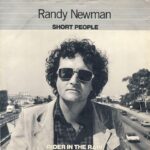
 When Randy Newman released Short People in 1977, he delivered a song that instantly captured public attention, not just for its catchy melody but for the razor-sharp wit and satirical bite embedded within its deceptively cheerful surface. Written, performed, and produced by Newman himself, the song became his highest-charting hit, reaching No. 2 on the Billboard Hot 100, and sparked both fascination and outrage, proving that pop music could provoke, amuse, and challenge cultural norms simultaneously. The brilliance of Short People lies in its ability to blend infectious musicality with a provocative, tongue-in-cheek commentary, creating a song that remains both iconic and misunderstood decades after its release.
Musically, Short People is classic Newman: bright, bouncy, and deceptively simple. The arrangement features a crisp piano foundation, playful horns, and a tight rhythm section that drives the song forward with an irresistible bounce. Newman’s vocals, warm yet sardonic, glide over the instrumentation with a casual charm that belies the underlying social commentary. The song’s melodic construction is deceptively sophisticated, balancing an upbeat, almost childlike feel with harmonic turns and shifts that give it depth and personality. It is precisely this contrast between musical levity and lyrical irony that defines the song’s lasting impact. The piano, the heart of Newman’s musical style, carries the tune with precision and charm, offering both melodic direction and rhythmic momentum, while the horns add a playful, almost cartoonish texture that amplifies the song’s tongue-in-cheek nature.
Newman’s vocal delivery is a study in controlled irony. His seemingly earnest performance encourages listeners to take the song at face value, which amplifies the impact of its satirical intent when one considers the lyrics more closely. The phrasing, the timing, and the subtle inflections all work to create an illusion of sincerity, making the song’s critique all the more effective. Lines such as “Short people got no reason to live” are deliberately shocking, designed to expose the absurdity of prejudice by exaggerating it to ridiculous extremes. Newman’s ability to maintain this delicate balance between humor and critique ensures that the song operates on multiple levels, rewarding listeners who appreciate both musical craftsmanship and incisive social commentary.
Lyrically, Short People is a masterclass in satire. At its core, the song is not about height at all but about the irrationality of bigotry and discrimination. Newman takes a common human tendency—the desire to categorize and demean others based on arbitrary traits—and magnifies it to ludicrous proportions. By targeting “short people” in a hyperbolically prejudiced way, he exposes the ridiculousness of all forms of social bias. The lyrics oscillate between mock seriousness and playful exaggeration, creating a tension that keeps listeners both engaged and uneasy. This tension is a key factor in the song’s enduring appeal, as it challenges audiences to think critically while enjoying a catchy, singable tune.
The song’s structure contributes to its effectiveness. With a straightforward verse-chorus arrangement, it is immediately accessible to listeners, but within that simplicity, Newman injects subtle musical and lyrical nuances that enhance the satire. The verses lay out the “prejudices” in an almost conversational tone, while the chorus drives home the exaggerated sentiment with a memorable melodic hook. This combination of accessible form and clever content ensures that the song’s message is both entertaining and thought-provoking, making it a standout example of how pop music can operate as social commentary.
Instrumentally, the song is a showcase for Newman’s skills as a composer and arranger. The piano lines are rhythmically playful, weaving in and out of the vocal melody to create a sense of forward motion and musical humor. Horn stabs punctuate key moments in the lyrics, emphasizing comedic beats and reinforcing the song’s ironic tone. The bass and drums maintain a steady groove, grounding the playful instrumentation in a solid rhythmic foundation. Every element of the arrangement serves the song’s satirical purpose, demonstrating Newman’s ability to align musicality with thematic intent. The interplay between the instruments and vocals is precise, with timing and phrasing carefully calibrated to enhance the humor and irony of the lyrics.
Despite—or perhaps because of—its satirical nature, Short People generated significant controversy upon release. Many listeners, hearing the lyrics at face value, interpreted the song as a literal attack on short individuals, prompting backlash and media attention. Newman, however, consistently clarified the song’s intent as satire, highlighting the absurdity of prejudice rather than promoting it. This controversy, while challenging, ultimately contributed to the song’s prominence, forcing listeners to engage with it on a deeper level and sparking conversations about the role of humor, irony, and social commentary in popular music. In this way, the public reaction to Short People underscores its effectiveness as a provocative cultural artifact, capable of eliciting strong reactions while conveying a sophisticated critique.
The song’s popularity was not merely a product of controversy; its musical qualities were central to its success. The catchy chorus, playful instrumentation, and Newman’s charismatic performance made it immediately memorable and accessible, appealing to a broad audience. The combination of humor, satire, and melodic appeal allowed the song to achieve significant commercial success without sacrificing artistic integrity. It is a rare example of a novelty-style hit that is both musically substantial and thematically rich, blending pop sensibility with thoughtful commentary in a way that few songs have managed to replicate.
Newman’s performance also demonstrates his unique ability to inhabit a character within his music. In Short People, he assumes the voice of an absurdly prejudiced narrator, using vocal inflection, timing, and phrasing to convey both the ridiculousness of the character and the satirical intent behind the lyrics. This technique allows Newman to explore complex social themes while maintaining the accessibility and humor necessary for pop success. It is this combination of characterization, humor, and musical craftsmanship that distinguishes Short People within Newman’s discography and within the broader landscape of 1970s popular music.
The song’s influence extends beyond its immediate commercial success. It helped establish Randy Newman as a distinctive voice in popular music, capable of blending humor, social commentary, and sophisticated musicality in ways that challenged and entertained audiences simultaneously. Short People demonstrated that pop music could be a vehicle for both satire and accessibility, inspiring future artists to experiment with lyrical irony, character-driven performances, and clever musical arrangements. Its impact can be seen in the work of comedians and musical satirists who followed, as well as in the broader tradition of socially aware pop and rock music that engages with cultural issues through humor and narrative.
Culturally, the song reflects the tensions and curiosities of the late 1970s, an era in which social norms were being questioned and pop culture was increasingly self-aware. Its humor and exaggeration highlight human tendencies toward irrational judgment and bias, offering a playful critique that resonates even in contemporary contexts. The ability of Short People to provoke thought while remaining musically engaging exemplifies Newman’s genius as both a songwriter and a social observer, blending art and commentary in a way that is rare in mainstream music.
Short People remains a defining track in Randy Newman’s career, showcasing his unique blend of wit, musicality, and narrative skill. Its catchy melody, clever lyrics, and playful instrumentation combine to create a song that is both entertaining and thought-provoking, capable of eliciting laughter while encouraging reflection on human behavior. The track’s enduring popularity is a testament to Newman’s artistry, as well as to the timelessness of music that engages both the intellect and the emotions. Its influence can be traced in the work of countless artists who have sought to combine humor, character, and musical sophistication in their own compositions, affirming the song’s place in the canon of innovative pop music.
In retrospect, the success of Short People can be seen as a convergence of several factors: Newman’s distinctive voice and performance style, his skillful arrangement and instrumentation, the satirical brilliance of the lyrics, and the cultural moment that amplified the song’s impact. Each element reinforces the others, creating a piece that is greater than the sum of its parts. The track is not merely a novelty hit or a humorous aside; it is a carefully constructed work that balances musical excellence with social commentary, demonstrating Newman’s ability to entertain while making a point about human behavior and societal prejudices.
Ultimately, Short People endures because it operates on multiple levels simultaneously. It is a catchy pop song with a memorable melody and playful arrangement, a piece of social satire that exposes the absurdity of prejudice, and a showcase for Randy Newman’s unique artistry as a performer, songwriter, and musical storyteller. Its combination of wit, charm, and sophistication ensures that it continues to resonate with listeners decades after its initial release, maintaining its status as a landmark achievement in popular music.
Randy Newman’s Short People is a masterful blend of humor, musicality, and cultural commentary, a song that remains as provocative and entertaining today as it was in 1977. Its ability to provoke laughter, spark discussion, and captivate audiences with its musical charm secures its place as one of the most inventive and memorable works in Newman’s catalog and in the history of popular music.