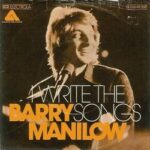
 Few pop songs have inspired as much confusion—and as much grandeur—as “I Write the Songs.” On the surface, it sounds like the ultimate declaration of artistic dominance. The singer claims authorship not just of his own hits, but of the very music that fills the world. It’s bold. It’s sweeping. It’s borderline cosmic.
And yet, the man who turned it into a No. 1 smash—Barry Manilow—didn’t even write it.
That twist alone makes “I Write the Songs” one of the most fascinating hits of the 1970s. Written by Bruce Johnston of The Beach Boys, the song became synonymous with Manilow’s theatrical persona, blurring the line between songwriter, performer, and mythic narrator.
It’s a pop anthem about creation itself—and it wrote a permanent chapter in Manilow’s legacy.
The Opening: A Declaration of Power
From the first swelling chords, “I Write the Songs” announces itself as something bigger than a love ballad. There’s no shyness here. No subtle metaphor.
“I’ve been alive forever…”
It’s not just confidence—it’s omniscience.
The narrator claims to have existed since the dawn of music, to have inspired melodies across time and space. The voice feels almost godlike, speaking not as a person but as a force.
That’s the key to understanding the song. Despite popular belief, it isn’t about Barry Manilow bragging. Bruce Johnston has explained that the lyrics are written from the perspective of “the spirit of music” itself—the universal creative energy that inspires artists.
But when Barry Manilow sings it, the distinction becomes deliciously blurred.
Barry Manilow’s Persona: Showmanship and Sincerity
By the mid-1970s, Barry Manilow was already establishing himself as a master of grand pop melodrama. With hits like “Mandy” and “Could It Be Magic,” he leaned into emotional crescendos, lush orchestration, and heartfelt delivery.
“I Write the Songs” fit perfectly into that framework.
Manilow’s voice doesn’t just sing the lyrics—it inhabits them. He delivers each line with sweeping conviction, riding the orchestration as if it were a Broadway overture.
His performance transforms the song from abstract concept into theatrical event.
The sincerity is crucial. If he had approached it with irony, the track might have collapsed under its own ambition. Instead, he commits fully, elevating the material into something anthemic.
The Arrangement: Orchestral Pop at Full Scale
Musically, “I Write the Songs” is quintessential 1970s orchestral pop.
The piano anchors the track, but it’s the strings and brass that give it grandeur. The arrangement builds gradually, layering instrumentation until the chorus feels expansive and triumphant.
It’s not disco. It’s not rock. It’s adult contemporary at its most cinematic.
There’s a sense of lift in the chorus, a feeling of upward motion that mirrors the song’s lyrical ambition. The melody is accessible, but the production gives it scale.
This wasn’t background music. It was spotlight music.
The Irony: He Didn’t Write the Song
One of the most persistent misconceptions about “I Write the Songs” is that Barry Manilow wrote it himself. In reality, Bruce Johnston penned the track and originally recorded it before Manilow’s version became the hit.
Manilow has often clarified this in interviews, sometimes with gentle humor. The irony, of course, only added to the song’s mystique.
Because even though he didn’t write it, Manilow made it his own.
In pop music, authorship and identity don’t always align. Some artists write their own material; others interpret songs so convincingly that they become inseparable from them. Manilow falls into the latter category here.
When he sings “I write the songs that make the whole world sing,” listeners hear Barry—even if the pen belonged to someone else.
Chart Success and Grammy Recognition
Released in 1975, “I Write the Songs” climbed to No. 1 on the Billboard Hot 100 and became one of Manilow’s signature hits.
It also won the Grammy Award for Song of the Year—an award that goes to the songwriter, meaning Bruce Johnston received the honor.
That distinction underscores the collaborative nature of pop music. The song’s success required both Johnston’s composition and Manilow’s performance.
Together, they created something larger than either could alone.
The 1970s Pop Landscape
The mid-1970s were an era of contrast in popular music. On one end, disco was rising, bringing dance-floor energy and urban nightlife to mainstream radio. On the other, singer-songwriters dominated adult contemporary charts with introspective ballads.
Barry Manilow occupied a unique space within that spectrum. His music leaned toward theatrical pop—emotionally expansive, melodically rich, and unapologetically sentimental.
“I Write the Songs” amplified that aesthetic.
It wasn’t edgy. It wasn’t rebellious. It was grand, romantic, and earnest.
In a decade often defined by irony and excess, Manilow’s sincerity felt both comforting and polarizing.
Polarizing Fame and the “Copacabana” Effect
Barry Manilow’s career has long been accompanied by a curious cultural divide. His fans are fiercely loyal. His critics sometimes dismiss his style as overly sentimental or schmaltzy.
“I Write the Songs” became emblematic of that divide.
To admirers, it’s an inspiring anthem about creativity and universal connection. To skeptics, it’s bombastic and self-aggrandizing.
But polarization is often a sign of impact. Songs that evoke strong reactions tend to endure.
And endure it has.
The Myth of the Artist as Creator
At its core, “I Write the Songs” taps into a larger cultural fascination: the myth of the artist as omnipotent creator.
The lyrics elevate songwriting to a near-divine act. Music becomes something timeless and elemental, flowing through human vessels.
It’s a romanticized vision of art-making—one that resonates with audiences who view music as transformative.
Even if listeners misunderstand the narrator’s identity, the emotional effect remains powerful. The song affirms the idea that music shapes our lives, that it exists before and beyond us.
That’s a potent message.
Listening Today
Decades later, “I Write the Songs” remains instantly recognizable. The opening piano chords still signal something grand. The chorus still invites sing-along participation.
But modern listeners may hear it differently.
In an era where authenticity and self-authorship are heavily emphasized, the irony of Manilow performing a song about songwriting invites reflection.
Yet that irony doesn’t diminish its impact. If anything, it highlights the collaborative magic of pop music. A song can belong to multiple creators—writer, arranger, performer—and still feel cohesive.
The Legacy of an Anthem
“I Write the Songs” stands as one of the definitive pop anthems of the 1970s. It captures:
-
The era’s love of lush orchestration
-
The theatrical flair of adult contemporary pop
-
The romantic idealism surrounding artistic creation
It also solidified Barry Manilow’s place as a master interpreter of grand, emotionally resonant material.
While he would go on to deliver other enduring hits, this song remains uniquely tied to his public image.
It’s both boast and myth. Both statement and spectacle.
Final Reflection
Barry Manilow may not have written “I Write the Songs,” but he wrote it into pop history.
Through conviction, vocal power, and theatrical flair, he transformed Bruce Johnston’s composition into a defining anthem of his career—and of the decade.
The song’s grandeur might invite eye-rolls from some corners, but its ambition is undeniable. It dares to elevate songwriting to cosmic significance.
And perhaps that’s the real magic of pop music: the ability to make something universal feel personal.
When Barry Manilow sings about writing the songs that make the whole world sing, he’s tapping into a collective truth.
Music outlives its creators.
It moves through generations.
It shapes memory.
And sometimes, it even writes its own legend.