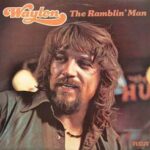
 “I’m a Ramblin’ Man” doesn’t ask for permission. It doesn’t apologize for its restlessness or soften its edges to make itself easier to accept. Released in 1974, the song arrived at a moment when Waylon Jennings was reshaping country music from the inside, pushing back against the polished constraints of the Nashville system and carving out what would soon be called outlaw country. In just over two minutes, “I’m a Ramblin’ Man” distilled a philosophy of independence, motion, and self-knowledge that defined not only Jennings’ career, but a broader cultural shift in American music.
From the first few notes, the song establishes its easy confidence. The tempo is brisk but relaxed, driven by a steady rhythm that feels made for open highways and long horizons. There’s no dramatic buildup or ornate introduction. The band drops straight into the groove, as if already in motion, mirroring the narrator’s refusal to stand still. This immediacy is part of the song’s charm—it feels like a snapshot of a life already underway rather than a story being carefully told.
Waylon Jennings’ voice is the song’s anchor. Deep, textured, and unmistakably his own, it carries an authority that makes every line feel lived-in. When Jennings sings about being a ramblin’ man, it doesn’t sound like a romantic fantasy or a pose. It sounds like a fact. There’s a world-weariness in his delivery, but also a quiet pride. He isn’t bragging about his restlessness; he’s stating it plainly, as something ingrained in his nature.
Lyrically, the song is refreshingly direct. Jennings doesn’t wrap his message in elaborate metaphors or poetic flourishes. He tells you exactly who he is and what that means for the people around him. Lines like “I love you baby, but I gotta keep movin’ on” capture the song’s central tension: affection without permanence. The narrator isn’t cruel or careless, but he’s honest to the point of inevitability. He knows his limitations, and he refuses to pretend otherwise.
That honesty is what keeps “I’m a Ramblin’ Man” from tipping into selfishness. The song doesn’t glamorize the damage that restlessness can cause, but it doesn’t wallow in guilt either. Instead, it occupies a middle ground, acknowledging the cost of freedom while still embracing it. The narrator doesn’t promise what he can’t deliver, and there’s a strange kind of integrity in that.
Musically, the song blends traditional country elements with a looser, more rock-influenced feel. The guitar work is clean and confident, the rhythm section tight without being rigid. There’s a subtle swing to the groove that gives the song momentum without urgency. Everything feels balanced, as if the band understands that the power of the song lies in its ease rather than its intensity.
“I’m a Ramblin’ Man” was also a significant commercial breakthrough for Jennings. It became his first number-one hit on the country charts, cementing his status as a leading voice in the outlaw movement. That success was notable not just because of its chart position, but because of what it represented. Here was a song that didn’t conform to Nashville’s expectations, topping the charts on its own terms. It was a quiet rebellion, delivered with a smile rather than a snarl.
The outlaw country movement was as much about attitude as sound, and “I’m a Ramblin’ Man” captured that attitude perfectly. It rejected the idea that country singers had to present themselves as morally upright or emotionally tidy. Instead, it embraced complexity and contradiction. The narrator isn’t a hero or a villain; he’s a man in motion, shaped by the road and honest about what it’s done to him.
There’s also a deep tradition behind the song’s theme. The rambling man has long been a staple of American music, from folk ballads to blues standards. What Jennings did differently was strip away the mythic distance and present the archetype in plain, contemporary terms. This isn’t a drifter from some bygone era; it’s a modern man navigating love, work, and identity in real time.
Listening to the song today, it still feels remarkably current. In a culture that often celebrates constant movement—career shifts, travel, reinvention—the idea of being a “ramblin’ man” resonates in new ways. At the same time, the song’s acknowledgment of the emotional cost of that lifestyle feels more poignant than ever. Freedom, the song suggests, is never free of consequence.
Jennings’ performance never overplays the emotion. There’s no dramatic swell, no moment of self-pity. Instead, the song maintains a steady emotional temperature, reflecting the narrator’s acceptance of who he is. This restraint makes the song feel grounded and authentic. It doesn’t ask the listener to sympathize or judge. It simply invites understanding.
Production-wise, the song exemplifies the cleaner, more organic sound Jennings favored during this period. Instruments are given space, vocals are front and center, and nothing feels overproduced. That clarity reinforces the song’s message. Just as the narrator refuses to complicate his truth, the music refuses unnecessary embellishment.
Ultimately, “I’m a Ramblin’ Man” endures because it captures a timeless tension: the pull between connection and independence. It doesn’t resolve that tension, and it doesn’t try to. Instead, it lives inside it, comfortable with ambiguity. In doing so, it offers a portrait of a man who knows himself well enough to be honest, even when that honesty is inconvenient.
More than fifty years after its release, the song still rolls along with the ease of a well-traveled road. It reminds us that not everyone is built to stay, and that sometimes the most authentic thing a person can do is keep moving—eyes forward, heart open, and no apologies for the miles behind them.