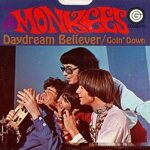
 “Daydream Believer” arrives with a piano line so instantly recognizable it feels like it’s always been there, waiting for you to notice it again. When The Monkees released the song in late 1967, it sounded bright, friendly, and effortless, the kind of record that slid naturally onto radios and into living rooms without demanding anything in return. On the surface, it’s pure pop optimism, a warm smile set to melody. Spend a little time with it, though, and “Daydream Believer” reveals something more nuanced, a song that balances hope with hesitation and fantasy with the quiet awareness that life rarely stays inside the dream.
The song opens with that gentle, rolling keyboard figure played by producer and songwriter John Stewart, and from the first seconds it establishes a mood that feels welcoming rather than overpowering. There’s no dramatic build-up, no sense of urgency. Instead, the track eases its way in, like waking up slowly and realizing the day might not be so bad after all. This tone is essential to its lasting appeal. “Daydream Believer” doesn’t shout happiness from the rooftops; it hums it to itself, confident that you’ll hear it if you’re listening.
Davy Jones’ vocal performance is a major part of why the song works so well. His voice carries a boyish warmth that feels sincere without being naïve. There’s an emotional lightness in the way he phrases the lyrics, but also a subtle restraint, as if he’s aware that believing in dreams is both necessary and a little risky. He never oversells the sentiment. Instead, he lets the melody do most of the emotional heavy lifting, gliding over the verses with a tone that’s affectionate and slightly wistful.
Lyrically, “Daydream Believer” plays an interesting game with expectation. It presents the idea of daydreaming not as escapism, but as survival. The narrator isn’t detached from reality; he’s navigating it by choosing to see something better just beyond the immediate circumstances. Lines about everyday life, work, and routine ground the song firmly in the real world. The dream isn’t an alternative universe so much as a lens through which reality becomes more bearable. That distinction gives the song its emotional complexity.
There’s also a gentle tension running through the lyrics that often gets overlooked. While the melody suggests carefree joy, the words hint at disappointment and compromise. The idea of being a “daydream believer” implies an awareness that belief itself is a choice, one that requires effort in the face of less-than-ideal conditions. This subtle undercurrent keeps the song from drifting into empty cheerfulness. It acknowledges that optimism is something you hold onto, not something you’re handed.
Musically, the arrangement is deceptively simple. The piano anchors the song, supported by light percussion, clean guitar, and harmonies that never overwhelm the lead vocal. Everything is carefully balanced to serve the mood. There’s no excess, no flashy instrumental break designed to impress. Instead, the song relies on cohesion, each element reinforcing the others. The result is a track that feels complete without feeling crowded, a quality that makes it endlessly replayable.
“Daydream Believer” also marked an important moment in The Monkees’ evolution. By 1967, the band was actively working to assert more creative control, moving away from their early image as a manufactured TV group. This song, written by Stewart rather than the band themselves, still fit comfortably within that transition. It showcased a maturity in sound and sentiment that aligned with where The Monkees were heading, even as it maintained the accessibility that made them so popular in the first place.
The timing of the song’s release adds another layer to its significance. Late 1967 was a period of cultural upheaval, with popular music increasingly leaning toward experimentation and social commentary. Against that backdrop, “Daydream Believer” might have seemed modest, even old-fashioned. Yet that restraint was part of its power. It offered a different kind of comfort, one rooted in personal emotion rather than grand statements. The song didn’t try to explain the world; it simply suggested that finding joy within it was still possible.
Over the years, “Daydream Believer” has taken on a life of its own, becoming one of those songs that feels almost detached from its original era. It’s been covered, referenced, and reused in countless contexts, each time carrying its core feeling with it. That adaptability speaks to the universality of its theme. Nearly everyone has experienced the push and pull between dreaming and doing, between hoping for more and dealing with what’s in front of them. The song captures that balance without judgment.
What’s particularly striking is how the song manages to feel both personal and communal. While it’s sung from a specific point of view, its sentiments are broad enough to invite listeners in. It doesn’t tell you what to believe in, only that believing in something can make the day feel lighter. That openness allows the song to resonate across generations, finding new meaning as listeners bring their own experiences to it.
The emotional core of “Daydream Believer” lies in its kindness. There’s no cynicism here, no sense of irony or detachment. The song treats its subject gently, respecting the vulnerability that comes with hope. In a musical landscape that often rewards bravado or bitterness, that softness stands out. It reminds you that tenderness can be a strength, and that sincerity doesn’t have to be complicated to be profound.
Listening to “Daydream Believer” today, it’s easy to understand why it has endured. The production still feels warm, the melody still inviting, and the sentiment still relevant. It hasn’t been dulled by overexposure; if anything, its familiarity has only deepened its impact. Each listen brings a renewed appreciation for the care and craft behind it, as well as for the emotional space it creates.
The Monkees’ legacy is often discussed in terms of their image and origins, but songs like “Daydream Believer” underscore why they mattered musically. They were capable of delivering pop songs that were both accessible and emotionally resonant, tracks that didn’t underestimate their audience. This song, in particular, stands as a reminder that pop music can be thoughtful without being heavy, and uplifting without being shallow.
In the end, “Daydream Believer” feels like a quiet promise. It doesn’t claim that dreams always come true or that life will magically improve. Instead, it suggests that choosing to believe, even imperfectly, has value in itself. That idea, wrapped in a melody as warm as a sunny morning, is what keeps the song alive. It continues to drift through the airwaves and into people’s lives, offering a moment of brightness and the gentle reassurance that it’s okay to keep dreaming.