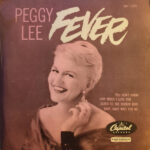
 In 1958, at the height of lush orchestras and booming rock ’n’ roll, a singer walked into a studio and stripped everything away. No sweeping strings. No brass section. No wall of sound. Just a finger snap, a bass line, and a voice that sounded like it knew more than it was telling.
That voice belonged to Peggy Lee.
The song was “Fever.”
Few recordings in American pop history feel as controlled — or as quietly dangerous — as Lee’s version of “Fever.” It doesn’t shout. It doesn’t plead. It doesn’t oversell itself. It smolders. And in doing so, it redefined what sensuality could sound like on record.
Before Peggy: The Song’s Origins
“Fever” was originally written by Eddie Cooley and Otis Blackwell (who used the pseudonym John Davenport). The first hit version was recorded in 1956 by Little Willie John, a gritty R&B singer whose take on the song was upbeat, driving, and rhythm-heavy.
His version had swagger. It moved. It swung.
But when Peggy Lee encountered the song, she heard something different. She didn’t hear a dance track. She heard tension.
So she slowed it down.
And in that slowdown, she created something iconic.
The Sound of Almost Nothing
Peggy Lee’s arrangement of “Fever” is one of the boldest acts of musical subtraction ever recorded.
The instrumentation is almost shockingly sparse:
-
Bass
-
Drums
-
Finger snaps
-
Voice
That’s it.
There are no harmonies cushioning her. No melodic fills distracting from the lyric. The bass pulses steadily, like a heartbeat. The drums tap lightly, leaving space between beats. The finger snaps feel intimate, as if someone is standing just inches away.
And then Lee begins.
“Never know how much I love you… never know how much I care…”
She doesn’t belt the line. She doesn’t project to the back row. She sings as if she’s leaning across a table in a dimly lit room.
The effect is immediate and hypnotic.
Redefining Vocal Power
In an era when vocalists were often judged by their volume and range, Peggy Lee demonstrated a different kind of strength: restraint.
Her performance on “Fever” is a masterclass in dynamics. She bends phrases ever so slightly. She lets certain consonants linger. She allows silence to do part of the work.
When she sings:
“You give me fever…”
it feels less like a statement and more like a confession.
Lee understood something crucial about desire in music: suggestion is often more powerful than declaration. By holding back, she draws listeners in closer.
Her voice doesn’t chase you. It makes you come to it.
The Lyrics: Love as Heat
Lyrically, “Fever” is deceptively simple. It uses the metaphor of heat to describe passion — a concept hardly groundbreaking. But Peggy Lee added new verses to the song, expanding its narrative scope.
She references historical lovers:
-
Romeo and Juliet
-
Captain Smith and Pocahontas
These additions give the song a timeless quality. Love isn’t just a fleeting emotion; it’s a recurring force throughout history. Fever isn’t temporary. It’s eternal.
The storytelling element elevates the track from a straightforward romantic tune to something more universal. Lee isn’t just singing about personal desire. She’s placing herself in a lineage of legendary passion.
The Power of Space
One of the most remarkable elements of “Fever” is how much space it contains.
Modern pop production often fills every second with sound. In contrast, Lee’s recording embraces silence. The pauses between lines are deliberate. They create tension. Anticipation.
When she sings:
“What a lovely way to burn…”
there’s a slight delay before the next beat lands. That fraction of a second feels charged.
Space, in this recording, is not emptiness. It’s electricity waiting to spark.
Cultural Context: 1958 America
When Peggy Lee released “Fever” in 1958, America was in the middle of cultural transformation. Rock ’n’ roll was shaking traditional norms. Television was reshaping celebrity. Social conventions around sexuality were beginning — slowly — to loosen.
Yet mainstream female vocalists were still often boxed into narrow archetypes: wholesome ingénue, glamorous diva, or tragic torch singer.
Peggy Lee carved out her own lane.
She didn’t present sexuality as wild or reckless. She presented it as controlled, self-aware, and confident. There’s no desperation in her voice. No pleading. She owns the feeling.
That quiet confidence made the song revolutionary.
A Career-Defining Performance
By the time she recorded “Fever,” Peggy Lee was already an established star. She had worked with Benny Goodman, scored hits throughout the 1940s and 1950s, and built a reputation as both a singer and songwriter.
But “Fever” became her signature.
The song reached No. 8 on the Billboard pop chart and earned her a Grammy nomination for Record of the Year. More importantly, it became inseparable from her persona.
Even decades later, when people think of Peggy Lee, they think of that bass line. Those snaps. That whisper.
It distilled her artistry into three minutes.
Influence Across Generations
“Fever” has been covered by dozens of artists over the years — from Elvis Presley to Madonna — but Peggy Lee’s version remains the definitive take.
Why?
Because she transformed the song from rhythm-and-blues shuffle into minimalist jazz-pop seduction. She set the template.
You can hear her influence in artists who understand the power of understatement:
-
Norah Jones
-
Sade
-
Lana Del Rey
All share an understanding that intimacy can be more compelling than intensity.
Peggy Lee showed that you don’t have to overpower a song to dominate it.
The Theater of Cool
There’s also a theatrical quality to Lee’s performance. Not dramatic in the Broadway sense, but in the sense of control.
She sounds like she’s playing a role — but one she completely inhabits. Every line feels intentional. Every pause calculated.
Yet nothing feels mechanical.
That balance between precision and spontaneity is rare. It’s what gives “Fever” its timeless cool. The song doesn’t feel trapped in 1958. It feels suspended outside of time.
A Lesson in Production
From a production standpoint, “Fever” is often studied as an example of how less can be more.
By limiting the instrumentation, the recording forces listeners to focus on texture:
-
The warmth of the upright bass
-
The crispness of the snaps
-
The breathiness of Lee’s phrasing
There’s nowhere to hide. Any flaw would be obvious.
Instead, the minimalism magnifies the mood.
In a way, “Fever” anticipates later stripped-down movements in music — from acoustic singer-songwriters to certain strands of indie pop. It proves that atmosphere doesn’t require complexity.
The Feminine Voice Reclaimed
Perhaps the most enduring legacy of “Fever” is how it presents female desire.
In many earlier pop songs, women were objects of affection or heartbreak. In “Fever,” Peggy Lee is the narrator. The experiencer. The one in control.
She describes passion without apology. Without shame.
“You give me fever when you kiss me…”
It’s direct. But it’s not vulgar. It’s confident.
In 1958, that mattered.
Why It Still Burns
More than sixty years later, “Fever” remains fresh. It appears in films, commercials, television shows. It’s played in cocktail lounges and sampled in modern productions.
Why does it endure?
Because the human experience it captures hasn’t changed. Attraction still feels like heat. Desire still creates tension. And confidence is still magnetic.
Peggy Lee’s recording doesn’t rely on trends. It relies on fundamentals: rhythm, voice, emotion.
And those never go out of style.
Final Thoughts: A Masterclass in Restraint
In the history of popular music, there are songs that explode and songs that glow. “Fever” glows — steadily, hypnotically, irresistibly.
Peggy Lee didn’t need volume to command attention. She didn’t need elaborate orchestration to create drama. She understood that sometimes the most powerful move is to step back and let the air crackle.
“When you put your arms around me…”
The line still lands like a spark.
“Fever” is more than a hit single. It’s a lesson in atmosphere. A study in control. A reminder that confidence doesn’t shout — it whispers.
And when Peggy Lee whispered, the world leaned in.
And felt the heat.