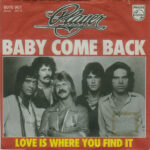
 There’s something instantly familiar about the opening notes of Player’s “Baby Come Back.” Maybe it’s the smooth groove, the polished harmonies, or that aching sense of regret baked into every line. Whatever it is, the song doesn’t just play—it lingers. Released in 1977, “Baby Come Back” is one of those rare tracks that manages to feel both deeply personal and universally relatable, a breakup song that doesn’t wallow so much as it pleads.
At a time when rock music was splintering into harder, louder, and more rebellious forms, Player arrived with something different: restraint, melody, and emotional vulnerability. “Baby Come Back” wasn’t trying to shake arenas—it was trying to win someone back. And somehow, that quieter ambition made it one of the most enduring soft rock songs of the 1970s.
The Sound of Regret, Perfectly Packaged
From its very first moments, “Baby Come Back” establishes a tone that feels almost conversational. There’s no bombast, no dramatic buildup—just a steady rhythm, clean guitar lines, and harmonies that glide rather than soar. It’s the sound of someone thinking out loud, replaying mistakes, and hoping—maybe foolishly—that there’s still time to fix things.
Musically, the track is a masterclass in late-’70s studio polish. The arrangement is tight but never sterile, blending elements of rock, pop, and what would later be labeled as yacht rock. The bassline carries a gentle funkiness, while the guitars shimmer with a kind of sunlit melancholy. Everything is balanced, everything is intentional.
But what really elevates the song is its restraint. Instead of building to a huge emotional climax, it stays grounded, almost understated. That choice mirrors the song’s message: this isn’t a dramatic declaration—it’s a quiet admission of fault.
A Rare Perspective: Owning the Mistake
Breakup songs are everywhere in popular music, but “Baby Come Back” stands out because of its perspective. This isn’t a song about blaming the other person or romanticizing the past. It’s about accountability.
“I was wrong, and I just can’t live without you.”
That line alone cuts through decades of clichés. There’s no attempt to soften the blow or shift responsibility. The narrator knows they messed up, and more importantly, they’re willing to say it out loud. In a genre often filled with vague longing or self-pity, that kind of directness feels almost radical.
And yet, the song never becomes heavy-handed. The lyrics are simple, almost conversational, which makes them feel more authentic. You get the sense that this isn’t a carefully crafted speech—it’s something blurted out in a moment of clarity.
That honesty is what gives the song its staying power. Even decades later, it still feels real.
Player: Lightning in a Bottle
Player wasn’t a household name before “Baby Come Back,” and in many ways, they never fully became one after. The band, formed by Peter Beckett and J.C. Crowley, had a knack for melody and a deep understanding of studio craftsmanship, but they didn’t have the larger-than-life persona of many of their contemporaries.
What they did have was chemistry—and on this song, everything clicks.
“Baby Come Back” became their defining hit, reaching #1 on the Billboard Hot 100. But unlike some chart-toppers that dominate through sheer spectacle, this one crept into people’s lives. It was the kind of song you’d hear on the radio late at night, the kind that felt like it was speaking directly to you.
That intimacy is part of what made it so successful—and also part of why it has endured. Even if Player didn’t maintain a long string of hits, they captured something here that many bigger bands never quite managed.
The Late ’70s Soft Rock Landscape
To really understand “Baby Come Back,” you have to place it in its moment. The late 1970s were a transitional period in music. Disco was exploding, punk was pushing back against excess, and arena rock was getting bigger and louder by the day.
Amid all of that, there was a parallel movement—one that valued smooth production, emotional honesty, and melodic precision. Bands like America, Bread, and Little River Band were crafting songs that didn’t demand attention so much as earn it.
“Baby Come Back” fits perfectly into that world. It’s not flashy, but it’s incredibly well-made. It doesn’t try to redefine music—it just tries to connect.
And in doing so, it became one of the defining songs of that softer, more introspective side of the decade.
Why It Still Works Today
Some songs are tied so tightly to their era that they feel like time capsules. “Baby Come Back,” while unmistakably ’70s in its production, has managed to avoid that fate.
Part of that is the universality of its theme. Regret, longing, and the desire for a second chance are timeless emotions. But it’s also the way those emotions are presented. There’s no irony here, no distance. The song is completely sincere, and that sincerity translates across generations.
It’s also incredibly catchy—though not in an obvious way. The melody doesn’t hit you over the head; it seeps in slowly, sticking with you long after the song ends. That subtlety is part of its charm.
And then there’s the chorus. Simple, direct, and instantly recognizable, it’s the kind of hook that feels inevitable, like it was always meant to exist.
From Soft Rock Staple to Cultural Touchstone
Over the years, “Baby Come Back” has taken on a life beyond its original release. It’s been featured in movies, TV shows, and commercials, often used to underscore moments of comedic regret or romantic mishaps.
That duality—being both genuinely emotional and slightly self-aware—has helped the song stay relevant. It can be played straight or with a wink, depending on the context. Not many songs can pull that off.
It’s also become a staple of classic rock and soft rock radio, a track that bridges generational gaps. Whether you first heard it in the ’70s, the ’90s, or last week, it feels equally accessible.
The Art of the Understatement
In a musical landscape that often rewards excess—bigger hooks, louder production, more dramatic performances—“Baby Come Back” stands as a reminder that sometimes less really is more.
There’s no over-singing here, no over-playing, no unnecessary flourishes. Every element serves the song, and nothing overstays its welcome. It’s a perfectly balanced piece of pop craftsmanship.
That restraint is what gives the song its emotional weight. By not trying too hard, it ends up saying more.
Legacy: A Quiet Classic That Never Left
“Baby Come Back” might not always get mentioned alongside the biggest, most iconic songs of the 1970s, but in many ways, that’s part of its identity. It’s not a song that demands recognition—it’s one that quietly earns it, over and over again.
For fans of soft rock, it’s essential listening. For casual listeners, it’s instantly familiar. And for anyone who’s ever wished they could take back a mistake, it hits a little too close to home.
Player may not have built an empire on the back of this song, but they didn’t need to. With “Baby Come Back,” they created something far more lasting: a moment of honesty, captured in melody, that continues to resonate decades later.
And maybe that’s the real magic of the song. It doesn’t just ask for forgiveness—it understands why that forgiveness matters.
Because sometimes, all you can do is admit you were wrong… and hope someone’s still listening.
This post has already been read 71247 times!