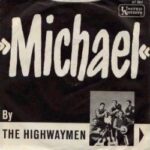
 In the early 1960s, American folk music experienced a remarkable revival. College campuses, coffeehouses, and small clubs across the country were filled with the sounds of acoustic guitars and harmony-driven songs that often traced their roots back to traditional spirituals and folk melodies. One of the most memorable recordings from this era was “Michael” by The Highwaymen, a song whose joyful simplicity and uplifting harmonies made it an unlikely pop sensation.
Released in 1961, “Michael” quickly climbed the charts and eventually reached No. 1 on the Billboard Hot 100. The record’s success was surprising in many ways. It was built around a centuries-old spiritual melody, performed by a group of college students rather than professional studio singers, and arranged with little more than acoustic guitar and group harmonies.
Yet the song resonated deeply with listeners. Its warm, communal feel captured the spirit of the folk revival at a moment when audiences were rediscovering the power of traditional music.
More than six decades later, “Michael” remains one of the most charming and enduring folk-pop hits of the era.
From Spiritual Roots to Folk Revival
The origins of “Michael” stretch far beyond the 1960s. The melody and basic lyrics come from a traditional spiritual known as “Michael, Row the Boat Ashore.”
The song dates back to the mid-19th century and was first documented among formerly enslaved African Americans in the Sea Islands of South Carolina and Georgia. These islands preserved a rich musical tradition known as Gullah culture, where spiritual songs were often sung collectively while working or traveling by boat.
In its earliest form, the song had a call-and-response structure, with one singer leading the melody while others joined in on the chorus.
The lyrics referenced the biblical archangel Michael, who in Christian tradition is often associated with guiding souls to heaven. The song’s imagery of rowing a boat ashore symbolized the journey from earthly hardship toward spiritual peace.
Over time, the melody and lyrics evolved through oral tradition, with different verses appearing in various versions of the song.
By the mid-20th century, folk singers had begun rediscovering these spirituals and adapting them for modern audiences.
The Highwaymen: A College Group with Big Dreams
The group that would eventually bring “Michael” to the top of the charts wasn’t originally a professional band at all.
The Highwaymen were four college students attending Wesleyan University in Connecticut. The group consisted of Dave Fisher, Steve Trott, Chan Daniels, and Bob Burnett, who began singing together informally during their time on campus.
Like many young musicians of the era, they were inspired by the growing folk movement that was sweeping across American universities.
The late 1950s and early 1960s were a fertile period for folk music. Artists like the Kingston Trio had proven that traditional-style songs could achieve mainstream success, and college students across the country began forming their own groups to perform acoustic folk material.
The Highwaymen started playing at campus events, coffeehouses, and small venues. Their performances focused on tight vocal harmonies and simple acoustic arrangements.
One of the songs they frequently performed was “Michael.”
A Simple Recording That Became a Hit
The Highwaymen recorded their version of “Michael” in 1960 for United Artists Records.
The recording was refreshingly straightforward.
Instead of elaborate instrumentation or studio effects, the arrangement centered on acoustic guitar and four-part vocal harmony. The tempo was upbeat but relaxed, giving the song a warm, communal feel.
From the opening line—
“Michael, row the boat ashore, hallelujah.”
—the listener is immediately drawn into the melody’s rhythmic flow.
The repetition of the chorus creates a hypnotic quality, while the verses introduce additional imagery rooted in spiritual tradition.
The harmonies are clean and unpretentious, reflecting the group’s origins as amateur singers rather than polished studio professionals.
Ironically, that authenticity became the record’s greatest strength.
Listeners felt as though they were hearing a group of friends singing together rather than a carefully manufactured pop product.
The Song’s Climb to the Top
When “Michael” was first released, it didn’t immediately dominate the charts.
But radio stations began picking up the record, and audiences quickly responded to its gentle charm and sing-along appeal.
By the summer of 1961, the song had become a national sensation.
It eventually climbed all the way to No. 1 on the Billboard Hot 100, where it remained for two weeks. It also reached the top of several international charts, including Canada.
The success was remarkable for a number of reasons.
First, the song was rooted in a traditional spiritual rather than an original pop composition. Second, the performers were college students with relatively little professional experience.
But perhaps most surprising was the song’s tone.
At a time when rock and roll was dominating the airwaves with electric guitars and energetic rhythms, “Michael” offered something quieter and more reflective.
Its success demonstrated that audiences were hungry for music that felt authentic and rooted in tradition.
The Folk Revival Moment
The success of “Michael” coincided with the broader American folk revival, a cultural movement that brought traditional music into the mainstream.
During the late 1950s and early 1960s, young listeners became fascinated with folk songs that reflected earlier eras of American history.
These songs often dealt with themes of community, spirituality, and social struggle.
Groups like the Kingston Trio had already opened the door for folk music to reach pop audiences, but “Michael” helped push the movement even further.
The Highwaymen’s version retained the simplicity and communal feel of traditional folk music while still fitting comfortably into the pop radio format.
It was music that could be enjoyed in a coffeehouse, a dorm room, or on a transistor radio.
And its success encouraged other folk artists to pursue wider audiences.
The Song’s Spiritual Imagery
Part of the enduring appeal of “Michael” lies in its spiritual symbolism.
The central image of rowing a boat ashore carries multiple meanings.
In the context of the original spiritual tradition, the journey across water represented the passage from earthly life to heavenly salvation. The act of rowing symbolized perseverance through hardship.
Even for listeners unfamiliar with that deeper context, the imagery evokes a sense of peace and hope.
Lines like:
“Sister help to trim the sails, hallelujah.”
suggest cooperation and community.
The song feels less like a performance and more like a shared experience, where each voice contributes to the larger harmony.
That communal feeling was a key part of the folk revival’s appeal.
Listeners didn’t just hear the music—they felt invited to participate in it.
The Highwaymen’s Brief Moment in the Spotlight
Despite the enormous success of “Michael,” The Highwaymen struggled to replicate its impact with subsequent releases.
They recorded additional singles and albums, continuing to perform folk material, but none of their later songs reached the same level of popularity.
As a result, the group is often categorized as a one-hit wonder.
But that label doesn’t fully capture their contribution.
The success of “Michael” helped bring traditional folk music to mainstream audiences during a crucial moment in American musical history.
It demonstrated that songs rooted in spiritual and folk traditions could resonate with modern listeners.
And it helped pave the way for other artists who would soon dominate the folk revival, including Bob Dylan, Peter, Paul and Mary, and Joan Baez.
Why the Song Still Works Today
More than sixty years after its release, “Michael” continues to charm listeners with its simplicity.
The song doesn’t rely on flashy production or complex arrangements. Instead, it succeeds through melody, harmony, and emotional warmth.
That simplicity makes it timeless.
The gentle rhythm of the chorus still feels soothing, while the layered harmonies create a sense of togetherness that’s increasingly rare in modern pop music.
In many ways, the song represents an era when music felt less commercial and more communal—something meant to be shared rather than simply consumed.
A Folk Classic That Endures
“Michael” by The Highwaymen is more than just a chart-topping single from the early 1960s.
It’s a bridge between centuries of musical tradition and modern popular music.
The song began as a spiritual sung by communities seeking hope and resilience. Through the folk revival, it found new life in the voices of four college students who helped bring its message to a wider audience.
Their recording captured something special: a moment when ancient melodies, youthful enthusiasm, and the spirit of the folk movement came together in perfect harmony.
The result was a song that felt both timeless and contemporary.
And every time the chorus returns—“Michael, row the boat ashore, hallelujah”—it still carries the same sense of warmth, faith, and communal joy that first captivated listeners more than half a century ago.