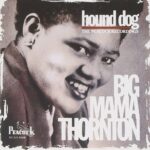
 In the summer of 1952, inside a small Los Angeles studio thick with cigarette smoke and postwar grit, a woman with a voice like gravel and thunder stepped up to a microphone and cut a record that would shake American music to its core. That woman was Big Mama Thornton, and the song was “Hound Dog.”
Long before it became a rock ’n’ roll anthem, before television appearances and swiveling hips turned it into pop mythology, “Hound Dog” was a raw, biting, unapologetic blues performance. It wasn’t cute. It wasn’t playful. It wasn’t aimed at teenagers. It was grown-folks business — sharp, sarcastic, and loaded with attitude.
The Woman Behind the Growl
Born Willie Mae Thornton in 1926 in Montgomery, Alabama, Big Mama Thornton grew up singing in church and absorbing the musical traditions of the South. She ran away from home as a teenager and joined Sammy Green’s Hot Harlem Revue, touring the Chitlin’ Circuit and honing her craft as a blues shouter and drummer. By the time she landed in Houston in the late 1940s, she had developed a style that was commanding and confrontational.
Thornton didn’t sing to be pretty. She sang to be heard.
She had a booming contralto voice that could roar or snarl, and she possessed a sense of timing that gave her performances swagger. She could stretch a line, snap it back, laugh through it, or grind it into the dirt. Her physical presence — tall, imposing, often dressed in men’s suits — only amplified her aura. In a male-dominated blues world, she didn’t ask for space. She took it.
The Birth of “Hound Dog”
“Hound Dog” was written by the young songwriting team of Jerry Leiber and Mike Stoller, who were barely out of their teens when they penned it specifically for Thornton. They weren’t trying to write a novelty tune or a dance craze. They were channeling the blunt sexual politics of rhythm and blues.
When Thornton entered the studio for Peacock Records in 1952, Leiber and Stoller were present, guiding the session. What emerged was something electric. Thornton didn’t just sing the song; she inhabited it.
“You ain’t nothin’ but a hound dog / Quit snoopin’ ’round my door…”
From the first line, the tone is clear: this is not a love song. It’s a dismissal. A put-down. The “hound dog” isn’t a literal dog, and it’s not the cartoonish figure later pop culture would soften it into. It’s a no-good man — a freeloader, a cheater, someone hanging around without contributing anything.
Thornton delivers the lyrics with biting contempt and sly humor. She barks the words, laughs between phrases, and leans into the rhythm with a physicality you can almost hear. The band behind her — led by guitarist Pete “Guitar” Lewis — pounds out a driving, blues-heavy groove that feels both stripped-down and explosive.
There’s no polish here. No sweetening. Just attitude.
A Blues Woman’s Declaration of Independence
At its core, “Hound Dog” is about power. Specifically, a woman reclaiming it.
In early 1950s America, especially in the segregated South, Black women were rarely afforded the luxury of bold self-expression in mainstream media. Thornton’s performance flips the script. She’s not pleading for affection or mourning lost love. She’s telling a man to get out.
“You can wag your tail, but I ain’t gonna feed you no more.”
That line alone captures the song’s defiance. It’s witty and cutting, but it also speaks to economic independence and emotional boundaries. The man in question isn’t just unfaithful; he’s useless. And Thornton isn’t having it.
In this sense, “Hound Dog” sits firmly in the tradition of classic blues storytelling — women confronting unreliable men with sharp tongues and sharper self-awareness. Thornton stands in the lineage of Ma Rainey and Bessie Smith, artists who used music as both catharsis and commentary.
But Thornton adds something extra: a raw, almost proto-rock aggression.
Chart Success — and Unequal Rewards
Thornton’s version of “Hound Dog” became a major R&B hit in 1953, spending seven weeks at No. 1 on the Billboard R&B chart. It sold hundreds of thousands of copies — an enormous number for a rhythm and blues record at the time.
Yet the financial rewards were modest. Thornton was reportedly paid a flat fee — around $500 — and did not receive substantial royalties. Like many Black artists in the 1950s, she watched as the music industry profited far more than she did.
The song became a staple of her live performances. Onstage, she would stretch it out, tease the crowd, and intensify its sarcasm. It was a showstopper. It was hers.
But history had other plans.
The Cover That Changed Everything
In 1956, a young singer from Memphis recorded “Hound Dog” for his second album. His version would become one of the best-selling singles of all time and help cement the rise of rock ’n’ roll.
That singer was Elvis Presley.
Presley’s take on “Hound Dog” was dramatically different from Thornton’s. Where her version is rooted in blues swagger and adult frustration, his is upbeat, frenetic, and almost cartoonish. The lyrics were slightly altered, smoothing out some of the song’s more pointed edges. The sexual politics were diluted. The sarcasm softened.
Presley’s version hit No. 1 on the pop charts and became a cultural phenomenon. Television performances, especially on The Milton Berle Show and The Ed Sullivan Show, ignited controversy and hysteria. Rock ’n’ roll had arrived in suburban living rooms.
For many white audiences, Presley’s “Hound Dog” was the original. Thornton’s recording, despite predating it by four years, was largely overshadowed in mainstream memory.
This dynamic — Black artists creating groundbreaking material that later finds greater commercial success through white performers — was tragically common in mid-century American music.
Blues vs. Rock: Two Different Beasts
Listening to Thornton’s “Hound Dog” today, it’s clear how distinct it is from the rock explosion it helped inspire.
Her version swings harder. It’s heavier, grittier, and more rhythmically grounded in the blues tradition. The guitar lines are distorted and slightly menacing. The tempo is deliberate, allowing her vocal phrasing to breathe and bite.
Presley’s rendition, by contrast, is faster and more percussive. It leans into rockabilly energy. The vocal delivery is playful rather than scathing.
Thornton’s “Hound Dog” feels like a confrontation. Presley’s feels like a party.
Neither interpretation is inherently invalid — both are culturally significant — but understanding the difference is crucial to appreciating the song’s origins. Thornton’s performance carries the emotional weight of lived experience. It doesn’t wink at the audience. It stares them down.
Legacy and Reclamation
In later years, Big Mama Thornton would express mixed feelings about the song’s legacy. She continued to perform it, but the imbalance of recognition and compensation was impossible to ignore.
Yet history has slowly begun to correct itself.
Thornton is now recognized as a foundational figure in both blues and early rock ’n’ roll. Artists and historians increasingly acknowledge that her vocal style — loud, raw, emotionally direct — helped shape the sound of rock before it had a name.
In 1984, she was inducted into the Blues Foundation Hall of Fame. In 2024, she was inducted into the Rock & Roll Hall of Fame as a Musical Influence, further cementing her rightful place in history.
“Hound Dog” is central to that recognition.
The Sound of Attitude
What makes Thornton’s version endure isn’t just its historical importance. It’s the sound.
There’s a looseness to the recording that feels alive. The band pushes and pulls. Thornton laughs mid-line. The performance feels like it could fly off the rails at any moment — and that’s part of its magic.
Her voice carries both humor and threat. When she calls the man a “hound dog,” it’s not whimsical. It’s dismissive. She’s done.
That emotional clarity resonates across decades. Modern listeners can still feel the sting in her delivery. In an era where pop music is often meticulously polished, Thornton’s “Hound Dog” feels almost radical in its rawness.
It’s messy. It’s human. It’s powerful.
Cultural Impact Beyond the Charts
Beyond music, “Hound Dog” reflects a broader story about race, gender, and ownership in American culture. Thornton’s original recording stands as a testament to the creative force of Black women in shaping popular music.
Without Thornton, there is no rock ’n’ roll explosion in quite the same way. Her vocal attack, her stage presence, her unapologetic energy — these elements became building blocks for generations of performers.
Janis Joplin, who would later cover another Thornton staple, “Ball and Chain,” cited her as a major influence. The lineage is clear: women using volume and vulnerability as weapons.
“Hound Dog” also illustrates how songs evolve. It moved from a biting blues number to a rock ’n’ roll juggernaut, crossing racial and cultural boundaries in the process. Each version tells us something about the era that embraced it.
Thornton’s speaks of postwar Black America — resilience, humor, independence. Presley’s reflects mid-1950s youth rebellion and the merging of musical traditions.
But the foundation belongs to Thornton.
Why It Still Matters
More than seventy years after its release, Big Mama Thornton’s “Hound Dog” still crackles with life. It doesn’t sound like a museum piece. It sounds immediate.
In an age increasingly aware of music history’s injustices, revisiting Thornton’s original recording isn’t just an act of nostalgia. It’s an act of recognition.
She wasn’t a footnote to rock history. She was a catalyst.
When you strip away the myth and return to that 1952 studio recording, you hear something undeniable: a woman claiming her space, telling a no-good man to get lost, and doing it with humor and ferocity.
“You ain’t nothin’ but a hound dog…”
The line echoes through decades of jukeboxes, dance floors, and radio waves. But in its purest form, it belongs to Big Mama Thornton — the blues powerhouse who barked first.
And when she barked, the world eventually listened.