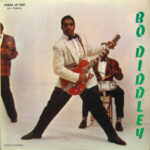
 When Bo Diddley released his self-titled track in 1955, he didn’t just put out a song—he unveiled a rhythmic signature that would ripple through generations of music. Bo Diddley, born Ellas McDaniel in McComb, Mississippi, had already been steeped in gospel, blues, and the vibrant rhythms of the South, but it was this song that solidified his identity as a revolutionary force in the early days of rock ’n’ roll. While many artists of the era were refining the blues into accessible pop, Bo Diddley took a different approach: he leaned into primal rhythm, raw guitar tone, and his own idiosyncratic vocal delivery, creating a sound that was immediately identifiable and endlessly influential.
The song Bo Diddley is built on what has come to be known as the “Bo Diddley beat,” a syncopated rhythm derived from the African “hambone” pattern and the clave rhythm often found in Afro-Cuban music. Its distinctive “shave and a haircut” kind of pulse—da, da-da, da-da—set it apart from the standard 4/4 blues shuffle dominating the airwaves at the time. The rhythm is hypnotic, driving, and percussive in a way that made the guitar almost function like a drum. In Bo Diddley’s hands, the guitar wasn’t just an instrument for chords or solos; it was a rhythmic engine propelling the song forward. This innovative approach to rhythm would later influence rock, soul, funk, and even hip-hop, with countless artists borrowing the beat or paying homage in their own work.
Vocally, Bo Diddley brought a style that was playful, assertive, and instantly recognizable. He didn’t just sing; he performed, combining spoken word, rhythmic exclamations, and bluesy moans with a confident, almost conversational delivery. In Bo Diddley, his voice functions as a percussive instrument in its own right, locking into the guitar’s rhythm while adding character and drive. The lyrics themselves are relatively simple, a mix of swagger, self-assertion, and wordplay, yet it’s the way Bo Diddley delivers them that gives the song its enduring power. Every shout, every staccato phrase, feels carefully placed to maximize impact without ever sounding overly polished—a rawness that became a hallmark of his style.
The song’s recording is as notable as its composition. Bo Diddley’s guitar tone was sharp, bright, and slightly distorted, cutting through the mix with a clarity that was rare for the time. This sound, combined with maraca-driven percussion that he often added to accentuate the rhythm, gave the track an infectious, danceable groove. Even with minimal production tools, Bo Diddley captured a sound that felt immediate and alive, as if the listener were in the room with the band. There’s a spontaneity to the recording—a sense that Bo Diddley and his backing musicians were having fun while inventing something new, a quality that resonates decades later.
One of the remarkable things about Bo Diddley is how it bridges musical worlds. It draws on the Delta blues tradition that Bo Diddley knew intimately, but it also looks forward to rock ’n’ roll and rhythm and blues. The song’s rhythmic innovation set it apart from contemporaries like Chuck Berry and Little Richard, whose music relied more on chord progressions and high-energy riffs. Bo Diddley’s focus on rhythm as the driving force of the song introduced a new approach that would shape rock guitar and band dynamics for years to come. Guitarists from Buddy Holly to Keith Richards and Jimi Hendrix have cited Bo Diddley as a direct influence, acknowledging the song’s foundational role in their own musical evolution.
The cultural impact of Bo Diddley was immediate. Released by Chess Records, a label already known for producing blues legends like Muddy Waters and Howlin’ Wolf, the track resonated with audiences hungry for new sounds. Its danceable rhythm and charismatic performance style made it popular in clubs and on jukeboxes, and it became a favorite among young listeners discovering the excitement of rock ’n’ roll. Beyond commercial appeal, Bo Diddley became a template for how rhythm and innovation could drive popular music forward. It proved that the pulse of a song could be just as important as melody or harmony—a lesson that would echo in funk, soul, and even disco in the decades to follow.
Live performances of Bo Diddley were legendary in their own right. Bo Diddley’s stage presence was larger than life, blending theatricality, charisma, and technical prowess. He often played his signature rectangular “cigar box” guitar, adding visual intrigue to his already compelling performance. On stage, the song became a showpiece for his rhythmic mastery, with maracas, guitar riffs, and call-and-response vocals all blending into a hypnotic, kinetic experience. Audiences were not just listening—they were participating, clapping along, stomping, and moving in time with the relentless beat. This emphasis on rhythm and crowd engagement would become a key aspect of rock performance and an influence on live shows for generations.
Bo Diddley also paved the way for the integration of rhythm-driven approaches into other genres. Artists across rock, pop, and even hip-hop have borrowed the song’s signature beat, and its influence can be traced through works by Buddy Holly, the Rolling Stones, U2, and countless others. The pattern became a musical shorthand, a nod to Bo Diddley’s originality and enduring innovation. Its simplicity makes it deceptively easy to adapt, yet its effect remains unmistakable—driving, infectious, and compelling.
The song also highlights Bo Diddley’s understanding of persona and branding. By naming the track after himself, he created a self-reinforcing identity: the music was Bo Diddley, and Bo Diddley was the music. This self-titling was a bold move in an era when most artists relied on covers, standards, or blues classics. It positioned him as a singular figure in the landscape of American music, a performer whose sound was inseparable from his personal presence. This strategy helped solidify his reputation, ensuring that both the man and the music became legendary.
Over time, the song’s influence only grew. The “Bo Diddley beat” became a fundamental building block for countless songs, from Buddy Holly’s Not Fade Away to U2’s Desire, and even into modern pop and hip-hop. Its percussive, driving rhythm proved timeless, demonstrating that a simple, well-executed idea could have enduring cultural resonance. Musicians and historians alike recognize Bo Diddley as a masterclass in rhythm, innovation, and performance, a recording that continues to inspire new generations of artists.
Bo Diddley’s work, epitomized by this song, also embodies the energy and experimentation of the early rock ’n’ roll era. While many contemporaries focused on melodic or lyrical novelty, Bo Diddley foregrounded rhythm in a way that felt both primal and sophisticated. His combination of blues sensibility, rhythmic drive, and stagecraft created a sound that was uniquely his own—a synthesis of tradition and innovation that helped define what rock music could be. Listening to Bo Diddley today, one can still feel the raw excitement, the sense of musical adventure, and the creative courage that characterized his career.
The legacy of Bo Diddley is not confined to technical innovation; it also lies in its infectious energy and enduring charisma. Bo Diddley himself is inseparable from the music, his personality embedded in every chord, every percussive hit, and every vocal flourish. The track captures a moment in American music history when the boundaries between blues, rhythm and blues, and rock were being pushed, expanded, and redefined. It is a testament to the power of performance and the enduring appeal of rhythm-driven innovation.
In retrospect, Bo Diddley is more than a song—it is a landmark moment in the evolution of modern music. It demonstrates how one artist’s vision, grounded in tradition but unafraid to innovate, can shape the course of entire genres. Its influence on guitarists, vocalists, and rhythm sections remains profound, and its signature beat continues to appear in new songs across decades. Bo Diddley’s name and the song itself are now synonymous with creativity, energy, and the relentless drive to push musical boundaries.
The track stands as a reminder that rock ’n’ roll, at its heart, is as much about rhythm and presence as it is about melody and harmony. Bo Diddley’s genius lay in his ability to fuse these elements with personality, charisma, and an unmistakable sense of style. Every note of Bo Diddley pulses with life, demonstrating the enduring power of an artist fully in command of his craft. It remains an essential piece of music history, a song that continues to inspire and excite listeners nearly seven decades after it first shook the world with its irresistible beat.