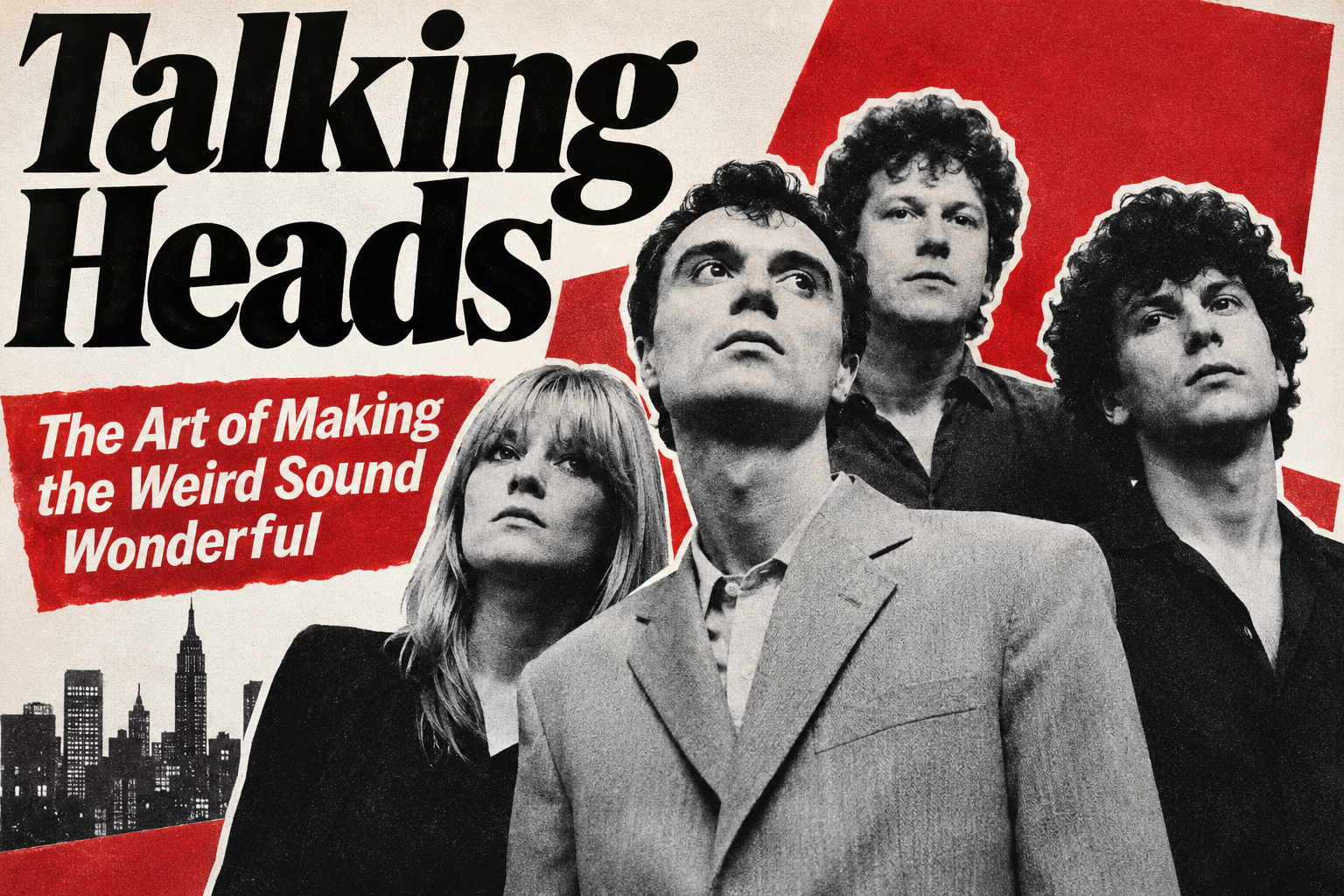
Talking Heads were one of the most unusual, influential, and intellectually adventurous bands to emerge from the American music scene of the 1970s. They started as an awkward-looking trio of art-school outsiders playing nervy, stripped-down songs in New York clubs, eventually becoming a group capable of blending punk, funk, disco, African rhythms, world music, electronic experimentation, theater, and pop into something that sounded like absolutely nobody else.
They were never a conventional rock band. Even when they were playing guitar-driven music, there was something slightly off-center about the arrangements. The rhythms seemed to move in unexpected directions. The lyrics could be funny, paranoid, philosophical, mundane, or downright bizarre. Their frontman looked less like a traditional rock star and more like a nervous guy who had wandered into the wrong room and accidentally become the most fascinating person there.
Yet somehow, Talking Heads made all of that work.
Over the course of their career, they transformed from downtown New York punk pioneers into one of the most musically sophisticated groups of their generation. Their albums challenged the boundaries of rock music, their live performances became increasingly theatrical and ambitious, and their influence can be heard in alternative rock, indie music, dance music, hip-hop, electronic music, and countless artists who learned that pop music didn’t have to follow the rules.
The story of Talking Heads is ultimately about four musicians who refused to stay in one place creatively, even when they had already found success doing something that worked.
The beginnings: art school, New York, and a strange little band
Talking Heads began taking shape in the early 1970s, when David Byrne, Chris Frantz, and Tina Weymouth were students at the Rhode Island School of Design. The three were part of the artistic and creative environment that surrounded the school, where music, visual art, performance, design, and unconventional ideas naturally overlapped.
David Byrne was already an unusual personality. He was born in Scotland in 1952 and moved to North America as a child. He developed an interest in music, art, and performance, but he was never particularly interested in becoming a traditional rock frontman. His personality was restless, analytical, and slightly awkward. He could be intensely focused on an idea while appearing completely disconnected from the social expectations around him.
Chris Frantz was a drummer with a more conventional musical background, though his approach would eventually become central to the band’s sound. Tina Weymouth, who was dating Frantz, was initially less experienced as a musician. That would turn out to be one of the band’s most important advantages.
The trio eventually relocated to New York City, where the downtown music scene was beginning to explode. The city was economically battered, artistically energized, and filled with musicians who had little interest in the polished, expensive rock productions dominating radio.
The emerging punk scene was not simply about playing fast and loudly. It was also about stripping away pretension, rejecting established musical hierarchies, and making music without waiting for permission from record companies, professional musicians, or critics.
Talking Heads fit perfectly into that environment, although they were never exactly a conventional punk band.
Their songs were strange. Byrne’s vocals could sound anxious, robotic, conversational, or almost childlike. The guitar parts often avoided traditional blues-rock patterns. Their arrangements were minimal, leaving plenty of room for tension and repetition.
They were a band that could make a song about an ordinary person walking down the street sound like a psychological emergency.
And that was the beginning of something remarkable.
CBGB and the birth of the downtown punk scene
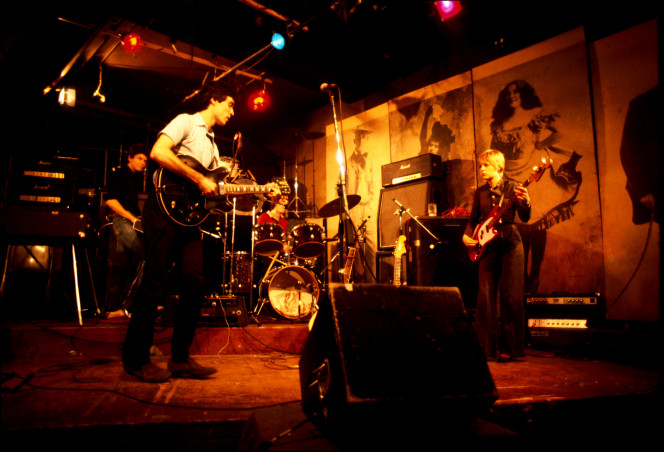 By the mid-1970s, New York had become one of the most important centers of underground music in the world.
At the heart of the scene was CBGB, the Bowery club that became synonymous with American punk rock. The venue hosted emerging bands who were playing music that was raw, inexpensive to produce, and fundamentally different from the arena rock dominating the mainstream.
Talking Heads became part of the club’s emerging musical community, alongside bands such as the Ramones, Television, Blondie, Patti Smith, and other artists who helped establish the New York punk movement.
But Talking Heads were always a little different from their peers.
The Ramones built their identity around speed, simplicity, and volume. Television emphasized long, intricate guitar interplay. Blondie blended punk with pop, disco, and new wave. Talking Heads were interested in rhythm, psychology, repetition, and the strange behavior of everyday life.
Their early performances were often uncomfortable in the most fascinating way.
David Byrne moved around the stage with an awkward, twitchy energy. He didn’t perform like a confident rock star. He looked like somebody trying to escape his own body while simultaneously using it as an instrument. His gestures were exaggerated, his facial expressions unpredictable, and his stage presence felt more like experimental theater than a conventional concert.
That became one of Talking Heads’ greatest strengths.
Instead of pretending to be cool, Byrne made awkwardness part of the performance. Instead of singing about traditional rock subjects like sex, rebellion, cars, and partying, he wrote about people behaving strangely, worrying about things they couldn’t explain, and trying to understand the world around them.
The band quickly developed a reputation as one of the more interesting groups in the New York scene.
Their early material was minimal, but it contained a distinctive tension. The music could sound deceptively simple, while the lyrics hinted at something much more complicated.
Talking Heads become a quartet
In 1975, Jerry Harrison joined Talking Heads.
Harrison had previously played with the Modern Lovers, an influential Boston group led by Jonathan Richman. His arrival expanded Talking Heads from a trio into a quartet and gave the band a much broader musical vocabulary.
Harrison brought keyboard skills, guitar ability, musical arrangement experience, and a greater sense of harmonic depth. The group was no longer simply a minimal punk trio relying on a few basic musical ideas.
The four musicians developed a remarkably complementary relationship.
Byrne supplied the lyrics, ideas, vocal personality, and much of the band’s artistic direction. Frantz provided a disciplined and steady rhythmic foundation. Weymouth developed into one of the most distinctive bass players of her generation. Harrison became an important musical architect, helping expand the band’s arrangements and adding textures that would become increasingly essential.
The chemistry wasn’t based on four musicians trying to dominate the same space.
Instead, Talking Heads became a band built around separation and coordination. Each member could occupy a distinct musical role while the arrangements allowed those parts to interact in unusual ways.
That quality would become increasingly important as the group began incorporating funk, African rhythms, electronic instruments, and more elaborate production.
Talking Heads: 77 — the debut that introduced the world to their nervous energy
In 1977, Talking Heads released their debut album, Talking Heads: 77.
It was a remarkably focused record. The band had not yet developed the elaborate arrangements or rhythmic experimentation that would characterize their later work, but the album established the essential Talking Heads personality.
The songs were short, economical, and built around unusual observations.
“Psycho Killer”
The album’s most famous track became “Psycho Killer,” a song that transformed a disturbing character study into an unlikely pop hit.
The song’s bassline is instantly recognizable. The arrangement feels almost deceptively relaxed, while the lyrics describe a character whose thoughts are becoming increasingly unstable. Byrne’s delivery alternates between controlled, conversational phrasing and moments of unsettling intensity.
The song’s brilliance lies in the contrast.
The music doesn’t behave like a typical horror soundtrack. It is catchy, rhythmic, and almost playful. The narrator, meanwhile, is clearly not somebody you would want sitting beside you on a long bus ride.
Talking Heads had discovered one of their most effective techniques: presenting something disturbing through music that was strangely inviting.
“Uh-Oh, Love Comes to Town”
The song demonstrated how Talking Heads could turn ordinary romantic subject matter into something slightly uncomfortable.
The lyrics were not filled with traditional romantic imagery. Instead, they explored uncertainty, nervousness, and the feeling of being overwhelmed by an emotion that you don’t completely understand.
“Pulled Up”
“Pulled Up” displayed the band’s early rhythmic instincts. The arrangement was tight, the guitar parts were angular, and the song had a nervous momentum that reflected the band’s punk roots.
“Don’t Worry About the Government”
One of the most interesting songs on the album was “Don’t Worry About the Government.”
Byrne sang about modern life, urban environments, infrastructure, government buildings, and the reassuring idea that everything was functioning exactly as it should.
The song was funny because its narrator seemed almost absurdly pleased with the systems surrounding him. It was also a little unsettling because the happiness felt exaggerated, as if the character were trying very hard to convince himself that the world was fine.
Talking Heads had found their lyrical territory.
They could write about the mundane and make it feel strange. They could write about paranoia without sounding like a traditional paranoid rock song. They could make an ordinary apartment, office building, or shopping trip feel like the setting of a psychological thriller.
Talking Heads: 77 wasn’t a blockbuster, but it established the band as one of the most original new groups in the American rock scene.
More Songs About Buildings and Food: the band begins to expand
Talking Heads’ second album, More Songs About Buildings and Food, arrived in 1978 and represented a significant step forward.
The band worked with producer Brian Eno, whose experimental background would become increasingly important to their development. Eno was interested in sounds, textures, rhythm, unconventional recording techniques, and ways of using the studio as an instrument rather than simply recording a band performing songs.
The partnership was a natural fit.
Talking Heads were already interested in making music that didn’t behave like conventional rock. Eno encouraged them to explore those instincts further.
The result was a record that sounded fuller, more rhythmic, and more adventurous than their debut.
“Take Me to the River”
The album’s most recognizable track was its cover of Al Green’s “Take Me to the River.”
Talking Heads didn’t attempt to recreate the original soul arrangement. They transformed the song into something much more angular and rhythmically unusual.
The bass became central to the track. The guitar and keyboard parts created a strange, hypnotic atmosphere. Byrne’s vocal delivery sounded less like a traditional soul singer and more like somebody obsessively trying to understand the emotional meaning of the song.
The cover was successful because it demonstrated that Talking Heads could reinterpret a song without simply copying its original style.
They were capable of taking material from another musical tradition and making it sound unmistakably like themselves.
“Found a Job”
“Found a Job” explored relationships, television, domestic life, and the possibility of people becoming trapped by their own routines.
The song was a perfect example of Byrne’s writing. He could take a subject that might seem completely uninteresting and turn it into a commentary on the absurdity of modern life.
“Artists Only”
“Artists Only” was a direct reflection of the band’s artistic environment. It explored the identity, pretensions, and self-consciousness of people who defined themselves through creativity.
The song had a sharp, almost sarcastic edge, suggesting that being an artist could be just as ridiculous as any other social role.
“The Big Country”
“The Big Country” was one of Byrne’s most memorable examinations of American life.
The song looked at the country from the perspective of someone who seemed increasingly uncomfortable with its landscapes, culture, and values. The narrator wasn’t exactly an outsider, but he appeared unable to understand why people found certain aspects of American life appealing.
Talking Heads were becoming more than a punk band.
They were developing a musical and lyrical identity that could comment on modern culture without sounding like a traditional protest band.
Fear of Music: darker, stranger, and more rhythmic
In 1979, Talking Heads released Fear of Music, one of the most important albums in their career.
The record was darker and more intense than their previous releases. The band’s rhythms became more aggressive, the arrangements more complicated, and the lyrics increasingly focused on anxiety, paranoia, violence, religion, nature, and the unsettling aspects of existence.
Brian Eno again played a major role in the production.
The album’s sound was unusually physical. The bass and drums often dominated the arrangements, while guitars and keyboards created layers of tension. The songs could feel almost mechanical, but there was also a sense of movement and energy that made the music exciting.
“Life During Wartime”
One of the band’s defining songs emerged from this album.
“Life During Wartime” imagined a world where ordinary life had been disrupted by conflict, political instability, and underground resistance.
The narrator described a life of movement, hiding, surveillance, and uncertainty. The song didn’t sound like a traditional war song. It sounded like a person trying to survive in a world where the rules had suddenly changed.
The famous opening declaration about not living in a shack, not owning a car, and not being able to rely on familiar comforts established the song’s sense of urgency.
The music was relentlessly rhythmic.
Frantz’s drums and Weymouth’s bass drove the song forward, while Harrison’s keyboard and guitar contributions helped create a tense, tightly controlled sound.
The song became a staple of Talking Heads’ live performances and one of their most enduring recordings.
“I Zimbra”
“I Zimbra” was one of the most radical tracks the band had recorded up to that point.
The song was built around a poem by Dadaist writer Hugo Ball, using words and syllables that didn’t follow conventional lyrical meaning. Talking Heads combined this nonsensical vocal material with a rhythmically complex arrangement influenced by African music.
The track was a major clue to where the band was heading.
They were no longer simply experimenting with the sound of punk and new wave. They were beginning to explore rhythmic structures, musical ideas, and cultural influences far beyond the traditional rock framework.
“Heaven”
“Heaven” was almost the opposite of “Life During Wartime.”
It was a relatively gentle song about the idea of heaven as a place where everything happens exactly as expected, where nothing changes, and where the same things repeat forever.
The concept was funny, philosophical, and slightly depressing.
Byrne seemed to suggest that a perfect place might actually be boring because it offered no surprises, no uncertainty, and no possibility of growth.
It was classic Talking Heads: a seemingly simple idea that became increasingly strange the longer you thought about it.
“Memories Can’t Wait”
“Memories Can’t Wait” was more atmospheric and unsettling, using repetition and unusual vocal phrasing to create a sense of psychological disorientation.
The album demonstrated how far Talking Heads had evolved in just three years.
They were becoming a band capable of making highly experimental music while still maintaining a recognizable identity.
Tina Weymouth becomes one of rock’s great bass players
One of the most important reasons Talking Heads worked was Tina Weymouth.
Weymouth initially entered the band with limited musical experience. She had not been a lifelong professional bass player, and her development was partly the result of learning the instrument while the group was taking shape.
That background gave her a somewhat unconventional approach.
Instead of relying heavily on traditional rock bass patterns, Weymouth developed basslines that were melodic, rhythmic, and often central to the entire arrangement.
Her playing was influenced by funk, disco, soul, and the increasingly rhythmic direction of Talking Heads’ music.
She understood that the bass didn’t simply have to support the guitar.
It could be the song’s primary hook.
Her lines often moved independently of the guitar parts, creating a sense of motion that gave Talking Heads their distinctive groove.
Weymouth’s playing became particularly important as the band moved toward funk and dance-oriented music. She was capable of creating basslines that were both simple and incredibly memorable.
Her work on songs such as “Psycho Killer,” “Life During Wartime,” “Once in a Lifetime,” and “Crosseyed and Painless” helped establish Talking Heads as a band whose rhythm section could compete with the best in rock, funk, and dance music.
She was also part of Tom Tom Club with Chris Frantz, a side project that would become a major success in its own right.
Talking Heads were often described through David Byrne’s personality, but the band’s musical identity depended heavily on Weymouth’s bass playing.
Without her, the band’s music would have sounded dramatically different.
The African music influence changes everything
Talking Heads’ growing interest in African music became one of the most important developments in their career.
The band had always been interested in rhythm, but by the late 1970s and early 1980s, their musical curiosity was expanding toward polyrhythms, interlocking percussion, repetitive patterns, and grooves that differed from traditional Western rock arrangements.
David Byrne and Brian Eno were particularly interested in African musical traditions and the way rhythmic patterns could interact to create a larger musical structure.
The influence was not simply about adding percussion.
It involved changing the way the band thought about music.
Instead of building songs around guitar riffs, chord progressions, and conventional verse-chorus structures, Talking Heads increasingly began building songs around rhythmic patterns.
The music could become repetitive without becoming boring because each instrument occupied a different rhythmic position.
The bass might repeat one pattern. The drums might emphasize another. Guitar and keyboards could add additional rhythmic layers. Percussion could create a further level of complexity.
The listener could focus on one part or hear the entire arrangement as a constantly moving machine.
That approach would become central to the band’s next album.
Remain in Light: the masterpiece that changed the band
If there is one Talking Heads album that represents the moment the band completely reinvented itself, it is Remain in Light.
Released in 1980, the album pushed the band into territory that had very little resemblance to the punk scene where they originally started. Guitar-driven rock was no longer the primary focus. The songs were built around rhythm, repetition, layered percussion, keyboards, bass patterns, and interlocking musical parts.
The album’s recording sessions were heavily influenced by the band’s interest in African music, particularly the rhythmic approaches associated with Afrobeat and musicians such as Fela Kuti. Rather than simply borrowing a few sounds, Talking Heads attempted to build songs around rhythmic concepts and musical patterns.
The recording process itself reflected this approach.
The musicians experimented with instrumental loops, repeated patterns, and layered performances. David Byrne and Brian Eno worked with ideas that could be expanded through the studio, allowing individual musical pieces to grow into complex arrangements.
The songs often began with relatively simple ideas.
A bass pattern. A drum rhythm. A keyboard part. A guitar figure.
Those elements were gradually assembled into increasingly dense arrangements. The individual parts might seem simple when heard separately, but together they created a constantly shifting musical landscape.
The album was a major departure from traditional rock songwriting.
“Once in a Lifetime”
“Once in a Lifetime” became one of Talking Heads’ most recognizable songs and perhaps the best example of the band’s ability to make philosophical ideas sound like dance music.
The song explores the feeling of suddenly realizing that your life has become something you never consciously chose.
You wake up in a house. You have a job. You own things. You have a family. You are surrounded by the objects and routines of modern life.
And then you stop and ask yourself:
How did I get here?
The song is built around repetition, with Byrne’s vocals becoming increasingly intense as he cycles through observations about life, identity, and the passage of time.
The music is hypnotic. The rhythm is almost impossible to ignore. The keyboard and guitar parts seem to float around the central groove, while the bass and percussion keep everything moving.
The famous video made the song even more memorable.
Byrne appeared in a series of increasingly strange movements, gestures, and poses, as though his body were trying to process information faster than his brain could handle it. The choreography was deliberately awkward and theatrical. It was not the kind of performance audiences expected from a rock singer.
That was the point.
Talking Heads made the song’s philosophical anxiety visible.
“Once in a Lifetime” eventually became one of the most important songs of the 1980s, but its popularity was somewhat ironic. The song was essentially about people living their lives without understanding how they arrived at their circumstances.
It became a massive cultural reference precisely because so many people recognized themselves in it.
“Crosseyed and Painless”
“Crosseyed and Painless” was one of the album’s most explosive tracks.
The song featured a relentless groove and a vocal performance that sounded like a man trying to keep up with an increasingly complicated world.
The lyrics were packed with references to numbers, calculations, information, anxiety, and the feeling of being overwhelmed by systems that never stop demanding attention.
It was a song about information overload before the internet existed.
The music was almost aggressively rhythmic. Every instrument seemed to be contributing to a larger pattern, creating the impression of a machine that was constantly moving and impossible to shut down.
“The Great Curve”
“The Great Curve” demonstrated the album’s musical ambition.
The song featured a dense arrangement built around rhythmic layers, guitar, keyboards, bass, and percussion. The music was energetic, complex, and constantly moving.
The vocal arrangements also played a major role, with additional voices creating a larger musical texture that made the song feel more like a collective performance than a traditional rock track centered around one singer.
“Born Under Punches”
“Born Under Punches” was one of the album’s most intense pieces.
The track was built around a complicated rhythmic structure that gradually became more overwhelming. Byrne’s vocal performance was urgent and almost frantic, while the instrumental parts continued to circle around one another.
The song seemed to capture the feeling of being trapped in a world where every decision, every interaction, and every piece of information demanded immediate attention.
It was an incredibly ambitious recording.
“Listening Wind”
“Listening Wind” offered a different perspective.
It was slower, atmospheric, and more spacious than the album’s other songs. The track explored themes of political resistance, surveillance, and the relationship between individuals and larger systems of power.
Its arrangement demonstrated that Talking Heads could create tension without relying on speed or volume.
“Remain in Light” changes what Talking Heads could be
The album was a major artistic breakthrough.
It demonstrated that Talking Heads could abandon the musical formula that originally made them successful without losing their identity.
The band had evolved from a punk group into a sophisticated rhythmic ensemble capable of combining funk, rock, electronic music, African-inspired rhythms, experimental production, and pop songwriting.
Remain in Light would become one of the most influential albums of its era and a record that continues to inspire musicians across multiple genres.
It also created a practical problem.
The music was becoming too complicated to perform live with only four people.
The expanded live band
Talking Heads understood that the new music required a different kind of live presentation.
The band expanded its lineup by bringing in additional musicians, including percussionists, backing vocalists, and instrumentalists who could reproduce the complicated arrangements developed in the studio.
The expanded lineup helped transform Talking Heads from an art-rock band into something closer to a rhythmic collective.
The live performances became increasingly energetic.
The musicians were no longer simply playing songs. They were building rhythmic patterns, layering percussion, and creating a physical musical experience that encouraged movement.
David Byrne’s stage presence also evolved.
The nervous, awkward movements that had once made him seem like an outsider became increasingly deliberate. He began incorporating theatrical gestures, dance movements, and visual elements into his performances.
The music had become more celebratory, but Byrne’s personality remained strange enough to prevent the performances from feeling like conventional dance-rock shows.
Talking Heads could be funky, but they never seemed entirely comfortable being funky.
That tension made them fascinating.
The Name of This Band Is Talking Heads
In 1982, Talking Heads released the live album The Name of This Band Is Talking Heads.
The record documented the band’s evolution from the early CBGB lineup into the expanded ensemble that had developed around Remain in Light.
It was an important album because it demonstrated just how dramatically the band had changed in a relatively short period.
The early recordings captured the angular, stripped-down sound of the original quartet. The later performances showcased the expanded group’s rhythmic complexity, percussion, backing vocals, and more elaborate arrangements.
The album was also a reminder that Talking Heads were not simply a studio experiment.
They were an excellent live band.
Their songs could be transformed onstage, with instrumental sections expanded, rhythms intensified, and arrangements altered to accommodate the larger lineup.
The group was increasingly moving toward a sound that combined rock concert energy with dance music, theatrical performance, and musical experimentation.
Tom Tom Club: Tina Weymouth and Chris Frantz take a detour
While Talking Heads were becoming increasingly ambitious, Tina Weymouth and Chris Frantz began exploring a different musical direction through their side project, Tom Tom Club.
The project was formed in 1981 and featured a more playful, dance-oriented approach. It embraced funk, reggae, disco, hip-hop, and electronic music in ways that were less experimental and more immediately accessible than much of Talking Heads’ work.
The group’s debut album produced one of the most influential tracks of the decade.
“Genius of Love”
“Genius of Love” became a major cult classic and an enormously influential recording.
The song’s groove was infectious. Its bassline, keyboards, percussion, and vocal arrangement created a sound that felt simultaneously futuristic and relaxed.
The track would later become particularly important in hip-hop.
Its instrumental elements and vocal sections were sampled by numerous artists, most famously Mariah Carey on “Fantasy,” helping introduce the song to an entirely new generation of listeners.
The success of Tom Tom Club demonstrated that Weymouth and Frantz had their own musical identity outside Talking Heads.
It also reinforced something that was already becoming obvious: the rhythm section was capable of driving music in entirely different directions.
Talking Heads had become a band with four highly creative musicians, each capable of pursuing different artistic interests.
That would eventually contribute to the group’s internal tensions.
Speaking in Tongues: the band finds a more accessible groove
After the massive artistic leap represented by Remain in Light, Talking Heads took a break from recording as a group.
The members pursued various projects, and Brian Eno’s relationship with the band eventually came to an end.
When Talking Heads returned in 1983 with Speaking in Tongues, the sound was different.
The album retained the rhythmic experimentation of Remain in Light, but it was warmer, more streamlined, and more accessible. The arrangements were less dense, and the songwriting moved toward a more conventional pop structure without abandoning the band’s musical personality.
The result was one of the band’s biggest commercial successes.
“Burning Down the House”
“Burning Down the House” became Talking Heads’ biggest hit in the United States and introduced the band to a much larger mainstream audience.
The song was built around a powerful rhythm and a memorable keyboard hook. Byrne’s vocals were strange enough to preserve the band’s identity, but the song had a directness and energy that made it accessible to radio audiences.
The lyrics were deliberately surreal.
The title sounded destructive, but the song didn’t follow a straightforward narrative about fire or disaster. Instead, it presented a series of images and phrases that created a sense of excitement, chaos, and release.
The song became an enormous success partly because it was difficult to categorize.
It was a rock song. It was funky. It was danceable. It was strange.
The music video helped as well.
Talking Heads had always understood the importance of visual presentation, and MTV provided an opportunity to reach audiences who might never have discovered the band through the underground club scene.
“Burning Down the House” proved that Talking Heads could make an experimental band sound like a pop act without sacrificing their weirdness.
“This Must Be the Place (Naive Melody)”
The album also contained one of the band’s most beautiful songs.
“This Must Be the Place (Naive Melody)” was a gentle, romantic track that revealed a side of David Byrne that wasn’t always visible in the band’s more anxious or eccentric material.
The song was built around a repeating keyboard pattern, a steady rhythm, and a remarkably warm arrangement.
Its lyrics explored the idea of home not necessarily as a physical location, but as a feeling of belonging.
For a band that had spent years writing about alienation, paranoia, social discomfort, and modern life, the song represented a surprisingly straightforward emotional moment.
It remains one of Talking Heads’ most beloved recordings.
“Slippery People”
“Slippery People” brought back the band’s more aggressive rhythmic approach.
The song was driven by an energetic groove, layered vocals, and a sense of movement that made it particularly effective live.
Its lyrics were abstract and unusual, but the music was immediately physical.
It was another example of Talking Heads successfully combining intellectual curiosity with music that could make an audience dance.
Stop Making Sense: one of the greatest concert films ever made
Talking Heads had already become an exceptional live band, but Stop Making Sense elevated their reputation to another level entirely.
The concert film was directed by Jonathan Demme and filmed during the band’s 1983 tour supporting Speaking in Tongues. It was released in 1984 and became one of the most celebrated concert films ever made.
The film is famous for its stripped-down presentation and unusual staging.
Rather than opening with a full band standing onstage, the concert begins with David Byrne walking out alone carrying an acoustic guitar and a cassette player.
He announces that he wants to play a tape.
The tape begins the rhythm of “Psycho Killer,” and Byrne performs the song by himself.
Then Chris Frantz joins him.
Then Tina Weymouth.
Then Jerry Harrison.
Then additional musicians.
The stage gradually fills as the concert progresses.
Instead of beginning with the spectacle, Talking Heads build the spectacle from nothing.
It is a brilliant idea because the audience gets to watch the music physically grow.
The band starts with almost nothing and gradually becomes a large, energetic ensemble capable of filling the stage with movement, rhythm, and sound.
The giant suit
The most famous visual element of the film is David Byrne’s oversized gray suit.
The suit was designed to look absurdly large, with exaggerated proportions that made Byrne appear almost cartoonish.
He wore it during “Girlfriend Is Better,” and the image became one of the most iconic visuals in rock history.
The suit was a perfect representation of Talking Heads.
It was funny. It was weird. It was visually memorable. And it made absolutely no attempt to look cool in the conventional rock-star sense.
Byrne’s movements inside the suit made the performance even more memorable. He appeared to be fighting the clothing, using the exaggerated proportions as part of the choreography.
The suit also became a visual metaphor for the band’s music.
Talking Heads were interested in the relationship between people and the systems surrounding them. The oversized suit suggested a person trapped inside an artificial structure, trying to move and express himself while the world around him remained slightly ridiculous.
It was simultaneously a comedy costume, a piece of performance art, and a rock-star outfit.
The musicians
The expanded lineup was one of the film’s greatest strengths.
The stage included musicians such as:
-
Bernie Worrell on keyboards
-
Alex Weir on guitar
-
Steve Scales on percussion
-
Lynn Mabry on backing vocals
-
Ednah Holt on backing vocals
The group was capable of creating an enormous rhythmic sound while still maintaining the precision of the original Talking Heads arrangements.
The percussion was especially important.
The music seemed to be constantly moving, with rhythms overlapping and shifting. The stage performances were energetic without becoming chaotic. Every musician seemed to understand exactly where they fit into the larger musical structure.
The performances
The film features outstanding versions of songs including “Psycho Killer,” “Heaven,” “Thank You for Sending Me an Angel,” “Found a Job,” “Slippery People,” “Burning Down the House,” “Life During Wartime,” “Making Flippy Floppy,” “Once in a Lifetime,” “Girlfriend Is Better,” “Take Me to the River,” and “This Must Be the Place.”
The performances are often more powerful than the studio recordings.
“Life During Wartime” becomes a full-blown rhythmic explosion. “Once in a Lifetime” feels almost like a spiritual experience, despite Byrne’s bizarre movements and delivery. “Burning Down the House” becomes an enormous celebration of rhythm and energy.
“Take Me to the River” demonstrates how Talking Heads could turn a relatively simple song into an extended musical journey.
The film is remarkable because it doesn’t rely on excessive camera tricks, elaborate storytelling, or artificial drama.
The band simply performs.
But the performance is so carefully constructed that it becomes theatrical without ever feeling fake.
Stop Making Sense remains one of the most important documents of Talking Heads’ career because it captures the band at the moment when their artistic ambitions, musicianship, personality, and live energy were all working together at their absolute best.
Little Creatures: Talking Heads embrace pop
After the complexity of Remain in Light and the rhythmic experimentation of Speaking in Tongues, Talking Heads released Little Creatures in 1985.
The album represented another significant change.
The band moved toward a more straightforward pop-rock sound. The arrangements were less complicated, the songs more melodic, and the production more polished.
Some longtime fans considered the album a retreat from the group’s experimentation.
Others appreciated the fact that Talking Heads were capable of producing a record that was accessible without sounding completely generic.
The album was a major commercial success.
“And She Was”
“And She Was” was one of the album’s most memorable songs.
It described a woman experiencing a sense of freedom and transcendence, seemingly floating above the ordinary world.
The lyrics were surreal, but the music was bright and melodic.
The song’s combination of pop accessibility and strange imagery was classic Talking Heads. Byrne could write a song that sounded almost like a conventional radio hit while introducing a character whose behavior was completely unexpected.
“Road to Nowhere”
“Road to Nowhere” became one of the band’s most beloved songs.
The song was built around a gospel-influenced arrangement, with a steady rhythm, layered vocals, and an uplifting melody.
But its lyrics were more ambiguous than the music initially suggested.
The idea of traveling down a road without necessarily knowing where it leads could be interpreted as optimism, resignation, existential confusion, or simply an acknowledgment that life rarely comes with a map.
Talking Heads were particularly good at creating songs that could be interpreted in multiple ways.
The music seemed joyful.
The lyrics were not necessarily reassuring.
“Creatures of Love”
“Creatures of Love” returned to some of the band’s more unusual lyrical territory.
The song explored relationships and human behavior through a strange, almost scientific perspective. Byrne’s writing often treated people as if he were observing them from a distance, attempting to understand why they behaved the way they did.
That approach was one of his most distinctive qualities.
He could write about love without sounding like a traditional romantic songwriter.
He could write about fear without sounding like a conventional horror writer.
He could write about society without sounding like a traditional political songwriter.
Talking Heads were always looking at familiar subjects from slightly unusual angles.
True Stories: a band enters the world of David Byrne’s imagination
In 1986, Talking Heads released True Stories, an album connected to David Byrne’s film of the same name.
The project was unusual because Byrne conceived the film as a collection of stories about eccentric characters living in a fictional Texas town.
The film explored suburban life, local culture, strange personalities, television, consumerism, romance, religion, and the peculiar ways people construct their identities.
Talking Heads’ album was connected to the film, though it wasn’t simply a traditional soundtrack album in which the band performed every song exactly as it appeared in the movie.
The album featured songs associated with the film’s fictional characters and situations.
The project was another example of Byrne’s interest in combining music, visual art, filmmaking, theater, and storytelling.
“Wild Wild Life”
“Wild Wild Life” became the album’s biggest hit.
The song was upbeat, playful, and accessible, with a catchy rhythm and an uncomplicated arrangement.
Its lyrics explored the idea of people attempting to escape the routines and expectations of everyday life.
The music video featured Byrne and the band performing in a deliberately theatrical setting, surrounded by characters and visual elements that reflected the film’s eccentric world.
It was one of Talking Heads’ most accessible recordings, but it still retained the band’s strange sense of humor.
“Love for Sale”
“Love for Sale” was more critical of consumer culture.
The song explored the relationship between desire, advertising, money, and the way people are encouraged to purchase happiness.
Talking Heads had spent much of their career examining modern life, and the song fit comfortably into that tradition.
“Radio Head”
The album also contained “Radio Head,” a song that would eventually have a surprising afterlife.
Years later, the British band Radiohead adopted the song’s title as their own band name.
The connection became one of those strange musical footnotes that perfectly suited Talking Heads’ history.
The band had created so many unusual ideas and titles that even their album tracks could eventually influence an entirely different musical generation.
Naked: the final studio album
Talking Heads released Naked in 1988.
The album marked another return to musical experimentation, incorporating international musicians, more elaborate percussion, and influences that included African and Latin rhythms.
The record was more complicated and less commercially straightforward than Little Creatures and True Stories.
It represented a band that still wanted to experiment, even as the relationships among its members were becoming increasingly strained.
“Blind”
“Blind” was one of the album’s most recognizable songs.
It featured a strong rhythmic foundation, unusual vocal phrasing, and an arrangement that moved between funk, rock, and more experimental sounds.
By this point, Talking Heads were no longer interested in fitting into one genre.
They had spent years moving between punk, art-rock, funk, dance music, pop, world music, and experimental arrangements.
Naked reflected that willingness to keep changing.
“Nothing But Flowers”
“Nothing But Flowers” was one of the album’s most interesting lyrical ideas.
The song imagined a world in which modern technology, commercial infrastructure, and urban development had disappeared, leaving nature to reclaim the landscape.
But rather than presenting this as a simple environmental fantasy, Byrne’s narrator seemed deeply uncomfortable with the consequences.
He missed supermarkets. He missed cars. He missed the conveniences of modern life.
The song was funny because the narrator was unable to enjoy the supposedly perfect natural world without complaining about the absence of modern comforts.
It was also a pointed commentary on the contradictions of modern environmental thinking.
“The Democratic Circus”
“The Democratic Circus” explored political and social themes through the band’s increasingly complex musical arrangements.
The song reflected Talking Heads’ continued interest in the absurdity of modern institutions, public behavior, and the spectacle surrounding politics.
It was another reminder that Byrne’s songwriting was rarely limited to straightforward storytelling.
He was interested in systems, rituals, and the ways people behaved when they believed they were participating in something meaningful.
The tensions inside Talking Heads
The band’s musical success did not necessarily translate into an easy relationship among its members.
As Talking Heads grew, David Byrne became increasingly associated with the band’s artistic direction. He was the most visible member, the primary lyricist, and the musician most closely identified with its unusual personality.
But Talking Heads were not simply David Byrne with a backing band.
Tina Weymouth, Chris Frantz, and Jerry Harrison were major contributors to the band’s musical identity. They had their own ideas, their own projects, and their own creative ambitions.
The increasingly ambitious arrangements sometimes created friction. Byrne’s growing involvement in film, theater, solo music, and other artistic projects also pulled him away from the group.
Frantz and Weymouth had their own success with Tom Tom Club. Harrison pursued production work and other musical projects. The band members were no longer dependent on Talking Heads as their sole creative outlet.
The group increasingly operated more like four artists with overlapping interests than four musicians committed to maintaining one permanent musical identity.
That situation became difficult to sustain.
After Naked, Talking Heads effectively stopped functioning as an active recording and touring band. The members pursued individual projects, and the relationship between Byrne and the other three musicians deteriorated.
For several years, there was no official announcement that the band had broken up.
The group simply stopped.
Eventually, in 1991, Talking Heads formally announced their breakup.
The announcement confirmed what had already become obvious: the band was finished.
The aftermath: four musicians, four different paths
David Byrne continued developing his solo career.
He explored world music, electronic music, film, theater, visual art, and collaborations with musicians from different parts of the world. His solo work was often just as experimental as Talking Heads, although it moved in directions that didn’t necessarily resemble the band’s sound.
Byrne also founded Luaka Bop, a record label dedicated to introducing audiences to music from different countries and cultures.
Tina Weymouth and Chris Frantz continued working with Tom Tom Club.
The project maintained a connection to funk, dance music, reggae, hip-hop, and electronic production. Their music remained playful and rhythmically adventurous, demonstrating that the musical chemistry between Weymouth and Frantz had never depended entirely on Talking Heads.
Jerry Harrison continued his career as a musician and producer.
He worked with other artists and bands, helping produce and shape recordings that drew on his experience with Talking Heads’ unusual arrangements, rhythmic structures, and musical experimentation.
The members remained active.
But Talking Heads, as a group, was over.
The reunions that never really happened
Talking Heads have reunited on a few occasions, but the idea of a full-scale reunion tour has remained elusive.
The original members came together for their Rock and Roll Hall of Fame induction in 2002, performing together at the ceremony.
They also reunited publicly around the restoration and re-release of Stop Making Sense in 2023, appearing together for interviews and promotional events.
The reunion generated enormous excitement among fans who hoped the renewed communication might lead to concerts.
It didn’t.
The members continued to express appreciation for one another and for the band’s legacy, but the underlying disagreements and different artistic directions made a full reunion unlikely.
Talking Heads had become one of those bands whose history was so important that fans could never completely stop hoping for one more show.
But perhaps the absence of a reunion has helped preserve the band’s legacy.
There is no farewell tour attempting to recreate the past. There is no modern version of Talking Heads trying to compete with its own history.
The band’s recorded work and live performances remain intact, allowing listeners to experience the group as it actually existed.
Why Talking Heads mattered so much
Talking Heads were influential because they expanded the definition of what a rock band could be.
They came from punk, but they didn’t remain punk.
They embraced funk without becoming a funk band.
They experimented with African rhythms without abandoning pop songwriting.
They incorporated electronic music without becoming an electronic act.
They explored theater and visual art without turning their concerts into gimmicks.
They made music that could be intellectually interesting without becoming inaccessible.
Most importantly, they understood that popular music could be strange.
A song could be about a man who suddenly realizes he has no idea how he arrived at his life. It could be about someone obsessively worrying about numbers. It could be about modern technology, government buildings, supermarkets, television, suburban life, or the absurdity of human behavior.
And it could still have a great bassline.
Talking Heads influenced artists across an enormous range of musical styles. Their rhythmic experimentation helped inspire musicians in alternative rock, indie music, dance music, hip-hop, electronic music, and beyond.
Their willingness to incorporate influences from outside traditional rock became particularly important for musicians who wanted to move beyond the standard guitar-bass-drums format.
The band’s work also helped establish the idea that musical experimentation and mainstream success weren’t necessarily opposites.
Talking Heads could make challenging music that still reached millions of listeners.
They could make an album as unusual as Remain in Light and follow it with a song like “Burning Down the House.”
They could make a concert film that looked like experimental theater and turn it into one of the most celebrated live music movies ever created.
They could be serious artists without taking themselves too seriously.
That balance was extraordinarily difficult to achieve.
The albums that tell the story
Talking Heads: 77 (1977)
The nervous, quirky punk beginnings. “Psycho Killer” introduces the band’s strange genius.
More Songs About Buildings and Food (1978)
The first major leap into funk, experimentation, and Brian Eno’s studio approach.
Fear of Music (1979)
Darker, tighter, more rhythmic, and filled with anxiety and paranoia.
Remain in Light (1980)
The revolutionary masterpiece. Polyrhythms, funk, electronics, African musical influence, and extraordinary songwriting.
Speaking in Tongues (1983)
The rhythmic experimentation becomes warmer, more accessible, and commercially successful.
Little Creatures (1985)
A pop-focused album that brings the band to a wider audience.
True Stories (1986)
Small-town America, odd characters, humor, and Byrne’s cinematic imagination.
Naked (1988)
A final studio album that returns to global rhythms and adventurous arrangements.
The legacy of Talking Heads
Talking Heads were a band that never seemed particularly interested in behaving like a band.
They began as art-school outsiders playing minimalist songs in small New York clubs. They became one of the defining groups of the punk and new wave era. They then transformed themselves into a rhythmic powerhouse that helped redefine the possibilities of rock music.
Their career was full of contradictions.
David Byrne was an awkward performer who became one of the most captivating frontmen in rock. Tina Weymouth began with relatively little bass experience and became one of the most distinctive players in popular music. Chris Frantz was the steady rhythmic foundation of a band whose arrangements became increasingly complicated. Jerry Harrison helped expand a minimal punk group into a sophisticated musical ensemble.
Talking Heads could sound nervous, paranoid, joyful, danceable, philosophical, ridiculous, and brilliant, sometimes all within the same song.
They made music about everyday life, but everyday life never sounded quite normal when they were finished with it.
They didn’t need to write about superheroes, rock-star excess, or grand romantic gestures. They could take a person standing in a supermarket, sitting in an office, driving through the suburbs, watching television, or staring at the ceiling in the middle of the night and turn that experience into something fascinating.
Their music was about the strange experience of being human in a world that was becoming increasingly complicated.
And they approached that subject with guitars, bass, drums, keyboards, percussion, electronics, bizarre dance movements, oversized suits, and a willingness to make themselves look ridiculous.
That may be the most important thing about Talking Heads.
They were smart enough to be experimental, talented enough to make it work, and self-aware enough to understand that music doesn’t always have to look cool to be great.
Sometimes the guy in the giant suit dancing like he’s having a nervous breakdown is the most interesting person on the stage.
And sometimes the band behind him is making some of the greatest music anyone has ever recorded.
Talking Heads managed to do both.
And nearly half a century after they first stepped onto the stage at CBGB, they still sound like a band from the future that somehow arrived early.
You can download 24 Talking Heads Live Shows from over the years at Concert-Downloads.com
This post has already been read 55 times!