Four Lives, One Plane Crash, and the Night That Became a Permanent Part of American Music History
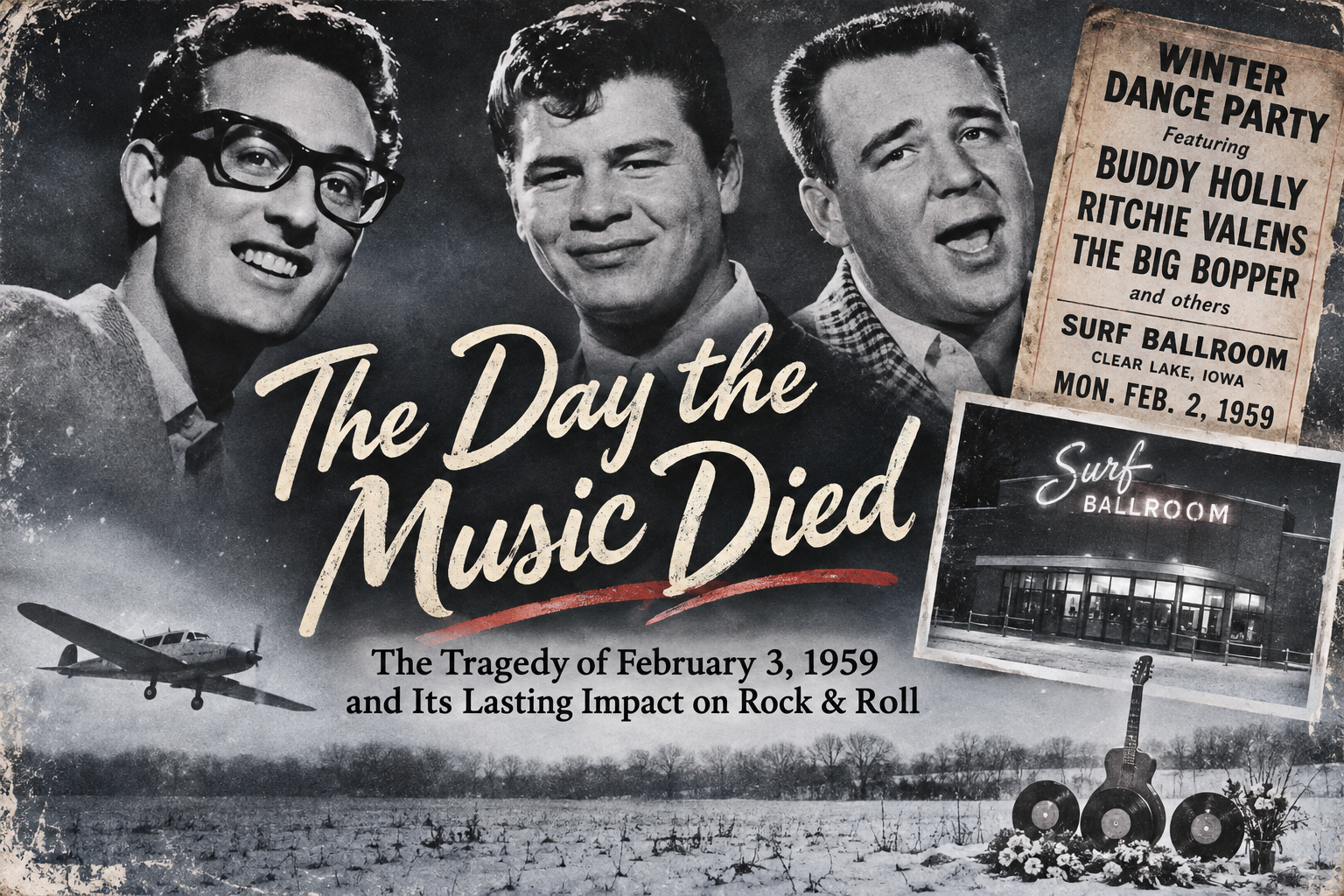
February 3, 1959, is one of the most famous dates in the history of popular music. On a bitterly cold winter morning in Iowa, a small airplane carrying three of rock and roll’s most promising young performers crashed into a frozen field, killing everyone aboard. The victims were Buddy Holly, 22, Ritchie Valens, 17, J.P. Richardson, better known as The Big Bopper, 28, and their 21-year-old pilot, Roger Peterson.
The three musicians had performed together just hours earlier at the Surf Ballroom in Clear Lake, Iowa. They were part of a traveling concert package called the Winter Dance Party, a tour that had been plagued by broken-down buses, freezing temperatures, exhausting travel schedules, and miserable accommodations. After another difficult evening, Buddy Holly decided he had enough of the unreliable bus transportation and arranged for a small aircraft to take him and two other performers to their next destination.
It was supposed to be a relatively routine flight to Fargo, North Dakota, near their next scheduled performance in Moorhead, Minnesota. Instead, it became one of the most devastating accidents in the history of American entertainment.
The tragedy would eventually become known as The Day the Music Died, a phrase made famous by Don McLean’s 1971 song “American Pie.” But behind that familiar expression was a very real disaster involving three young musicians whose careers were flourishing, a poorly organized concert tour, deteriorating weather conditions, and a series of decisions that would have consequences far beyond anything anyone could have imagined.
To understand the significance of what happened, it helps to look at the musical landscape of 1959, the three performers involved, the miserable conditions surrounding the tour, and the events that unfolded during the early morning hours of February 3.
Rock & Roll in 1959: A Musical Revolution in Progress
By 1959, rock and roll had already transformed American popular music.
Only a few years earlier, the genre had been considered a rebellious novelty by much of the adult population. Now it was becoming the soundtrack of an entire generation.
Elvis Presley had exploded onto the scene, Chuck Berry was establishing the electric guitar as the defining instrument of rock and roll, and Little Richard was delivering performances that seemed almost impossibly energetic compared with the traditional pop entertainment of the period.
Jerry Lee Lewis, Eddie Cochran, Gene Vincent, Carl Perkins, and countless others were helping establish a new musical vocabulary.
Teenagers were buying records, attending dances, listening to radio stations that specialized in rock and roll, and developing musical tastes that frequently put them at odds with their parents.
However, the genre was also experiencing a period of uncertainty.
Elvis had entered the United States Army in March 1958, temporarily removing one of rock’s biggest stars from the performing circuit. Chuck Berry was dealing with legal troubles, and Jerry Lee Lewis had suffered a serious career setback following the controversy surrounding his marriage to his teenage cousin.
The early rock and roll explosion had not disappeared, but its original stars were facing significant challenges.
A younger generation of performers was beginning to take center stage.
Buddy Holly, Ritchie Valens, and The Big Bopper were three of those rising stars. They had different musical backgrounds and personalities, but each represented something important about the direction popular music was taking.
Their careers were moving forward. Their records were selling. Their audiences were growing.
None would make it through the winter of 1959.
Buddy Holly: The Songwriter Who Helped Build Modern Rock
Charles Hardin Holley was born on September 7, 1936, in Lubbock, Texas. The world would come to know him as Buddy Holly.
At just 22 years old, Holly had already become one of the most influential musicians in American popular music.
He grew up surrounded by country music, gospel, and rhythm and blues. He began performing while still young and gradually developed a sound that combined the storytelling and melodic qualities of country with the energy of rock and roll.
His breakthrough came in 1957 with “That’ll Be the Day,” recorded with his band, The Crickets. The song became a major hit, reaching number one on the Billboard charts.
What made Holly particularly important was that he was more than a singer. He was a songwriter, guitarist, arranger, and creative force who wanted control over his own music.
Songs such as “Peggy Sue,” “Oh, Boy!,” “Everyday,” “Maybe Baby,” and “Not Fade Away” demonstrated his ability to create memorable recordings with relatively straightforward arrangements.
The Crickets also helped establish the classic rock band configuration of lead guitar, rhythm guitar, bass, and drums. That lineup would become the foundation for thousands of groups that followed.
Holly’s influence would eventually reach The Beatles, The Rolling Stones, Bob Dylan, and countless other musicians.
The Beatles were particularly influenced by him. Their name was partly inspired by The Crickets, and Paul McCartney would eventually acquire the publishing rights to Holly’s songwriting catalog.
By 1959, however, Holly was experiencing professional and financial difficulties.
He had separated from the original lineup of The Crickets and was attempting to establish himself independently. His relationship with his former management had deteriorated, and he was dealing with the financial consequences of that separation.
He had also married María Elena Santiago in August 1958 and was establishing a new life in New York.
The Winter Dance Party tour offered an opportunity to earn money and continue performing for audiences across the country.
It would also become his final professional tour.
Ritchie Valens: The Teenager Who Was Changing American Music
Richard Steven Valenzuela was born on May 13, 1941, in Pacoima, California.
He was only 17 years old when he died.
Valens was a Mexican-American teenager who grew up listening to a combination of traditional Mexican music, rhythm and blues, and the emerging sounds of rock and roll.
He learned guitar and began performing locally before being discovered by producer Bob Keane, who signed him to Del-Fi Records.
His first major recording was “Come On, Let’s Go,” which introduced audiences to his energetic guitar playing and youthful vocals.
His next release, “Donna,” was a completely different kind of recording. A romantic ballad inspired by his high school girlfriend, Donna Ludwig, it became a major hit and demonstrated that Valens could handle both energetic rock and emotional material.
But his most important musical contribution was still to come.
“La Bamba” was based on a traditional Mexican folk song associated with the Veracruz region. Valens transformed it into a rock and roll recording featuring electric guitar, a driving rhythm, and an infectious arrangement.
The result was something genuinely different.
Valens was helping introduce Mexican musical influences to a mainstream American audience at a time when Latino performers had relatively few opportunities to achieve that level of recognition.
He was barely beginning his career, but he had already demonstrated enormous potential.
“La Bamba” would eventually become one of the most recognizable songs in rock history.
Valens never had the opportunity to discover how far his music might take him.
The Big Bopper: Radio Personality, Songwriter, and Entertainer
Jiles Perry Richardson Jr. was born on October 24, 1930, in Sabine Pass, Texas.
He was 28 years old when he died, making him considerably older than Holly and Valens.
Richardson had originally built his career in radio, working as a disc jockey and developing an entertaining broadcasting personality.
He eventually created the larger-than-life character known as The Big Bopper.
His biggest hit was “Chantilly Lace,” released in 1958. The recording featured Richardson delivering a playful telephone conversation, complete with an exaggerated personality and a memorable vocal performance.
The song became a major hit and established him as a popular new figure in rock and roll.
He was also an accomplished songwriter. One of his compositions, “White Lightning,” became a major country hit for George Jones.
Richardson had ambitions beyond performing. He was interested in the possibilities of filmed musical performances and television distribution, ideas that anticipated aspects of the music video industry that would develop decades later.
He was a natural entertainer who understood how to capture an audience’s attention.
Like Holly and Valens, he was building a career with considerable potential.
Unfortunately, his story would end on the same night.
The Winter Dance Party: A Tour That Went Wrong Almost Immediately
The Winter Dance Party tour began on January 23, 1959, and was scheduled to visit approximately 24 cities across the Midwest.
The lineup included Buddy Holly, Ritchie Valens, The Big Bopper, Dion and the Belmonts, and other performers.
It was designed as a traveling rock and roll extravaganza, bringing popular young artists directly to audiences in smaller cities and towns.
The problem was the organization.
The itinerary was poorly planned, with performers expected to travel enormous distances between appearances, sometimes with very little time to rest.
The tour covered portions of Wisconsin, Minnesota, and Iowa during one of the coldest periods of the winter.
Transportation was a constant problem.
The musicians were traveling in an old bus that repeatedly broke down. The heating system was unreliable, and the performers were frequently left sitting in freezing conditions while the vehicle was repaired.
The situation became particularly dangerous when temperatures dropped below zero.
At one point, drummer Carl Bunch suffered frostbite in his feet and had to be hospitalized. He was unable to continue performing for part of the tour.
The musicians were not enjoying the luxurious lifestyle often associated with successful entertainers. They were working performers traveling through miserable weather with inadequate transportation.
The schedule was also exhausting.
They were expected to perform almost every night, pack their equipment, travel to another city, and repeat the process.
For Buddy Holly, who had already experienced considerable frustration with his professional situation, the tour was becoming increasingly unpleasant.
The musicians had little control over their travel arrangements, and the constant breakdowns were affecting their ability to get enough rest.
By February 2, everyone had experienced more than enough of the miserable conditions.
Unfortunately, the worst was still ahead.
February 2, 1959: The Final Concert at the Surf Ballroom
The Winter Dance Party arrived at the Surf Ballroom in Clear Lake, Iowa, on Monday, February 2, 1959.
The venue was an established entertainment destination that had previously hosted big-band performers and other popular musical acts.
By the late 1950s, it had embraced the rock and roll movement and become an important stop for touring performers.
That evening, the ballroom was packed with approximately 1,000 enthusiastic fans.
The lineup included Buddy Holly, Ritchie Valens, The Big Bopper, Dion and the Belmonts, and other members of the tour.
The musicians delivered an energetic performance, and the audience responded enthusiastically.
Holly was performing with his temporary touring group, which included guitarist Tommy Allsup and bassist Waylon Jennings. His regular drummer, Carl Bunch, was absent because of his frostbite injuries.
The concert was a success.
There was no indication that the evening would become one of the most famous final performances in rock history.
After the show, the performers began preparing for their next destination.
The following evening’s appearance was scheduled for the Moorhead National Guard Armory in Moorhead, Minnesota.
The journey was approximately 350 miles, and the musicians were facing yet another long bus ride through the freezing Midwest.
Buddy Holly had reached his limit.
He decided that instead of enduring another uncomfortable trip on the unreliable bus, he would charter an airplane to get ahead of the rest of the touring group.
He wanted to arrive earlier, get some rest, and avoid the miserable transportation arrangements.
It seemed like a sensible decision.
It would prove fatal.
The Coin Toss: A Chance Decision With Tragic Consequences
Holly arranged to charter a small Beechcraft Bonanza through Dwyer Flying Service at Mason City Municipal Airport.
The aircraft had three passenger seats in addition to the pilot’s seat.
Holly intended to fly with two members of his touring group.
Initially, guitarist Tommy Allsup and bassist Waylon Jennings were expected to accompany him.
However, The Big Bopper was feeling ill, reportedly suffering from influenza, and wanted to avoid another freezing bus journey.
He approached Jennings and asked if he could take his seat.
Jennings agreed.
That left another seat to be determined.
Ritchie Valens wanted to fly, and he and Allsup reportedly settled the matter with a coin toss.
Valens won.
The teenager would take the final passenger seat.
The story of the coin toss has become one of the most famous details associated with the tragedy. Although the commonly repeated version has been questioned in some historical accounts, it remains the traditional explanation of how the passengers were selected.
The other famous exchange involved Holly and Jennings.
According to Jennings’ later recollections, Holly jokingly told him that he hoped the bus would freeze up.
Jennings responded that he hoped Holly’s plane would crash.
It was a casual exchange between friends, intended as a joke.
After the accident, Jennings would remember those words for the rest of his life.
He had no idea that giving up his seat would mean the difference between life and death.
Allsup would also live with the knowledge that a coin toss had determined whether he or Valens would board the aircraft.
Three musicians were about to take a flight that none of them would survive.
The Final Flight: February 3, 1959
The aircraft was a 1947 Beechcraft Bonanza, registered N3794N.
The pilot was Roger Peterson, a 21-year-old aviator employed by Dwyer Flying Service.
The passengers were Buddy Holly, Ritchie Valens, and The Big Bopper.
The intended destination was Fargo, North Dakota, which served the Moorhead, Minnesota, area.
The flight was expected to take approximately an hour and a half.
However, the weather was becoming increasingly dangerous.
Snow was falling, visibility was deteriorating, and the region was experiencing conditions that could make nighttime flying extremely difficult.
Peterson had obtained weather information earlier in the evening, but important details about the worsening conditions were not properly communicated to him.
The airplane was operating under visual flight rules. Peterson was not qualified to fly solely by reference to instruments.
That distinction would become critically important.
At approximately 12:55 a.m. on February 3, the aircraft took off from Mason City Municipal Airport.
The plane climbed normally, reaching an estimated altitude of approximately 800 feet before turning toward the northwest.
Witnesses watched its lights disappear into the darkness.
For a few minutes, there was no indication of an emergency.
Then the aircraft began descending.
Its tail light was observed gradually moving downward until it disappeared from view.
Radio operators attempted to contact the airplane, but there was no response.
Approximately five minutes after takeoff, the aircraft struck a field about five miles northwest of Mason City.
The impact was catastrophic.
The airplane struck the ground in a steep right turn, with its nose pointed downward. The wreckage was scattered across the frozen field.
All four occupants were killed instantly or died from the impact.
Buddy Holly was 22.
Ritchie Valens was 17.
The Big Bopper was 28.
Roger Peterson was 21.
The three musicians had performed for a cheering audience only hours earlier.
Now they were gone.
The Discovery of the Crash
The aircraft did not arrive at its destination, and concern gradually grew among those waiting for it.
Later that morning, the owner of Dwyer Flying Service, Hubert Dwyer, conducted an aerial search.
At approximately 9:35 a.m., he spotted the wreckage in a snow-covered field.
The discovery confirmed the worst.
The bodies of the three musicians and their pilot were recovered from the crash site.
News spread quickly through the local community and then across the country.
For the music industry, it was an extraordinary shock.
Buddy Holly had become one of the most important young songwriters in America. Ritchie Valens was a teenager with a rapidly developing recording career. The Big Bopper was a popular entertainer and songwriter.
All three had been killed in the same accident.
The surviving musicians were devastated.
Waylon Jennings was particularly affected by the death of Holly, whom he considered a close friend.
Tommy Allsup also had to deal with the knowledge that he had narrowly avoided the same fate.
The Winter Dance Party tour did not immediately end.
The remaining performers continued their scheduled appearances, despite the tragedy.
The concerts were understandably difficult, and the atmosphere had changed completely.
What had begun as an exciting tour promoting the latest sounds of rock and roll had become a traveling memorial to three young musicians.
What Actually Caused the Plane Crash?
Over the years, the accident has sometimes been described simply as a tragic consequence of bad weather.
However, the official investigation provides a much more detailed explanation.
The Civil Aeronautics Board investigated the accident and released its report on September 23, 1959.
The aircraft had not suffered a mechanical failure.
The engine was producing power when the plane struck the ground.
Investigators instead focused on the pilot’s decision to undertake the flight in deteriorating weather conditions.
There were several important factors.
The weather
Snow was falling, the sky was overcast, and visibility was deteriorating.
The flight route crossed a relatively sparsely populated area where ground lights would have been limited.
Under those conditions, the pilot would have had difficulty maintaining visual reference with the ground and horizon.
Inadequate weather information
The investigation found serious deficiencies in the weather briefing supplied to Peterson.
Important warnings about adverse flying conditions were not properly communicated.
This meant the pilot did not receive the complete information necessary to evaluate the risks of the flight.
The pilot’s qualifications
Peterson did not hold the appropriate instrument qualification to fly solely by reference to cockpit instruments.
When visibility disappears, pilots must rely on instruments to determine whether the aircraft is climbing, descending, turning, or flying straight.
Without proper training, the sensations experienced by the human body can become dangerously misleading.
An unfamiliar instrument
The aircraft’s attitude indicator displayed information differently from the instrument Peterson was accustomed to using.
Investigators believed this unfamiliarity may have contributed to confusion when he entered conditions requiring instrument flight.
The official conclusion was that Peterson made an unwise decision to undertake a flight that would require instrument flying when he was not properly qualified or sufficiently familiar with the aircraft’s instruments.
The inadequate weather briefing and his unfamiliarity with the attitude indicator were identified as contributing factors.
It was a tragic combination of circumstances.
The accident was not the result of a mysterious mechanical failure or some unexplained event.
It was a preventable aviation disaster involving poor weather information, inadequate qualifications for the conditions, and a decision to fly when the situation was becoming increasingly dangerous.
The investigation would become an important historical document in aviation safety.
The Aftermath: The Music Industry Loses Three of Its Rising Stars
The deaths of Holly, Valens, and Richardson were a devastating blow to the young rock and roll industry.
Each represented a different direction in which popular music was developing.
Buddy Holly was helping establish the modern rock band as a creative unit. His songwriting and recording techniques would influence generations of musicians.
Ritchie Valens was opening doors for Latino performers and demonstrating how different cultural traditions could become part of mainstream rock and roll.
The Big Bopper represented the growing importance of personality, entertainment, and songwriting in popular music.
Their deaths also highlighted the difficult working conditions faced by touring musicians.
The Winter Dance Party had demonstrated how poorly organized some concert tours could be. Performers were expected to travel long distances in unreliable vehicles, often without adequate heating or opportunities for rest.
The musicians were young, successful, and popular, but that did not mean they were protected from the realities of life on the road.
The tragedy would remain an important reminder of the dangers associated with touring and transportation.
But perhaps the most significant consequence was the loss of three creative voices at a time when rock and roll was still developing.
Nobody could know what Holly, Valens, or Richardson might have accomplished over the following decades.
Their recordings would have to speak for them.
Don McLean and “American Pie”: How the Tragedy Got Its Famous Name
Thirteen years after the crash, singer-songwriter Don McLean released “American Pie,” one of the most recognizable recordings of the 1970s.
McLean was 13 years old when the accident happened. He was working as a newspaper delivery boy in New Rochelle, New York, and remembered learning about the deaths while delivering newspapers.
Buddy Holly had been one of his musical heroes.
The opening of “American Pie” reflects McLean’s memories of the tragedy, and the famous phrase referring to February 3, 1959, as the day the music died gave the accident its lasting popular name.
The song itself was much broader than a tribute to the three musicians. It used the crash as a starting point for a reflection on American culture, popular music, and the dramatic changes that took place throughout the 1960s.
Released in 1971, the approximately eight-and-a-half-minute recording became a massive hit, reaching number one on the Billboard Hot 100 in 1972.
Its popularity introduced millions of listeners to the story of Holly, Valens, and Richardson.
One common misconception is that American Pie was the name of the airplane. It wasn’t. The aircraft was a Beechcraft Bonanza.
McLean’s song was a cultural commentary, but its opening reference permanently connected his recording to one of the most tragic moments in rock history.
The Surf Ballroom: Preserving the Last Night
The Surf Ballroom in Clear Lake, Iowa, remains one of the most important historic locations in rock and roll.
It was the venue where Buddy Holly, Ritchie Valens, and The Big Bopper gave their final performances on February 2, 1959.
The building has continued operating as a live entertainment venue and has hosted generations of musicians.
It was designated a National Historic Landmark, recognizing its importance to American popular music.
The ballroom also hosts an annual Winter Dance Party celebration, bringing musicians and fans together to perform the music of the artists who died in the crash.
Visitors can see memorabilia associated with the performers and learn about the concert that became their final appearance.
The venue is more than a museum or a historical curiosity. It remains an active concert destination, continuing the tradition that made it famous.
Every February, the story returns to the place where it began.
The Crash Site Memorial
The field where the airplane came down has also become a place of remembrance.
A memorial near the crash site features a guitar and three records bearing the names of Holly, Valens, and Richardson.
A separate memorial honoring Roger Peterson was installed in 2009.
The location is relatively quiet and unassuming. It is a rural Iowa field, surrounded by the kind of landscape that can be found throughout the Midwest.
There is no elaborate entertainment complex or enormous monument.
Instead, visitors find a simple reminder of four lives lost in a few tragic minutes.
Music fans continue to visit the location, particularly around the anniversary of the crash.
For many, it is an opportunity to remember not just the famous musicians, but also the young pilot whose life ended alongside theirs.
The Legacy: Did the Music Really Die?
The phrase The Day the Music Died is powerful, but it is worth remembering that rock and roll did not actually disappear on February 3, 1959.
The 1960s would become one of the most important decades in popular music history.
The Beatles, The Rolling Stones, The Beach Boys, Bob Dylan, Jimi Hendrix, The Who, and countless other artists would transform the genre.
Rock and roll continued to evolve, eventually producing progressive rock, hard rock, heavy metal, punk, and many other styles.
However, the deaths of Holly, Valens, and Richardson represented the sudden loss of three important figures from its earliest generation.
Buddy Holly’s influence was particularly enormous.
His songwriting, guitar playing, and approach to recording helped establish the blueprint for the modern rock band.
Ritchie Valens helped demonstrate that rock music could incorporate different cultural influences and reach audiences far beyond its original boundaries.
The Big Bopper left behind a distinctive body of work and an entertaining personality that remains recognizable through “Chantilly Lace.”
Their recordings have survived decades of changing musical tastes.
New generations continue to discover their music, often without initially realizing just how young the performers were when they made those records.
There is also something particularly striking about the fact that all three were still developing as artists.
Holly had only begun exploring his possibilities outside The Crickets. Valens was barely 18. Richardson was developing ideas that extended beyond his recording career.
They had lives and careers that were nowhere near finished.
Final Thoughts: Four Lives Lost, Three Musical Legacies That Endured
The tragedy of February 3, 1959, remains one of the most heartbreaking stories in American music history.
What makes it particularly difficult to comprehend is how ordinary the events leading up to the accident seemed.
Buddy Holly had performed a concert, packed his equipment, and decided he wanted to avoid another miserable bus journey.
Ritchie Valens wanted a seat on the airplane.
The Big Bopper was feeling sick and wanted to travel more comfortably.
Waylon Jennings and Tommy Allsup made decisions that seemed completely insignificant at the time.
Roger Peterson accepted a charter flight that should have been routine under suitable conditions.
Nobody was planning a final journey. Nobody knew that history was about to be made.
The accident took four lives and abruptly ended three promising musical careers.
The phrase popularized by Don McLean eventually gave the tragedy a permanent place in American popular culture. But behind those famous words was a real winter night, a poorly organized concert tour, a small airplane, deteriorating weather, and four people who never reached their destination.
Buddy Holly was 22. Ritchie Valens was 17. The Big Bopper was 28. Roger Peterson was 21.
Their music would continue reaching audiences long after their deaths.
February 3, 1959, did not actually bring an end to rock and roll. The music would go on to become bigger, louder, and more influential than anyone in 1959 could have imagined.
But the world lost three extraordinarily promising performers before they had the chance to discover just how far their talents could take them.
The music didn’t die that morning.
The people who helped create it were simply taken away far too soon.
This post has already been read 21 times!