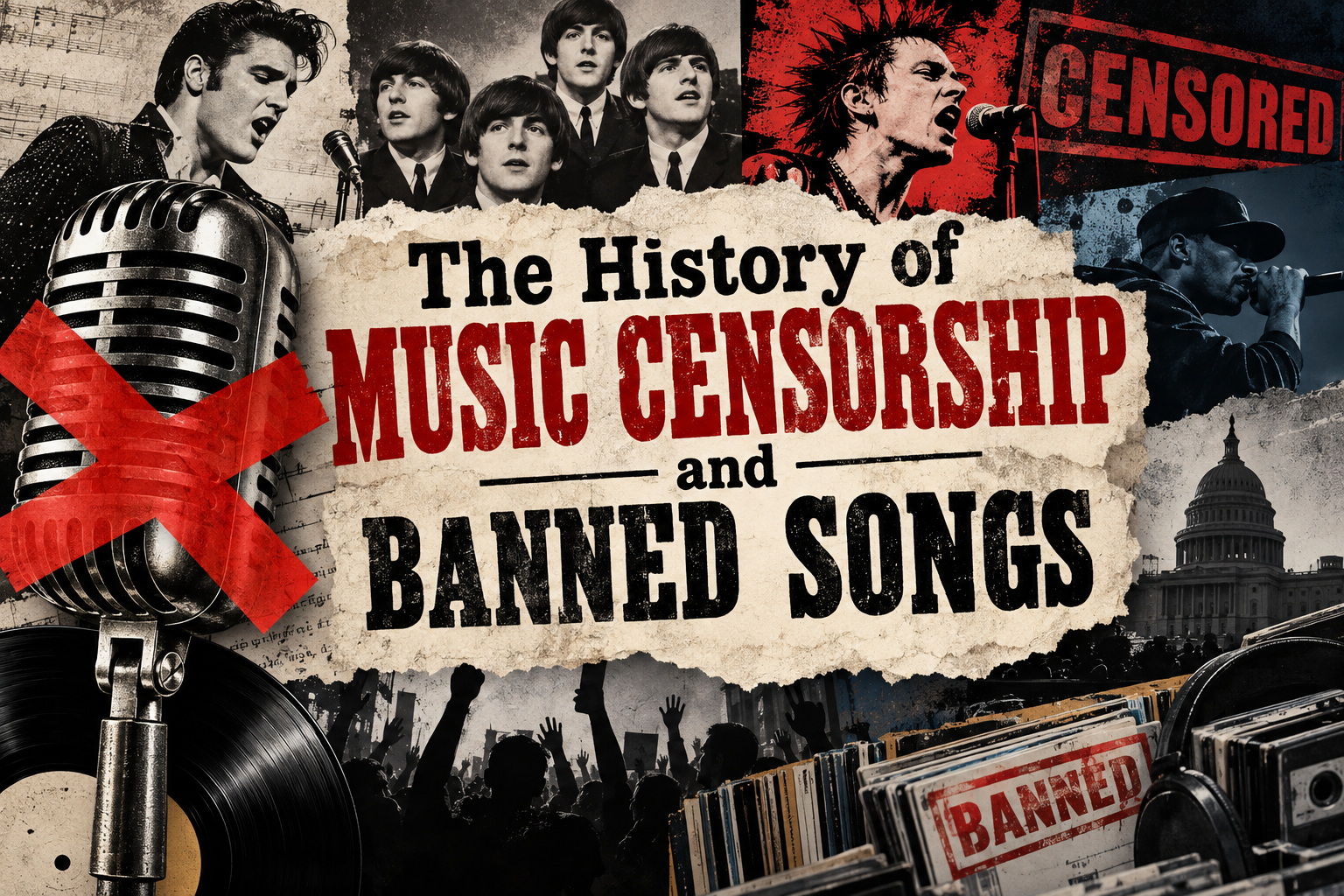
From Elvis Presley and the Beatles to punk rock, heavy metal, hip-hop, and the modern streaming era, the battle over music has always been about more than entertainment.
Music has a remarkable ability to make people uncomfortable. A three-minute recording can challenge a government, question religious beliefs, expose racial injustice, celebrate sexuality, or encourage an entire generation to reject the values of its parents. Throughout history, people in positions of authority have recognized that power and attempted to control what audiences could hear.
The history of music censorship stretches back thousands of years, long before the invention of radio, vinyl records, and electric guitars. Ancient philosophers worried that music could corrupt character. Religious authorities restricted musical practices they considered inappropriate. Governments suppressed songs associated with political opposition, while broadcasters refused recordings they believed might offend listeners or advertisers. As popular music became a global industry, the battle over acceptable expression grew into a recurring cultural conflict.
The arrival of rock and roll made the controversy impossible to ignore. Elvis Presley scandalized conservative audiences with his performances. The Beatles provoked an international religious controversy, while the Rolling Stones challenged conventional attitudes toward sexuality. Punk bands attacked political institutions, heavy metal musicians faced accusations of promoting dangerous behavior, and hip-hop artists found themselves at the center of debates about violence, race, and freedom of expression.
Some recordings were formally prohibited. Others were removed from radio playlists, edited for television, excluded from stores, or targeted by campaigns demanding that audiences stop listening. The methods differed, but the underlying struggle remained familiar: who gets to decide what people are allowed to hear?
The answers have changed with every generation. A recording condemned as dangerous in one decade can become a beloved classic in another. A song once considered too political for mainstream broadcasting can eventually become part of the historical record. Sometimes censorship destroys an artist’s opportunities. Other times, it makes the artist more famous.
Understanding music censorship therefore requires looking beyond the controversy surrounding individual recordings. It means examining the societies that produced them, the institutions that attempted to suppress them, and the audiences who decided whether those attempts deserved to succeed.
The Origins of Music Censorship
The belief that music can influence behavior is much older than the recording industry. Ancient Greek philosophers debated the moral effects of musical expression, arguing that different styles could encourage desirable or undesirable qualities in listeners.
Plato believed that music and poetry should be regulated as part of education in the ideal state. He argued that artistic expression helped shape character and that certain musical forms could undermine the discipline expected of responsible citizens. Aristotle also considered music’s influence on emotion and behavior, although his approach differed from Plato’s.
These arguments established a principle that would appear repeatedly throughout history: if music can influence how people think and behave, controlling music can become a way of controlling society.
Religious institutions later became major authorities over musical expression. During the medieval period, the Christian Church played a central role in European musical life, supporting composers and preserving traditions while also debating which musical practices were appropriate for worship.
The Protestant Reformation intensified those disagreements. Different religious movements challenged established practices and developed competing ideas about how music should be used in religious services. Some reformers supported congregational singing, while others opposed elaborate musical traditions they considered distracting or inappropriate.
Music could therefore become controversial because of what it represented rather than because of its sound alone. A hymn accepted by one religious community might be rejected by another. A musical tradition could symbolize devotion to one group and unacceptable beliefs to its rivals.
Political authorities eventually recognized the same potential. Governments promoted patriotic songs and military marches while discouraging music associated with rebellion or opposition. During revolutions, wars, and periods of political instability, songs could become symbols of competing loyalties.
The French Revolution demonstrated how music could become an instrument of political mobilization. La Marseillaise, written in 1792, became associated with revolutionary France and eventually developed into the country’s national anthem. Its history illustrates how the political meaning of a song can change as governments change.
Music that celebrates one administration may become uncomfortable when another takes power. A recording associated with resistance can become a national symbol after the movement it represents succeeds. The same song can be praised as patriotic by one generation and condemned as subversive by another.
The development of slavery and racial segregation in the United States introduced another dimension to music censorship. Enslaved African Americans created spirituals, work songs, and other musical traditions that preserved cultural memories, expressed religious beliefs, and communicated experiences of suffering and hope. Authorities sometimes restricted gatherings and forms of collective activity because they feared communication and organized resistance.
After emancipation, Black musicians continued transforming American culture through blues, jazz, gospel, rhythm and blues, and other musical traditions. Yet discrimination limited where they could perform, how their recordings were distributed, and which audiences they could reach.
Music could be welcomed when presented in a commercially acceptable form while the Black artists responsible for creating it continued to face exclusion. Some broadcasters avoided Black performers, and record companies sometimes favored cover versions by white musicians for mainstream audiences.
These restrictions were not always formal bans. Often, censorship operated through commercial and social barriers that determined whose music could be heard.
One of the most powerful examples was Billie Holiday’s 1939 recording of Strange Fruit. The song confronted racist lynching through stark imagery that forced audiences to face a subject many institutions preferred to avoid. Its importance came partly from its refusal to make the subject comfortable.
The recording encountered resistance because of its content and the discomfort it created. It demonstrated that a song could be controversial not because it invented a disturbing reality, but because it brought an existing injustice into public view.
The arrival of radio transformed these disputes. During the 1920s and 1930s, broadcasters gained enormous influence over popular music. A station could prevent a recording from reaching a large audience simply by refusing to play it.
Some restrictions involved sexual innuendo or language considered unsuitable for families. Others reflected racial prejudice, political concerns, or a desire to avoid offending advertisers. There was no single universal list of prohibited recordings, but individual stations and networks maintained their own standards.
During World War II, broadcasters also restricted songs they believed might undermine morale or conflict with the national mood. Britain’s BBC became known for its cautious approach to popular music, with policies that sometimes targeted material considered too sentimental, suggestive, or otherwise inappropriate for wartime audiences.
Radio established a pattern that would continue throughout the twentieth century. Music did not need to be illegal to be effectively censored. It only needed to be excluded from the platforms that controlled access to the public.
Rock and Roll, the Beatles, and the Cultural Revolution
The arrival of rock and roll during the 1950s transformed music censorship into a major generational conflict. The combination of rhythm and blues, country, gospel, and energetic performance created a sound that appealed to teenagers who increasingly wanted a culture of their own.
Rock and roll represented more than a new musical style. It challenged expectations about race, sexuality, youth independence, and commercial entertainment. Teenagers were buying records, attending concerts, and listening to radio programs that their parents often regarded with suspicion.
Elvis Presley became the most recognizable symbol of this revolution.
Presley’s music drew heavily from Black musical traditions, particularly blues and rhythm and blues, alongside country and gospel. His success brought elements of those traditions to a much larger white audience, although the racial inequalities of the music industry meant that Black artists who had developed similar sounds did not always receive comparable recognition or commercial rewards.
Presley’s stage presence created another controversy. His movements were considered sexually suggestive by some adults, and television appearances intensified arguments about what should be shown to young audiences. During his 1956 appearance on The Ed Sullivan Show, his performance became part of a national debate about whether his movements were appropriate for television.
The reaction helped transform Presley into a symbol of teenage rebellion. Adults who considered him vulgar or dangerous found themselves competing with young listeners who saw him as exciting, attractive, and independent.
The hostility was not limited to Presley. Chuck Berry, Little Richard, Bo Diddley, and other pioneers challenged musical and racial conventions through their performances. Their work helped establish the sound of modern rock, but their success unfolded within a society still deeply divided by segregation and racial prejudice.
Some critics claimed that rock and roll encouraged juvenile delinquency, sexual misconduct, and disrespect for authority. These accusations often reflected wider fears about changing youth culture rather than convincing evidence that particular recordings caused criminal behavior.
Radio stations sometimes refused to play rock and roll, while schools and community organizations discouraged it at dances and other events. The genre was never universally prohibited, but the controversy surrounding it was unmistakable.
The attempt to suppress rock and roll also created a commercial paradox. Every warning that the music was dangerous made it more attractive to teenagers curious about what their parents found objectionable. Records became symbols of independence, and the effort to control the music helped reinforce its identity as a rebellion against adult authority.
During the 1960s, the Beatles and the Rolling Stones brought these conflicts to an international audience. Their popularity made their public statements and performances extraordinarily influential, and their music became associated with a generation questioning traditional authority.
The Beatles initially became famous for catchy pop songs, energetic performances, and a public image that appealed to teenagers. As their music developed, however, they experimented with studio techniques, unconventional arrangements, and subjects that moved beyond straightforward love songs.
In 1966, John Lennon remarked that the Beatles were more popular than Jesus, commenting on the declining influence of organized Christianity among young people in Britain. When the statement received widespread publicity in the United States, it provoked outrage among some religious communities.
Radio stations announced boycotts, records were destroyed at public events, and religious leaders condemned the band. Lennon later clarified his remarks and expressed regret over the offense they had caused.
The controversy demonstrated how an artist’s public statements could lead to restrictions on the music itself. The Beatles had not released a recording attacking Christianity, yet their records became targets because of a remark by one member of the group.
The Rolling Stones encountered similar hostility, particularly over sexuality and rebellion. Their 1967 single Let’s Spend the Night Together was considered too suggestive for some broadcasters. When the band appeared on The Ed Sullivan Show, Mick Jagger reportedly altered the disputed wording to satisfy the program’s producers.
Their recording Street Fighting Man, released in 1968, encountered resistance from some American radio stations during a period of protests and political unrest. Its references to street confrontation made it particularly sensitive at a time when broadcasters were nervous about political agitation.
Meanwhile, musicians such as Bob Dylan, Joan Baez, and Pete Seeger connected music with civil rights, political dissent, and opposition to the Vietnam War. Their songs gave social movements a shared language and helped communicate ideas beyond traditional political speeches.
Seeger’s experience demonstrated that restrictions could extend beyond individual recordings. His political associations contributed to his blacklisting from major television appearances during the anti-communist climate of the 1950s. He faced scrutiny from the House Un-American Activities Committee and was convicted of contempt of Congress before his conviction was overturned on appeal.
The exclusion of a musician from major platforms could be as damaging as the banning of a particular song. Without access to radio or television, artists could lose opportunities to reach audiences and sustain their careers.
The counterculture of the 1960s also produced music that challenged conventional ideas about sexuality, religion, and drug use. The Doors encountered controversy when their 1967 appearance on The Ed Sullivan Show became a dispute over a phrase in Light My Fire that producers interpreted as a drug reference. Jim Morrison performed the original wording rather than making the requested change.
By the end of the decade, popular music had become inseparable from debates about political authority, racial equality, religion, and personal freedom. Censorship was no longer simply a question of whether a song contained an unacceptable word. It was increasingly about whether the ideas and attitudes expressed through music challenged the established social order.
Punk Rock, Heavy Metal, and the Fight Over Explicit Music
If the 1960s challenged traditional values, punk rock made confrontation part of its identity.
Emerging during the mid-1970s, punk rejected much of the polish and grandeur associated with mainstream rock. Its music was often fast, stripped down, aggressive, and deliberately provocative. Its fashion and public image emphasized rebellion, while its songs frequently attacked politicians, social conventions, and established institutions.
The Sex Pistols became the most notorious representatives of British punk.
Their 1977 single God Save the Queen was released during Queen Elizabeth II’s Silver Jubilee celebrations. Rather than celebrating the monarchy, the recording attacked the establishment and challenged conventional ideas about national loyalty.
The BBC excluded the song from its official playlists, and major commercial broadcasters also avoided it. The controversy helped make the recording one of the defining works of British punk.
The song’s history includes a long-running argument about its position on the British singles chart. Some accounts claim that its ranking was deliberately manipulated to prevent it from reaching number one, although the extent of any deliberate suppression remains disputed. The broadcasting restrictions themselves are better established.
The controversy demonstrated how political content could influence programming decisions, especially when a song challenged national institutions during a period of patriotic celebration.
Punk’s challenge extended beyond one recording. The Clash addressed unemployment, racism, social inequality, and political frustration. Their music presented a view of Britain that differed sharply from official celebrations of national identity.
At the same time, heavy metal attracted its own controversies. Its loud sound, dark imagery, theatrical performances, and frequent exploration of death, fantasy, violence, and the supernatural made it a target for critics concerned about youth culture.
During the 1980s, the United States experienced a moral panic surrounding Satanism and popular music. Some religious campaigners argued that heavy metal encouraged immoral behavior or concealed satanic messages. Bands such as Black Sabbath, Iron Maiden, Judas Priest, and W.A.S.P. became associated with debates about the influence of dark imagery on young listeners.
These accusations often confused artistic representation with real-world endorsement. A recording about demons or supernatural conflict did not necessarily indicate that its creator promoted satanism, just as a horror film did not automatically demonstrate that its director supported the actions of its villains.
Nevertheless, concerns about heavy metal contributed to efforts to restrict access to recordings and encourage stronger content warnings.
One of the most extraordinary controversies involved Judas Priest. In 1990, the band faced a civil lawsuit after two young men attempted suicide in 1985, resulting in one death and one survivor with serious injuries. The lawsuit alleged that subliminal messages in the band’s music had contributed to the incident.
The case focused partly on Better by You, Better Than Me, a song originally recorded by Spooky Tooth. Judas Priest denied that the recording contained the alleged messages, and the judge ultimately ruled in the band’s favor after finding that the evidence did not establish the claims.
The case demonstrated the difficulty of proving that a recording had directly caused a listener’s actions through hidden messages. It also showed how public fears about music could move from cultural criticism into the courtroom.
The controversy surrounding explicit music became even more significant in 1985, when the Parents Music Resource Center launched its campaign for stronger warnings on recordings.
The organization, commonly known as the PMRC, was founded by a group of women concerned about sexual references, violence, drug use, and other material appearing in commercially successful music. Tipper Gore, the wife of then-Senator Al Gore, became its most recognizable representative.
The PMRC argued that parents should be able to identify recordings containing material they considered inappropriate for children. Its campaign proposed warning labels and other measures intended to make explicit content easier to recognize.
Critics worried that the campaign would give political and commercial institutions new ways to restrict artistic expression. A label intended to inform consumers could become a reason for retailers to refuse to stock albums or for record companies to avoid controversial artists.
The PMRC compiled a list of fifteen recordings it considered especially objectionable. Known as the “Filthy Fifteen,” the list included music by Prince, Madonna, Twisted Sister, Mötley Crüe, and W.A.S.P.
The controversy culminated in a Senate hearing on September 19, 1985. Several musicians testified against the proposed approach, arguing that it threatened artistic freedom and relied on subjective judgments about the meaning of songs.
Frank Zappa was one of the most outspoken critics. He warned that a labeling system could encourage censorship through commercial pressure even without a formal government ban.
Dee Snider of Twisted Sister also challenged the campaign, arguing that critics had misinterpreted his band’s work and public image. He questioned the assumption that theatrical performance and fictional narratives demonstrated harmful intentions.
John Denver, whose public image differed considerably from that of many controversial rock musicians, also opposed the proposed restrictions. His participation demonstrated that concerns about censorship extended beyond a small group of performers.
The resulting agreement between the recording industry and the PMRC led to the familiar Parental Advisory label. Rather than creating a federal law banning explicit music, the industry adopted a voluntary warning system.
The label was intended to provide information to parents, but its effects were more complicated. Some retailers refused to stock labeled albums, while others restricted sales. Record companies and artists worried that the warning could affect distribution and commercial opportunities.
For some musicians, however, the label became a selling point. Teenagers who wanted music their parents disliked could interpret it as an invitation rather than a warning.
Prince’s Darling Nikki, which contains an explicit sexual reference, became one of the recordings associated with the controversy. The debate demonstrated that censorship did not always require a government to prohibit a recording. Classification, labeling, and commercial pressure could influence what audiences encountered just as powerfully as an official ban.
Hip-Hop, Political Backlash, and the Digital Age
Hip-hop became one of the most controversial musical genres of the late twentieth century, partly because it challenged mainstream audiences to confront subjects they often preferred to ignore.
Emerging from the Bronx during the 1970s, hip-hop developed through DJing, MCing, dance, graffiti, and community performance. As the genre expanded, its artists began addressing urban poverty, racism, police brutality, gang violence, sexuality, and political inequality.
Rap was never a single musical or political movement. Some recordings celebrated parties and everyday life, while others delivered social commentary or adopted deliberately provocative fictional personas. Treating the entire genre as a unified problem obscured the diversity of its artists and audiences.
Nevertheless, critics frequently accused rap of promoting violence, misogyny, drug use, and disrespect for authority. These arguments sometimes reflected genuine concerns about individual recordings, but they also overlapped with longstanding racial stereotypes about Black communities and urban culture.
N.W.A.’s F**k tha Police, released in 1988, became one of the defining controversies. The recording directly challenged police conduct and racial discrimination, using aggressive language to express anger toward law enforcement.
The song appeared at a time when concerns about police brutality and racial inequality were becoming increasingly visible. The FBI sent a letter to N.W.A.’s record company in 1989 criticizing the recording’s portrayal of police, making it a prominent example of conflict between law enforcement institutions and musicians challenging their authority.
The song faced resistance from broadcasters and other gatekeepers, yet it became one of the most influential recordings in hip-hop history.
Its significance lay partly in the disagreement over what it represented. Supporters viewed it as an expression of anger about police misconduct, while critics argued that it encouraged hostility toward law enforcement.
The controversy intensified in 1992 with Cop Killer by Body Count, the heavy metal band led by rapper Ice-T. The song presented a fictional narrator expressing rage toward police. Its release coincided with intense national debate about police brutality, including the beating of Rodney King and the subsequent acquittals of four officers in the state criminal trial.
Police organizations, politicians, and other critics condemned the recording. Supporters argued that it expressed frustration about police misconduct and should be understood within the context of racial conflict and public distrust.
The controversy placed considerable pressure on Warner Bros. Records, which distributed the album. Ice-T eventually agreed to remove Cop Killer from later editions in 1992.
The removal was not the result of a nationwide federal ban. It followed public pressure and commercial negotiations, demonstrating how a recording could disappear from distribution without a court declaring it illegal.
The controversy surrounding hip-hop also involved artists whose work explored the consequences of poverty, violence, and discrimination. Tupac Shakur’s music ranged from aggressive recordings to reflective works about social injustice, family, and personal vulnerability. Yet his public image and legal controversies often influenced how audiences interpreted his work.
During the 1990s, civil rights activist C. Delores Tucker became a prominent critic of explicit rap music. She argued that some recordings degraded women and harmed Black communities. Her campaign attracted support from people who believed that commercial entertainment could exploit marginalized communities by turning violent or misogynistic imagery into a profitable product.
Critics of the campaign worried that restrictions would disproportionately target Black artists and reinforce existing inequalities in the music industry.
These disagreements were not easily resolved. Defending artistic freedom did not require approving every recording, and criticizing a song did not automatically justify banning it.
Hip-hop’s history demonstrates why the distinction matters. Music can document social conditions, express anger, create fictional narratives, and provoke audiences at the same time. Censorship campaigns that ignore those distinctions risk silencing the very voices attempting to describe difficult realities.
Music censorship has also affected artists outside the United States and Britain. During the Cold War, Soviet authorities periodically restricted Western musical influences they considered ideologically undesirable. Jazz was criticized at various times as an expression of Western decadence, although Soviet musicians continued to perform and develop the genre.
Obtaining foreign recordings could be difficult, but informal distribution networks helped music circulate outside official channels. Some Soviet listeners copied recordings onto discarded X-ray film, creating inexpensive records known as bone music. The practice illustrated how people could find ways to access music even when conventional distribution was restricted.
In Iran, the cultural policies introduced after the 1979 Revolution brought significant restrictions on certain forms of popular music. Musicians have faced obstacles involving performance licenses, broadcasting, and public concerts, while women have encountered specific limitations on solo singing in some public settings. Nevertheless, Iranian artists have continued to create traditional, popular, electronic, and rock music, sometimes distributing their work through alternative channels or performing abroad.
China has also restricted songs, performers, and cultural material associated with politically sensitive subjects. Music connected with the 1989 Tiananmen Square protests exists within a broader environment in which public discussion of those events is heavily restricted.
South Africa under apartheid provides another example of censorship serving a system of racial oppression. Musicians who challenged segregation or became associated with opposition movements could face restrictions on their performances and recordings. Some continued their work overseas, helping draw international attention to the struggle against apartheid.
These examples demonstrate that the consequences of censorship depend heavily on the political environment. A broadcaster refusing a song because it contains explicit language is not equivalent to a government suppressing music associated with political dissent.
The internet appeared to offer a way around traditional gatekeepers. Artists could distribute recordings independently, share performances directly with fans, and reach international audiences without relying entirely on major record companies or radio stations.
However, streaming services and social media platforms have become powerful gatekeepers in their own right. A recording can be removed because of copyright disputes, licensing changes, or platform policies. Explicit content may be restricted by age settings, while recordings considered to violate rules about threats, hate speech, or other prohibited material can face removal or reduced visibility.
Digital censorship is not always obvious. A song may remain available while disappearing from recommendations, playlists, or other prominent areas of a service. That can make it harder for new listeners to discover the recording even though existing fans can still access it.
Automated moderation creates additional challenges. Computer systems can identify explicit words, but understanding context is more difficult. A recording criticizing racism may contain offensive language because it is describing racist abuse. A historical recording may include language that is unacceptable today but important to understanding its period.
The internet has made music easier to distribute, but it has not eliminated the struggle over who controls access to it.
The Lasting Legacy of Banned Music
One of the great ironies of music censorship is that the attempt to suppress a recording can make it more successful.
The Sex Pistols’ God Save the Queen became more notorious after its exclusion from BBC playlists. Frankie Goes to Hollywood benefited from the publicity surrounding the broadcasting ban on Relax. Prince’s Darling Nikki became part of a national debate that helped establish the significance of Purple Rain in discussions about explicit music.
In each case, the controversy created a story that extended beyond the recording itself. News organizations reported on the dispute, politicians and public figures weighed in, and listeners argued about whether the song deserved to be restricted.
For teenagers, the forbidden record can become a symbol of independence. If adults declare a particular band dangerous, listening to that band may become a way of asserting individuality.
The music industry has often benefited from this effect. A recording condemned by a politician can attract new buyers, while a warning label may make a recording more appealing to people who enjoy challenging conventional expectations.
Controversy does not always benefit an artist, however. A musician can lose important distribution opportunities, and an emerging performer may lack the resources or audience needed to survive exclusion. Censorship can increase sales, but it can also reduce exposure, damage careers, and prevent audiences from discovering new work.
The consequences depend on the circumstances.
The history of banned music also raises an important question about what censorship actually means. A government prohibiting a recording, a radio station declining to play it, a retailer refusing to stock it, and an artist deciding to stop performing it are different situations.
Government censorship involves public authority restricting expression through laws, official orders, licensing rules, or other state powers. Commercial exclusion occurs when record companies, retailers, advertisers, or distributors refuse to support a recording. Social campaigns attempt to persuade institutions or audiences to stop supporting an artist.
These categories can overlap, but they should not be treated as interchangeable.
A private broadcaster may have legitimate reasons to exclude explicit content from a family-oriented program. A retailer may choose which products to sell. An audience has the right to criticize a musician or stop buying that musician’s records.
The concern arises when coordinated pressure effectively prevents an artist from reaching the public, particularly when the target is political criticism or the expression of an unpopular viewpoint.
In the United States, the First Amendment generally limits government interference with speech; it does not require every private company to distribute every recording. That distinction is important when evaluating claims about censorship.
Nevertheless, private decisions can have enormous cultural consequences when a small number of broadcasters or platforms dominate distribution. A recording that is technically available but rarely recommended may have difficulty reaching a large audience.
It is also important to distinguish between portraying an action and encouraging it. A fictional narrative about violence does not automatically endorse violence. A recording that depicts racism may use offensive language to criticize the behavior it describes.
Artistic freedom does not make every recording immune from criticism. Listeners can reasonably object to hateful, degrading, or exploitative material without demanding that the government prohibit it.
A society can defend freedom of expression while allowing vigorous debate about the consequences of artistic choices.
The future of music censorship will be shaped by technology, international politics, and changing expectations about public expression. Artificial intelligence, automated moderation, and increasingly sophisticated recommendation systems are creating new ways to classify and restrict musical material.
A platform might identify explicit language automatically, restrict a recording according to a user’s age, or remove content based on an interpretation of its meaning. These systems can make moderation faster, but they can also produce mistakes.
The international nature of digital distribution creates additional complications. A recording permitted in one country may violate the laws of another. Platforms may respond by restricting access in specific regions, removing recordings globally, or changing how content is presented.
Artists can therefore encounter multiple systems of censorship at once: government restrictions, platform rules, licensing agreements, advertiser expectations, and public campaigns.
The technology will continue changing, but the central question will remain familiar. Who controls access to music? What standards should govern that access? How much power should governments, businesses, and advocacy groups have over the material other people can hear?
Music censorship is ultimately a history of changing fears. Ancient philosophers worried that music could corrupt character. Religious authorities tried to protect established beliefs. Governments suppressed songs associated with rebellion, while broadcasters attempted to regulate sexuality, political criticism, and other subjects considered inappropriate. Parents worried about rock and roll, heavy metal, and explicit recordings. Modern platforms face similar questions about which recordings should remain available and how audiences should encounter them.
The targets have changed, but the underlying struggle remains familiar. Music can challenge authority, preserve uncomfortable memories, expose injustice, and give people a shared language for experiences they might otherwise struggle to express.
Billie Holiday’s Strange Fruit confronted audiences with the reality of racist violence. The Sex Pistols’ God Save the Queen attacked the British establishment during a national celebration. N.W.A.’s F**k tha Police expressed anger about police conduct and racial inequality. Each recording provoked controversy because it challenged the way some people understood their society.
These songs did not resolve the conflicts that inspired them. They made those conflicts harder to ignore.
There is no guarantee that censorship will backfire. Sometimes a ban generates publicity and turns a recording into a symbol of resistance. Other times, restrictions can damage careers and prevent important work from reaching an audience.
The most important lesson is that a difficult song does not have to be celebrated simply because somebody tried to ban it. But neither should it be dismissed without consideration of what it says, the circumstances in which it was created, and the reasons people wanted it silenced.
Music has always been more than entertainment. It is a means of communication, a form of cultural memory, a source of identity, and sometimes a challenge to power. Those qualities make it valuable, but they also make it vulnerable to censorship.
The history of banned songs is not just a catalog of recordings that offended someone. It is a history of artists pushing boundaries, audiences arguing over meaning, and institutions struggling to determine how much freedom they are willing to tolerate.
Every generation has its own list of unacceptable songs. Some are considered too sexual, others too violent, too political, too religious, too offensive, or too challenging to established authority. Many eventually become familiar classics, while others remain controversial long after their release.
The passage of time does not automatically make every recording admirable. What it can do is allow society to examine the original arguments more clearly and understand why certain works provoked such strong reactions.
Whenever a song makes powerful people uncomfortable, the same question returns: is the music itself the problem, or is it saying something that somebody would rather not hear?
This post has already been read 14 times!