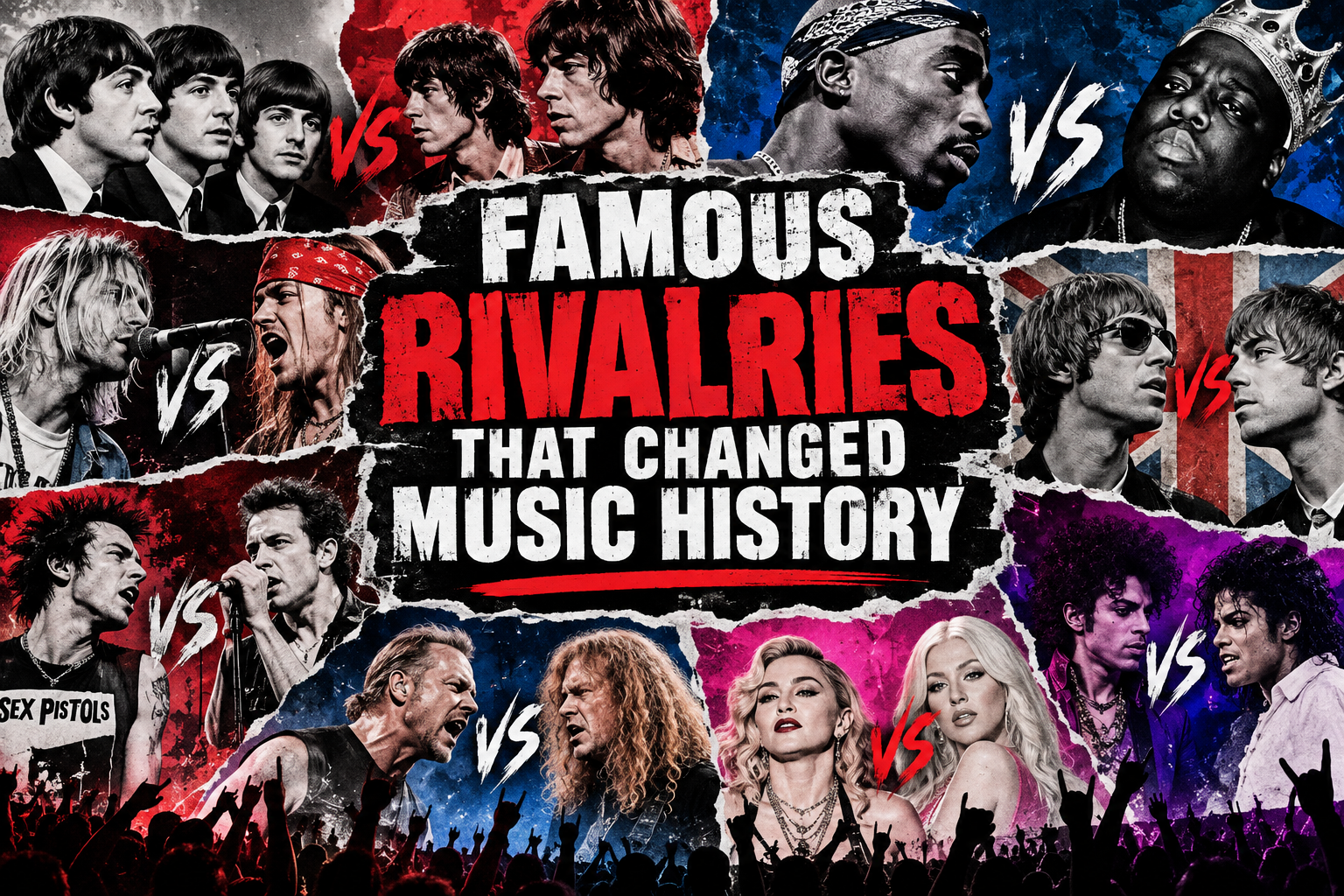
Music history is full of rivalries.
Some were carefully manufactured by record companies. Some were fueled by gigantic egos, bruised friendships, competitive ambition, or plain old resentment. Others grew naturally from two artists trying to prove that their version of music was the one that mattered. A few were mostly harmless competition. Others became genuinely ugly.
But the most interesting rivalries did something much bigger than generate headlines.
They changed music.
Sometimes a rivalry pushed two artists to make better records. Sometimes it created an entirely new sound. Sometimes it divided an audience so completely that fans began treating musical taste like a political affiliation. In other cases, competition between artists helped create entire scenes, from punk and hip-hop to heavy metal and alternative rock.
The history of popular music might have unfolded very differently without some of these battles.
The Beatles and the Rolling Stones helped define the British Invasion while being constantly compared with each other. The Beach Boys and the Beatles pushed one another into increasingly ambitious studio experimentation. Tupac Shakur and The Notorious B.I.G. became the faces of a feud that represented a much larger East Coast-West Coast divide. Blur and Oasis turned British rock into a national sporting event. Metallica and Megadeth grew out of one particularly bitter breakup. Nirvana and Guns N’ Roses represented dramatically different ideas about what rock music should be in the early 1990s.
Some rivalries involved two people who couldn’t stand each other.
Others involved artists who actually respected one another enormously.
And some of the greatest rivalries weren’t even personal. They were battles over what music itself should become.
Here are some of the most famous rivalries that changed music history.
The Beatles vs. The Rolling Stones
If you wanted to explain the British Invasion to someone who knew absolutely nothing about it, you could start with two bands: The Beatles and The Rolling Stones.
They weren’t exactly enemies. In fact, members of the two groups were friends, collaborators, and supporters of each other’s music. But the public quickly turned them into rivals.
The Beatles were the polished, charismatic four-piece from Liverpool who became international superstars almost overnight. The Rolling Stones were marketed as something different: rougher, darker, more rebellious and more dangerous.
The contrast was irresistible.
The Beatles were the band your parents might tolerate.
The Stones were the band your parents worried about.
That distinction became enormously important because rock music was still figuring out what it was supposed to represent.
The Beatles initially arrived as an explosion of youthful energy, but their image was relatively clean. Matching suits, television appearances, clever humor and infectious pop songs made them accessible to an enormous audience.
The Stones leaned into danger.
Their appearance, attitude and blues-based music made them seem like the anti-Beatles. Where the Beatles represented one vision of British pop stardom, the Stones represented another: sexier, nastier and more rooted in American blues and R&B.
The rivalry helped create a larger marketplace for rock music.
Suddenly, being a young music fan wasn’t simply about liking music. It was about identifying with a band.
Beatles fans could be Beatles fans.
Stones fans could be Stones fans.
And music journalism could endlessly debate which group mattered more.
The competition also helped push both bands creatively.
The Beatles became increasingly adventurous in the studio. The Stones became more confident in developing their own identity. By the late 1960s, both groups had moved far beyond their original images.
The Beatles produced increasingly experimental albums such as Rubber Soul, Revolver, Sgt. Pepper’s Lonely Hearts Club Band and The White Album.
The Stones responded with records such as Beggars Banquet, Let It Bleed, Sticky Fingers and Exile on Main St.
The rivalry wasn’t necessarily about beating the other band to a number-one record.
It was about proving that your version of rock music had greater staying power.
And that competition helped establish something that would become fundamental to popular music: artists could evolve publicly while their audiences followed every move.
The Beatles and Stones didn’t destroy each other.
They made each other more important.
The Beatles vs. The Beach Boys
This rivalry is particularly fascinating because it was driven less by hostility than admiration.
Brian Wilson was fascinated by what The Beatles were doing.
The Beatles were fascinated by what Brian Wilson and The Beach Boys were doing.
And the result was one of the most important creative competitions in popular music.
When Rubber Soul arrived in 1965, Wilson heard something that changed his understanding of what a pop album could be.
Instead of thinking about individual singles, he began thinking about the album as a unified artistic statement.
The response was Pet Sounds.
Released in 1966, it was radically more ambitious than the Beach Boys’ earlier surf-pop material. It used unusual instruments, elaborate arrangements, sophisticated vocal harmonies and studio techniques that made the record sound unlike conventional pop.
The Beatles heard it.
Paul McCartney in particular was deeply impressed.
The Beatles responded with Sgt. Pepper’s Lonely Hearts Club Band, which pushed the album concept even further.
And then the cycle continued.
The two camps were effectively challenging each other without openly declaring war.
What made the rivalry historically important was the way it changed the expectations placed on popular musicians.
Before this period, a pop album could contain a collection of songs designed primarily to support singles.
Afterward, the album increasingly became an artistic canvas.
Musicians could experiment with sequencing, production, unusual instrumentation, sound effects, orchestration and extended concepts.
The recording studio became part of the instrument.
That development influenced virtually everything that followed, from progressive rock to psychedelic music, art rock, electronic music and eventually hip-hop production.
There is an irony here.
The rivalry that helped produce some of the most innovative music of the 1960s wasn’t really a fight.
It was two groups of musicians hearing what the other had done and thinking:
“Okay. We can do that too.”
Then they tried to do it better.
That may be the healthiest kind of rivalry in music.
The Beatles vs. Themselves
Sometimes the most important rivalries aren’t between artists.
They’re between the artist you were and the artist you want to become.
The Beatles provide one of the clearest examples.
The group that recorded “Love Me Do” in 1962 was almost unrecognizable compared with the musicians who created Abbey Road seven years later.
They constantly challenged their own previous achievements.
Every successful record created a new problem:
How do we follow this?
That internal competition helped accelerate the development of rock music.
Please Please Me established them as a major pop act.
With the Beatles expanded the formula.
A Hard Day’s Night demonstrated that they could write an enormous percentage of their own material.
Rubber Soul moved toward greater maturity.
Revolver expanded their studio vocabulary.
Sgt. Pepper transformed the idea of the rock album.
Then came The White Album, Abbey Road and Let It Be.
Each stage forced other musicians to reconsider what was possible.
The Beatles effectively competed against their own reputation.
That is an important reason their influence became so enormous.
They didn’t settle for repeating the thing that had worked six months earlier.
Motown vs. Stax
Not every great musical rivalry involved famous individual performers.
One of the most important battles of the 1960s and early 1970s was between two record labels: Motown and Stax.
Motown, based in Detroit, had developed an extraordinarily successful approach to soul music.
The label’s records were polished, tightly arranged and built for crossover success. Artists such as Marvin Gaye, The Supremes, The Temptations, Stevie Wonder and The Four Tops became major stars.
Stax, based in Memphis, had a different feel.
Its records were deeply rooted in Southern soul, gospel, blues and R&B.
Otis Redding, Booker T. & the M.G.’s, Sam & Dave, Isaac Hayes and many others helped establish the Stax sound.
The competition gave soul music multiple directions.
There wasn’t one definition of what successful Black popular music had to sound like.
Detroit had one approach.
Memphis had another.
And audiences could hear the difference.
The rivalry also demonstrated the importance of the musicians behind the singers.
At Stax, the house band became an essential part of the label’s identity. At Motown, the Funk Brothers provided an extraordinary musical foundation behind countless recordings.
The competition between the labels helped create a golden age for soul music.
More importantly, both companies demonstrated that Black artists could become major commercial forces without abandoning the musical traditions from which they came.
Their influence extended directly into funk, disco, R&B, rock and eventually hip-hop sampling culture.
Led Zeppelin vs. Black Sabbath
The rivalry between Led Zeppelin and Black Sabbath was never as bitter as some later rock conflicts, but the comparison between them helped shape the development of heavy metal.
Both bands emerged from Britain around the same period.
Both relied heavily on massive guitar riffs.
Both pushed rock toward greater heaviness.
But they approached that heaviness differently.
Led Zeppelin could be bluesy, acoustic, psychedelic, funky and experimental. Jimmy Page was interested in dynamics as much as sheer volume.
Black Sabbath went somewhere darker.
Tony Iommi’s guitar sound, Geezer Butler’s bass lines, Bill Ward’s drumming and Ozzy Osbourne’s voice created a combination that sounded ominous and unusually heavy.
As the 1970s progressed, fans and critics began debating which band represented the future of hard rock.
Led Zeppelin became enormous.
Black Sabbath became enormously influential.
That distinction matters.
Led Zeppelin influenced generations of rock bands through songwriting, production and musicianship.
Black Sabbath helped provide the blueprint for heavy metal itself.
The rivalry between their reputations helped establish the idea that rock could become dramatically heavier without losing its identity.
That opened the door for Judas Priest, Iron Maiden, Motörhead, Metallica, Slayer, Megadeth and countless others.
The Clash vs. The Sex Pistols
British punk was never simply one unified movement.
The Sex Pistols represented one version of punk: confrontation, provocation, chaos and an almost deliberate rejection of conventional musicianship.
The Clash represented another.
They were political, ambitious and musically curious. Their records incorporated reggae, dub, rockabilly, funk and other influences.
The two groups became symbols of different philosophies.
The Sex Pistols seemed to say:
Destroy the old system.
The Clash increasingly seemed to say:
Take the energy of punk and use it to build something new.
That distinction became enormously important.
If punk had remained limited to three chords, fast tempos and deliberately crude recordings, its influence might have been considerably smaller.
Instead, punk became a gateway.
Musicians discovered they didn’t need permission to experiment.
The Clash demonstrated that a punk band could make a sprawling double album and still maintain punk credibility.
That idea influenced alternative rock, post-punk, hardcore, ska revival, indie rock and eventually much of modern guitar music.
The Sex Pistols helped light the match.
The Clash showed how far the fire could spread.
The Clash vs. The Ramones
This was less of a personal feud and more of a battle between different versions of punk.
The Ramones took the idea of stripping rock down to its essentials and turned it into something brutally efficient.
Fast songs.
Simple structures.
Short running times.
No unnecessary decoration.
The Clash took a broader approach.
Their music increasingly incorporated reggae, dub, funk, soul and political songwriting.
Both approaches became enormously influential.
The Ramones provided a blueprint for punk’s stripped-down side.
The Clash demonstrated that punk could absorb almost anything.
The rivalry helped establish one of punk’s defining characteristics: there was no single way to do it.
You could be minimal.
You could be political.
You could be melodic.
You could be abrasive.
You could be experimental.
That flexibility is one reason punk survived long after its original explosion.
David Bowie vs. Himself
David Bowie constantly reinvented himself, and each new version of Bowie effectively competed against the previous one.
There was the folk-influenced early Bowie.
Then Ziggy Stardust.
Then the Thin White Duke.
Then the Berlin period.
Then the pop superstar.
Then the industrial-influenced Bowie of the 1990s.
Then the late-career artist who returned with The Next Day and Blackstar.
Bowie’s career demonstrated that an artist didn’t have to remain trapped inside a successful identity.
That idea became enormously influential.
Madonna adopted constant reinvention as a central part of her career.
Prince changed styles constantly.
Lady Gaga built entire eras around different visual and musical identities.
Hip-hop artists later embraced distinct eras and personas in ways that would have been difficult to imagine in earlier decades.
Bowie’s greatest rival wasn’t another musician.
It was boredom.
Punk vs. Disco
This wasn’t a rivalry between two bands.
It was a cultural argument.
By the late 1970s, punk rock and disco represented dramatically different sides of popular music.
Punk emphasized rawness, rebellion and rejection of mainstream excess.
Disco emphasized dancing, production, nightlife and elaborate studio craftsmanship.
Their audiences could seem completely incompatible.
The famous “Disco Demolition Night” in Chicago in 1979 became one of the most notorious moments in the conflict.
A promotion involving the destruction of disco records spiraled into a stadium disturbance.
The event became a symbol of the backlash against disco.
But the story is more complicated than simply “rock defeated disco.”
Disco’s influence didn’t disappear.
It moved into pop, dance music, electronic music, house, hip-hop production and countless other genres.
Punk didn’t disappear either.
It splintered into hardcore, post-punk, new wave, alternative rock and indie music.
In the long run, both sides won.
And popular music became more fragmented and diverse because of it.
New Wave vs. Punk
As the 1970s ended, another rivalry developed.
What happened when punk musicians became better musicians?
Some wanted to remain raw.
Others wanted synthesizers.
Others wanted pop melodies.
Others wanted dance rhythms.
The result was new wave.
Bands such as Talking Heads, Blondie, Devo, The Cars and many others demonstrated that the energy of punk could be transformed into something more sophisticated.
The debate was inevitable.
Was this evolution?
Or had punk sold out?
That argument has existed in music ever since.
Every time a rebellious genre becomes successful, somebody asks whether it has lost its original purpose.
New wave’s success helped break down the walls between rock, pop, electronic music and dance music.
That eventually became one of the defining characteristics of the 1980s.
Metallica vs. Megadeth
Few famous band rivalries have such a clear origin story.
Dave Mustaine was a member of Metallica.
He was fired from the band in 1983.
He returned home angry and determined to form a band that could compete with his former group.
That band became Megadeth.
The rivalry was born.
For years, Metallica and Megadeth were constantly compared.
Metallica became the bigger band.
Megadeth developed its own reputation for technical playing, complicated songwriting and Dave Mustaine’s distinctive approach to thrash metal.
The competition helped fuel one of the greatest periods in heavy metal.
Metallica released Ride the Lightning, Master of Puppets and …And Justice for All.
Megadeth released Peace Sells… But Who’s Buying?, So Far, So Good… So What!, Rust in Peace and Countdown to Extinction.
The rivalry was particularly significant because both bands helped move thrash metal from an underground phenomenon toward international prominence.
Metallica eventually became one of the biggest rock bands on Earth.
Megadeth became one of the defining technical forces in metal.
The argument over which band was better lasted decades.
But without the rivalry, both careers might have looked very different.
Mustaine’s desire to prove himself became a powerful creative force.
Sometimes resentment makes surprisingly effective fuel.
Van Halen vs. David Lee Roth vs. Sammy Hagar
This rivalry was really several rivalries stacked on top of each other.
First there was the internal conflict between Eddie Van Halen and David Lee Roth.
Then Roth left.
Sammy Hagar joined.
Then Hagar left.
Roth returned.
Hagar returned.
The band became almost a case study in how fans can become emotionally attached to different eras of the same group.
Roth represented the outrageous, party-oriented version of Van Halen.
Hagar represented a more polished, arena-rock version.
Fans argued endlessly about which era was superior.
The fascinating part was that both eras were successful.
The original lineup produced some of the most influential hard rock of the late 1970s and early 1980s.
The Hagar era produced major commercial successes such as 5150 and OU812.
The rivalry demonstrated how much a singer can change the perceived identity of a band.
It also created one of rock’s enduring debates:
Can a band be the same band when its defining singer changes?
Run-D.M.C. vs. The Beastie Boys
This rivalry wasn’t particularly hostile, but it represented two paths for hip-hop’s expansion into mainstream culture.
Run-D.M.C. helped establish rap as a commercial force.
They brought hip-hop into rock audiences through collaborations and performances that made the genre impossible to ignore.
The Beastie Boys came from a punk background and initially approached hip-hop with an irreverent, chaotic energy.
Both groups helped expand the audience.
But they represented different cultural approaches.
Run-D.M.C. presented hip-hop as a serious musical and cultural movement.
The Beastie Boys demonstrated how hip-hop could absorb punk, rock and alternative influences while becoming something completely new.
Their success helped make hip-hop increasingly impossible for the mainstream music industry to dismiss.
Public Enemy vs. N.W.A.
The late 1980s produced two enormously influential visions of politically charged hip-hop.
Public Enemy emerged from New York with dense production, confrontational political commentary and a sound built around layers of samples and aggressive production.
N.W.A. emerged from Compton with a radically different perspective.
Their music reflected the realities of life in Los Angeles and the relationship between Black communities and law enforcement.
Both groups were controversial.
Both attracted enormous attention.
Both forced mainstream audiences to confront subjects that many radio stations and record companies would have preferred to avoid.
The rivalry between their approaches helped demonstrate the geographic diversity of hip-hop.
New York had one sound.
Los Angeles had another.
And neither city had to imitate the other.
That competition helped establish regional identity as one of the most important elements of hip-hop.
The East Coast vs. West Coast Hip-Hop Rivalry
No rivalry in modern music became more famous, more destructive or more consequential than the East Coast-West Coast hip-hop conflict of the 1990s.
At its center were two artists:
Tupac Shakur and The Notorious B.I.G.
But the conflict was never simply about them.
It involved record labels, producers, radio stations, magazines, entourages, regional pride and a growing sense that New York and Los Angeles represented competing centers of hip-hop power.
Tupac had become one of the most famous rappers in America.
The Notorious B.I.G. was emerging as the dominant voice of New York hip-hop.
Their relationship began with mutual respect.
Then it collapsed.
After Tupac was shot in New York in 1994, he believed people associated with Biggie’s circle knew more about the attack than they admitted.
That suspicion became one of the central sparks of the feud.
Tupac’s subsequent attacks on Biggie and Bad Boy Records intensified the conflict.
The media amplified everything.
Radio stations played the records.
Magazines covered every insult.
Fans picked sides.
The conflict became a feedback loop.
The more intense the music became, the more attention it received.
The more attention it received, the more pressure there was to respond.
It eventually became catastrophic.
Tupac was murdered in Las Vegas in September 1996.
Biggie was murdered in Los Angeles six months later.
Neither murder was ever definitively resolved in court.
The deaths transformed the rivalry from a music-industry feud into one of the darkest chapters in popular music.
But the musical consequences were enormous.
Hip-hop became even more commercially powerful.
The public became fascinated with rap culture.
West Coast and East Coast styles were treated as separate musical identities.
Southern hip-hop began gaining greater prominence soon afterward.
The rivalry also demonstrated the dangers of turning competition into an ecosystem where artists, media and audiences constantly reward escalation.
The music benefited commercially.
The people involved paid an enormous price.
Tupac vs. Biggie: Two Different Kinds of Superstar
Tupac and Biggie are often grouped together because they died so close together.
But their artistic approaches were very different.
Tupac was extraordinarily emotional and direct.
His music could move from political commentary to personal vulnerability to anger within the same project.
Biggie was known for extraordinary flow, humor, storytelling and technical control.
He could make brutality sound cinematic and then turn around and deliver something playful.
Their rivalry worked because both represented something believable.
Tupac sounded like a person who wanted to change the world while wrestling with himself.
Biggie sounded like someone who understood the absurdity, danger and ambition of his environment.
Their competition helped establish the idea that hip-hop could support multiple definitions of greatness.
One didn’t have to sound like the other.
Oasis vs. Blur
If there was ever a rivalry designed for British tabloids, this was it.
Oasis and Blur emerged from different sides of British alternative rock.
Blur were already established when Oasis began exploding in popularity.
The two groups represented different images of Britain.
Blur could be witty, artful and deliberately British.
Oasis embraced the mythology of rock stardom.
The Gallagher brothers were loud, arrogant, funny and completely willing to say exactly what they thought about Blur.
The media loved it.
The rivalry reached its famous peak when Blur’s “Country House” and Oasis’ “Roll with It” were released as competing singles on the same week in 1995.
The result became a national conversation.
People who had never previously cared about British alternative rock suddenly had an opinion.
The battle was about more than two songs.
It represented two competing visions of British music.
Blur won the chart battle.
Oasis eventually became the bigger global phenomenon.
And Britpop became one of the defining cultural movements of 1990s Britain.
The rivalry helped turn guitar music into a mainstream cultural event.
For a while, buying a single felt like participating in a sporting competition.
Oasis vs. Oasis
The Gallagher brothers deserve their own category.
No external rival was required.
Liam and Noel Gallagher could create enough conflict for several bands.
Their relationship became one of rock’s most entertaining and frustrating family dynamics.
Noel was the primary songwriter.
Liam was the frontman.
Both were essential.
Both knew it.
Both knew the other knew it.
That combination produced incredible music and enormous instability.
The internal rivalry contributed to the mythology of Oasis.
It also demonstrated the strange relationship between dysfunction and creativity.
Sometimes conflict destroys a band.
Sometimes it creates an energy that becomes part of the band’s identity.
Oasis eventually became impossible to sustain.
But their influence remained.
Nirvana vs. Guns N’ Roses
This was one of the most revealing musical contrasts of the early 1990s.
Guns N’ Roses represented the enormous, decadent, technically polished world of late-1980s hard rock.
Nirvana represented something almost completely different.
Their success made the older rock establishment look increasingly out of touch.
Axl Rose reportedly disliked Kurt Cobain’s music and image.
Cobain, meanwhile, had little interest in the arena-rock culture represented by Guns N’ Roses.
The conflict became symbolic.
Hair metal was fading.
Grunge was exploding.
The music industry suddenly wanted flannel shirts instead of leather pants.
The guitar solo was no longer automatically considered cool.
Songs became darker, stranger and less polished.
The rivalry wasn’t responsible for the collapse of glam metal by itself.
The musical culture was already changing.
But Nirvana’s rise made the transition impossible to ignore.
Guns N’ Roses had represented one endpoint of rock stardom.
Nirvana represented a reaction against it.
The industry quickly learned that the next generation didn’t necessarily want rock stars who looked like rock stars.
Metallica vs. Napster
This was one of the most important artist-versus-technology battles in modern music.
In 2000, Metallica discovered that an unreleased demo of “I Disappear” was circulating through Napster.
The band responded aggressively.
They sued Napster and became one of the most visible opponents of peer-to-peer file sharing.
Many fans turned against Metallica.
To younger listeners, the argument often seemed bizarre.
Why were enormously wealthy musicians fighting people over downloading songs?
But the underlying issue was serious.
Digital technology had changed the economics of music almost overnight.
The record industry had built a business around physical objects.
Napster demonstrated that music could be copied and distributed globally without a physical product.
Metallica’s battle didn’t stop file sharing.
Nothing could.
But it forced the industry to confront a technological shift it had largely ignored.
Within a few years, digital downloads became central to music distribution.
Then streaming arrived.
Then playlists.
Then subscription services.
The physical album ceased being the center of the music economy.
Metallica didn’t cause that transformation.
They became one of its most visible opponents.
The irony is that their fight helped make the digital music revolution impossible to ignore.
Britney Spears vs. Christina Aguilera
The music industry loves creating rivalries between women.
Britney Spears and Christina Aguilera became two of the biggest examples of the late 1990s and early 2000s.
Both emerged from The Mickey Mouse Club.
Both became major pop stars.
Both were young.
Both were blonde.
The media immediately compared them.
Britney was presented as the pop phenomenon.
Christina was presented as the powerhouse vocalist.
The comparison became almost absurdly simplistic.
One was supposedly the performer.
The other was supposedly the singer.
But both eventually demonstrated that they were more complicated artists than the early marketing suggested.
The rivalry helped expose one of pop music’s recurring problems: the tendency to place female artists into artificial categories and encourage fans to choose between them.
Later generations of artists pushed back against that model.
The idea that there must be only one successful female pop star at a time became increasingly difficult to maintain.
Madonna vs. Cyndi Lauper
Another rivalry of the 1980s involved two women who represented very different approaches to pop stardom.
Madonna became associated with reinvention, sexuality, controversy and control over her image.
Cyndi Lauper brought theatricality, eccentric fashion, powerful vocals and a playful personality.
The comparison was inevitable.
But again, both artists demonstrated that female pop stars could occupy very different identities and still become major successes.
Madonna’s career became a masterclass in reinvention.
Lauper’s influence extended into pop, rock, musical theater and fashion.
Their competition helped establish the 1980s as a period when the visual identity of a pop artist became almost as important as the music.
Madonna vs. Prince
Madonna and Prince weren’t exactly traditional rivals.
But their careers overlapped in ways that encouraged constant comparison.
Both understood that pop music could be a combination of sound, image, sexuality, fashion and controversy.
Both challenged conventional ideas about gender and performance.
Both maintained enormous creative control.
Prince was more musically prolific and instrumentally involved.
Madonna became one of the most effective architects of the modern pop-star persona.
Their parallel careers helped redefine what a superstar could be.
The rivalry was less about who sold more records and more about who could continually redefine the boundaries of mainstream pop.
Michael Jackson vs. Prince
This was one of the great “what if they had collaborated more?” rivalries.
Michael Jackson was the biggest pop star on Earth.
Prince was one of the most prolific and musically adventurous artists alive.
They represented different kinds of genius.
Jackson was a master of performance, choreography, vocal arrangement and blockbuster production.
Prince was a multi-instrumentalist, songwriter, producer and studio obsessive who could move between funk, rock, pop, soul and experimental music.
They competed for cultural dominance during the 1980s.
Jackson’s Thriller became a phenomenon unlike anything pop music had previously experienced.
Prince responded with Purple Rain, a record and film that established him as a superstar capable of competing at the highest level.
The rivalry demonstrated that there wasn’t one formula for becoming an enormous artist.
You could build a massive production around yourself.
Or you could play nearly every instrument yourself.
You could become a polished pop icon.
Or a mysterious musical eccentric.
Both approaches worked.
The Kinks vs. The Who
The rivalry between The Kinks and The Who represented another important chapter in British rock.
Both bands were associated with the mod scene.
Both were loud.
Both had aggressive personalities.
Both became known for explosive live performances.
The Who eventually became one of the defining arena-rock bands of the 1970s.
The Kinks developed a more distinctly English songwriting style, especially through Ray Davies’ observational writing.
The rivalry helped demonstrate that British rock could develop beyond the blues imitation of its earliest years.
The music became increasingly about British identity itself.
The Beatles vs. The Monkees
This one sounds strange today.
The Beatles were arguably the biggest band in the world.
The Monkees were assembled for a television show.
Yet the Monkees became enormously successful, and their popularity raised serious questions about what a rock band was supposed to be.
Were they a legitimate musical group?
Did they write enough of their own material?
Did appearing on television make them less authentic?
The debate became part of the larger 1960s argument about authenticity.
The Monkees eventually became much more involved in their own music.
The controversy helped establish a distinction that would become increasingly important in rock:
Were musicians entertainers, artists, or both?
That question continues today.
The Beatles vs. The Establishment
There was also a much broader rivalry happening throughout the 1960s.
Young musicians were increasingly challenging the traditions of the music industry.
Artists wanted more control over their recordings.
Songwriters wanted recognition.
Albums became more important.
The idea of the singer simply showing up, recording material selected by producers and going home was increasingly outdated.
The Beatles were among the artists who helped destroy that model.
Their success demonstrated that musicians could become creative directors of their own careers.
That changed the balance of power between performers and record companies.
Hip-Hop’s Battle for the Crown: Jay-Z vs. Nas
The Jay-Z and Nas rivalry is one of hip-hop’s great examples of competition producing genuinely great music.
Both were New York rappers.
Both were considered elite lyricists.
Both were fighting for the unofficial title of New York’s best rapper.
Jay-Z had commercial success and growing influence.
Nas had established himself with Illmatic, an album that became one of the most respected hip-hop records ever made.
Their rivalry intensified in the early 2000s.
Jay-Z attacked Nas.
Nas responded.
The records became increasingly direct.
What made the feud historically important was that the artists were operating at such a high level.
The competition produced some of the most memorable diss records in hip-hop.
Eventually, the rivalry cooled.
The two artists later collaborated.
That ending was important too.
It demonstrated that hip-hop rivalries didn’t necessarily have to end with permanent hatred.
Competition could eventually turn into mutual respect.
Drake vs. Kendrick Lamar
The Drake-Kendrick rivalry became one of the defining hip-hop conflicts of the 2020s.
Unlike earlier feuds, it unfolded in a completely different media environment.
Social media was everywhere.
Streaming made new songs instantly available worldwide.
Listeners could analyze lines, screenshots, interviews and videos almost immediately.
Drake represented one model of modern superstar success: massive commercial reach, genre flexibility and an enormous global audience.
Kendrick represented another: album-focused artistry, conceptual writing and a reputation for serious artistic ambition.
Their competition had been simmering for years before becoming openly hostile.
Once it escalated, the releases became major cultural events.
The rivalry demonstrated how dramatically hip-hop had changed since the 1990s.
There was no waiting for a physical single.
No need for a magazine to publish the story.
An artist could release a response and have millions of people dissecting it within minutes.
The feud became less like a traditional music-industry dispute and more like a global real-time conversation.
Whatever one thinks of the individual records, the rivalry demonstrated that diss tracks still mattered in an era dominated by streaming and social media.
The Smiths vs. Themselves
Some bands become legendary partly because they seem incapable of staying together.
The Smiths are one of the classic examples.
Morrissey and Johnny Marr created music that became hugely influential.
But their relationship became increasingly difficult.
Marr wanted to move forward musically.
Morrissey had strong opinions about the band’s direction and identity.
The group eventually broke apart while still at a creative peak.
Their rivalry wasn’t necessarily between two competing bands.
It was between two visions of what The Smiths should be.
That conflict has become common in music history.
The songwriter wants one thing.
The singer wants another.
The guitarist wants another.
The record company wants something else entirely.
Eventually somebody leaves.
Fleetwood Mac vs. Fleetwood Mac
Few bands turned interpersonal chaos into successful music as consistently as Fleetwood Mac.
The classic lineup contained multiple relationships, breakups and creative disagreements.
When the band recorded Rumours, several members were dealing with romantic turmoil.
Instead of destroying the record, the tension became part of its emotional power.
The album became one of the best-selling records in music history.
Fleetwood Mac demonstrated one of the strangest realities of musical collaboration:
People who can barely stand each other can sometimes make incredible art together.
The challenge is surviving long enough to finish the record.
The Eagles vs. The Eagles
The Eagles had a reputation for internal conflict almost from the beginning.
Don Henley and Glenn Frey were ambitious and demanding.
Other members had their own ideas.
The result was music that became increasingly polished and successful while the relationships inside the band became increasingly strained.
Their eventual breakup became part of their mythology.
When they reunited, the reunion itself became a major event.
The Eagles showed that internal rivalry can be commercially useful and personally exhausting at the same time.
The Sex Pistols vs. The Music Industry
The Sex Pistols weren’t merely fighting other bands.
They were fighting the entire structure around them.
Record companies.
Television.
Radio.
Traditional rock culture.
British social expectations.
Their controversial television appearance with Bill Grundy became a national scandal.
The band’s deliberately confrontational behavior created enormous publicity.
Ironically, the more the establishment tried to suppress them, the more interesting they became.
The Pistols demonstrated that controversy itself could become a marketing engine.
That lesson was absorbed by generations of musicians.
Oasis vs. The Rest of Britpop
Oasis didn’t just compete with Blur.
They eventually became the band against which much of Britpop was measured.
Pulp had a different sound.
Suede had a different sound.
Elastica had a different sound.
Supergrass had a different sound.
But Oasis became the giant.
Their success created an enormous commercial ecosystem around British guitar music.
For several years, British rock was everywhere.
Then the movement faded.
But the lesson remained:
A rivalry can transform a musical scene into a cultural movement.
Country Music’s Hatfields and McCoys: The Battle Between Outlaw and Nashville Traditions
Country music has always had internal battles over authenticity.
Should country music remain rooted in traditional sounds?
Should it embrace rock, pop and modern production?
The “outlaw country” movement of the 1970s pushed back against Nashville’s polished establishment.
Artists such as Willie Nelson and Waylon Jennings became symbols of independence.
The tension between the Nashville system and the outlaw movement helped expand the definition of country music.
It also demonstrated that rebellion wasn’t limited to rock.
Country musicians could challenge the industry from inside their own genre.
The Grateful Dead vs. The Commercial Music Industry
The Grateful Dead represented a completely different business philosophy from most major rock bands.
They developed an unusually dedicated fan community.
They allowed concert taping.
They embraced improvisation.
Their shows became events rather than simply performances.
They didn’t fit neatly into the standard singles-driven model.
The Dead demonstrated that an artist could build a sustainable career around live performance and community rather than constant radio exposure.
Their influence later appeared in jam bands, independent touring models, fan communities and internet-era music culture.
The irony is that a band that often seemed uninterested in mainstream commercial conventions eventually became one of the most successful touring acts in American music history.
Phish vs. The Grateful Dead
This wasn’t a hostile rivalry.
It was more like succession.
When the Grateful Dead ended in the mid-1990s, a growing audience began looking toward Phish as the next major improvisational touring band.
Phish never simply copied the Dead.
They developed their own musical language, fan culture and approach to improvisation.
But the comparison was unavoidable.
Both groups created communities where the concert experience was central.
Both encouraged fans to follow multiple shows.
Both developed extensive live recordings and trading cultures.
The rivalry, if you can call it that, demonstrated how one generation of improvisational rock could influence the next without the older band needing to be defeated.
The Beach Boys vs. Themselves
The Beach Boys had another fascinating internal struggle.
Brian Wilson wanted to push the group toward increasingly sophisticated music.
Other members sometimes preferred the group’s earlier commercial formula.
The tension became especially intense around the creation of Pet Sounds and the unfinished Smile project.
Wilson’s ambitions were enormous.
The rest of the group had to decide how far they wanted to follow him.
The resulting conflict became one of the great stories of 1960s rock.
It also showed that innovation can create internal problems.
Success gives a band a formula.
Artists then have to decide whether to protect that formula or destroy it.
The Beatles vs. The Rolling Stones: The Long-Term Effect
The reason the Beatles-Stones rivalry remains important decades later is that it established a template.
Rock music would repeatedly produce pairs of artists who seemed to represent opposing sides.
Blondie and Television.
Punk and disco.
Metallica and Megadeth.
Nirvana and Guns N’ Roses.
Oasis and Blur.
East Coast and West Coast hip-hop.
Pop versus alternative.
Mainstream versus underground.
These comparisons help audiences understand music.
They create narratives.
And narratives create attention.
The danger is that the media can exaggerate differences that musicians themselves don’t necessarily consider important.
But when the rivalry is genuine, the results can be spectacular.
Why Rivalries Matter
There is a temptation to dismiss musical rivalries as publicity stunts.
Sometimes they are.
Record companies have always understood that conflict sells.
Give the audience two sides and people will pick one.
But genuine artistic competition can produce something much more meaningful.
A rivalry forces musicians to answer a question:
What are you going to do next?
If another artist is producing something incredible, you can either imitate them, ignore them or try to surpass them.
The greatest artists usually choose the third option.
That is why musical rivalries can accelerate innovation.
The Beatles heard The Beach Boys.
They responded.
Brian Wilson heard The Beatles.
He responded.
Metallica inspired Megadeth.
Megadeth pushed Metallica.
Blur and Oasis competed.
Britpop exploded.
East Coast and West Coast hip-hop competed.
Regional styles became more distinct.
Jay-Z and Nas battled.
Both careers continued evolving.
Rivalry creates pressure.
Pressure can create terrible decisions.
It can also create great art.
The Dark Side of Musical Rivalry
There is another lesson in these stories.
Competition can become dangerous when the people involved stop seeing it as competition.
The Tupac-Biggie conflict is the obvious example.
What began as distrust, insults and record-industry politics became part of a culture in which escalation was rewarded.
The media wanted another headline.
Fans wanted another response.
Artists felt pressure to answer.
Labels benefited from the attention.
Eventually, two extraordinary artists were dead.
That is the point where the idea of a musical rivalry stops being entertaining.
Music is supposed to be competitive.
Artists are supposed to want to be better than one another.
Fans are supposed to argue about who made the better record.
But there is a line between artistic competition and personal destruction.
The history of music contains examples of both.
Rivalries That Changed Genres
If you step back from individual artists, the most important rivalries were really battles over musical direction.
Rock versus pop.
Punk versus disco.
Metal versus punk.
East Coast versus West Coast hip-hop.
Underground versus mainstream.
Analog versus digital.
Albums versus singles.
Artists versus record companies.
Physical media versus streaming.
Each conflict forced the industry to adapt.
And music kept changing.
That is why music history can’t be understood simply by listing the biggest-selling artists.
You also have to understand who was challenging whom.
Who was trying to prove something?
Who was rejecting the previous generation?
Who was stealing ideas from another scene?
Who heard a new sound and thought:
“I can do something with that.”
The Rivalry That Never Ends: Mainstream vs. Underground
Perhaps the oldest rivalry in modern music is the argument between commercial success and artistic credibility.
The underground says the mainstream has compromised.
The mainstream says the underground is inaccessible.
The underground artist gets a record deal.
Fans complain that the artist sold out.
The artist responds that they simply wanted more people to hear the music.
Then the cycle begins again.
Punk went mainstream.
Alternative rock went mainstream.
Hip-hop went mainstream.
Electronic music went mainstream.
Indie rock went mainstream.
Every time, the same argument returned.
And every time, the underground changed in response.
This rivalry is actually useful.
Without the underground, mainstream music can become stagnant.
Without mainstream success, many experimental ideas never reach a large audience.
The relationship is uncomfortable.
But it works.
The Importance of Friendly Rivalries
Not every rivalry needs an enemy.
Some of the best musical competition comes from mutual respect.
The Beatles and The Beach Boys are perhaps the perfect example.
Two artists hear each other’s work.
They become inspired.
They try something new.
The other artist responds.
The audience wins.
This happens constantly in music.
Jazz musicians challenge each other.
Guitarists push each other’s technique.
Rappers compete over wordplay.
Songwriters compete over hooks.
Producers compete over sound.
Bands compete for festival slots.
The competitive element is part of what makes music evolve.
The Greatest Rivalry of All: The Artist vs. Time
Eventually every musician faces the same opponent.
Time.
A sound becomes popular.
Then another sound replaces it.
The audience gets younger.
Technology changes.
Radio changes.
The record store disappears.
Streaming arrives.
Social media changes promotion.
Artists who once seemed untouchable become historical figures.
The musicians who survive this process are the ones who find a way to remain interesting.
David Bowie did it.
Madonna did it.
Prince did it.
The Rolling Stones did it.
Paul McCartney did it.
Many others didn’t.
That is why reinvention may be the most important competitive skill in music.
Final Thoughts
The history of popular music is often presented as a series of isolated breakthroughs.
A band makes a great album.
A singer becomes a superstar.
A new genre appears.
A revolutionary record changes everything.
But music rarely develops that neatly.
Artists hear other artists.
They copy them.
They challenge them.
They compete with them.
They criticize them.
Sometimes they become friends.
Sometimes they become enemies.
Sometimes they become both.
The Beatles pushed The Rolling Stones.
The Beatles pushed The Beach Boys.
Metallica pushed Megadeth.
The Sex Pistols challenged the establishment while The Clash expanded punk’s possibilities.
Nirvana challenged the assumptions of arena rock.
Oasis and Blur turned Britpop into a national competition.
Tupac and Biggie became symbols of a rivalry that had consequences far beyond music.
Jay-Z and Nas demonstrated how lyrical competition could produce exceptional hip-hop.
Metallica’s battle with Napster helped expose how dramatically technology had changed the music business.
And countless internal rivalries have demonstrated that sometimes the biggest battle is inside the band itself.
The important thing is that rivalries don’t always produce winners and losers.
Sometimes both sides win.
The Beatles and the Stones both became legends.
Metallica and Megadeth both became metal institutions.
Blur and Oasis both left enormous marks on British music.
Nas and Jay-Z both continued successful careers.
The Beach Boys and The Beatles both became essential to the history of recorded music.
Even when one artist clearly becomes commercially bigger, the rival can still provide the creative pressure that makes the entire scene more interesting.
That may be the real purpose of a musical rivalry.
It gives artists something to react against.
And reaction is one of the engines that drives music forward.
A new generation hears the previous generation and says, “We can do better.”
Another musician hears that and says, “Not so fast.”
Someone else hears both and says, “What if we tried something completely different?”
Then a new genre is born.
A new scene develops.
A new audience appears.
And years later, people look back and argue about who was better.
That argument is part of the fun.
Because music history isn’t finished.
There will always be another rivalry.
Another two artists who don’t like each other.
Another pair of bands competing for the same audience.
Another scene declaring that the previous generation is obsolete.
Another musician hearing a rival’s record and deciding to make something even better.
And somewhere down the line, that rivalry will probably change music again.
This post has already been read 19 times!