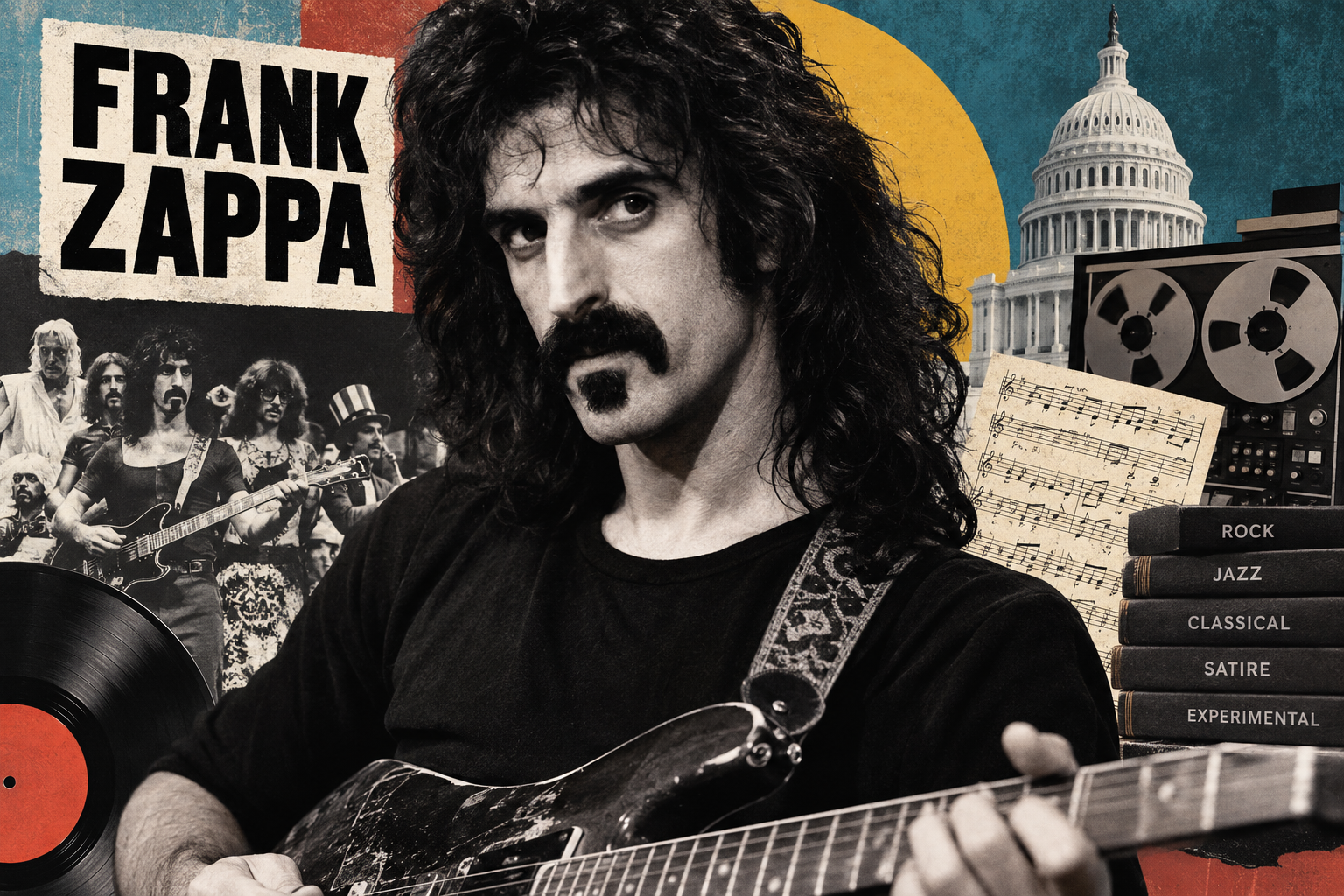
Frank Zappa spent his entire career making sure nobody could comfortably put him in a box.
He was a rock musician who loved modern classical composition. He was a guitarist who sometimes treated the guitar like a laboratory experiment. He was a bandleader who demanded extraordinary technical precision from his musicians. He was a composer who could write music of startling complexity and then surround it with deliberately ridiculous comedy. He was a recording artist who distrusted the record industry. He was a political critic who refused to become a conventional politician. He was an advocate for artistic freedom who could also be one of the most provocative and difficult personalities in popular music.
Most importantly, Zappa was relentlessly curious.
He wanted to know what happened if rock music became more complicated, what happened if jazz musicians played alongside rock musicians, what happened if modern classical ideas were brought into a recording studio, what happened if a guitar solo was treated as a carefully constructed composition, what happened if comedy and serious musicianship occupied the same song, and what happened if an artist simply refused to obey the unwritten rules of the music business.
He spent his career finding out.
The result was one of the largest, strangest and most fascinating bodies of work in twentieth-century popular music. Zappa’s catalog contains rock albums, jazz-rock fusion, orchestral pieces, instrumental guitar music, electronic compositions, satire, live improvisation, vocal comedy, elaborate concept albums and recordings that seem to exist primarily because he had an idea that he couldn’t resist trying.
His career also produced an extraordinary list of musicians. Steve Vai, Terry Bozzio, Vinnie Colaiuta, George Duke, Adrian Belew, Ruth Underwood, Chester Thompson, Jean-Luc Ponty and many other musicians spent time in Zappa’s orbit. Many went on to major careers of their own.
Zappa died in 1993 at only 52 years old, but his influence has continued to grow. His music remains a challenge, a joke, a technical exercise, a history lesson and an invitation to think differently.
To understand Frank Zappa is to understand an artist who believed that music didn’t need permission to be strange.
Growing Up Different
Frank Vincent Zappa was born on December 21, 1940, in Baltimore, Maryland. His father, Francis Zappa, worked in defense-related industries, and because of his father’s career, the family moved several times during Frank’s childhood.
The constant relocation meant that Zappa experienced different environments while growing up, but his strongest early interests were intellectual and musical.
He became fascinated with music at an unusually young age.
The music that surrounded him wasn’t limited to the rock and roll that would later dominate his generation. Zappa became fascinated by classical composition, particularly twentieth-century composers whose work was far removed from the traditional romantic orchestral music that most young Americans encountered.
Igor Stravinsky was important to him.
So was Edgard Varèse.
Varèse became particularly significant because his approach to rhythm, texture, percussion and sound seemed to offer Zappa a completely different understanding of what music could be.
Zappa wasn’t simply listening to records and deciding which songs he liked.
He was studying sound.
That distinction became increasingly important throughout his life.
He was fascinated by unusual rhythms, strange instrumental combinations and the idea that music could be constructed rather than simply performed. At the same time, he loved rhythm and blues, doo-wop and early rock and roll.
That combination might have seemed contradictory.
To Zappa, it wasn’t.
He saw no reason why a piece of music couldn’t contain elements from completely different traditions.
A melody could come from pop music. A rhythmic idea could come from jazz. An arrangement could borrow from classical composition. A guitar solo could draw from blues. A joke could interrupt everything.
That basic philosophy would become the foundation of his career.
Discovering the Possibilities of Recording
Zappa’s interest in recorded sound developed early.
He was fascinated by recording equipment and by the possibility that the studio could become more than a place where musicians simply captured performances.
The concept would eventually become central to his work.
For Zappa, the recording studio was an instrument.
Tape could be edited.
Sounds could be rearranged.
Performances could be layered.
Different musical ideas could be combined.
A musician could play one part, another musician could play something else, and the final recording could become something neither musician could have created alone in a conventional live setting.
This idea would become increasingly important as recording technology developed.
Long before digital audio became common, Zappa was thinking about recordings as objects that could be constructed, manipulated and reshaped.
He was not content simply to reproduce a concert.
He wanted to create things that existed specifically because the recording studio allowed them to exist.
The Formation of the Mothers of Invention
Zappa’s professional career began taking shape in the early 1960s in the Southern California music scene.
He played guitar and wrote music while working with various local groups. One of the most important was the Soul Giants.
Zappa eventually took control of the band’s musical direction, and the group evolved into the Mothers.
The name itself was provocative. In the language of the time, “mother” could be short for a vulgar expression referring to a highly skilled musician.
Zappa and his musicians embraced the ambiguity.
The group became the Mothers of Invention.
It was an appropriate name for a band that seemed determined to invent itself from scratch.
The Mothers did not fit neatly into the Los Angeles rock scene. They could play rock, blues, jazz and experimental material, often switching styles without warning.
Their performances became increasingly theatrical and unpredictable.
Zappa was not interested in creating a band that simply entertained audiences for a couple of hours.
He wanted to challenge them.
Freak Out!
The breakthrough came in 1966 with Freak Out!, the Mothers’ debut album.
It was one of the most ambitious rock records of its era.
At a time when many albums were still primarily collections of singles, Freak Out! suggested that a rock album could be a large-scale artistic project.
The album combined conventional songs with strange instrumental passages, vocal harmonies, satire, studio experimentation and extended musical sections.
It also introduced listeners to Zappa’s distinctive approach to humor.
He wasn’t merely writing jokes and placing music underneath them.
The music itself was often part of the joke.
He could imitate pop conventions, exaggerate them and then suddenly take the music somewhere completely unexpected.
The album’s importance went beyond its immediate commercial performance.
It became an example for musicians who were beginning to view the album as an artistic medium.
The Beatles would soon take that idea even further with Sgt. Pepper’s Lonely Hearts Club Band, and Zappa’s influence was part of the larger movement toward treating albums as complete statements rather than simple collections of singles.
Zappa was already operating in that world.
Zappa and the Counterculture
Zappa emerged during one of the most culturally turbulent periods in American history.
The 1960s brought political protests, changing social attitudes, psychedelic culture and a growing youth movement.
Many musicians embraced the counterculture.
Zappa looked at it differently.
He was deeply suspicious of conformity, but that did not automatically make him a supporter of everything associated with the counterculture.
He mocked hippie culture just as readily as he mocked conservative America.
That was one of the things that made him unusual.
Zappa didn’t seem interested in choosing one group to please.
He preferred to stand outside the crowd and make fun of it.
His targets included politicians, television personalities, rock musicians, suburban culture, religious figures, record companies, sexual hypocrisy and counterculture clichés.
The jokes could be crude.
They could also be remarkably perceptive.
Zappa understood that absurdity could reveal hypocrisy.
Instead of delivering a serious lecture about American culture, he could create an absurd character and let the character expose the ridiculousness of the culture itself.
We’re Only in It for the Money
That approach reached one of its clearest expressions with We’re Only in It for the Money, released in 1968.
The album was a parody of the counterculture and the music business surrounding it.
Its famous cover deliberately echoed the Beatles’ Sgt. Pepper artwork.
Zappa was essentially asking why everyone was taking themselves so seriously.
The album’s title was itself a joke.
The Mothers were supposedly mocking musicians who claimed to be changing the world while also making money from the music industry.
Zappa understood the contradictions of popular culture.
Musicians could criticize commercialism while trying to sell records.
Fans could reject conformity while dressing and behaving according to another set of cultural expectations.
Artists could preach freedom while demanding that audiences accept their own worldview.
Zappa enjoyed those contradictions.
He collected them.
The Mothers Were a Training Ground
One of Zappa’s greatest contributions to music was not simply the material he recorded.
It was the musicians he developed.
Zappa’s bands became legendary among musicians because playing for him could be extremely demanding.
He expected musicians to learn complicated arrangements.
They had to be able to read music.
They needed to understand unusual rhythms.
They had to perform precisely.
They also had to improvise.
And they had to be able to switch between styles without losing the musical thread.
This was not easy.
Zappa could give his musicians material that required enormous technical ability and then expect them to perform it night after night.
The musicians who succeeded in that environment often became exceptional players.
The list is remarkable.
George Duke became an important keyboardist, composer and producer.
Terry Bozzio became one of the most distinctive drummers in rock.
Vinnie Colaiuta became one of the most respected drummers in the world, eventually working with an enormous range of artists.
Adrian Belew went on to become a major figure in progressive and experimental rock.
Steve Vai became one of the most influential instrumental guitarists of his generation.
Ruth Underwood became renowned for her work with percussion and mallet instruments.
Chester Thompson became a major touring drummer.
Jean-Luc Ponty developed his career as a pioneering electric violinist.
Zappa’s band was therefore more than a touring group.
It was a musical laboratory.
Zappa the Bandleader
Zappa’s reputation as a demanding bandleader was well deserved.
He expected a lot from his musicians.
His compositions often required complicated arrangements and exact timing. A single mistake could disrupt an entire passage.
He also expected musicians to remember large quantities of material.
The reward was that Zappa’s concerts could be incredibly tight.
The band could move from a complicated written passage into improvisation and then return to the arrangement almost seamlessly.
Zappa had a remarkable ability to recognize musical talent.
He also understood that great musicianship wasn’t simply about playing fast.
A musician needed to understand timing, dynamics, tone and ensemble playing.
This philosophy helped create some of the most formidable bands in rock history.
The Guitarist Behind the Composer
Zappa’s guitar playing deserves far more attention than it sometimes receives.
He was never primarily marketed as a guitar hero in the way that Eric Clapton, Jimi Hendrix or later Eddie Van Halen were.
Yet Zappa developed a highly distinctive guitar voice.
His playing could be bluesy, angular, melodic, aggressive, humorous or bizarre.
He often approached solos as though they were conversations.
Instead of simply displaying technique, he explored unusual phrases and rhythms.
His tone was also distinctive.
He could make a note sound almost vocal.
He frequently used sustained notes, bends and unusual rhythmic patterns to create solos that sounded improvised but still had a strong sense of structure.
His guitar work on Hot Rats remains particularly important.
Hot Rats
Released in 1969, Hot Rats was one of the major turning points in Zappa’s career.
It was largely instrumental and focused heavily on jazz-rock fusion.
The album demonstrated that Zappa could create sophisticated instrumental music without depending on the comedy and satire that had characterized much of the Mothers’ work.
The centerpiece was “Peaches en Regalia,” a bright, melodic instrumental that became one of Zappa’s most recognizable compositions.
It is also one of the best introductions to his music.
The piece is complicated without sounding intimidating.
It has memorable melodies, unusual instrumentation and rhythmic sophistication, but it remains accessible.
Hot Rats helped establish Zappa as a serious instrumental composer and guitarist.
It also demonstrated that rock musicians could create complex fusion music without abandoning the energy that made rock exciting.
The 1970s: The Zappa Universe Expands
The 1970s saw Zappa’s music become even more ambitious.
He explored jazz fusion, orchestral music, complex rock arrangements and elaborate stage productions.
Albums such as Waka/Jawaka, The Grand Wazoo, Over-Nite Sensation, Apostrophe (‘), One Size Fits All and Zappa in New York revealed different aspects of his personality.
The sheer variety is astonishing.
He could create a sophisticated instrumental piece and then follow it with a song built around a deliberately absurd character.
He could write a technically difficult ensemble passage and then turn around and create a catchy chorus.
He could take a familiar rock structure and fill it with strange rhythmic changes.
This was one of the great contradictions of Zappa’s work.
He wanted music to be sophisticated, but he didn’t want sophistication to become pretentious.
Over-Nite Sensation
Over-Nite Sensation, released in 1973, became one of Zappa’s most popular albums.
It combined strong musicianship with accessible song structures and Zappa’s trademark humor.
The album featured musicians capable of handling demanding arrangements while still sounding like a cohesive rock band.
It also demonstrated Zappa’s growing ability to make technically complicated music commercially approachable.
He wasn’t simplifying himself.
He was learning how to hide complexity inside catchy structures.
That would become one of his most useful skills.
Apostrophe (‘)
The following year brought Apostrophe (‘), another major success.
The album included “Don’t Eat the Yellow Snow,” which became one of Zappa’s better-known songs.
It was a good example of his approach.
The song is funny and memorable, but the arrangement behind it is far more sophisticated than the surface-level comedy might suggest.
Zappa frequently did this.
He would give the audience something immediately accessible and then bury more complicated musical ideas underneath it.
Listeners could enjoy the joke without understanding the composition.
Musicians could enjoy the composition without caring about the joke.
Both audiences could find something to appreciate.
One Size Fits All
One Size Fits All arrived in 1975 and remains one of the strongest examples of Zappa’s compositional approach.
The album is packed with intricate arrangements, unusual rhythms and exceptional instrumental performances.
It also contains “Inca Roads,” a composition that demonstrates just how sophisticated the Zappa ensemble could become.
The musicians were expected to handle complex written sections while leaving room for improvisation.
That balance became one of Zappa’s trademarks.
He didn’t believe improvisation required abandoning structure.
He wanted musicians to improvise inside carefully constructed musical environments.
Live Music Was Central to Zappa
Zappa’s studio albums tell only part of his story.
He was also a tremendous live performer and bandleader.
His concerts could be unpredictable, but they were not chaotic.
The band often had an enormous amount of material prepared.
Zappa could choose songs based on the musicians available, the venue, the audience and whatever musical ideas he wanted to explore.
He frequently rearranged material.
He encouraged musicians to improvise.
He sometimes incorporated audience suggestions or spontaneous musical events into the performance.
His concerts became laboratories where compositions could evolve.
The live versions of his songs were often significantly different from their studio counterparts.
This made collecting Zappa recordings particularly rewarding.
The same composition could exist in multiple forms.
Zappa’s Humor
It is impossible to discuss Zappa without discussing comedy.
Humor was not an occasional feature of his work.
It was one of his primary artistic tools.
He used comedy to attack hypocrisy.
He used it to parody pop music.
He used it to mock celebrity culture.
He used it to make fun of sexual stereotypes.
He used it to ridicule politicians.
He used it to expose the absurdity of suburban life.
He used it because he genuinely thought some things were funny.
His comedy was not always subtle.
Sometimes it was deliberately juvenile.
Sometimes it was aggressively sexual.
Sometimes it was absurd for the sake of absurdity.
That has made portions of his catalog divisive.
But even when the jokes don’t work for a modern listener, the musical construction behind them can remain fascinating.
Zappa was not a comedian who happened to write music.
He was a composer who understood how comedy could function musically.
The Characters in Zappa’s Songs
Zappa frequently created fictional characters.
These characters represented different aspects of American culture.
Some were ridiculous.
Some were pathetic.
Some were arrogant.
Some were sexually obsessed.
Some were simply bizarre.
Zappa used these characters to create miniature worlds.
Instead of writing a straightforward political statement, he might create a ridiculous character who embodies the issue.
Instead of criticizing a particular social trend directly, he could exaggerate it until it became absurd.
That technique allowed him to say things without preaching.
The listener could laugh first and think about the underlying idea later.
Joe’s Garage
Zappa’s ambitious Joe’s Garage project arrived in 1979.
It was structured as a rock opera and combined satire, narrative, complicated music and social commentary.
The story examined themes involving government control, censorship, sexuality, religion and technology.
At its center was Joe, an ordinary musician whose experiences become increasingly absurd.
The project allowed Zappa to explore his recurring concerns in a larger narrative.
It also demonstrated his interest in technology.
The album included extensive use of studio manipulation and sound design.
Zappa increasingly understood that recorded music could function like cinema.
Instead of simply presenting songs, he could create environments.
Zappa and the Recording Studio
Zappa’s use of the studio deserves special attention.
He was fascinated by editing.
He recorded large amounts of material and sometimes reused performances years later.
He could combine sections from different sessions.
He could edit together performances recorded at different times.
He could use live material as the foundation for studio projects.
This approach anticipated techniques that would become common decades later.
Today, listeners are accustomed to digital editing, sampling and manipulating recordings.
Zappa was doing analogous things with analog tape.
He understood that recorded music did not have to represent a single moment in time.
A record could be assembled from many moments.
That made the studio a compositional environment.
Zappa and Technology
Zappa was fascinated by emerging technology throughout his career.
His interest eventually included digital synthesizers and computer-based musical systems.
One of the most important tools he adopted was the Synclavier.
The system allowed him to create highly precise electronic compositions and manipulate sounds in ways that traditional recording equipment could not easily accomplish.
Zappa wasn’t interested in technology simply because it was new.
He wanted to know what it could allow him to compose.
That distinction is important.
He saw technology as another instrument.
A computer was not a replacement for musical creativity.
It was a new way to realize ideas.
His interest in technology also demonstrated how far ahead of his time he could be.
Zappa and the Music Industry
Zappa’s relationship with record companies was rarely comfortable.
He believed artists should have more control over their work.
He distrusted executives who treated music primarily as a commercial product.
He also objected to the idea that record companies should control how musicians presented themselves.
These conflicts eventually led him toward greater independence.
Zappa founded his own labels and became increasingly involved in the business side of his career.
This required enormous effort.
He wasn’t merely writing songs.
He was managing musicians, producing records, dealing with distribution, handling business decisions and maintaining an enormous archive.
His independence was not theoretical.
He was willing to do the work necessary to maintain it.
The 1980s and a Changing Music Industry
The music industry changed dramatically during the 1980s.
MTV transformed the relationship between musicians and audiences.
Music videos became increasingly important.
Digital recording technology developed rapidly.
Compact discs began replacing vinyl and cassette formats.
Pop music became increasingly polished and commercially focused.
Zappa remained difficult to categorize.
He could still create accessible songs, but he never became a conventional pop artist.
“Valley Girl,” released in 1982, was his most notable commercial breakthrough.
The song featured his daughter Moon Zappa speaking in an exaggerated version of teenage Valley Girl slang.
It became a hit.
There was something wonderfully ironic about the situation.
Zappa, who had spent his career attacking commercial pop culture, suddenly had a major pop success with a satirical song about teenage culture.
He didn’t become a conventional pop star afterward.
Instead, the success simply became another strange chapter in his career.
Frank Zappa and Censorship
The most important political battle of Zappa’s later career involved music censorship.
During the 1980s, the Parents Music Resource Center, associated with Tipper Gore and several other prominent political figures, advocated for warning labels and greater scrutiny of music containing sexual or explicit material.
Zappa strongly opposed the campaign.
In 1985, he testified before a U.S. Senate committee.
His appearance became famous because he treated the issue as a question of free expression.
He argued that government involvement in music could create dangerous precedents.
Zappa was particularly concerned about the possibility that labeling systems could become a form of indirect censorship.
His argument was larger than his own music.
He believed that once institutions gained authority to determine what content was acceptable, the definition of acceptable content could continually expand.
The hearing became an important part of his public legacy.
Zappa the Political Thinker
Zappa’s political views were difficult to classify.
He was deeply skeptical of government.
He criticized Republicans and Democrats.
He attacked religious influence in politics.
He criticized censorship.
He was suspicious of corporate power.
He distrusted ideological movements.
He was also skeptical of political correctness and social conformity.
This made him difficult to recruit into conventional political categories.
He wasn’t interested in being a spokesperson for a movement.
He preferred independence.
His political philosophy was based heavily on individual freedom and skepticism toward authority.
He believed adults should be capable of making their own choices.
That attitude appeared repeatedly in his music and interviews.
Zappa’s Public Persona
Zappa cultivated an unmistakable public image.
The long hair, mustache, serious expression and deadpan delivery became instantly recognizable.
But the image could be misleading.
Behind the eccentric exterior was an intensely disciplined worker.
Zappa was not a chaotic artist waiting for inspiration.
He was organized.
He wrote constantly.
He rehearsed extensively.
He maintained detailed musical arrangements.
He archived recordings.
He supervised productions.
He planned tours.
He managed musicians.
He was extraordinarily productive.
The seriousness with which he approached his work was one of the great contrasts of his personality.
The man who could spend an entire song making fun of something might spend hours making sure every instrumental part was precisely correct.
The Zappa Musicians
Perhaps the clearest measure of Zappa’s influence is the number of exceptional musicians who passed through his bands.
Steve Vai is the most famous example.
As a young guitarist, Vai was obsessed with Zappa’s compositions and famously transcribed his music before eventually becoming a member of Zappa’s band.
The experience helped shape Vai’s entire musical philosophy.
Terry Bozzio became another major success story.
His powerful and highly technical drumming became one of the defining elements of Zappa’s 1970s sound.
Vinnie Colaiuta demonstrated extraordinary rhythmic flexibility and later became one of the most sought-after drummers in music.
George Duke brought sophisticated jazz and keyboard playing to Zappa’s music.
Adrian Belew learned to combine experimental guitar sounds with unconventional songwriting.
The list goes on.
Zappa’s bands effectively created a network of musicians who carried his ideas into other genres.
Zappa’s Influence on Guitar Playing
Zappa’s guitar influence is easy to underestimate because he wasn’t part of the traditional guitar-hero mythology.
He didn’t build his reputation primarily around speed.
His influence was more conceptual.
He demonstrated that a guitar solo could have its own personality.
He showed that strange phrasing could be as important as technical speed.
He showed that improvisation could be treated as composition.
He also demonstrated that guitar music could move between rock, jazz, blues and experimental music without requiring a stylistic explanation.
Steve Vai absorbed these lessons and carried them into the world of instrumental guitar music.
Other guitarists took different elements.
Some adopted Zappa’s rhythmic approach.
Others absorbed his willingness to experiment with tone.
Others took his belief that a solo could tell a story.
Zappa and Progressive Rock
Zappa has always had an unusual relationship with progressive rock.
He wasn’t a conventional progressive-rock artist.
He didn’t fit the genre’s typical visual or conceptual traditions.
Yet much of his music clearly shares progressive rock’s interest in complex arrangements, unusual rhythms, instrumental virtuosity and ambitious compositions.
What made Zappa different was his sense of humor.
He could take the same technical complexity that another progressive band might present with great seriousness and place it inside a joke.
He refused to separate intelligence from entertainment.
That made him particularly influential among musicians who wanted sophisticated music without pretension.
Zappa and Jazz Fusion
Zappa was also an important figure in the development of jazz-rock fusion.
His interest in jazz was not superficial.
He understood improvisation, ensemble interaction and complex rhythmic structures.
Albums such as Hot Rats, Waka/Jawaka and The Grand Wazoo demonstrated his interest in larger jazz-oriented ensembles.
His bands often featured horns, keyboards and rhythm sections capable of handling difficult material.
Zappa’s fusion music was different from that of Miles Davis or Weather Report, but he was part of the same broader movement toward breaking down the boundaries between rock and jazz.
Zappa and Classical Composition
Zappa’s classical interests were present from the beginning and continued throughout his career.
He wrote orchestral works and frequently discussed composers and composition.
His fascination with Stravinsky, Varèse and other modern composers helped shape his approach to rhythm, structure and instrumentation.
Unlike many rock musicians who occasionally experimented with orchestras, Zappa approached composition as a serious discipline.
He didn’t simply want strings behind a rock song.
He wanted to compose.
This distinction explains why some of his instrumental music feels fundamentally different from conventional rock arrangements.
His goal wasn’t to make rock sound classical.
He wanted to create music that could exist on its own terms.
Zappa and Musical Intelligence
One of Zappa’s most important contributions was demonstrating that popular music could be intellectually ambitious without becoming inaccessible.
He never accepted the idea that popular music had to be simple.
He also rejected the idea that complicated music automatically had to be serious or humorless.
His work could be intellectually demanding and completely ridiculous at the same time.
That combination became one of his signatures.
He proved that a musician could expect listeners to pay attention without abandoning entertainment.
The Darker Side of Zappa’s Humor
Zappa’s legacy also requires acknowledging the parts of his work that can be difficult.
His humor could be misogynistic.
His sexual material could be crude.
Some of his jokes were deliberately offensive.
Some listeners find sections of his catalog dated or uncomfortable.
Zappa would probably not have been surprised by that reaction.
Provocation was part of his artistic philosophy.
But understanding the historical context does not require pretending every joke works.
The best way to approach Zappa is to recognize that his catalog contains both extraordinary musical achievements and material that may not resonate with every listener.
His influence does not depend on every song being a masterpiece.
It comes from the larger body of work.
The Sheer Size of the Catalog
One of the biggest challenges for anyone discovering Zappa is simply figuring out where to begin.
There is an enormous amount of material.
The catalog includes studio albums, live albums, archival releases, compilations, orchestral projects and posthumous material.
A listener who starts with one album can easily find themselves somewhere completely different on the next.
That is part of the adventure.
Someone who discovers Zappa through Hot Rats might assume he is primarily an instrumental jazz-rock musician.
Someone who starts with We’re Only in It for the Money might think he is primarily a satirist.
Someone who starts with Joe’s Garage might see him as a theatrical storyteller.
Someone who starts with his later orchestral works might encounter a completely different composer.
All of those descriptions are correct.
None of them tells the whole story.
Zappa’s Relationship With His Fans
Zappa developed a particularly loyal audience.
His fans often became deeply involved with the catalog.
Because his albums contained so many references, recurring jokes and musical ideas, repeated listening revealed additional layers.
A joke heard once might become part of a larger musical pattern.
A melody from one album might reappear years later.
A live performance might completely transform a familiar composition.
This created a culture of deep listening.
Zappa rewarded people who paid attention.
The Archive
Zappa’s enormous recording archive became one of the most important aspects of his posthumous legacy.
He recorded constantly.
That meant there were large quantities of unreleased performances and compositions.
After his death, archival releases began revealing more of the enormous body of work he had accumulated.
These recordings also demonstrated just how productive he was.
He wasn’t simply releasing albums when inspiration struck.
He was constantly creating.
The archive also helps explain the remarkable consistency of his output.
There were always more ideas.
More recordings.
More arrangements.
More concerts.
More experiments.
Frank Zappa’s Final Years
Zappa continued working at an extraordinary pace during his final years.
His health was deteriorating, but he remained deeply involved in music.
He continued composing and recording.
He explored electronic music and orchestral composition.
He also continued working with the enormous archive of material he had accumulated.
His diagnosis of prostate cancer had occurred years earlier, but the disease eventually became terminal.
Zappa died on December 4, 1993, just seventeen days before his 53rd birthday.
His death came at an age when many musicians were still producing some of their most important work.
That makes his unfinished projects particularly poignant.
There was clearly more music he wanted to make.
The Legacy After His Death
Zappa’s death did not end his career in the traditional sense.
His archive meant that new releases could continue appearing.
More importantly, his influence became increasingly visible.
Musicians who had grown up listening to him began incorporating his ideas into new forms of music.
Alternative rock embraced eccentricity.
Progressive music became more technically ambitious.
Experimental musicians gained access to increasingly sophisticated technology.
Independent musicians gained greater control over production and distribution.
Zappa’s philosophy seemed increasingly relevant.
Zappa and Independent Music
One of Zappa’s most important long-term contributions was his attitude toward artistic independence.
He wanted control over his recordings.
He disliked being told what music should sound like.
He distrusted executives who didn’t understand the creative process.
He was willing to challenge contracts and business arrangements when he believed they threatened his artistic control.
Decades later, the internet would make independent music distribution dramatically easier.
Musicians could record at home.
They could release music directly.
They could communicate with audiences without relying entirely on major labels.
Zappa had been arguing for greater artistic independence long before those technologies existed.
Zappa’s Influence on Alternative and Experimental Rock
Zappa’s influence became especially noticeable among musicians who didn’t fit comfortably into mainstream rock.
Bands such as Primus embraced the combination of technical musicianship, eccentric humor and unconventional songwriting.
Other alternative artists adopted his willingness to experiment with structure.
Progressive metal musicians absorbed his emphasis on complex rhythms and virtuosity.
Experimental rock musicians followed his example of treating the studio as an instrument.
Even musicians who did not sound obviously like Zappa often inherited his attitude.
That may be his most important influence.
He made it seem acceptable to be weird.
Zappa and Primus
Primus provides one of the clearest examples of Zappa’s influence on later rock.
The band’s combination of absurd humor, unusual rhythms, technical playing and unconventional songwriting reflects several principles that Zappa had established decades earlier.
Les Claypool’s bass playing, in particular, demonstrates the idea that a rhythm instrument can become a lead voice.
That philosophy is very compatible with Zappa’s approach to ensemble music.
The point wasn’t simply to imitate Zappa.
It was to understand that rock music could accommodate strange ideas and technical musicianship without losing its personality.
Zappa and Steve Vai
Steve Vai’s career provides perhaps the strongest individual example of Zappa’s legacy.
Vai became fascinated with Zappa’s compositions as a teenager and eventually joined Zappa’s band.
Zappa gave Vai an environment in which his technical abilities could develop alongside compositional discipline.
Vai later became a major solo artist and an influential figure in instrumental guitar music.
His work is obviously different from Zappa’s.
But the connection is unmistakable.
The emphasis on precision, unusual phrasing, complex arrangements and the guitar as a compositional voice can be traced directly back to the Zappa experience.
Zappa and Modern Musicians
Zappa’s influence has never been limited to musicians who sound exactly like him.
That is an important distinction.
A musician does not have to use odd time signatures or absurd comedy to be influenced by Zappa.
They might simply have absorbed his attitude toward artistic freedom.
They might believe a rock band can incorporate orchestral ideas.
They might treat the studio as an instrument.
They might refuse to choose between technical ability and humor.
They might decide that a song doesn’t have to fit a genre.
Those are all Zappa ideas.
The Importance of Curiosity
Perhaps the simplest way to understand Zappa is through curiosity.
He was curious about everything.
He wanted to know how an instrument worked.
He wanted to know how recording technology worked.
He wanted to know how musicians responded to unusual compositions.
He wanted to know how audiences reacted to satire.
He wanted to know what happened when different genres collided.
That curiosity drove his entire career.
He didn’t seem satisfied with answers.
He wanted another experiment.
Another record.
Another arrangement.
Another tour.
Another idea.
Why Zappa Can Be Difficult
Zappa isn’t always easy listening.
Some albums are dense.
Some songs are extremely long.
Some compositions contain complicated rhythms that require repeated listening.
Some of the comedy is deliberately abrasive.
Some projects are almost entirely instrumental.
Others are dominated by spoken material and satire.
For listeners accustomed to conventional rock songwriting, Zappa can feel like too much information at once.
That is why approaching his catalog as a single unified thing can be overwhelming.
The better approach is to explore different sides of him.
Listen to the guitar.
Listen to the arrangements.
Listen to the rhythm sections.
Listen to the humor.
Listen to the orchestral material.
Listen to the live recordings.
Eventually, the connections begin to emerge.
Why Zappa Can Be So Rewarding
The flip side of the difficulty is the reward.
Zappa’s music gets deeper with repeated listening.
A first listen might reveal the melody.
A second might reveal the joke.
A third might reveal the rhythm.
A fourth might reveal the arrangement.
Eventually, a piece that initially sounded chaotic can begin to sound extremely organized.
That is one of the great pleasures of his work.
He often constructed music that initially appeared ridiculous but revealed extraordinary precision underneath.
Zappa’s Legacy as a Composer
Zappa’s importance as a composer deserves to stand alongside his reputation as a rock musician.
He helped demonstrate that composition didn’t need to belong to a single tradition.
Rock musicians could compose seriously.
Jazz musicians could incorporate rock.
Classical ideas could appear in popular music.
Electronic technology could become part of composition.
Comedy could coexist with technical sophistication.
These ideas seem obvious today.
They were far less obvious when Zappa was developing them.
Zappa’s Legacy as a Producer
He was also an important producer.
He understood how performances could be shaped in the studio.
He knew how to arrange musicians.
He understood how to capture unusual sounds.
He was willing to experiment with editing.
He also understood the importance of controlling the final product.
His production work was another part of his larger philosophy of independence.
He didn’t want to hand his music to someone else and hope they understood it.
He wanted to be involved in every stage.
Zappa’s Legacy as a Teacher
Zappa never operated a formal music school.
He didn’t need to.
His bands were the school.
Musicians learned from watching him.
They learned how to rehearse.
They learned how to read difficult arrangements.
They learned how to play odd rhythms.
They learned how to improvise within structures.
They learned how to adapt.
They learned how to perform difficult music in front of audiences.
The musicians who passed through his bands carried those lessons into other projects.
That created a ripple effect that continues today.
Zappa and the Idea of Artistic Freedom
At the heart of Zappa’s career was a belief that artists should be free to create.
That freedom did not mean every artistic choice was good.
It meant artists should be allowed to take risks.
Zappa believed audiences were capable of deciding for themselves what they liked.
He didn’t believe politicians, record companies or cultural gatekeepers should make those decisions for them.
That philosophy made his opposition to censorship particularly powerful.
It also explains why he was so resistant to being categorized.
Categories create expectations.
Zappa preferred possibilities.
An Artist Who Refused to Behave
Frank Zappa’s career can almost be viewed as one long refusal.
He refused to sound normal.
He refused to respect genre boundaries.
He refused to accept that popular music had to be simple.
He refused to believe that serious music had to be humorless.
He refused to let record companies completely control his work.
He refused to treat political authority as automatically deserving respect.
He refused to make himself comfortable for the audience.
And he refused to stop experimenting.
That refusal became his identity.
The Contradictions of Frank Zappa
Zappa was full of contradictions.
He could be extremely disciplined and completely absurd.
He could be intellectually sophisticated and juvenile.
He could be politically serious and relentlessly sarcastic.
He could be commercially successful while criticizing commercial culture.
He could demand absolute precision while encouraging improvisation.
He could embrace technology while being deeply attached to musicianship.
He could create music that was extraordinarily complex and then write something incredibly simple.
Those contradictions weren’t flaws in his personality as an artist.
They were part of the point.
Zappa didn’t believe people needed to choose one identity.
Why couldn’t serious music be funny?
Why couldn’t comedy contain great musicianship?
Why couldn’t a rock guitarist care about modern classical music?
Why couldn’t a musician criticize the music business while making records?
Why couldn’t a performer be both entertainer and composer?
Zappa’s career was his answer.
The Music That Remains
Today, Zappa’s music continues to feel surprisingly modern.
The technology has changed.
The music industry has changed.
The political arguments have changed.
The way people consume music has changed.
But the fundamental questions remain.
What can music become?
How much control should an artist have?
How much complexity can a popular audience accept?
Can humor make serious ideas more powerful?
Can musicians cross genres without losing their identity?
Can technology expand creativity?
Zappa’s work doesn’t provide simple answers.
Instead, it keeps asking the questions.
The Enduring Appeal of Frank Zappa
Frank Zappa remains fascinating because there was never just one Frank Zappa.
There was the guitarist.
The composer.
The bandleader.
The producer.
The satirist.
The businessman.
The political critic.
The technology enthusiast.
The recording obsessive.
The father.
The provocateur.
The teacher.
All of those identities existed simultaneously.
His music reflects that complexity.
You can listen to Zappa for the guitar playing.
You can listen for the musicians.
You can listen for the arrangements.
You can listen for the jokes.
You can listen for the bizarre characters.
You can listen for the political commentary.
You can listen for the compositional ideas.
Or you can simply listen because you want to hear something that doesn’t sound like anything else.
That may be the strongest reason his music has survived.
Final Thoughts
Frank Zappa never seemed interested in being easy to understand.
He wanted to make music that challenged assumptions.
He wanted to make audiences laugh.
He wanted to make musicians work.
He wanted to experiment with technology.
He wanted to explore composition.
He wanted control over his recordings.
He wanted to criticize hypocrisy.
He wanted to defend artistic freedom.
And above all, he wanted to create.
That enormous creative drive produced a body of work unlike almost anything else in popular music.
His records range from beautiful instrumental compositions to deliberately ridiculous comedy. His concerts could feature technical precision, improvisation and theatrical absurdity. His bands became breeding grounds for some of the finest musicians of their generations. His political battles turned him into an unexpected advocate for free expression. His fascination with technology anticipated changes that would transform music after his death.
But perhaps the most remarkable thing about Zappa is that he never seemed to think any of this was particularly unusual.
For him, music was simply a place where ideas could collide.
Rock could meet jazz.
Jazz could meet classical composition.
Classical composition could meet electronics.
Electronics could meet satire.
Satire could meet guitar solos.
Guitar solos could become compositions.
Compositions could become jokes.
Jokes could become political statements.
And all of it could exist on the same record.
That was Frank Zappa’s world.
He didn’t build a career around following musical trends. He built one around curiosity, independence and an almost obsessive desire to discover what was possible.
That is why his influence reaches so far beyond his own recordings.
The musicians he trained carried his ideas forward. The artists who discovered his records learned that complexity didn’t have to be boring. Guitarists learned that individuality mattered more than speed. Producers learned that the studio could become an instrument. Independent artists found an early example of someone fighting for control of his own work. Political observers found a musician willing to challenge censorship publicly. Experimental musicians found someone who had already spent decades ignoring the boundaries between genres.
Frank Zappa died far too young, leaving behind unfinished projects and an archive that continues to reveal new dimensions of his career.
But the central idea of his work remains remarkably simple.
Music doesn’t have to behave.
It doesn’t have to fit a category.
It doesn’t have to make everyone comfortable.
It doesn’t have to choose between intelligence and entertainment.
It doesn’t have to follow the rules simply because the rules have always been there.
Zappa spent his life proving that.
And more than thirty years after his death, the proof is still sitting on the record shelf, waiting to be played.
This post has already been read 8 times!