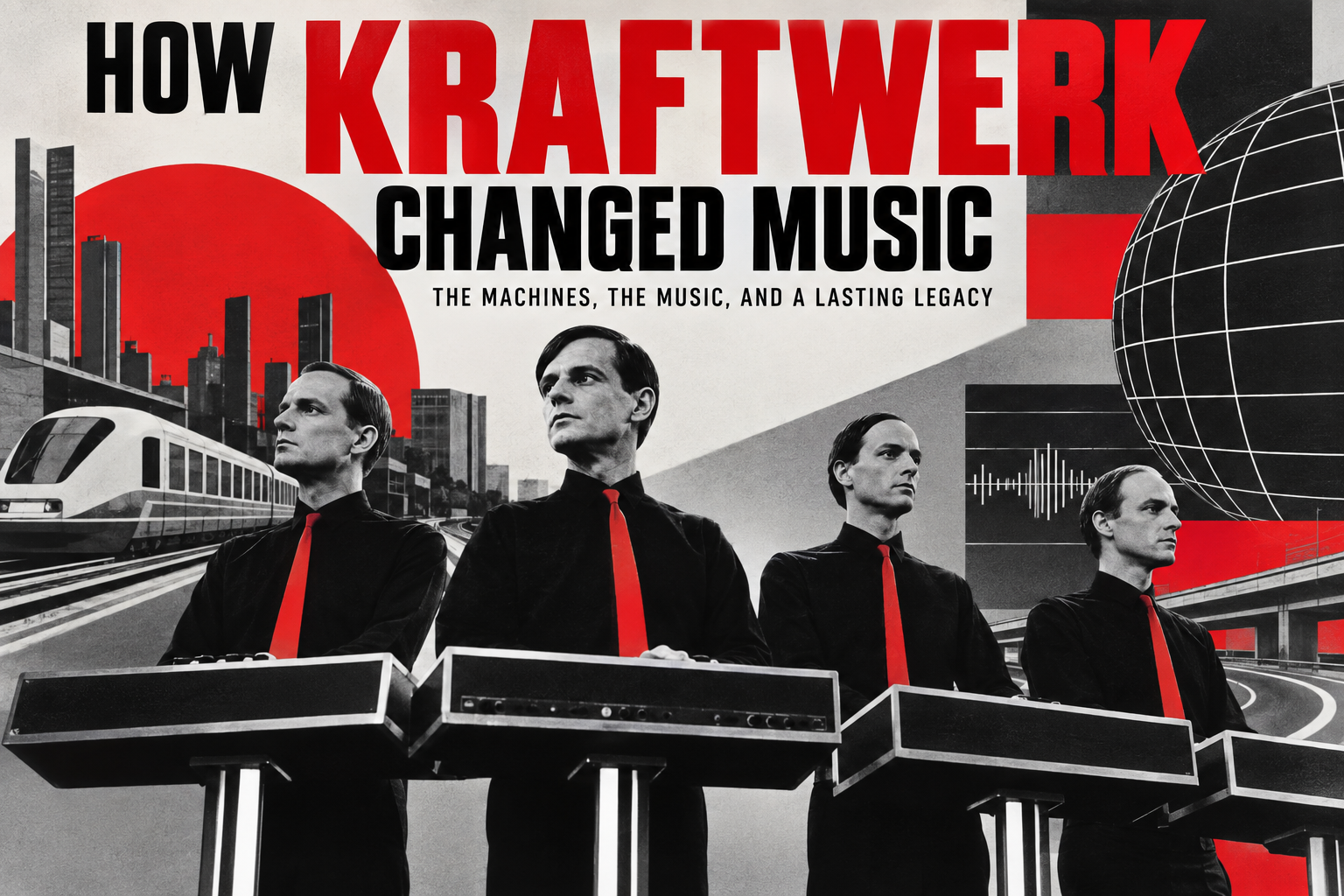
It is difficult to think of another band that changed the sound of modern music as profoundly as Kraftwerk. Their records did not merely create a successful new style. They helped establish an entirely new musical vocabulary. Electronic instruments existed before Kraftwerk. Synthesizers existed before Kraftwerk. Experimental musicians had already explored tape manipulation, electronic sound, and machines. But Kraftwerk took these ideas and turned them into something that could reach far beyond laboratories and avant-garde concert halls.
They made electronic music feel modern, accessible, rhythmic, stylish, and strangely human.
The influence of Kraftwerk can be heard everywhere. Techno, synth-pop, hip-hop, electro, house, industrial music, new wave, ambient music, dance music, and modern pop all owe something to the German group. Their influence has reached artists who may sound nothing like them on the surface. A rapper from the Bronx, a Detroit techno producer, a British synth-pop band, and a modern electronic artist might have very different approaches to music, but all can trace part of their musical ancestry back to Kraftwerk.
That is what makes the group’s story so remarkable.
Kraftwerk did not rely on the traditional tools of rock and roll. They did not build their reputation around guitar solos. They did not have a conventional frontman in the style of Mick Jagger or Freddie Mercury. Their stage performances often emphasized precision rather than chaos. They wore suits. They stood behind electronic equipment. At times, they allowed mannequins and robots to represent them.
For a rock audience, this could have seemed almost anti-rock.
That was partly the point.
Kraftwerk imagined a different future for music. They saw technology not as something separate from art but as part of it. Machines could make music. Human beings could communicate through machines. Repetition could become hypnotic. A simple electronic rhythm could have as much power as a traditional drum kit.
The group was fascinated by cars, trains, highways, computers, radios, telephones, robots, and the increasingly technological world surrounding modern society.
But Kraftwerk was never simply a band celebrating machines.
Their greatest music explored the complicated relationship between humans and technology.
Were machines making people more powerful?
Were people becoming dependent on machines?
Could technology bring people together?
Could it make them more isolated?
Could a machine possess personality?
Could a human musician become part of a machine?
These questions were built into Kraftwerk’s music decades before computers, smartphones, artificial intelligence, social media, and digital communication became central parts of everyday life.
Listening to Kraftwerk today can be a strange experience. Music recorded in the 1970s sometimes sounds like it came from the future. Their records are clearly products of their era, yet their ideas continue to feel contemporary.
To understand how Kraftwerk changed music, it is necessary to look at where they came from, how they developed their sound, and what happened when their music escaped Germany and began influencing the rest of the world.
The result is one of the most fascinating stories in popular music.
Before Kraftwerk: Germany Searches for a New Musical Identity
Kraftwerk emerged during an unusual period in German cultural history.
After World War II, Germany faced the enormous task of rebuilding itself. The country had been physically devastated, politically divided, and psychologically damaged by the Nazi era and the war.
German musicians of the postwar generation faced an artistic problem.
What did modern German music sound like?
American and British rock and roll dominated popular culture. Jazz had enormous influence. Classical music remained important. But many young German musicians did not want simply to imitate American or British artists.
They wanted something different.
During the late 1960s and early 1970s, an experimental German music scene began developing. Musicians explored improvisation, electronic instruments, psychedelic music, jazz, classical music, and unusual recording techniques.
This movement was later labeled “krautrock,” although many of the musicians associated with the term disliked it.
The scene included groups and artists such as Can, Neu!, Faust, Tangerine Dream, Cluster, and others.
These artists did not all sound alike.
Can incorporated improvisation, funk, experimental rock, and world music influences.
Tangerine Dream became associated with atmospheric electronic music.
Neu! developed repetitive motorik rhythms that would influence generations of musicians.
Faust created wild experimental recordings.
What connected many of these artists was a willingness to reject traditional rock conventions.
Kraftwerk emerged from this environment.
The group would eventually become much more famous than most of its early contemporaries, but in the beginning, Kraftwerk was also an experimental band trying to discover a new sound.
The group’s founders were Ralf Hütter and Florian Schneider.
Both were interested in experimental music and the possibilities offered by technology.
Their partnership would become one of the most important creative relationships in electronic music history.
Ralf Hütter and Florian Schneider Build a New Sound
Ralf Hütter and Florian Schneider met while studying in Düsseldorf.
Düsseldorf would become central to Kraftwerk’s identity.
The city was modern, industrial, and connected to Germany’s postwar economic development. It was not London, New York, or Los Angeles. Kraftwerk’s music would emerge from a distinctly German environment.
The group’s name, Kraftwerk, translated to “power station” in English.
The name was perfect.
It suggested industry.
Energy.
Technology.
Electricity.
Machines.
It also suggested something larger than an ordinary rock band.
A power station produces energy.
Kraftwerk would produce sound.
The early version of the group was quite different from the Kraftwerk most people know.
Their first albums were experimental and heavily influenced by improvisation.
The early music included traditional instruments.
Flutes appeared.
Drums appeared.
Keyboards appeared.
The music could be abstract and unpredictable. And honestly, was not very enjoyable to listen to.
At this point, Kraftwerk had not yet developed the highly controlled electronic style that would make them famous.
But the experimentation was important.
Hütter and Schneider were learning.
They were discovering what they did not want to do.
Eventually, they would move away from the free-form experimental approach and toward something more precise.
This transformation was one of the most important decisions in their career.
Many musicians believe freedom means playing as much as possible.
Kraftwerk discovered the power of limitation.
Instead of adding more sounds, they began removing them.
Instead of long improvisations, they developed repetition.
Instead of uncontrolled performances, they pursued precision.
Instead of traditional rock instrumentation, they increasingly embraced electronics.
This was the beginning of the classic Kraftwerk sound.
The Machine Becomes the Music
Kraftwerk’s most important innovation was not simply using synthesizers.
Many musicians were already doing that.
The difference was philosophical.
Kraftwerk treated electronic technology as the foundation of the music.
The synthesizer was not an unusual decoration added to a rock song.
It was central.
Electronic percussion was central.
Sequencing was central.
Sound processing was central.
The machines were not supporting traditional music.
The machines were changing the definition of what music could be.
Kraftwerk became interested in repetition.
A repeating rhythm could create momentum.
A repeating bass line could become hypnotic.
A repeating electronic phrase could function almost like a physical environment.
The listener entered the sound.
This approach was different from traditional rock music.
Rock often emphasized dramatic changes.
Verses led to choruses.
Guitar solos interrupted vocal sections.
Drummers added fills.
Musicians demonstrated individual personality.
Kraftwerk often did the opposite.
The personality came from the system.
The repetition became the identity.
A small change could suddenly become important because the listener had become familiar with the pattern.
This was a revolutionary idea.
Later electronic dance music would depend heavily on this approach.
Techno, house, trance, electro, and countless other styles use repetition as a fundamental element.
A groove develops gradually.
The listener becomes immersed.
Changes happen slowly.
Kraftwerk helped demonstrate how powerful this could be.
Autobahn: The Road to International Success
Kraftwerk’s breakthrough came with the 1974 album Autobahn.
The title track became their first major international success.
“Autobahn” was a remarkable piece of music.
It was inspired by Germany’s highway system, the Autobahn.
The song captured the experience of movement.
Driving.
Traveling.
Passing through landscapes.
Machines and human beings moving together.
The original album version was more than twenty minutes long.
That alone made it unusual for a popular song.
Yet the music remained accessible.
The rhythm created forward motion.
Electronic sounds suggested engines and automobiles.
The melody was simple and memorable.
The vocals were delivered in a controlled, almost detached style.
“Autobahn” did not sound like American rock.
It did not sound like British pop.
It sounded like something else.
That was the point.
Kraftwerk had found its identity.
The international success of “Autobahn” was enormously important.
It proved that electronic music could reach a mainstream audience.
The song received radio play.
The band gained attention outside Germany.
Suddenly, Kraftwerk was no longer simply an experimental German group.
They had become international artists.
But Autobahn was important for another reason.
It established a pattern that Kraftwerk would continue exploring.
The band often built entire albums around a central concept.
Technology and transportation became recurring subjects.
Cars.
Trains.
Radio.
Computers.
Robots.
Communication.
These subjects were not treated as simple gimmicks.
Kraftwerk used them to explore modern life.
The automobile was not just a machine.
It changed society.
It changed cities.
It changed how people experienced distance.
The highway became a symbol of movement.
This ability to turn technology into art became one of Kraftwerk’s defining strengths.
Radio-Activity: Music From Invisible Waves
After Autobahn, Kraftwerk continued developing its sound.
The 1975 album Radio-Activity explored another technological subject: radio communication.
Radio had transformed the twentieth century.
People could hear voices and music from distant locations.
Information could travel through invisible signals.
A person could sit in one country and hear sounds originating somewhere else.
For Kraftwerk, this was fascinating.
The album explored radio as technology, communication, and cultural experience.
The music was more electronic than Autobahn.
The sound was becoming increasingly refined.
Kraftwerk’s visual identity was also developing.
The group began presenting itself with a carefully controlled image.
The musicians often appeared formally dressed.
Their expressions could be neutral.
The visual presentation suggested efficiency and precision.
This was dramatically different from the traditional image of a rock band.
Rock musicians were expected to look wild.
Kraftwerk often looked like engineers.
Or office workers.
Or scientists.
The image reinforced the music.
The human beings behind the machines were becoming part of the concept.
Trans-Europe Express: A New Musical World
If Autobahn introduced Kraftwerk to the world, Trans-Europe Express helped establish their legendary status.
Released in 1977, the album is one of the most important electronic records ever made.
The title track explored the idea of a European train traveling across borders.
Like “Autobahn,” it was about transportation.
But the train represented something larger.
Europe had spent much of the twentieth century divided by war.
The idea of traveling across Europe carried historical and cultural significance.
The album presented Europe as modern, connected, and technologically advanced.
The music was elegant and controlled.
Kraftwerk had developed an extraordinary sense of atmosphere.
The rhythms were mechanical without becoming lifeless.
The melodies were simple but memorable.
The synthesizers created an environment rather than simply playing conventional musical parts.
Then there was the song “Europe Endless.”
The title itself suggested a continent without limits.
The music had a dreamlike quality.
It was futuristic and nostalgic at the same time.
But perhaps the most important song on the album was “Trans-Europe Express.”
Its influence would extend far beyond Germany.
The song would eventually become crucial to the development of hip-hop and electro.
This was one of the strangest and most important parts of Kraftwerk’s story.
A group from Düsseldorf would have a major influence on musicians in the Bronx and Detroit.
At the time, few people could have predicted this.
Kraftwerk and the Birth of Hip-Hop’s Electronic Future
The connection between Kraftwerk and hip-hop is one of the greatest examples of music crossing cultural boundaries.
During the early years of hip-hop, DJs searched constantly for interesting records.
They wanted rhythms.
They wanted breaks.
They wanted sounds that could make people move.
American funk music was enormously important.
James Brown was important.
Parliament-Funkadelic was important.
Soul and disco were important.
But DJs were also willing to experiment.
They found something unusual in Kraftwerk.
The electronic rhythms of songs such as “Trans-Europe Express” and “Numbers” had a distinctive quality.
They were futuristic.
They were repetitive.
They were danceable.
They sounded unlike traditional funk, but they could work with funk.
The most famous example came through Afrika Bambaataa and the Soulsonic Force.
Their 1982 record “Planet Rock” became one of the most important recordings in hip-hop history.
“Planet Rock” incorporated musical ideas associated with Kraftwerk, particularly “Trans-Europe Express” and “Numbers.”
The result was revolutionary.
Hip-hop had entered a new electronic world.
“Planet Rock” combined rap with electronic rhythm.
It used technology in a way that sounded radically different from traditional funk-based hip-hop.
The record helped establish electro.
Electro would influence breakdancing, hip-hop production, Miami bass, techno, and electronic dance music.
The connection between Kraftwerk and Afrika Bambaataa demonstrated something important.
Music does not always travel in predictable directions.
Kraftwerk’s music was rooted in European modernism and technology.
Hip-hop emerged from Black and Latino communities in New York.
The two worlds seemed very different.
But rhythm connected them.
Technology connected them.
The desire to create something new connected them.
Kraftwerk’s influence on hip-hop proved that their music was not limited to one culture.
The machines spoke an international language.
The Man-Machine: Humans and Machines Become One
In 1978, Kraftwerk released The Man-Machine.
The title captured the central theme of their work.
Where does the human end and the machine begin?
This question has become increasingly relevant in the twenty-first century.
Today, people communicate through smartphones.
Algorithms influence what they see.
Artificial intelligence creates images, music, and text.
Human beings spend enormous portions of their lives interacting with machines.
Kraftwerk was thinking about the relationship between humans and technology decades earlier.
The Man-Machine included “The Robots,” one of Kraftwerk’s most famous songs.
The song embraced the robotic image.
The band seemed almost to be suggesting that the musicians themselves could become machines.
Their movements on stage were controlled.
Their appearance was carefully designed.
Eventually, robots would literally become part of Kraftwerk’s performances.
The idea was fascinating.
Most rock bands wanted audiences to see their personalities.
Kraftwerk sometimes seemed interested in removing personality.
Or perhaps creating a new form of personality.
The robot became a character.
The machine had identity.
“The Model” became another major song from the album.
It demonstrated Kraftwerk’s pop sensibility.
The song was catchy.
The melody was memorable.
It had a structure that could appeal to mainstream audiences.
When it later became a major hit in Britain, it helped demonstrate that Kraftwerk could compete in the pop marketplace.
This was extremely important.
Kraftwerk was not simply making experimental music.
They understood the power of a hook.
Their best songs were both innovative and memorable.
That combination made their influence much greater.
Kraftwerk Invents the Sound of Synth-Pop
By the late 1970s and early 1980s, a new generation of musicians was discovering synthesizers.
Electronic instruments were becoming more practical.
Musicians could imagine creating bands without traditional guitar, bass, and drum lineups.
Kraftwerk became a blueprint.
British musicians were especially influenced.
Groups such as Depeche Mode, The Human League, Orchestral Manoeuvres in the Dark, Ultravox, Gary Numan, and countless others helped create the synth-pop movement.
These artists did not all sound exactly like Kraftwerk.
Many added more traditional pop structures.
Some emphasized dramatic vocals.
Others created darker music.
But the basic idea was clear.
A synthesizer could be the central instrument in a pop band.
A drum machine could create rhythm.
Electronic sounds could replace traditional guitars.
Technology was no longer something limited to progressive rock or experimental music.
It could create hit singles.
Kraftwerk had helped make that possible.
Gary Numan was one of the artists whose early work demonstrated a fascination with technology and alienation.
The Human League built a successful pop career around synthesizers.
Depeche Mode would eventually become one of the most successful electronic bands in history.
New Order combined post-punk with electronic dance music.
The influence spread rapidly.
Without Kraftwerk, synth-pop would almost certainly still have developed.
But it would not have developed in exactly the same way.
Kraftwerk provided a model.
They had already shown what an electronic band could look and sound like.
The Importance of Image
Kraftwerk changed more than music.
They changed how musicians could present themselves.
Traditional rock culture emphasized individuality.
The guitarist had a recognizable style.
The singer was charismatic.
The drummer might have a wild personality.
The audience wanted to know who everyone was.
Kraftwerk often challenged this.
Their visual identity was controlled.
They wore coordinated clothing.
They appeared almost interchangeable.
They reduced the importance of individual celebrity.
This was unusual.
It also became influential.
Electronic music would eventually produce many artists whose identity was closely connected to visual concepts.
Daft Punk famously used helmets.
Other electronic artists performed behind masks.
Some avoided interviews.
Some preferred the music to remain more important than the individual.
Kraftwerk helped establish this possibility.
They also understood the importance of album artwork.
Their covers were often clean and modern.
They used typography and design carefully.
The visual presentation matched the music.
A Kraftwerk album looked like a Kraftwerk album.
This level of conceptual consistency influenced generations of musicians.
The Robots Take the Stage
Kraftwerk’s relationship with robots became one of the most famous elements of their career.
During performances, the band sometimes used mannequins or robotic versions of themselves.
The idea was both humorous and unsettling.
Could the robots replace the musicians?
Did it matter whether the audience was watching a person or a machine?
If the music was programmed, what exactly was the role of the performer?
These questions became increasingly important as electronic music developed.
A traditional rock audience could see a guitarist playing a solo.
The physical relationship between musician and sound was obvious.
Electronic music changed this.
A musician might press a button.
A sequence might begin.
A computer might control part of the performance.
The audience might not know exactly what was happening.
Kraftwerk embraced this ambiguity.
The robotic performances were not simply a joke.
They were part of the artistic concept.
The band was exploring what performance meant in the age of machines.
Today, this seems almost normal.
Electronic musicians perform with laptops.
DJs perform in front of massive audiences.
Software controls enormous parts of modern music.
Artificial intelligence can generate musical material.
But Kraftwerk was exploring the artistic possibilities long before most people imagined these technologies becoming central to popular music.
Computer World: Kraftwerk Predicts the Digital Age
Released in 1981, Computer World may be one of the most prophetic albums in popular music.
At the time, personal computers were not part of everyday life for most people.
There was no World Wide Web.
There were no smartphones.
Social media did not exist.
The digital world was still developing.
Kraftwerk saw the direction society was moving.
Computer World explored computers, data, communication, and technology.
Songs such as “Computer Love” and “Computer World” now sound almost astonishingly relevant.
The album explored the possibility that computers would influence human relationships.
That idea has become impossible to ignore.
People now meet online.
They communicate through screens.
They form relationships through digital platforms.
They work through computers.
They store their lives electronically.
Kraftwerk understood that technology was becoming personal.
This was a major shift.
Earlier machines had often been large and industrial.
Factories used machines.
Governments used machines.
Corporations used machines.
The computer would eventually enter the home.
It would become part of individual life.
Kraftwerk recognized the cultural importance of this development.
“Computer Love” explored the possibility of human connection through technology.
Today, the concept barely seems futuristic.
Online dating and digital relationships are ordinary.
But in 1981, the idea had a different quality.
Kraftwerk was imagining the future.
The music also continued influencing other artists.
Electro.
Synth-pop.
Techno.
Electronic dance music.
All continued developing.
And Kraftwerk remained one of the central reference points.
The Birth of Techno and the Kraftwerk Connection
If Kraftwerk’s relationship with hip-hop was surprising, their influence on Detroit techno was equally important.
Detroit became the birthplace of techno during the 1980s.
The city had a powerful industrial identity.
It was associated with automobiles and manufacturing.
It was also experiencing economic difficulties and social change.
A group of young Black musicians began creating futuristic electronic music.
Among the most important figures were Juan Atkins, Derrick May, and Kevin Saunderson.
They became known as the Belleville Three.
Their music combined electronic instruments with funk, disco, European electronic music, and futuristic ideas.
Kraftwerk was a major influence.
This made sense.
Detroit and Düsseldorf were different cities, but they shared certain themes.
Industry.
Machines.
Automobiles.
Modern technology.
Urban environments.
Techno musicians took Kraftwerk’s ideas and pushed them in new directions.
The music became more dance-floor focused.
The rhythms became more aggressive.
The relationship with Black American musical traditions became especially important.
Detroit techno was not simply German electronic music recreated in America.
It was something new.
But Kraftwerk was part of its foundation.
Juan Atkins and other early techno figures openly recognized the influence.
The result was another extraordinary example of Kraftwerk’s international reach.
A German band had helped inspire a new musical movement created by Black American musicians in Detroit.
Techno would eventually travel back to Europe.
European audiences embraced it.
The music developed new styles.
House and techno spread across the world.
The cycle continued.
Kraftwerk’s influence moved from Germany to America and then back into Europe and beyond.
The Sound of Electronic Dance Music
Modern electronic dance music is built around many concepts that Kraftwerk helped popularize.
Repetition.
Sequencing.
Electronic rhythm.
Synthesized bass.
Mechanical precision.
Gradual development.
The use of technology as a creative instrument.
Of course, Kraftwerk did not invent everything.
Disco was enormously important.
Chicago house was essential.
Detroit techno was essential.
Jamaican dub influenced electronic production.
European experimental music played a role.
Countless producers and DJs developed the technology.
But Kraftwerk was one of the earliest groups to demonstrate the artistic potential of an entirely electronic musical environment.
They showed that electronic sound could create emotion.
This is important.
Early critics sometimes assumed electronic music would be cold.
Machines were associated with a lack of feeling.
Kraftwerk challenged this.
“Computer Love” could feel lonely.
“Neon Lights” could feel romantic.
“Europe Endless” could feel dreamlike.
“Trans-Europe Express” could feel mysterious.
The sounds were electronic, but the emotions were human.
This remains one of Kraftwerk’s greatest achievements.
They proved that technology did not eliminate emotion.
It simply changed the tools used to express it.
“The Model” and Kraftwerk as Pop Stars
“The Model” is one of the clearest examples of Kraftwerk’s ability to create conventional pop success.
The song was released in the late 1970s and eventually became a major hit in Britain.
Its success surprised some listeners.
Kraftwerk had a reputation as an experimental electronic group.
But “The Model” was undeniably catchy.
It had a memorable melody.
It had a recognizable rhythm.
It had a concise structure.
The song demonstrated that Kraftwerk understood pop music.
They were not making difficult music simply to prove they were intellectual.
They wanted the music to communicate.
A great pop song can be both simple and sophisticated.
“The Model” achieved that balance.
Its success also influenced countless musicians who realized that electronic music did not have to remain underground.
A synthesizer could create a hit.
A machine could produce a melody that millions of people remembered.
This idea became fundamental to 1980s pop.
Kraftwerk and New Wave
New wave was a broad category.
It included artists who sounded very different from one another.
Some came from punk.
Some came from art rock.
Some embraced disco.
Some embraced electronic music.
Kraftwerk influenced a large portion of this musical world.
The band’s emphasis on modernity fit perfectly with new wave.
New wave musicians often rejected the old traditions of rock.
They were interested in fashion.
Technology.
Art.
Design.
Synthesizers.
Kraftwerk seemed to represent an entirely new possibility.
Their music was modern.
Their image was modern.
Their subjects were modern.
They sang about technology rather than mythology.
They sang about highways rather than ancient landscapes.
They sang about computers before most pop musicians were thinking about them.
For artists looking toward the future, Kraftwerk was an obvious influence.
Kraftwerk and Industrial Music
Industrial music also owes something to Kraftwerk.
The connection is not always obvious because industrial music often sounds much harsher.
Artists in the industrial tradition embraced mechanical sounds.
Repetition.
Technology.
Urban alienation.
The relationship between humans and machines.
Kraftwerk explored many of these subjects in a more controlled and melodic environment.
Industrial musicians often made the machines sound threatening.
Kraftwerk sometimes made them sound beautiful.
But the conceptual relationship remained.
Both understood that modern life had become increasingly technological.
Both recognized that machinery could become part of music.
Both challenged the idea that music required traditional instruments.
The influence continued into electronic body music, industrial rock, and numerous other styles.
Kraftwerk and the Art of Repetition
One of Kraftwerk’s most important contributions was changing how musicians thought about repetition.
In traditional songwriting, repetition can be viewed as a limitation.
A musician may be told to add variation.
Change the chord.
Add a new section.
Create a dramatic bridge.
Kraftwerk demonstrated that repetition itself could be the subject.
A repeating pattern could create tension.
It could create hypnosis.
It could create anticipation.
When something finally changed, the listener noticed.
This became fundamental to dance music.
A house track might repeat a rhythm for several minutes.
A techno track might build slowly.
A DJ might mix two records together, extending the experience.
The repetition was not a failure to develop the song.
The repetition was the development.
Kraftwerk helped listeners understand this.
Their music created environments.
A listener could enter the rhythm.
The repetition became physical.
The body responded.
This was a major step toward modern electronic dance culture.
The Studio as an Instrument
Kraftwerk also helped redefine the recording studio.
Traditional musicians often viewed the studio as a place to capture a performance.
A band played.
Microphones recorded the sound.
The goal was to preserve what happened.
Electronic music changed that relationship.
The studio became an instrument.
Sounds could be created that did not exist naturally.
Machines could be manipulated.
Electronic signals could be processed.
Rhythms could be programmed.
The recording itself became the artwork.
Kraftwerk embraced this approach.
The exact sound mattered.
The texture mattered.
The placement of sounds mattered.
The production was not separate from the composition.
This idea became central to modern music production.
Today, producers can build an entire song inside a computer.
They can create sounds electronically.
They can manipulate vocals.
They can construct rhythms without recording a traditional drummer.
This world would be impossible to understand without pioneers such as Kraftwerk.
Kraftwerk’s Influence on Modern Pop
Modern pop music may not always sound like Kraftwerk, but electronic technology is now everywhere.
Synthesizers are common.
Electronic drums are common.
Digital production is standard.
Vocal processing is standard.
Sequencing is standard.
The idea that popular music could be created primarily through electronic technology no longer seems unusual.
Kraftwerk helped make this normal.
A modern pop producer may use hundreds of digital tools that did not exist during Kraftwerk’s early career.
But the underlying philosophy remains familiar.
Technology can be creative.
Machines can produce beauty.
Electronic sounds can communicate emotion.
A song does not need a guitar to be powerful.
These ideas are now part of the basic language of popular music.
The Human Side of Kraftwerk
The most common criticism of Kraftwerk is that their music is cold.
This is understandable.
Their visual presentation could seem distant.
Their vocals were often restrained.
Their rhythms were precise.
Their electronic sounds were mechanical.
But calling the music cold misses something important.
Kraftwerk often used machines to explore human experience.
Traveling on a highway is a human experience.
Listening to the radio is a human experience.
Falling in love is a human experience.
Using a computer is a human experience.
The machines were part of the story.
They were not the entire story.
“Computer Love” is not really about a computer.
It is about loneliness and connection.
“Autobahn” is not simply about a road.
It is about movement.
“Neon Lights” is not simply about electricity.
It creates an emotional atmosphere.
Kraftwerk understood that technology becomes meaningful because humans use it.
That is why their music has survived.
The Mystery of Kraftwerk
Another fascinating aspect of Kraftwerk’s career was their control over their public image.
The band rarely behaved like traditional rock celebrities.
They did not constantly seek attention.
They maintained a certain distance.
This created mystery.
Fans wanted to understand them.
But Kraftwerk did not always make that easy.
The group itself became almost like a machine.
Individual members could change.
The concept remained.
This was unusual in popular music.
Most bands depend heavily on individual personalities.
Kraftwerk increasingly seemed larger than its members.
The project itself was the star.
This idea would later influence electronic acts such as Daft Punk and others who placed concepts, costumes, or visual identities between themselves and the audience.
Florian Schneider and the End of an Era
Florian Schneider was one of the central architects of Kraftwerk’s sound.
His contributions to the group’s electronic experimentation were essential.
Over time, the classic Kraftwerk lineup changed.
Schneider eventually left the group.
His departure marked the end of one of the most important creative partnerships in electronic music.
When Florian Schneider died in 2020, musicians and fans around the world recognized his importance.
His work with Ralf Hütter had helped create a new musical universe.
The sounds they developed influenced generations.
Schneider’s legacy remains difficult to measure because his influence is everywhere.
Sometimes the most influential artists become invisible.
People use the ideas they introduced without realizing where they came from.
That is true of Kraftwerk.
Kraftwerk’s Influence on Daft Punk
Daft Punk was one of the most successful electronic acts of the modern era, and the connection to Kraftwerk was obvious.
Like Kraftwerk, Daft Punk embraced the relationship between humans and machines.
They used robotic imagery.
They wore helmets.
They created a mysterious identity.
They allowed technology to become part of the artistic presentation.
But Daft Punk took the concept in their own direction.
Their music incorporated house, disco, funk, rock, and pop.
They became global superstars.
Still, the philosophical connection was clear.
Kraftwerk had demonstrated that a band did not need to behave like a traditional band.
Musicians could hide their faces.
Machines could become characters.
Technology could become part of the mythology.
Daft Punk’s success demonstrated how powerful these ideas could become.
Why Musicians Still Study Kraftwerk
Kraftwerk remains important to musicians because the group solved problems that artists continue facing.
How do you use technology without becoming controlled by technology?
How do you make experimental music accessible?
How do you create a distinctive identity?
How do you combine concept and entertainment?
How do you use repetition without becoming boring?
How do you make electronic music emotional?
Kraftwerk found answers.
Their methods were not the only answers.
But they created a model.
A musician can study Kraftwerk and learn about minimalism.
A producer can study Kraftwerk and learn about sound design.
A songwriter can study Kraftwerk and learn about simplicity.
A visual artist can study Kraftwerk and learn about artistic identity.
An electronic musician can study Kraftwerk and understand the importance of concept.
That is why their influence remains so large.
Kraftwerk Predicted the World We Live In
Perhaps the most fascinating thing about Kraftwerk is how relevant their subjects became.
They sang about computers before computers became personal possessions.
They explored digital communication before the internet transformed society.
They created robotic imagery before robots became part of ordinary technological discussions.
They explored transportation and globalization before the modern world became increasingly interconnected.
They asked questions about humans and machines before artificial intelligence became a major cultural issue.
Kraftwerk did not predict every detail.
They were musicians, not fortune tellers.
But they understood the direction of modern society.
Technology was becoming increasingly important.
The machine was entering human life.
The future would not look like the past.
Kraftwerk made music for that future.
The Legacy of Kraftwerk
The easiest way to understand Kraftwerk’s importance is to imagine modern music without them.
Remove some of the inspiration behind synth-pop.
Remove a major influence on electro.
Remove an important influence on Detroit techno.
Remove one of the connections between European electronic music and early hip-hop.
Remove a model for electronic pop groups.
Remove a major influence on industrial music.
Remove a blueprint for conceptual electronic performance.
The musical landscape would look very different.
Of course, electronic music would still exist.
Technology was developing.
Other musicians were experimenting.
Someone would have created new sounds.
But Kraftwerk’s combination was unique.
They combined technology, melody, rhythm, visual design, conceptual thinking, and popular accessibility.
They did not simply invent sounds.
They created a world.
Conclusion: The Band That Built the Future
Kraftwerk changed music because they changed the way people thought about music.
Before them, electronic instruments were often viewed as unusual additions to traditional music.
Kraftwerk placed electronics at the center.
Before them, machines were often considered cold and inhuman.
Kraftwerk made machines dance.
Before them, popular music was largely dominated by guitars, drums, bass, and charismatic singers.
Kraftwerk demonstrated another possibility.
A band could stand behind synthesizers.
A drum machine could create a groove.
A robotic voice could become recognizable.
Repetition could become exciting.
Technology could become art.
Their influence spread in directions that nobody could have predicted.
British synth-pop musicians heard the possibilities.
Hip-hop DJs heard the rhythms.
Afrika Bambaataa and electro artists created a new fusion.
Detroit musicians heard a futuristic soundtrack for an industrial city and helped create techno.
Industrial musicians embraced the relationship between sound and machinery.
Dance music producers built entire genres around repetition and electronic rhythm.
Pop musicians adopted synthesizers.
Electronic artists developed new visual identities.
The ideas continued spreading.
Today, Kraftwerk’s influence is so widespread that it can be difficult to recognize.
Electronic music is normal now.
Synthesizers are normal.
Drum machines are normal.
Computer production is normal.
Digital communication is normal.
Technology is part of nearly every aspect of musical life.
A musician can record an entire album on a laptop.
A producer can create a hit without ever entering a traditional recording studio.
A singer can collaborate with someone on the other side of the world.
An artist can distribute music globally within seconds.
The world Kraftwerk imagined has arrived.
That does not mean every modern artist sounds like Kraftwerk.
Most do not.
But the doors Kraftwerk helped open remain open.
Their greatest achievement may be that they made the future sound possible.
Kraftwerk understood that music did not have to be trapped by tradition.
A guitar did not have to be the center of a band.
A human drummer was not the only source of rhythm.
A conventional singer was not the only way to communicate.
Music could be created from electricity.
It could be programmed.
It could repeat.
It could be precise.
It could be mechanical.
And somehow, it could still make people feel.
That final point is what makes Kraftwerk truly extraordinary.
Machines alone are not interesting.
Technology alone is not art.
The brilliance of Kraftwerk was their ability to take technology and give it meaning.
They found melodies inside machines.
They found rhythm inside repetition.
They found beauty inside precision.
They found personality inside robots.
And they found humanity inside the future.
More than fifty years after Kraftwerk began developing their revolutionary sound, the band remains impossible to escape.
Listen to synth-pop.
Kraftwerk is somewhere in the background.
Listen to techno.
Kraftwerk is part of the foundation.
Listen to electro and early electronic hip-hop.
Their influence is unmistakable.
Listen to modern electronic dance music.
Their ideas about rhythm and repetition are everywhere.
Look at artists who perform behind masks or create robotic identities.
The connection is there.
Listen to modern pop built around synthesizers and digital production.
The world Kraftwerk helped create surrounds it.
They were not simply a German electronic band.
They were architects.
They helped design the musical future.
And the most remarkable thing is that the future they imagined is still unfolding.
This post has already been read 4 times!