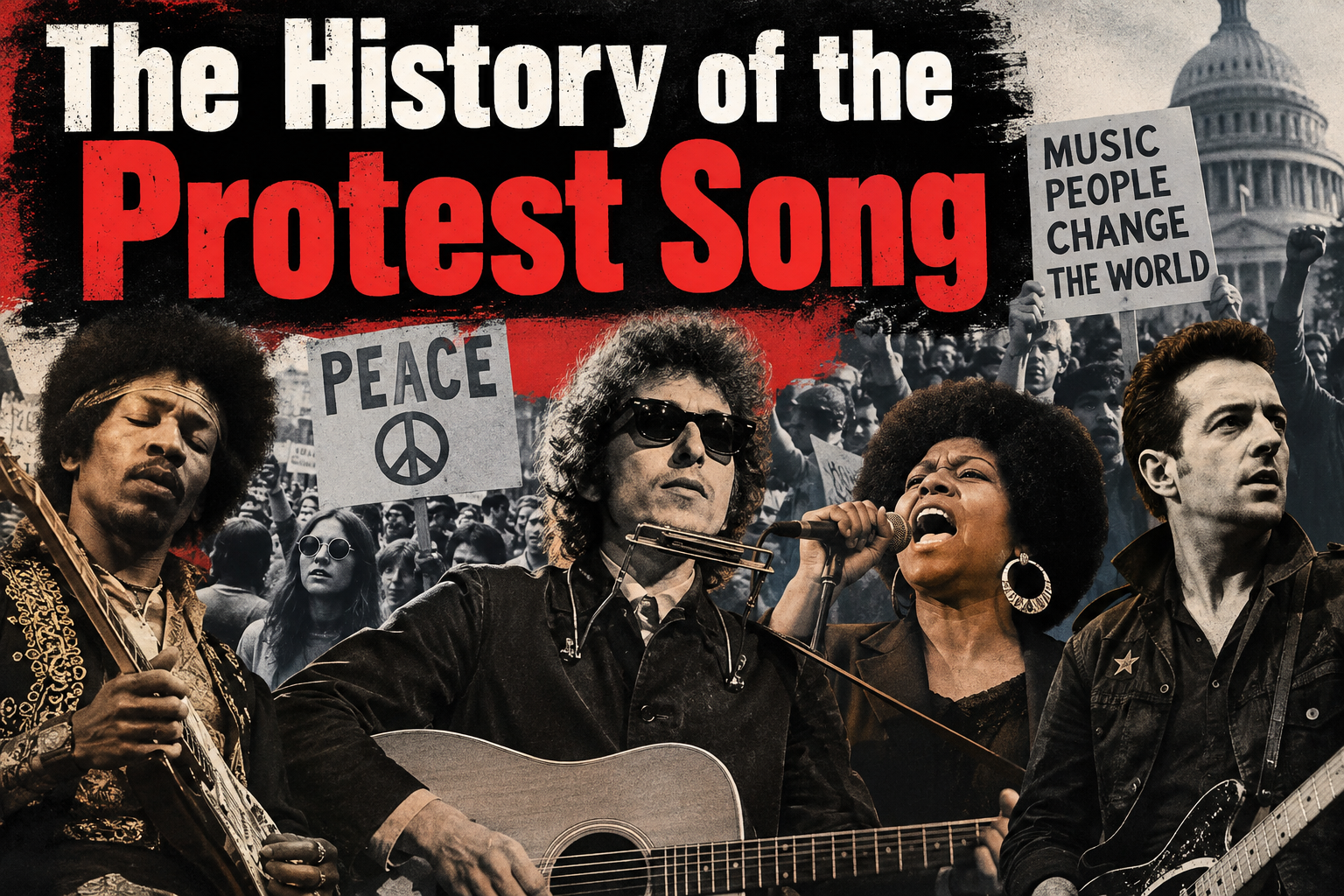
A protest song is more than a song with an opinion. It is music made to challenge power, mourn injustice, preserve collective memory, demand change, or help people recognize themselves as part of a larger cause. It may be sung in a church, at a picket line, in a prison, on a battlefield, in a nightclub, over the radio, or through a phone speaker to millions of listeners. It can be solemn or funny, furious or hopeful, coded or direct. It can name a president, a war, a law, or an oppressor—or it can speak in metaphors so that listeners understand the message without the singer ever saying it plainly.
The history of the protest song is, in many ways, the history of people refusing to accept the world exactly as it is. Before mass literacy, before newspapers reached ordinary households, and long before social media, songs carried news, values, grievances, and dreams from one person to another. They helped communities remember what had happened to them. They gave movements a shared language. They turned private pain into public expression.
Protest songs do not always create revolutions, and their impact can be difficult to measure. A song cannot pass legislation by itself. It cannot end a war simply by being sung. But music can make an idea emotionally available. It can transform a political argument into something a person can remember, repeat, and feel. It can make people less isolated. It can turn a crowd into a chorus, and a chorus into a community.
This is the long story of how songs have served resistance: from folk traditions and spirituals to labor anthems, civil-rights hymns, antiwar rock, feminist punk, hip-hop, global liberation music, and today’s digital activism.
Before “Protest Songs” Had a Name
The phrase “protest song” is relatively modern, but the practice is ancient. Wherever people have lived under unequal systems of power, they have found ways to express dissent through music. Many early songs were not recorded in written form because they belonged to oral traditions. They survived because people taught them to one another.
In societies where literacy was limited, songs could preserve history more effectively than documents available only to elites. Ballads told stories of wars, betrayals, executions, romance, migration, and rebellion. In Europe, traveling musicians and singers spread news between villages and towns. In West African traditions, griots carried genealogies, political histories, and social criticism through music and storytelling. Indigenous musical traditions across the world often connected songs to land, spiritual practice, survival, and communal memory. Under colonization, those connections could become acts of resistance in themselves.
Not every old political song sounds like a modern protest anthem. Some celebrated monarchs, armies, or national victories. Others mocked public figures, criticized taxes, mourned poverty, or warned communities about injustice. Satire was especially important because humor could conceal political criticism. A song that sounded like a comic story could carry sharp commentary about class, corruption, or repression.
Religious music also provided a powerful language for protest. Faith traditions often contain stories about exile, liberation, suffering, justice, and redemption. These stories can be interpreted in ways that challenge earthly power. The biblical story of the Israelites escaping slavery in Egypt, for example, has repeatedly served as a metaphor for freedom movements. Songs invoking liberation, promised lands, or deliverance could express hopes that were both spiritual and political.
The protest song was therefore not invented by the modern recording industry. It existed wherever people needed to speak beyond the limits placed on them.
Spirituals, Enslavement, and Coded Resistance
One of the most important roots of the American protest-song tradition lies in the spirituals created by enslaved Black people in the United States. These songs emerged under conditions of extreme violence, forced labor, family separation, legal exclusion, and constant surveillance. They were religious songs, but reducing them to simple expressions of faith misses their depth. Spirituals often carried grief, endurance, community, and hope for liberation.
Songs such as “Go Down Moses” drew on the story of Moses leading the Israelites out of bondage. The phrase “Let my people go” had an obvious biblical meaning, but it also resonated powerfully with the experience of slavery. “Wade in the Water,” “Steal Away,” and “Swing Low, Sweet Chariot” have often been associated with escape, coded communication, death, freedom, and the possibility of a world beyond oppression. Scholars continue to debate the exact use of codes in particular songs, and it is important not to turn every spiritual into a secret map. Yet there is no doubt that these songs carried meanings that extended beyond conventional worship.
Spirituals could help people endure unbearable conditions. Singing together created emotional solidarity in spaces where enslaved people were denied control over nearly every other part of their lives. The songs could also preserve a sense of identity and dignity. In a system designed to treat human beings as property, communal music asserted personhood.
After emancipation, spirituals continued to evolve and influence American music. Gospel, blues, jazz, soul, rhythm and blues, and later hip-hop all inherited parts of this musical and emotional tradition. The call-and-response pattern common in many Black musical forms was especially important. It made music participatory rather than passive. A leader might sing a line, and the group would answer. In protest settings, that structure became politically useful: it allowed a crowd to become an active body rather than an audience.
The spiritual tradition also shaped later civil-rights music. “We Shall Overcome,” perhaps the most famous American movement song of the twentieth century, has roots in gospel, labor organizing, and Black church culture. It became a hymn of collective resolve precisely because it carried both religious and political force.
Revolutionary Songs and the Birth of National Anthems
Political songs have often been tied to revolutions and nation-building. During the American Revolution, songs and ballads helped spread patriotic sentiment, ridicule opponents, and build a sense of shared identity among colonists. “Yankee Doodle,” originally used by British forces to mock colonial Americans, was adopted and transformed by those it insulted. This reversal demonstrated a familiar strategy in protest culture: reclaiming what was intended as humiliation.
The French Revolution produced “La Marseillaise,” first written in 1792 and later adopted as France’s national anthem. It was a revolutionary war song, filled with urgency, patriotism, and violent imagery. Its history reveals a recurring tension in political music. A song born in rebellion can later become part of official state culture. What begins as a challenge to authority may, over time, be absorbed into the institutions it once opposed.
National anthems often contain traces of protest, revolution, or liberation. They can unite people against foreign rule or inherited oppression. At the same time, they can exclude those who do not fit the nation’s dominant story. This dual nature appears throughout the history of political music. Songs can be tools of liberation, but they can also be used to enforce conformity.
In the nineteenth century, movements for independence and democratic reform across Europe and the Americas produced songs that celebrated popular sovereignty, national identity, and freedom from empire. Many of these songs were sung in public gatherings, political meetings, and military contexts. Their themes were often broad: liberty, homeland, sacrifice, and collective destiny.
The emotional power of such songs was immense. A political pamphlet might persuade a reader, but a song could move a crowd immediately. Shared melody made a cause memorable. Repetition made it durable. People who could not read a manifesto could still sing an anthem.
Labor Songs and the Music of Working People
The industrial revolution transformed work, cities, and social conflict. As factories expanded in the nineteenth century, workers often faced long hours, dangerous conditions, low pay, child labor, and little political power. Labor organizing created one of the richest traditions of protest music.
Workers sang in mines, factories, railroad camps, docks, farms, and union halls. These songs described exploitation, honored solidarity, mocked bosses, and encouraged people to join strikes. The music was often practical. A simple chorus could be learned quickly and sung by large groups. It could sustain morale during long marches or tense picket lines.
“The Internationale,” written in France after the Paris Commune of 1871, became perhaps the most internationally recognized socialist anthem. Its lyrics called on workers of the world to unite, and it was translated into many languages. The song spread through labor movements, socialist parties, and revolutionary organizations across Europe, Asia, Africa, and the Americas. It became a symbol of international working-class solidarity.
In the United States, the Industrial Workers of the World, or IWW, made especially memorable use of music. Founded in 1905, the organization embraced industrial unionism and sought to organize workers across trades, races, and nationalities. The IWW’s “Little Red Songbook” collected songs that could be sung to familiar tunes. It included humor, satire, and militant optimism.
Joe Hill, a Swedish-born labor organizer and songwriter associated with the IWW, became a legendary figure in this tradition. His songs, including “The Preacher and the Slave,” used parody to criticize religious institutions that encouraged workers to accept suffering in exchange for promised rewards after death. The phrase “pie in the sky” came from this song. Hill was executed in 1915 after a controversial murder conviction, and his death turned him into a labor martyr. The song “Joe Hill,” written later by Alfred Hayes and set to music by Earl Robinson, kept his memory alive with the line, “I never died, said he.”
Labor songs gave workers a sense that they belonged to a movement larger than their individual job or town. That mattered because industrial labor could be isolating and dehumanizing. A song could connect a miner in Pennsylvania to a textile worker in Massachusetts or a dockworker in California.
The labor-song tradition also influenced folk revival music in the twentieth century. Songs about unions, unemployment, strikes, and economic injustice continued to appear during the Great Depression and beyond. They were not merely historical artifacts. They became part of a living repertoire that could be adapted to new struggles.
Folk Music, the Great Depression, and Woody Guthrie
The Great Depression of the 1930s created ideal conditions for a new wave of American protest music. Economic collapse devastated millions of people. Banks failed, farms were lost, unemployment soared, and migrant workers traveled in search of survival. Musicians and writers responded by documenting hardship and criticizing the systems that produced it.
Woody Guthrie became one of the defining figures of this era. Born in Oklahoma in 1912, Guthrie traveled widely during the Dust Bowl and Depression. He sang about migrants, workers, unions, landlords, poverty, fascism, and the American landscape. His style was plainspoken, direct, and rooted in traditional folk forms.
Guthrie’s best-known song, “This Land Is Your Land,” is often taught as a cheerful patriotic song. But its original verses were more critical. Written partly in response to Irving Berlin’s “God Bless America,” Guthrie’s song questioned whether the country’s wealth and land truly belonged to everyone. One verse described a sign reading “No Trespassing” and answered, in effect, that the other side of the sign belonged to the people. Another verse depicted people waiting in a relief line and asked whether the nation was really made for them.
This is a common fate for protest songs: the most challenging verses can be omitted when a song enters mainstream culture. A song’s melody may become widely known while its political edge is softened. Yet the full version of “This Land Is Your Land” remains one of the clearest statements of egalitarian American folk music.
Guthrie famously wrote “This Machine Kills Fascists” on his guitar. The phrase captured the belief that music could be a weapon—not in a literal sense, but as a tool against propaganda, fear, and injustice. His influence on later musicians was enormous. Pete Seeger, Bob Dylan, Bruce Springsteen, Billy Bragg, and countless others drew from his example.
The folk revival of the 1940s, 1950s, and early 1960s expanded the role of political song. Groups such as The Weavers brought traditional and labor songs to wider audiences. Pete Seeger, one of the central figures in American protest music, performed songs about peace, civil rights, the environment, and economic justice for decades. He understood music as a communal practice. His concerts often emphasized sing-alongs, teaching audiences that they were not spectators but participants.
Civil Rights and the Sound of Collective Courage
The U.S. civil-rights movement transformed the protest song into a central feature of modern political life. Music was present in mass meetings, churches, marches, arrests, voter-registration drives, and demonstrations. It gave people courage when they faced police violence, threats, imprisonment, and uncertainty.
Many songs used by the movement were older spirituals, hymns, folk songs, and labor songs adapted to new circumstances. “We Shall Overcome” became the movement’s most enduring anthem. Its evolution demonstrates how protest music often works. The song had roots in an older hymn, moved through labor organizing, and was reshaped by Black activists in the South. Through repeated use, it became inseparable from the struggle for civil rights.
Its power came from simplicity. The melody was slow and easy to learn. The words were modest rather than grandiose: “We shall overcome someday.” Yet the phrase carried immense force. It expressed hope without pretending that victory was immediate. It acknowledged struggle while insisting that change was possible.
Other movement songs included “Ain’t Gonna Let Nobody Turn Me Around,” “This Little Light of Mine,” “Keep Your Eyes on the Prize,” “Woke Up This Morning (With My Mind Stayed on Freedom),” and “Which Side Are You On?” These songs could be altered to fit a particular city, campaign, or moment. Singers added local names, changed verses, and responded to current events. That flexibility made them useful.
Freedom songs were not simply background music. They helped organize time and emotion. Singing before a march could steady nerves. Singing in jail could resist humiliation. Singing at a mass meeting could make people feel that they belonged to a movement with history and purpose. The songs were also a form of education. Their lyrics taught movement values: courage, unity, nonviolence, solidarity, perseverance, and justice.
The civil-rights movement also brought individual artists into public political roles. Nina Simone’s “Mississippi Goddam,” written after the murder of Medgar Evers and the bombing of Birmingham’s 16th Street Baptist Church, was a furious rejection of gradualism and polite silence. Unlike “We Shall Overcome,” it was not designed for communal singing. It was a personal, sharp-edged statement of outrage.
Sam Cooke’s “A Change Is Gonna Come,” released in 1964, offered a different kind of protest song. It was reflective, mournful, and deeply personal. Inspired in part by Cooke’s experience with segregation and by the broader civil-rights struggle, the song framed change as both necessary and uncertain. Its beauty made it enduring, but its emotional complexity prevented it from becoming a simple slogan.
The civil-rights era showed that protest songs could take many forms. They could be collective hymns, angry declarations, quiet prayers, or poetic expressions of longing. What united them was their relationship to a struggle for dignity and equality.
The Antiwar Movement and the Folk-Rock Era
The Vietnam War intensified the role of protest music in the 1960s and early 1970s. Television brought images of war into American homes, while the draft made the conflict personal for young people and their families. Musicians responded with songs that questioned military power, nationalism, political leadership, and the human cost of war.
Bob Dylan became one of the most influential writers of the era. “Blowin’ in the Wind,” released in 1963, asked a series of unanswered questions about peace, freedom, and human indifference. Its language was poetic and open-ended. Rather than telling listeners exactly what to think, it invited them to confront the fact that the answers were visible but ignored.
“The Times They Are A-Changin’” was more direct. It addressed writers, politicians, parents, and social leaders, warning them that social change was already underway. The song became an anthem for a generation, although it was broad enough to be adopted by many later movements.
Other musicians used more confrontational language. Country Joe and the Fish’s “I-Feel-Like-I’m-Fixin’-to-Die Rag” used dark humor and a memorable chorus to attack the logic of war. Creedence Clearwater Revival’s “Fortunate Son” criticized the class inequalities behind patriotism, pointing out that the sons of wealthy and connected families were often protected from the risks faced by ordinary soldiers. Edwin Starr’s “War” asked its famous question: “What is it good for?” Its answer was blunt.
Rock music gave protest songs a new scale. Amplified guitars, large festivals, radio exposure, and record sales allowed political messages to reach enormous audiences. Events such as the 1969 Woodstock festival became symbols of youth culture, antiwar sentiment, and countercultural identity.
Yet the relationship between rock and protest was complicated. Commercial success could turn rebellion into a marketable image. Artists had to navigate record labels, radio restrictions, public backlash, and the risk of being reduced to symbols. Some listeners wanted music to remain personal or entertaining rather than political. Others argued that musicians had a responsibility to speak out.
The antiwar era also broadened the idea of what a protest song could sound like. Soul, folk, rock, jazz, country, and pop all contributed. Marvin Gaye’s 1971 album What’s Going On addressed war, poverty, police brutality, addiction, and environmental damage through lush, emotionally layered soul music. Rather than shouting, Gaye created a conversation among voices. The album asked listeners to look closely at pain that many preferred not to see.
Black Power, Soul, Funk, and Political Self-Definition
As the civil-rights movement developed, the language of protest changed. The Black Power movement emphasized self-determination, political autonomy, cultural pride, and resistance to systemic racism. Music became a major vehicle for those ideas.
James Brown’s “Say It Loud – I’m Black and I’m Proud,” released in 1968, was a declaration of identity and confidence. Its chant-like chorus was designed for collective participation. At a time when Blackness was routinely stigmatized in American culture, the song asserted pride as a political act.
Aretha Franklin’s “Respect” was not written originally as a feminist anthem, but her version transformed it. Her performance turned a demand for respect into a statement of female authority, self-worth, and independence. The spelling out of “R-E-S-P-E-C-T” became an unforgettable act of vocal command.
Curtis Mayfield’s music, including songs associated with Super Fly, connected urban life, Black consciousness, poverty, and survival. Gil Scott-Heron blended poetry, jazz, soul, and spoken word to critique television culture, consumerism, racism, and political complacency. His work influenced later spoken-word artists and hip-hop musicians.
Political Black music did not always sound like a march. It could be danceable, sensual, stylish, humorous, or experimental. Funk, for example, used rhythm as a form of assertion. The groove itself could communicate confidence, communal energy, and refusal to be diminished.
Jazz also remained important. Artists such as Charles Mingus, Max Roach, Abbey Lincoln, John Coltrane, and Nina Simone used composition, improvisation, and performance to confront racism and violence. Max Roach’s 1960 album We Insist! Freedom Now Suite was explicitly connected to civil-rights struggles and anti-colonial movements. Jazz’s freedom of form often mirrored political desires for freedom in society.
Feminist Songs and the Politics of Personal Experience
The women’s liberation movement of the 1960s and 1970s generated its own musical traditions. Feminist protest songs challenged sexism, domestic violence, unequal pay, reproductive restrictions, sexual double standards, and the assumption that women’s personal lives were apolitical.
The phrase “the personal is political” became central to feminist thought. Songs could expose experiences that had often been kept private: abuse, unequal relationships, unpaid labor, objectification, and exclusion. By naming those experiences publicly, musicians challenged the idea that they were isolated individual problems.
Helen Reddy’s “I Am Woman,” released in the early 1970s, became a mainstream feminist anthem. Its direct declaration of strength resonated with many listeners, even as some critics found it overly polished or commercial. The song’s popularity mattered because it showed that feminist language could enter mass culture.
Other artists created more complicated feminist music. Joni Mitchell wrote songs that explored relationships, freedom, ambition, motherhood, vulnerability, and artistic identity without always fitting into slogan-driven politics. Joan Baez connected antiwar activism, civil rights, and human rights to her folk performances. Later, artists such as Ani DiFranco, Tracy Chapman, Sinéad O’Connor, Bikini Kill, Sleater-Kinney, and many others addressed gender, sexuality, power, and violence in distinctly different ways.
The Riot Grrrl movement of the early 1990s brought feminist politics into punk. Bands such as Bikini Kill, Bratmobile, and Heavens to Betsy created music that was raw, confrontational, and deliberately anti-polished. Riot Grrrl encouraged girls and women to form bands, make zines, organize shows, and speak openly about abuse, sexuality, body image, and gender inequality.
The movement also exposed tensions within feminist music. Who gets heard? Whose experience is treated as universal? How do race, class, disability, gender identity, and sexuality shape access to the stage? These questions pushed protest music beyond simple declarations of unity and toward a more complex understanding of power.
Punk, Hardcore, and the Refusal of Respectability
Punk emerged in the 1970s as a reaction against economic stagnation, social alienation, commercial rock excess, and political frustration. Its sound was often fast, loud, stripped-down, and confrontational. Punk did not have one political position, but many punk scenes became deeply associated with anti-authoritarianism.
In the United Kingdom, punk developed amid unemployment, class tension, and anger at political institutions. The Sex Pistols’ “God Save the Queen” attacked the monarchy and national complacency with deliberate provocation. The Clash combined punk energy with anti-racist, anti-imperialist, and working-class concerns. Their songs addressed policing, war, unemployment, and racial conflict.
In the United States, punk and hardcore scenes created local networks of independent labels, small venues, fanzines, and community spaces. Bands such as Dead Kennedys used satire to attack militarism, consumerism, and political hypocrisy. Black Flag and other hardcore bands expressed alienation, anger, and resistance to social control. Later punk movements took up animal rights, anti-fascism, environmentalism, queer liberation, and anti-globalization.
Punk’s political importance was not only lyrical. Its do-it-yourself ethic challenged the idea that artistic legitimacy required permission from major labels or established institutions. People could make their own records, organize their own shows, publish their own writing, and build their own communities. That infrastructure became a form of protest against cultural gatekeeping.
The limitations of punk were also real. Some scenes reproduced sexism, racism, and exclusion even while claiming to oppose authority. Protest music is never automatically progressive simply because it sounds rebellious. Its politics depend on who participates, who is represented, and what forms of power are being challenged or ignored.
Reggae, Anti-Colonialism, and Global Liberation
Protest music has always been global, though histories written from an American perspective often overlook that fact. Across Africa, the Caribbean, Latin America, Asia, the Middle East, and Europe, musicians have used song to oppose colonialism, apartheid, dictatorship, censorship, racism, and economic exploitation.
Reggae is one of the most internationally influential forms of political music. Emerging in Jamaica, reggae drew from ska, rocksteady, Rastafari spirituality, African diasporic traditions, and the social realities of postcolonial life. Its themes included poverty, racial injustice, spiritual liberation, police violence, and resistance to “Babylon,” a term often used to describe oppressive systems of power.
Bob Marley became reggae’s most famous global figure, but his importance was not merely commercial. Songs such as “Get Up, Stand Up,” “Redemption Song,” “War,” and “Zimbabwe” connected personal dignity to anti-colonial and pan-African politics. “Redemption Song,” in particular, drew on the words of Marcus Garvey and urged listeners to “emancipate yourselves from mental slavery.” Its acoustic simplicity made the message especially direct.
Peter Tosh, Burning Spear, Culture, and many other reggae artists also made powerful political music. Their work emphasized that freedom was not just a legal condition but a spiritual, economic, and cultural struggle.
In South Africa, music played a central role in the fight against apartheid. Protest songs circulated in churches, unions, funerals, rallies, and international solidarity campaigns. “Nkosi Sikelel’ iAfrika,” originally a hymn, became a symbol of Black South African resistance and later formed part of the country’s post-apartheid national anthem. Artists such as Miriam Makeba and Hugh Masekela brought South African music and anti-apartheid politics to international audiences, often while living in exile.
In Nigeria, Fela Kuti used Afrobeat to criticize military rule, corruption, colonial legacies, and economic inequality. His music combined Yoruba rhythms, jazz, funk, long instrumental passages, and sharply political lyrics. Fela’s activism came with serious consequences: harassment, arrests, beatings, raids, and repression by the Nigerian state. His work demonstrated that protest music can be dangerous precisely because it reaches people so effectively.
In Chile and elsewhere in Latin America, the Nueva Canción movement blended folk traditions with political commitment. Artists such as Violeta Parra, Víctor Jara, Mercedes Sosa, and Silvio Rodríguez used music to address class inequality, indigenous identity, dictatorship, and liberation. Víctor Jara was tortured and murdered after the 1973 military coup in Chile, becoming one of the era’s most enduring symbols of artistic resistance.
These examples show that protest songs are not a genre defined by a particular sound. They are a function of social purpose. Reggae, folk, Afrobeat, salsa, nueva canción, jazz, rock, and traditional music can all become protest music when they speak to conditions of power and struggle.
Hip-Hop and the Politics of Witness
Hip-hop emerged in the Bronx in the 1970s amid disinvestment, segregation, poverty, housing crises, and the neglect of urban neighborhoods. From the beginning, hip-hop was shaped by survival and invention. DJs, MCs, dancers, and graffiti artists created culture with limited resources. The music documented life in communities often misrepresented or ignored by mainstream media.
Early hip-hop was not always explicitly political, but it quickly became a vehicle for social commentary. Grandmaster Flash and the Furious Five’s “The Message,” released in 1982, described urban despair with vivid realism: broken glass, poverty, addiction, violence, pressure, and the feeling of being trapped. The song’s famous line, “Don’t push me, ’cause I’m close to the edge,” captured both psychological strain and social critique.
Public Enemy expanded hip-hop’s political possibilities in the late 1980s. Their music combined dense production, media critique, Black nationalism, anti-racist politics, and urgent performance. Songs such as “Fight the Power” and “911 Is a Joke” criticized racism, institutional neglect, and unequal public services. Their sound was intentionally intense, using samples, sirens, spoken voices, and sonic chaos to convey the pressure of the world they described.
N.W.A.’s “Fuck tha Police” became one of the most controversial protest songs of its era. Its language and aggression provoked outrage, but its central subject—police violence and harassment in Black communities—was rooted in lived experience. The song’s reception showed how protest music can be judged more harshly when it comes from marginalized voices using uncompromising language.
Hip-hop’s political range continued through artists such as KRS-One, Queen Latifah, Tupac Shakur, Lauryn Hill, Mos Def, Common, The Roots, Dead Prez, M.I.A., Kendrick Lamar, J. Cole, Noname, Rapsody, Run the Jewels, and many others. Songs have addressed racism, mass incarceration, poverty, misogyny, immigration, war, surveillance, gentrification, and capitalism.
Kendrick Lamar’s “Alright” became closely associated with Black Lives Matter protests in the 2010s. Its refrain, “We gon’ be alright,” was chanted in demonstrations after police killings of Black people. Like “We Shall Overcome,” the song was not created as an official movement anthem, but activists transformed it through use. That transformation is one of the defining processes in protest-song history: movements choose songs as much as artists write them.
Hip-hop also raises difficult questions about protest and commercialization. A politically charged song can become a streaming hit, a brand soundtrack, or a social-media trend. That does not necessarily erase its meaning, but it changes the context in which it is heard. Artists must navigate the tension between being widely visible and being safely marketable.
LGBTQ+ Liberation and Songs of Identity
Music has been central to LGBTQ+ communities, especially where open expression was dangerous. Songs have provided coded recognition, celebration, escape, and direct political assertion. Long before LGBTQ+ rights movements gained broad public visibility, queer listeners found meaning in songs about secrecy, longing, difference, and chosen family.
Disco became especially important in the 1970s for many gay, Black, Latino, and marginalized communities. Dance floors offered spaces where bodies, identities, and desires could be expressed with greater freedom than in mainstream public life. The anti-disco backlash of the late 1970s was not only about musical taste; it was also connected to racism, homophobia, and discomfort with the communities that disco represented.
Artists such as Sylvester turned disco into a site of queer liberation. His voice, style, and performances challenged narrow ideas of gender and masculinity. Later artists, including k.d. lang, Melissa Etheridge, Indigo Girls, RuPaul, Elton John, George Michael, Bronski Beat, Lady Gaga, Frank Ocean, Janelle Monáe, Lil Nas X, and many others, contributed to a broad and evolving tradition of LGBTQ+ musical expression.
Bronski Beat’s “Smalltown Boy,” released in 1984, told a story of a young gay man facing isolation and violence. Its emotional force came from its combination of dance music and vulnerability. The song demonstrated that a protest song does not need a slogan to be political. Simply telling a truth that society tries to erase can be an act of resistance.
During the AIDS crisis, music helped communities mourn, organize, and demand action. Activists criticized governmental inaction, stigma, and medical neglect. Songs and benefit concerts raised awareness and money, while queer artists insisted on visibility during a period of profound loss.
Environmental Protest and the Politics of the Planet
Environmental protest songs have roots in older traditions of land, labor, and indigenous resistance. Songs about poisoned water, devastated farms, mining disasters, deforestation, and displacement have long linked ecological damage to economic power.
In the United States, Pete Seeger’s “Where Have All the Flowers Gone?” and “If I Had a Hammer” became associated with peace and justice movements, while his environmental activism later focused on the Hudson River and public ecological awareness. Joni Mitchell’s “Big Yellow Taxi,” with its memorable warning that “you don’t know what you’ve got till it’s gone,” became a widely recognized critique of environmental destruction.
Marvin Gaye’s “Mercy Mercy Me (The Ecology)” linked pollution and ecological loss to soul music’s emotional language. More recent musicians across genres have addressed climate change, extractive industries, indigenous land rights, wildfires, droughts, and environmental racism.
Environmental protest music often faces a special challenge: the crisis can seem too large and abstract. Songs help make it personal by connecting global threats to rivers, neighborhoods, animals, weather, food, family, and memory. They can also expose the unequal distribution of environmental harm. Poor communities and communities of color are often more likely to live near pollution, toxic waste, industrial facilities, or climate-related danger.
Indigenous musicians and activists have been especially important in movements against pipelines, land theft, and resource extraction. Their songs frequently connect environmental defense to sovereignty, ancestry, and cultural survival. In these contexts, protecting land is not a separate political issue. It is tied to language, ceremony, history, and the future of a people.
Digital Activism and the Modern Protest Song
The internet has transformed how protest songs are created, shared, and used. A song can now be uploaded, remixed, subtitled, streamed, and circulated globally within hours. Artists no longer need traditional radio or record-label support to reach listeners. Protesters can record songs at demonstrations and distribute them immediately.
This speed has advantages. Songs can respond to events in real time. A chant can become a track, a local performer can find an international audience, and activists can share music across borders. Social media also allows listeners to attach protest songs to videos, posts, and campaigns, creating new forms of political meaning.
At the same time, digital culture can make political music feel temporary. A song may go viral for a few days and then disappear beneath the next wave of content. The speed of circulation does not always create sustained organizing. A powerful chorus can become a meme, separated from the movement that gave it meaning.
Still, recent movements have shown that music remains central to public resistance. During the Arab Spring, protest songs and performances circulated through demonstrations and online networks. In Hong Kong, “Glory to Hong Kong” became associated with pro-democracy protests. In Chile, the feminist performance “Un violador en tu camino,” created by the collective Las Tesis, spread internationally as women adapted it in cities around the world. In the United States, songs connected to Black Lives Matter, immigrant rights, gun-violence prevention, reproductive freedom, and labor organizing have continued to emerge.
The modern protest song may be a polished commercial release, a homemade video, a spoken-word performance, a chant, a remix, or a short clip used thousands of times online. Its format has changed, but its purpose remains familiar: to make injustice visible and collective action imaginable.
Why Protest Songs Endure
Protest songs endure because they solve a human problem that politics alone cannot solve. People need facts, policies, strategies, institutions, and votes. But they also need courage, memory, belonging, and emotional energy. Music can help provide those things.
A successful protest song often balances specificity and openness. It may speak to a particular event while allowing later listeners to hear their own struggles in it. “We Shall Overcome” belonged to the civil-rights movement, but it has been sung by movements around the world. “This Land Is Your Land” emerged from Depression-era inequality, but its questions about ownership and belonging remain relevant. “Fight the Power” was connected to a specific cultural and political moment, yet its title alone can be adopted by many causes.
The most durable protest songs also invite participation. They can be sung, chanted, adapted, or remembered. A song that exists only as a recording may move listeners, but a song that can be used by a crowd becomes part of a movement’s infrastructure.
Protest music can fail, too. It can become preachy, simplistic, commercialized, or disconnected from the people it claims to represent. It can substitute feeling for action. It can preach rebellion while reproducing the same inequalities it condemns. These failures do not make protest songs meaningless; they remind us that music is part of politics, not a replacement for it.
The history of the protest song is ultimately a history of voices refusing silence. From spirituals sung under slavery to union songs in strike camps; from civil-rights hymns to antiwar folk; from reggae’s calls for liberation to hip-hop’s witness against police violence; from feminist punk to climate-justice music, people have used song to say that their lives matter and that the world can be different.
The protest song remains necessary because injustice remains unfinished. As long as people are denied safety, dignity, freedom, representation, or a future, someone will write a song about it. And somewhere, someone else will recognize themselves in the chorus.
This post has already been read 13 times!