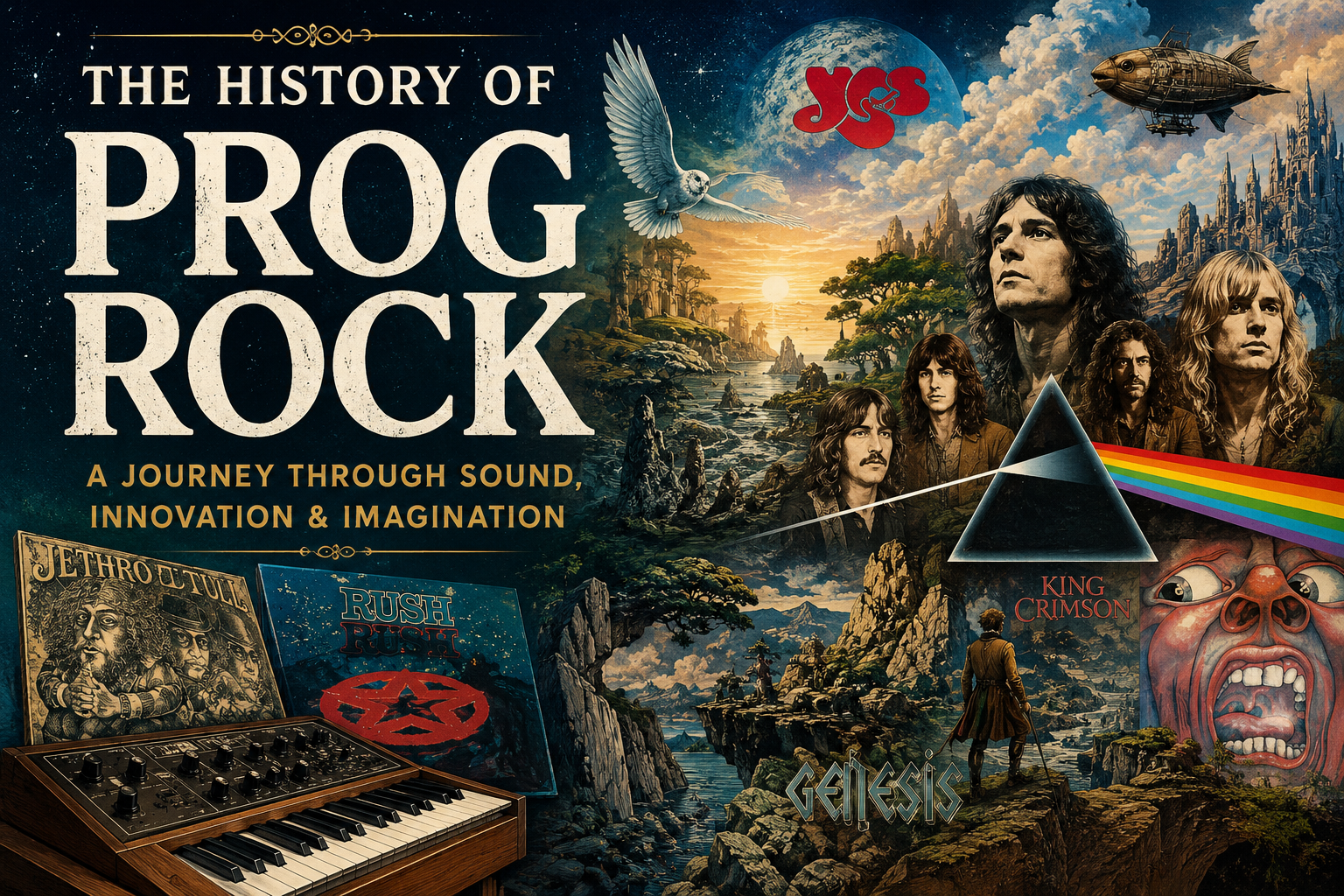
Progressive rock, or prog rock, was one of the strangest and most ambitious musical movements to emerge from the 1960s and 1970s. It took the basic ingredients of rock music—electric guitars, bass, drums, keyboards, vocals—and treated them as raw materials rather than rules. Songs could stretch past ten or twenty minutes. Albums could tell elaborate stories. Musicians could borrow ideas from classical music, jazz, folk, blues, electronic music, and even medieval composition. A rock band could suddenly sound less like a group playing songs and more like a small orchestra attempting something enormous.
That ambition made progressive rock both celebrated and controversial. To its supporters, prog represented rock music growing up. It demonstrated that popular music could be adventurous, sophisticated, intellectually curious, and emotionally powerful without abandoning the electricity that made rock exciting. To its critics, prog sometimes represented the exact opposite: musicians becoming so impressed with their own technical abilities that the songs disappeared underneath the complexity.
Both arguments contain some truth.
The history of progressive rock is therefore more interesting than a simple story about virtuoso musicians and giant albums. Prog emerged from a particular cultural moment, developed rapidly, became one of the dominant forms of ambitious album-oriented rock, suffered a spectacular backlash, and then spent decades influencing musicians who had little interest in calling themselves progressive rock artists.
Its story begins before anyone had a name for it.
Before Prog: The Seeds of Something Bigger
Rock music had always contained ambitious musicians. The idea that rock had to be simple, short, and commercially straightforward was never completely accurate.
The Beatles were already expanding the possibilities of popular music by the middle of the 1960s. Albums such as Rubber Soul, Revolver, Sgt. Pepper’s Lonely Hearts Club Band, and Magical Mystery Tour demonstrated that an album could be conceived as more than a collection of unrelated singles. George Martin’s orchestral arrangements, unusual studio techniques, tape manipulation, unconventional instrumentation, and increasingly adventurous songwriting helped establish a new idea: rock musicians did not have to stay within the boundaries established by early rock and roll.
The Beach Boys were doing something similar from another direction. Brian Wilson’s work on Pet Sounds transformed the idea of what a pop album could sound like. The album was sophisticated without being dominated by instrumental virtuosity. Its importance to progressive rock was less about specific musical techniques than about the idea that popular musicians could approach an album as an artistic project.
Meanwhile, psychedelic rock was breaking down the traditional boundaries of the three-minute single.
Groups such as Jefferson Airplane, The Doors, Cream, The Jimi Hendrix Experience, and Pink Floyd were exploring longer arrangements, unusual sounds, extended instrumental passages, and studio experimentation. The psychedelic era also encouraged audiences to accept music that was less immediately accessible.
Cream were particularly important because their performances demonstrated how much instrumental freedom could exist inside a rock format. Eric Clapton, Jack Bruce, and Ginger Baker could stretch songs into extended improvisations while still operating within a recognizable rock framework. The power-trio format placed enormous emphasis on musicianship.
The Doors brought another ingredient: theatricality. Their songs could feel like miniature dramas, and Jim Morrison’s performances suggested that rock could draw from poetry, theater, and mythology.
Pink Floyd initially pushed in an experimental direction that was even less conventional. Their early work under Syd Barrett emphasized atmosphere, studio effects, psychedelic imagery, and unusual song structures. They would eventually become one of progressive rock’s most successful bands, although their identity would continue evolving long after the genre’s original period.
Jazz also mattered enormously.
Rock musicians were increasingly listening to jazz musicians who treated improvisation and composition as complementary rather than opposing ideas. The influence of jazz encouraged musicians to think about rhythm differently, particularly through complex time signatures, extended instrumental passages, and group interaction.
Classical music provided another source of inspiration.
Many young British musicians had grown up hearing orchestral music and were fascinated by composers such as Bach, Beethoven, Stravinsky, Bartók, and Holst. The ambition was not necessarily to turn rock into classical music. Instead, musicians wanted to borrow some of classical composition’s scale, structure, dynamics, and sense of development.
That distinction is important.
Progressive rock did not simply appear because rock musicians suddenly decided they wanted to imitate classical music. It emerged because musicians were increasingly willing to treat rock as a flexible musical language.
The technology of the late 1960s helped make that possible.
Multitrack recording became increasingly sophisticated. Keyboards became more important. The Mellotron could create orchestral textures without requiring an orchestra to be physically present. Moog synthesizers opened entirely new sonic possibilities. Studio recording became less about documenting a live performance and more about constructing a musical environment.
The album itself was becoming the central artistic format.
The conditions were perfect for prog.
The Early British Progressive Scene
There is no single moment when progressive rock was invented.
Instead, the genre developed through several overlapping British scenes during the late 1960s.
One of the most important early groups was The Moody Blues. Their 1967 album Days of Future Passed combined rock instrumentation with orchestral arrangements and presented the album as a continuous artistic experience. The record’s success demonstrated that audiences were willing to embrace something considerably more elaborate than a conventional rock album.
Procol Harum were another crucial bridge between psychedelic rock, classical influence, and progressive music. Their “A Whiter Shade of Pale” became a massive hit, but their albums revealed a group increasingly interested in elaborate arrangements and unusual structures.
The Nice, featuring keyboardist Keith Emerson, went even further. Emerson was fascinated by classical composers and wanted to bring the power and drama of the organ and piano into a rock setting. His stage performances were theatrical, aggressive, and sometimes deliberately outrageous.
The Nice helped establish the idea of the keyboard player as a rock star.
That would become enormously important.
Rock had traditionally been dominated visually by guitarists. Prog expanded the possibilities. Suddenly a band could revolve around a keyboardist, a bassist, or a drummer just as easily as a guitarist.
At the same time, groups such as King Crimson were pushing the music toward a darker and more experimental territory.
King Crimson’s 1969 debut, In the Court of the Crimson King, is often treated as one of the defining starting points of progressive rock. The album combined heavy rock, jazz, classical influences, Mellotron textures, dramatic dynamics, and unusually complex arrangements.
What made King Crimson different was not simply that the music was complicated. The band created an atmosphere that felt almost cinematic. The songs could move from quiet passages to overwhelming climaxes, from delicate sections to enormous walls of sound.
The album demonstrated what prog could be.
It could be heavy.
It could be beautiful.
It could be strange.
And it could be completely committed to the album format.
Yes and the Rise of Virtuosity
Yes became one of the most important bands in the development of progressive rock.
The group’s early albums were relatively experimental, but Yes gradually developed the enormous sound that would define their classic period.
Jon Anderson’s high voice gave the band an ethereal quality. Chris Squire’s bass playing was unusually prominent and aggressive. Bill Bruford brought jazz-influenced drumming. Tony Kaye and later Rick Wakeman supplied increasingly elaborate keyboard textures. Steve Howe added a remarkably versatile guitar style that could move from acoustic passages to aggressive electric playing.
Yes demonstrated that complexity did not necessarily mean sacrificing melody.
Albums such as The Yes Album, Fragile, and Close to the Edge established the band’s reputation. Their music could contain numerous sections, tempo changes, unusual rhythms, instrumental passages, and extended forms while still producing memorable themes.
“Roundabout” became one of the best-known examples of prog reaching a mainstream audience.
The song was unusual for a rock hit, yet its central guitar riff and vocal melody were immediately recognizable. This was one of progressive rock’s great strengths: the best bands could make complicated music feel natural.
Close to the Edge took that philosophy even further. The title track occupied an entire side of the original album and demonstrated how prog musicians increasingly thought in terms of movements rather than conventional verses and choruses.
This was not simply songwriting on a larger scale.
It was a different approach to songwriting.
The question became less “How can we make this song last three minutes?” and more “How much musical territory can this idea contain?”
Genesis and the Art of Storytelling
If Yes represented one side of prog’s musical ambitions, Genesis represented another.
Genesis developed a more theatrical and literary approach to progressive rock. Peter Gabriel’s presence gave the group a distinctive personality, while Tony Banks, Mike Rutherford, Steve Hackett, and Phil Collins created an intricate musical framework.
Early Genesis albums were full of unusual characters, fantasy, surreal imagery, shifting perspectives, and elaborate musical arrangements.
The group’s live performances became increasingly theatrical. Gabriel would eventually appear in elaborate costumes, using characters to turn concerts into miniature pieces of theater.
This helped expand the definition of what a progressive rock performance could be.
It was not enough to play complicated music. The performance itself could become part of the narrative.
Genesis also demonstrated that progressive rock could be emotionally intimate.
Songs such as “The Musical Box” and “Supper’s Ready” contained complex structures, but they were not merely exercises in technique. Genesis understood atmosphere and tension. Quiet passages mattered because they made the louder passages more powerful.
Their music could be strange without being cold.
That became increasingly important as prog developed.
The best progressive rock was not simply music designed to impress musicians. It was music designed to take listeners somewhere.
Emerson, Lake & Palmer and the Supergroup Era
When Keith Emerson joined forces with Greg Lake and Carl Palmer, progressive rock gained one of its most spectacular groups.
Emerson, Lake & Palmer were essentially a three-piece, but they sounded much larger.
Emerson brought classical keyboard influences, Greg Lake provided a powerful voice and melodic songwriting, and Carl Palmer brought a highly technical drumming style.
The group embraced excess almost as a philosophy.
Their arrangements could be enormous. Emerson’s keyboard performances were often theatrical and physically aggressive. Palmer’s drumming could dominate entire sections. Lake provided the melodic center.
ELP also helped establish another important aspect of prog: the reinterpretation of classical works.
The group adapted pieces by composers such as Mussorgsky and later incorporated classical concepts into their original material. Their approach was sometimes controversial, but it demonstrated that rock musicians could treat the classical canon as something they could interact with rather than simply admire from a distance.
The group’s popularity proved that audiences would accept astonishingly ambitious instrumental music when it was presented with enough personality.
But ELP also became one of the bands most frequently cited by critics when progressive rock later developed its reputation for excess.
That tension would follow the genre throughout its history.
Pink Floyd: Prog Becomes Atmospheric
Pink Floyd followed a different path.
The band’s early psychedelic period was dominated by Syd Barrett, whose eccentric songwriting and experimental approach helped establish the group as one of London’s most intriguing underground acts.
After Barrett’s departure, the band slowly evolved.
Roger Waters, David Gilmour, Richard Wright, and Nick Mason developed a sound built less around constant technical fireworks and more around atmosphere, texture, repetition, studio experimentation, and long-form composition.
Atom Heart Mother and Meddle showed the group moving toward something larger.
Then came The Dark Side of the Moon.
Released in 1973, the album became one of the defining records of the entire progressive era.
Its success was remarkable because it did not sound like traditional prog in every respect. There were no endless displays of instrumental virtuosity. Instead, Pink Floyd created a carefully constructed sonic environment.
The album flowed continuously from one track to another. Themes of time, money, mortality, mental instability, and human pressure connected the songs. Synthesizers, tape loops, sound effects, female vocals, saxophone, and studio manipulation became part of the musical architecture.
The record demonstrated another path for progressive rock.
You could be progressive without constantly showing off.
Pink Floyd’s greatest strength was their ability to make experimentation accessible.
That helped make them one of the most commercially successful bands associated with progressive rock.
The Album Becomes the Event
The rise of prog cannot be separated from the rise of the album.
During the 1960s, singles remained central to popular music. By the early 1970s, however, a growing audience was buying albums as complete artistic statements.
This changed the economics and psychology of rock music.
A three-minute single had obvious limitations. An album could contain forty minutes or more of music. It could have a visual identity, recurring themes, instrumental sections, and a narrative structure.
Progressive rock took advantage of every one of those possibilities.
Album covers became increasingly important.
Roger Dean’s artwork for Yes helped establish an entire visual language for progressive music. Hipgnosis created iconic covers for Pink Floyd and other artists. Fantasy imagery, surreal landscapes, futuristic environments, mythology, and elaborate typography became part of the prog experience.
The record was no longer simply something you bought to hear music.
It was something you could examine.
You could read the sleeve.
You could study the artwork.
You could follow the sequence of tracks.
You could listen to an entire side without interruption.
This was particularly important in the era of vinyl records.
The physical limitations of a record side encouraged musicians to think about music in large blocks. Some progressive albums effectively turned Side One and Side Two into separate movements.
Prog was perfectly suited to this environment.
The Golden Age: 1970–1975
The early-to-mid 1970s represented the peak of progressive rock.
Yes, Genesis, King Crimson, ELP, Pink Floyd, Jethro Tull, Gentle Giant, Van der Graaf Generator, and several other groups were producing ambitious albums.
Jethro Tull occupied a particularly interesting position.
Led by Ian Anderson, the band incorporated progressive arrangements without abandoning folk, blues, hard rock, and theatrical humor. Aqualung and Thick as a Brick became major records.
Thick as a Brick was especially provocative because it essentially presented an entire album as one extended composition.
The joke was part of the concept, but the music was serious.
Jethro Tull showed that prog could have a sense of humor about itself.
Gentle Giant took complexity to another level. Their music could contain unusual harmonies, intricate vocal arrangements, counterpoint, odd meters, and abrupt structural changes. They were less commercially successful than Yes or Genesis, but their influence among musicians became enormous.
King Crimson continued to reinvent itself.
Robert Fripp treated the band almost as a constantly changing musical laboratory. Different lineups produced dramatically different sounds. Rather than settle into a fixed formula, King Crimson repeatedly altered its approach.
This willingness to change became one of progressive rock’s defining characteristics.
Prog was supposed to progress.
That created an unusual problem.
If a progressive band stopped changing, was it still progressive?
The European Explosion
Although Britain became the center of progressive rock, the movement quickly spread throughout Europe.
Italy developed one of the most important prog scenes outside Britain. Bands such as Premiata Forneria Marconi, Banco del Mutuo Soccorso, and Le Orme created music that combined British progressive influences with Italian melodic traditions.
Germany developed its own experimental path through groups associated with what became known as krautrock. While krautrock and British prog were not identical, there was considerable overlap in their interest in experimentation, electronics, extended forms, and unconventional structures.
Bands such as Can, Neu!, and Kraftwerk approached progressive ideas from a more experimental and minimalist perspective.
France produced groups such as Magma, whose music was almost impossible to categorize within conventional rock terminology.
The Netherlands developed bands such as Focus.
Switzerland, Sweden, Spain, and other countries developed their own progressive scenes.
Prog was no longer simply a British phenomenon.
Japan also developed an important progressive rock audience and eventually its own artists.
The global spread of the genre demonstrated that progressive rock was less about a particular national sound than a particular philosophy: rock music could be ambitious, experimental, and album-oriented.
Canterbury and the Jazzy Side of Prog
One of progressive rock’s most fascinating branches developed around the Canterbury scene in England.
Groups such as Soft Machine and Caravan combined progressive rock with jazz, psychedelia, and unusual songwriting.
The Canterbury musicians often approached complexity differently from Yes or ELP. Their music could be whimsical, relaxed, abstract, and improvisational rather than grand and theatrical.
Robert Wyatt became one of the most distinctive figures from this world.
Soft Machine’s early work was particularly important because it blurred the boundaries between rock and jazz. The band demonstrated that progressive music did not have to rely on orchestral grandeur.
It could be strange and improvisational.
This opened the door for a much wider understanding of what prog could be.
Progressive rock was becoming an umbrella rather than a single sound.
The Birth of the Prog Superstar
As progressive rock became more popular, its musicians became stars.
This was unusual because many of them were not traditional rock personalities.
Keith Emerson could be theatrical, but he was also a keyboard virtuoso.
Rick Wakeman became famous for his flowing blond hair, elaborate capes, enormous stage setup, and massive keyboard rigs.
Steve Howe was celebrated primarily for his musicianship.
Tony Banks became one of rock’s most influential keyboard composers.
Steve Hackett developed a distinctive guitar style built around texture and atmosphere.
The drummer was no longer simply the person keeping time.
Bill Bruford, Carl Palmer, Phil Collins, and later other progressive drummers became central musical personalities.
Bass players gained unprecedented prominence as well.
Chris Squire’s playing was so distinctive that his bass became a defining component of the Yes sound.
This emphasis on musicianship helped inspire generations of players.
It also created one of prog’s biggest criticisms.
The genre sometimes seemed to place technical ability above emotional communication.
The debate was already beginning.
Why Prog Became So Successful
Progressive rock’s commercial success during the early 1970s can seem surprising today.
Why would millions of people buy albums containing twenty-minute songs, complex instrumental passages, and minimal interest in the traditional single?
The answer is that the culture of rock music had changed.
The audience was getting older.
Teenagers who had grown up with the Beatles and psychedelic rock were now young adults with money to spend on records and concert tickets.
FM radio was increasingly willing to play album tracks that commercial AM radio would never touch.
Record companies realized that a band could sell millions of albums without necessarily producing hit singles.
Concerts became enormous.
Arena rock was developing, and progressive bands were perfectly suited to large venues.
Their music was dramatic.
Their stage equipment was impressive.
Their albums were events.
The audience wanted spectacle.
Prog provided it.
The Problem With Excess
Success eventually created a problem.
Progressive rock was built on ambition.
Ambition naturally encourages musicians to go further.
And further.
And further.
Soon, some progressive albums became extraordinarily elaborate productions.
There were giant stage sets.
There were enormous keyboard rigs.
There were concept albums about fantasy worlds.
There were twenty-minute songs with multiple movements.
There were extended solos.
There were elaborate album covers.
There were increasingly expensive tours.
The genre’s strengths were becoming its weaknesses.
The music could sometimes feel self-important.
The humor could disappear.
The simple pleasures of rock and roll could get buried underneath layers of complexity.
This became especially noticeable by the middle of the 1970s.
The musical culture around rock was changing.
A new generation was arriving.
And that generation had a very different idea about what rock should be.
Punk Changes Everything
Punk did not destroy progressive rock by itself.
But punk became the perfect cultural reaction to many of prog’s excesses.
The basic punk philosophy was almost the opposite of progressive rock.
Prog said:
“Let’s make the music bigger.”
Punk said:
“Let’s make it simpler.”
Prog musicians often spent years developing their technical abilities.
Punk musicians famously embraced the idea that you did not need virtuosity to start a band.
Prog celebrated long songs.
Punk favored short ones.
Prog valued elaborate arrangements.
Punk valued directness.
Prog concerts could feature massive productions.
Punk could thrive in small clubs.
The contrast was almost comical.
And critics noticed.
By the late 1970s, progressive rock had become a convenient symbol for everything some people disliked about 1970s rock.
It was too long.
Too complicated.
Too serious.
Too expensive.
Too theatrical.
Too self-indulgent.
Punk represented a clean break.
The irony is that progressive rock had never been a single unified style, and many of its best musicians were still experimenting. But once a genre acquires a reputation, that reputation can become more powerful than the music itself.
Prog went from being cutting edge to being unfashionable remarkably quickly.
The Changing Sound of the Late 1970s
The musical landscape was changing beyond punk.
Disco was enormous.
New wave was emerging.
Electronic music was becoming increasingly sophisticated.
Hard rock was evolving into heavy metal.
Pop music was becoming more production-oriented.
Record companies were increasingly interested in singles and radio-friendly formats.
Many progressive bands responded by simplifying their music.
Genesis is perhaps the most famous example.
The group gradually moved away from the dense, sprawling structures of its early years toward shorter, more accessible songs.
This eventually produced enormous commercial success.
Phil Collins became one of the biggest pop stars of the 1980s.
The story is sometimes presented as if Genesis “sold out,” but the reality is more complicated. The band’s musical development had always involved change. The members simply discovered that they could communicate their ideas through more concise forms.
Yes also entered a new phase.
After several personnel changes, the group embraced a more modern sound in the 1980s, producing 90125 and the hit “Owner of a Lonely Heart.”
The song was a major success and demonstrated that progressive musicians could adapt to the new musical environment.
Pink Floyd remained enormously successful.
The Wall, released in 1979, became one of the biggest albums of the era. It was theatrical and conceptually ambitious, yet its songs were generally more accessible than some of the group’s earlier extended compositions.
Progressive rock was changing rather than simply disappearing.
The New Wave of British Heavy Metal Connection
The relationship between progressive rock and heavy metal is often overlooked.
Many early heavy metal musicians admired progressive bands.
Black Sabbath introduced heavy riffs and dark atmosphere, while progressive musicians were experimenting with structure and musicianship.
Later metal musicians increasingly adopted prog’s complexity.
Iron Maiden incorporated longer songs and intricate arrangements.
Rush, although Canadian and often classified separately from British prog, became one of the most important bridges between progressive rock and hard rock.
The rise of technical metal would eventually make progressive ideas fashionable again.
But that would take time.
Rush and the North American Version of Prog
Rush deserves special attention because the band demonstrated that progressive rock could thrive outside the British scene.
The group began with a hard-rock foundation but gradually became more ambitious.
Geddy Lee’s high voice, bass playing, and keyboards combined with Alex Lifeson’s guitar work and Neil Peart’s highly sophisticated drumming.
Peart’s arrival was especially important.
His drumming was technically impressive, but his songwriting contributions and conceptual interests also helped push Rush toward progressive territory.
Albums such as 2112, A Farewell to Kings, and Hemispheres established the group’s reputation.
Rush had a crucial advantage over some British prog bands.
They could be complex without losing the muscular energy of hard rock.
Their songs still had riffs.
They still sounded like a rock band.
That made them an important influence on musicians who loved progressive music but did not necessarily want the theatrical grandeur associated with some British groups.
Rush also became one of the great examples of a band whose reputation grew over time.
They were never simply a nostalgia act.
Their influence would eventually extend into progressive metal, alternative rock, technical rock, and countless other genres.
Prog’s Disappearance From the Mainstream
By the early 1980s, classic progressive rock was no longer a dominant commercial force.
The music industry was changing rapidly.
MTV made visual presentation increasingly important.
New wave and synth-pop embraced concise songs and modern production.
Punk’s influence continued spreading.
Hip-hop was emerging.
Hard rock and metal were becoming more aggressive.
Progressive rock’s traditional audience was aging.
Some bands broke up.
Others changed direction.
Others continued quietly.
But the genre itself became increasingly associated with the previous decade.
This is where progressive rock’s history becomes especially interesting.
It did not die.
It went underground.
The Neo-Prog Revival
During the 1980s, a new generation of progressive rock musicians began rebuilding the style.
Marillion became one of the most successful examples.
Their early albums combined the atmosphere and ambition of classic prog with a more modern production style.
Other groups such as IQ and Pendragon developed similar approaches.
This movement became known as neo-prog.
The musicians clearly understood the classic progressive tradition, but they were not simply recreating 1972.
They had access to new technology.
Synthesizers were more sophisticated.
Digital recording was becoming increasingly important.
Guitar sounds had changed.
The influence of new wave and alternative music was impossible to ignore.
Neo-prog demonstrated that progressive rock could survive even when the mainstream had moved on.
Progressive Metal
Perhaps the most important long-term development in progressive rock came through heavy metal.
Metal musicians had already absorbed prog’s interest in technical ability and long-form composition.
During the 1980s and 1990s, bands increasingly combined heavy riffs with complex structures.
Dream Theater became the most obvious example.
The band’s 1992 album Images and Words helped establish progressive metal as a major subgenre.
Dream Theater combined the virtuosity of classic prog with the aggression of metal.
John Petrucci’s guitar playing became legendary.
Mike Portnoy’s drumming incorporated enormous technical complexity.
Jordan Rudess later expanded the keyboard vocabulary.
James LaBrie’s vocals gave the band a melodic center.
The important thing was that progressive music had found a new home.
Instead of trying to compete with pop music, prog could exist within metal.
This solved one of the genre’s historical problems.
Complexity no longer had to be defended.
Metal audiences were already accustomed to musicianship.
Alternative Rock Discovers Prog
Progressive ideas also began appearing in alternative rock.
Radiohead became one of the most important examples.
The band’s early work was relatively straightforward alternative rock, but later albums such as OK Computer, Kid A, and Amnesiac demonstrated a willingness to experiment with structure, electronics, texture, and unusual arrangements.
Radiohead did not need the progressive rock label.
In fact, they often avoided it.
But the spirit of prog was unmistakable.
The same thing happened with many other alternative artists.
The influence of progressive rock was becoming invisible precisely because it had become so widespread.
Musicians no longer needed to announce that they were making progressive music.
They could simply incorporate its ideas.
The 1990s: Prog Becomes a Musical Vocabulary
By the 1990s, progressive rock had changed from a dominant genre into a musical vocabulary.
A band could use odd time signatures without being called prog.
A songwriter could create a twenty-minute composition without automatically sounding like Yes.
A metal band could include symphonic passages.
An alternative band could create a concept album.
A singer-songwriter could write an interconnected suite.
The borders had disappeared.
This was actually a victory for progressive rock.
The genre’s original goal had been to expand the possibilities of rock music.
By the 1990s, those possibilities had expanded enormously.
Prog no longer needed to dominate the charts to succeed.
Its ideas had already escaped into the wider musical culture.
The 2000s Progressive Renaissance
The 21st century brought another major revival.
Bands such as Porcupine Tree, The Mars Volta, Tool, Opeth, Mastodon, Coheed and Cambria, and later Steven Wilson’s solo work demonstrated that progressive music could sound contemporary rather than nostalgic.
Tool was especially significant.
The band combined metal heaviness with unusual rhythms, long compositions, psychological themes, atmospheric arrangements, and elaborate visual presentation.
Their success proved that a large audience still existed for ambitious rock music.
The Mars Volta approached prog from an entirely different direction.
Their music was chaotic, energetic, experimental, and influenced by punk, Latin music, jazz, and psychedelic rock.
They demonstrated that progressive rock did not have to sound polished or traditional.
Porcupine Tree, led by Steven Wilson, became another important bridge between classic progressive traditions and modern alternative rock.
Wilson also played a major role in reviving interest in the history of progressive rock by producing and remixing classic recordings.
Opeth combined progressive rock with extreme metal, moving between delicate acoustic passages and brutal heavy sections.
Mastodon incorporated progressive structures into a heavy-metal framework.
The genre was no longer one thing.
That had always been its secret.
The Internet Changes Prog
The internet transformed progressive rock more than almost any technology since multitrack recording.
In the vinyl era, discovering an obscure progressive band could be difficult.
In the internet era, almost every important recording became accessible.
Fans could explore Italian prog, Canterbury jazz-rock, Japanese prog, German experimental music, obscure British bands, progressive metal, modern fusion, and countless independent artists.
Online communities created new audiences for music that had once been difficult to find.
YouTube also changed the way musicians learned.
A young guitarist could study Steve Howe.
A drummer could study Bill Bruford.
A keyboardist could study Keith Emerson or Rick Wakeman.
The technical language of progressive rock became part of the global musical education system.
The genre’s once intimidating complexity became more accessible.
The Return of Vinyl and the Concept Album
The revival of vinyl during the 2010s and 2020s also benefited progressive music.
Prog has always been unusually compatible with physical albums.
The artwork matters.
The sequence matters.
The side lengths matter.
The idea of listening to an album from beginning to end makes sense for progressive music.
Modern artists began creating elaborate physical editions, concept albums, box sets, and immersive releases.
The format that had once seemed obsolete became fashionable again.
Prog’s relationship with the album suddenly looked less like a relic and more like a strength.
Why Progressive Rock Has Survived
Progressive rock has survived because its central idea is remarkably durable.
It is not really about synthesizers.
It is not about twenty-minute songs.
It is not about odd time signatures.
It is not even about classical influences.
Those are tools.
The deeper idea is that rock music does not have to remain within a fixed set of expectations.
That idea can be applied to almost anything.
A progressive musician can experiment with structure.
Another can experiment with rhythm.
Another can experiment with technology.
Another can experiment with storytelling.
Another can combine genres.
Another can simply make an unusually ambitious album.
That is why prog has never completely disappeared.
Every generation discovers the possibility of making rock music bigger than the conventional format.
The Criticism of Prog
It is impossible to tell the history of progressive rock honestly without acknowledging its weaknesses.
Prog sometimes becomes too complicated.
Technical skill can become an end in itself.
Long songs can become long simply because they are long.
Concept albums can become pretentious.
Musicians can forget that a memorable melody is often more powerful than an impressive passage.
This criticism has followed prog for decades, and sometimes it is justified.
But the opposite criticism can also be unfair.
Complexity does not automatically mean pretension.
A long song is not automatically self-indulgent.
A difficult instrumental passage is not automatically meaningless.
Some of the greatest progressive music is complicated because the ideas genuinely require room to develop.
The best prog balances complexity with emotion.
That balance is what separates the classics from the forgettable imitations.
The Importance of Melody
One of the least appreciated characteristics of great progressive rock is melody.
People often remember prog for its complexity, but the best progressive bands wrote remarkably memorable themes.
Yes had “Roundabout.”
Genesis had “The Carpet Crawlers.”
Pink Floyd had countless unforgettable melodies.
ELP had “From the Beginning.”
King Crimson had powerful musical themes even when their structures were unconventional.
Rush had “The Spirit of Radio,” “Limelight,” and “Tom Sawyer.”
These songs worked because the complexity served memorable musical ideas.
This is an important lesson for later progressive musicians.
Technique attracts attention.
Melody creates memory.
The Importance of the Drummer
Progressive rock also transformed the role of the drummer.
In many traditional rock bands, the drummer’s primary job was to establish the groove and support the songs.
Prog turned drumming into composition.
Bill Bruford could treat the drums almost like a melodic instrument.
Carl Palmer brought classical precision and theatricality.
Phil Collins combined technical ability with an instinctive sense of groove.
Neil Peart became famous for elaborate arrangements and massive drum solos.
Later progressive metal drummers pushed the instrument even further.
This influence spread far beyond prog.
Modern rock and metal drumming owes an enormous debt to progressive musicians who demonstrated that rhythm could be a compositional language.
The Bass Revolution
The same thing happened with bass.
Chris Squire transformed the instrument into a lead voice.
John Wetton combined power and melody.
Geddy Lee made bass, keyboards, and vocals central to Rush’s sound.
Progressive rock encouraged bass players to think beyond simply supporting the guitar.
This helped influence funk-rock, jazz-rock, metal, and alternative music.
The bass could be a melodic instrument.
It could carry riffs.
It could interact with the drums rather than simply follow them.
Again, progressive rock expanded the vocabulary of rock music.
Progressive Rock and Technology
Technology has always been central to prog.
The Mellotron helped create orchestral textures.
The Moog synthesizer introduced electronic sounds into rock.
Early analog synthesizers allowed musicians to create sounds that no traditional instrument could produce.
Later digital synthesizers expanded the possibilities.
Sequencers and sampling eventually changed the relationship between musician and studio.
Modern progressive musicians have access to an almost absurd number of tools.
Computer recording allows musicians to construct elaborate arrangements that would have been nearly impossible in the 1970s.
Yet the central challenge remains the same.
Technology can create possibilities.
It cannot create musical ideas.
The greatest progressive musicians have always used technology in service of composition.
Prog and the Concept Album
The concept album remains one of progressive rock’s most important contributions.
The Beatles had helped establish the album as an artistic format, but progressive musicians pushed the concept much further.
A concept album could tell a story.
It could explore a philosophical idea.
It could create a fictional universe.
It could connect recurring musical themes.
It could turn the entire record into one composition.
Pink Floyd’s The Dark Side of the Moon used recurring ideas and sounds to create unity.
The Wall used characters, narrative, and recurring themes.
Genesis created fantasy worlds.
Yes often approached albums as large musical environments.
Later artists such as Coheed and Cambria built entire fictional narratives across multiple albums.
The concept album remains one of prog’s most enduring ideas.
Prog and Live Performance
Progressive rock also changed the concert.
The traditional rock concert had generally revolved around a band playing songs.
Prog introduced something more theatrical.
Lighting became elaborate.
Stages became enormous.
Video projections became important.
Musicians used large keyboard systems and unusual instruments.
Concept albums could be performed as complete works.
Pink Floyd eventually turned concerts into immersive visual experiences.
Genesis incorporated theatrical storytelling.
Yes created elaborate stage productions.
ELP treated the performance itself as spectacle.
These developments influenced arena rock, metal, pop, and modern concert production.
Even artists who would never be described as progressive musicians inherited the idea that a concert could be a complete visual and musical production.
The Legacy of King Crimson
King Crimson deserves particular attention because the band’s influence is much larger than its commercial success.
Robert Fripp repeatedly rejected the idea that progressive music should settle into a formula.
The band changed personnel and direction constantly.
Their early symphonic sound eventually gave way to heavier, more experimental music. Later incarnations incorporated new technologies, complex rhythmic systems, and interlocking guitar parts.
King Crimson demonstrated that “progressive” could mean genuine reinvention.
That idea has influenced musicians in virtually every experimental corner of rock.
The band’s career also offers an important warning.
Progressive music is not necessarily about making things bigger.
Sometimes progress means making things stranger.
The Legacy of Genesis
Genesis represents another fascinating side of prog’s history.
The band’s early work helped establish the theatrical and narrative side of progressive rock.
Their later transformation into a highly successful pop-rock group demonstrated something equally important: progressive musicians could evolve without abandoning their musical identities.
Phil Collins became one of the defining pop musicians of the 1980s.
Tony Banks continued to write sophisticated keyboard material.
Mike Rutherford developed Mike + the Mechanics.
Peter Gabriel built a remarkable solo career that incorporated world music, art rock, technology, and experimental pop.
The members of Genesis proved that the creative ambition developed during the progressive era could survive even when the musical style changed.
The Legacy of Pink Floyd
Pink Floyd’s influence is almost impossible to measure.
The band’s music helped establish the idea of the album as an immersive experience.
Their use of sound effects, studio experimentation, visual presentation, and thematic unity became fundamental to modern album production.
The Dark Side of the Moon became one of the most enduring records ever made.
Wish You Were Here, Animals, and The Wall continued expanding the band’s artistic vocabulary.
Pink Floyd also demonstrated that progressive music could reach an enormous audience without becoming simplistic.
That may be their greatest achievement.
They made ambitious music feel universal.
The Legacy of Yes
Yes became a blueprint for progressive musicians.
The band’s influence can be heard in technical rock, progressive metal, fusion, and countless keyboard-driven groups.
Their approach to harmony, rhythm, arrangement, and musicianship established standards that later musicians would spend decades trying to match.
Their classic albums remain reference points for anyone interested in progressive rock.
Perhaps more importantly, Yes proved that musicianship could become part of popular culture.
Steve Howe could be a guitar hero without fitting the traditional blues-rock model.
Rick Wakeman could become a star playing keyboards.
Chris Squire could make the bass guitar unmistakable.
That was a major shift.
The Legacy of ELP
Emerson, Lake & Palmer left a complicated but important legacy.
Their critics often pointed to the band’s excesses as evidence of everything wrong with progressive rock.
Their supporters point to the astonishing ambition.
Both views are understandable.
ELP showed how far a rock trio could stretch.
They also demonstrated the danger of stretching too far.
The band’s influence can be heard throughout progressive metal, symphonic rock, and technical music.
Their willingness to make keyboards the dominant instrument also helped change the possibilities for rock arrangements.
The Legacy of Rush
Rush may have had the most important long-term influence on musicians.
The band became a bridge between classic rock, progressive rock, and heavy metal.
Their technical ability inspired generations of players.
Their independence and longevity made them a model for musicians who wanted commercial success without abandoning unusual ideas.
Rush also demonstrated that progressive rock could be tough, energetic, and riff-driven.
That became crucial to the development of progressive metal.
The Modern Definition of Prog
Today, the term “progressive rock” is almost impossible to define precisely.
It can refer to classic 1970s bands.
It can refer to neo-prog.
It can refer to progressive metal.
It can refer to experimental art rock.
It can refer to concept albums.
It can refer to bands using unusual time signatures.
It can refer to musicians combining seemingly unrelated genres.
That ambiguity is not necessarily a problem.
It reflects the genre’s history.
Progressive rock was born from musicians who refused to accept the boundaries of their time.
Once those boundaries expanded, the genre itself became harder to contain.
Why the 1970s Still Matter
Despite all the changes, the classic era remains the center of the progressive rock story.
There is something unique about the period between roughly 1969 and 1975.
The technology was developing quickly.
The album was becoming culturally important.
Musicians had extraordinary freedom.
Record companies were willing to finance ambitious projects.
Audiences were willing to listen.
FM radio provided space for long songs.
And rock music had not yet fractured into the enormous number of specialized genres that exist today.
That combination created a brief window in which a band could make a twenty-minute composition, put it on an album, tour arenas, and still become commercially successful.
It was a remarkable moment.
Prog Was Never Really Dead
The common story says progressive rock died with punk.
That is catchy, but it is wrong.
What actually died was progressive rock’s position at the center of popular rock culture.
The music continued.
Yes continued.
Genesis continued.
King Crimson continued.
Rush continued.
Pink Floyd continued.
New bands emerged.
Neo-prog developed.
Progressive metal developed.
Experimental rock absorbed progressive ideas.
Alternative musicians incorporated its techniques.
Eventually the genre became fashionable again.
The word “prog” even lost much of its negative baggage.
Young musicians could openly admit that they loved Yes or Genesis without worrying about appearing hopelessly out of date.
The music had survived long enough for the criticism to become historical rather than cultural.
The Modern Prog Audience
Today’s progressive rock audience is remarkably diverse.
There are older fans who discovered the classic albums in the 1970s.
There are metal fans who arrived through Dream Theater, Tool, Opeth, and Mastodon.
There are younger musicians who discovered King Crimson or Yes through streaming services.
There are collectors interested in vinyl.
There are musicians fascinated by odd meters and complex arrangements.
There are listeners who simply like long songs.
The internet has connected these groups.
A fan in 2026 can move effortlessly from Close to the Edge to Red, from The Lamb Lies Down on Broadway to Lateralus, from 2112 to a modern independent prog band.
The history is no longer linear.
Everything is available at once.
The Greatest Achievement of Progressive Rock
Progressive rock’s greatest achievement was not producing the longest songs.
It was changing the expectations surrounding rock music.
Before prog became prominent, a rock band could certainly be ambitious.
After prog, ambition became part of the vocabulary.
Rock musicians could think like composers.
They could build albums around concepts.
They could use unusual instruments.
They could incorporate classical harmony.
They could experiment with rhythm.
They could create theatrical performances.
They could treat the studio as an instrument.
They could make records that demanded repeated listening.
Those ideas never disappeared.
They became normal.
That is the ultimate sign of influence.
When a once-radical idea becomes ordinary, it has won.
The Endless Argument: Is Prog Rock?
There has always been a philosophical question surrounding progressive rock.
At what point does something stop being rock?
If a song has orchestral arrangements, complicated rhythms, synthesizers, and a twenty-minute structure, is it still rock?
The answer is ultimately yes, because rock has never been defined by simplicity.
Rock is a tradition of experimentation.
The earliest rock musicians were already combining blues, country, gospel, rhythm and blues, and other styles.
Progressive rock simply continued that tradition on a larger scale.
The genre did not abandon rock.
It tested how far rock could stretch.
Sometimes it stretched too far.
Sometimes it discovered something extraordinary.
That is the nature of experimentation.
The Contradiction at the Heart of Prog
Progressive rock contains a fascinating contradiction.
It began as rebellious music.
Then it became associated with musicianship and sophistication.
It tried to escape commercial formulas.
Then its biggest bands became arena superstars.
It wanted to expand rock.
Then critics accused it of becoming predictable.
It celebrated individuality.
Then imitators copied the same formulas.
It wanted to be progressive.
Eventually it became a tradition.
But perhaps that contradiction is exactly why the genre remains fascinating.
Every generation can ask the same question:
What happens if rock music refuses to stay where it is?
That question has no final answer.
The Future of Progressive Rock
The future of prog will probably not sound exactly like the past.
That is appropriate.
The genre’s original philosophy was about moving forward.
Modern progressive musicians have access to technology that musicians in 1970 could hardly imagine. They can combine electronic production, sampling, orchestration, global musical traditions, metal, jazz, hip-hop, ambient music, pop, and experimental composition.
The possibilities are enormous.
The challenge is the same one that faced Yes, Genesis, King Crimson, Pink Floyd, and every other ambitious group.
Complexity is easy.
Meaning is harder.
Technical skill is impressive.
A great song is unforgettable.
The future of progressive rock will belong to musicians who understand that distinction.
The Enduring Appeal
Progressive rock has lasted because there is something deeply satisfying about music that asks the listener to pay attention.
A great progressive album rewards repeated listening.
The first time, you hear the obvious themes.
The second time, you notice the transitions.
The third time, you recognize the instrumental details.
Eventually, the strange parts become familiar.
The complicated structures begin to feel natural.
The album becomes a place you know how to visit.
That is one of the unique pleasures of progressive music.
It does not always reveal everything immediately.
It invites exploration.
And exploration is the entire point.
Conclusion: Rock Without Borders
Progressive rock emerged from a moment when musicians began asking whether rock music could become something more.
The answer was yes.
It could become orchestral.
It could become theatrical.
It could become experimental.
It could become philosophical.
It could become a twenty-minute suite.
It could become a concept album.
It could become a visual experience.
It could become technically demanding without losing its emotional core.
The movement reached its commercial peak in the early 1970s, suffered a brutal backlash later in the decade, and gradually transformed into something more diffuse and more influential. Its original bands continued evolving, while new generations rebuilt the style through neo-prog, progressive metal, experimental rock, alternative music, and countless hybrids.
The genre’s history therefore isn’t really a story about rise and fall.
It is a story about expansion.
Progressive rock expanded what musicians thought a rock band could be. It expanded the role of the album, the possibilities of the concert, the vocabulary of the keyboard, the guitar, the bass, and the drums. It encouraged musicians to think about composition rather than simply songs. It made the studio part of the creative process. It encouraged audiences to listen more carefully.
Most importantly, it challenged the assumption that popular music had to be simple to be popular.
Sometimes it could be complicated.
Sometimes it could be weird.
Sometimes it could be excessive.
Sometimes it could be beautiful.
And sometimes it could be all four at once.
That is why progressive rock remains alive more than half a century after its classic era began. The musicians, albums, and fashions of the original movement belong to history, but the idea behind them does not.
Rock music can always go somewhere it has never gone before.
That is the real history of prog rock.
It never stopped progressing.
This post has already been read 380 times!