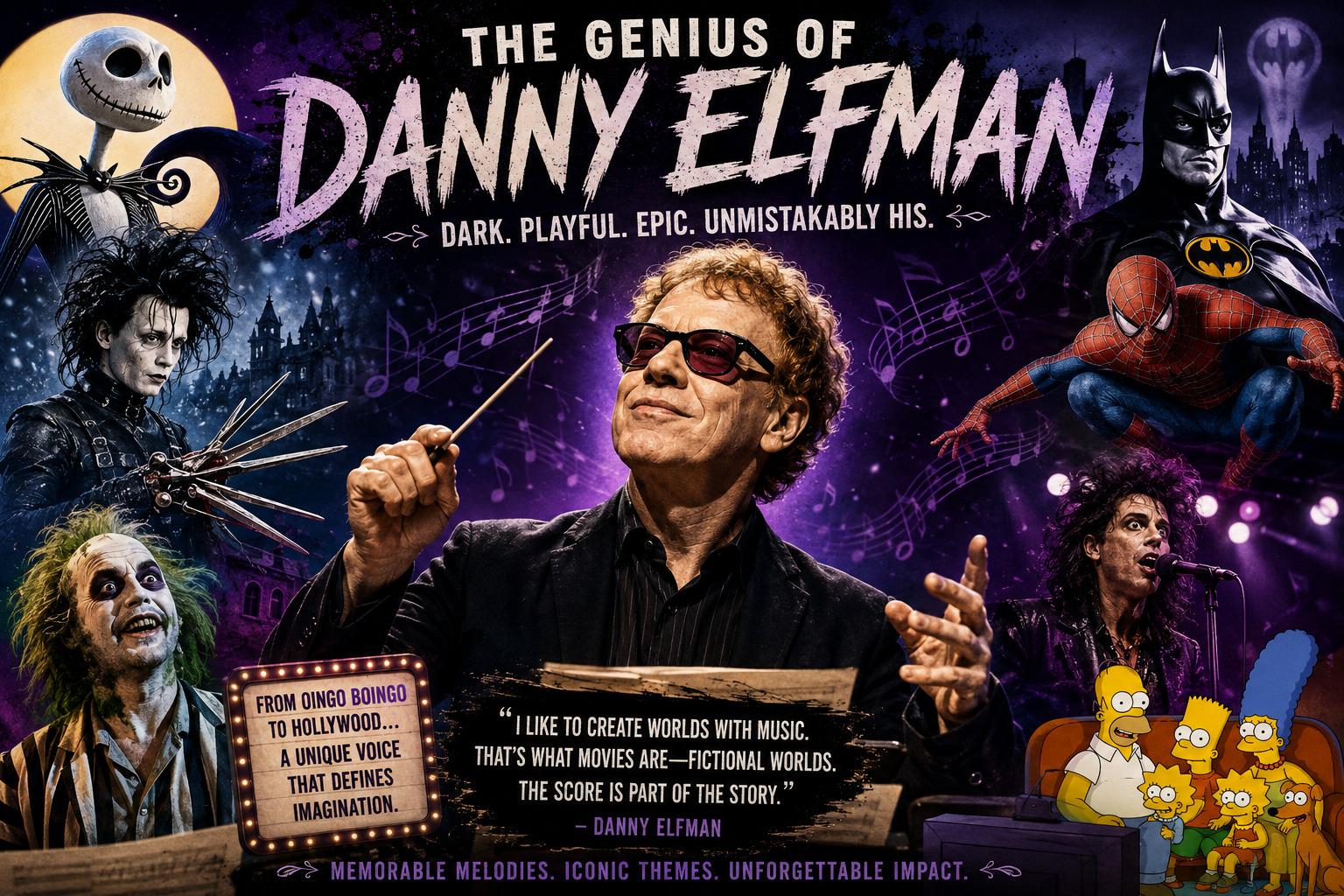
There are plenty of great film composers. There are composers who can write beautiful melodies, composers who can create terrifying atmospheres, composers who can make an audience feel tension before anything has even happened on screen, and composers who can make a movie feel bigger simply by putting the right notes in the right places.
Danny Elfman can do all of those things.
But what makes Elfman different is that you can usually recognize his music almost immediately.
That is an extraordinary achievement.
A great composer can disappear into a movie so completely that the audience doesn’t consciously notice the score. Elfman’s music often does the opposite. It becomes part of the movie’s identity. Sometimes it feels as though the characters, sets, costumes and camera movements were all designed around the music.
His scores can be dark, funny, romantic, grotesque, playful, aggressive, melancholy and completely ridiculous, sometimes within the same piece of music.
That versatility is the real genius of Danny Elfman.
He didn’t arrive in Hollywood through the traditional path of a conservatory-trained composer spending decades working his way through orchestral assignments. His background was far stranger. He came out of the world of rock, theater, punk, cabaret and performance art, fronting Oingo Boingo and developing a musical personality that was already unlike anything else happening in popular music.
Then he met Tim Burton.
That partnership changed both of their careers.
Burton found a composer who understood the strange worlds inside his imagination, while Elfman found a filmmaker who gave him room to develop a musical language unlike anything else in Hollywood.
The result has become one of the most important composer-director collaborations in modern film.
But Elfman’s genius extends far beyond Tim Burton.
He has scored superheroes, horror movies, comedies, dramas, science-fiction films, television shows and enormous Hollywood blockbusters. He has written music that can support a $200 million spectacle and music that can make a lonely character walking down a hallway feel emotionally devastating.
And somehow, through all of it, he has remained unmistakably Danny Elfman.
From Oingo Boingo to Hollywood
The easiest way to misunderstand Danny Elfman is to think of him as someone who simply became a movie composer.
He wasn’t.
Before Hollywood, Elfman was the frontman of Oingo Boingo, a band that mixed rock, new wave, ska, jazz, theatrical music and bizarre performance art into something almost impossible to categorize.
That experience mattered enormously.
Elfman learned how to write melodies that immediately grabbed attention. He understood rhythm. He understood orchestration in an unconventional way. He understood how to create a mood quickly.
Most importantly, he understood theatricality.
Those qualities would become central to his film work.
When Tim Burton made Pee-wee’s Big Adventure in 1985, he needed a composer who could match the bizarre visual world he was creating.
Elfman was an unlikely choice.
He didn’t have a conventional Hollywood résumé.
But Burton recognized something in his music.
Elfman wrote a score that sounded playful, strange and slightly unhinged. It wasn’t simply accompanying the movie. It was helping define the movie’s universe.
That partnership would continue for decades.
The Burton Connection
The relationship between Tim Burton and Danny Elfman is one of the great creative partnerships in film history.
Burton has a very distinctive visual language.
His worlds often feel simultaneously beautiful and unsettling. They’re populated by outsiders, misfits, ghosts, monsters and people who don’t quite fit into ordinary society.
Elfman’s music speaks that same language.
Listen to the score for Beetlejuice.
It’s chaotic, mischievous and theatrical.
Listen to Edward Scissorhands.
Suddenly the same composer can create music of extraordinary tenderness.
Listen to Batman.
Now he’s writing huge, dark orchestral music capable of making Gotham City feel like a mythological place.
Listen to The Nightmare Before Christmas.
Now he’s writing songs, character themes and musical storytelling.
The remarkable part isn’t simply that Elfman can write all of those things.
It’s that they all sound like they came from the same musical imagination.
Batman Changed Everything
Elfman’s score for Batman in 1989 was a major turning point.
The movie itself was enormous. Expectations were enormous. The character had already existed in popular culture for decades.
Elfman could have simply written generic superhero music.
He didn’t.
Instead, he created a musical identity for Batman that was dark, dramatic, mysterious and surprisingly emotional.
The main theme has a sense of grandeur, but it also has menace.
It doesn’t sound like someone triumphantly saving the day.
It sounds like a character emerging from the shadows.
That’s exactly what Burton’s Batman needed.
The score helped establish the tone of the movie before the audience even fully understood what kind of Batman they were watching.
This wasn’t the bright, colorful television version.
This was gothic, damaged and theatrical.
Elfman’s music made that clear.
And his approach to superhero music would influence generations of composers who came afterward.
The Genius of a Theme
One of Elfman’s greatest strengths is his understanding of musical themes.
A great film theme doesn’t simply sound good.
It tells you something.
It can represent a character, a place, an emotion or an entire world.
Elfman is exceptionally good at creating themes that are memorable without becoming simplistic.
His themes often have enough melodic identity to stick in your head, but enough complexity to support different emotional variations.
That is why his scores can make a character feel completely different depending on the scene.
A theme can begin as playful.
Later, the same basic musical idea can become tragic.
Then it can return in a heroic form.
The audience may not consciously recognize all of those transformations, but they feel them.
That is the power of film scoring.
And Elfman understands it instinctively.
Edward Scissorhands
If you want to understand the emotional side of Danny Elfman, Edward Scissorhands is one of the best places to start.
The movie is strange.
The character is strange.
The world is strange.
But the music is beautiful.
Elfman doesn’t simply make Edward sound like a monster.
He makes him sound lonely.
The score captures innocence, wonder, sadness and longing.
There is something almost childlike about the music, but there is also an awareness that this story cannot have a conventional happy ending.
That combination is quintessential Elfman.
He understands that fantasy doesn’t have to mean happiness.
Sometimes fantasy makes sadness more powerful because the world is so beautiful.
The Nightmare Before Christmas
The Nightmare Before Christmas may be Elfman’s most complete demonstration of his talents.
He wasn’t merely composing the score.
He was writing songs.
He was developing characters musically.
He was helping establish the structure of the story.
He even provided the singing voice for Jack Skellington.
That is an enormous amount of creative responsibility.
The music gives every character a distinct identity.
Jack’s music feels different from Sally’s.
Oogie Boogie’s material sounds completely different from the material surrounding the citizens of Halloween Town.
The entire world seems to operate according to its own musical rules.
And that’s the key.
Elfman doesn’t treat the songs as interruptions to the story.
The songs are the story.
That is an extremely difficult thing to accomplish.
He Can Be Funny Without Becoming Cartoonish
Comedy is one of the hardest things to score.
If you make the music too obvious, you’re telling the audience when to laugh.
If you make it too subtle, the humor can disappear.
Elfman has an extraordinary sense of comic timing.
His music can be manic without becoming irritating.
It can be exaggerated without becoming meaningless.
That’s part of what made his work on movies like Mars Attacks! so effective.
He understands that comedy can still have serious musical architecture.
The joke works better when the music is actually good.
That’s something Elfman never sacrifices.
Even when the material is absurd, the composition itself is carefully constructed.
Spider-Man
When Sam Raimi brought Spider-Man to the big screen in 2002, Elfman once again faced a challenge.
How do you create music for a character that has already existed in comics, television, toys and popular culture for decades?
His answer was to make Spider-Man feel mythological.
The score combines orchestral power with darker, more aggressive textures.
There is a sense of transformation running through the music.
Peter Parker isn’t simply becoming a superhero.
He’s becoming someone else.
Elfman’s music gives that transformation emotional weight.
The main theme also manages to sound heroic without being excessively cheerful.
That’s important.
Spider-Man is a teenager dealing with responsibility, loss and identity.
Elfman’s music understands that underneath the superhero spectacle is a coming-of-age story.
The Simpsons
Then there is The Simpsons.
The opening theme may be one of the most recognizable pieces of television music ever written.
And it came from Elfman.
The assignment seems simple enough: write something that captures the strange energy of a new animated comedy.
Elfman delivered something almost ridiculously memorable.
The theme is fast, chaotic, playful and full of musical jokes.
It immediately establishes the personality of the show.
You don’t need dialogue.
You don’t need to see the characters.
The music tells you what you’re about to watch.
That is exactly what great theme music should do.
And it became one of the rare television themes that achieved a life completely independent of its show.
Elfman Knows How to Make Darkness Beautiful
One of the most distinctive qualities in Elfman’s music is his ability to make dark material beautiful.
He doesn’t treat darkness as simply loud or frightening.
Sometimes his darkest music is delicate.
Sometimes it sounds almost heavenly.
That contrast is one reason his work is so effective.
Horror becomes scarier when the music isn’t constantly screaming at you.
Fantasy becomes more emotionally powerful when the score contains genuine melancholy.
A monster becomes more interesting when the music suggests vulnerability.
Elfman understands all of this.
His music often creates sympathy for characters who might otherwise seem completely strange.
He Isn’t Afraid of Melody
Modern film scoring can sometimes become dominated by atmosphere.
Texture.
Sound design.
Drones.
Percussion.
Electronic layers.
Those things can be effective, but Elfman remains deeply committed to melody.
His music often gives you something you can hum afterward.
That seems simple, but it’s incredibly difficult.
A memorable melody can become inseparable from a movie.
That’s why his best themes continue to exist in popular culture long after the credits roll.
His Range Is Almost Ridiculous
Consider the range of projects Elfman has worked on.
Superhero movies.
Animated films.
Horror.
Fantasy.
Comedy.
Science fiction.
Drama.
Television.
Crime.
He can write enormous orchestral music for a blockbuster and then turn around and write something intimate and emotional.
He can create music for children without making it childish.
He can score dark material without making it relentlessly bleak.
He can write action music without losing his personality.
That’s what separates a good specialist from a great composer.
Elfman isn’t simply good at one particular kind of movie.
He’s good at finding the musical identity of the movie in front of him.
The Influence of Rock Music
Elfman’s rock background never completely disappeared.
You can hear it in his sense of rhythm.
You can hear it in his willingness to use unusual percussion.
You can hear it in his understanding of repetition.
You can hear it in the sheer physicality of some of his music.
That gives his orchestral work a different energy.
He doesn’t approach an orchestra like someone simply trying to recreate traditional classical music.
His scores can hit with the force of a rock band.
That makes them especially effective in action sequences.
There is movement.
There is impact.
There is attitude.
He Understands Characters
Perhaps the most important quality of Elfman’s music is that he understands characters.
His scores don’t simply establish atmosphere.
They tell us who people are.
Edward Scissorhands sounds lonely.
Batman sounds driven.
Jack Skellington sounds restless.
Spider-Man sounds uncertain before he becomes confident.
The strange characters in Burton’s movies often receive music that makes us understand them before they even explain themselves.
That is a remarkable storytelling ability.
The Music Can Become the Movie
There are scores that enhance a movie.
Then there are scores that become inseparable from the movie.
Elfman has produced an enormous number of the latter.
Imagine Batman without Elfman’s score.
Imagine Edward Scissorhands without the music.
Imagine The Nightmare Before Christmas without the songs.
Imagine Beetlejuice without that musical insanity.
Imagine The Simpsons without its theme.
The movies and shows would still exist.
But they would feel fundamentally different.
That is the ultimate compliment for a composer.
Why Elfman’s Style Has Lasted
Musical trends change.
The sound of Hollywood changes.
Technology changes.
Recording techniques change.
Yet Elfman’s music has remained recognizable.
Part of that is because his musical personality is stronger than whatever production style happens to surround it.
He can use modern technology without becoming dependent on it.
He can write enormous orchestral passages without sounding like he’s simply copying older composers.
He can write playful music without becoming disposable.
And he can write emotional music without becoming sentimental.
That balance is incredibly difficult.
More Than a Tim Burton Composer
It would be easy to reduce Danny Elfman to “Tim Burton’s composer.”
The partnership is certainly one of the most important parts of his career.
But that description sells Elfman short.
His work outside Burton’s films demonstrates how broad his abilities really are.
His television work alone would be enough to establish a major legacy.
His superhero scores demonstrate his ability to handle blockbuster storytelling.
His work in animation shows his understanding of character and rhythm.
His dramatic scores demonstrate that he can operate without relying on Burton’s gothic visual language.
Burton gave Elfman a perfect creative environment.
He didn’t create Elfman’s talent.
The talent was already there.
The Oingo Boingo Connection Still Matters
There is a direct line from Oingo Boingo to the film scores.
The theatricality.
The unusual rhythms.
The dark humor.
The strange combinations of instruments.
The willingness to embrace eccentricity.
The energy.
All of it eventually found a new home in film.
That’s part of what makes Elfman’s career so interesting.
He didn’t abandon his past when he became a film composer.
He absorbed it.
He transformed it.
The wild performer from Oingo Boingo became a composer capable of working with some of Hollywood’s biggest filmmakers while retaining the personality that made him interesting in the first place.
The Real Genius of Danny Elfman
Danny Elfman’s genius isn’t simply that he can write great music.
It’s that he understands what music is supposed to do in storytelling.
He knows when a theme should be huge.
He knows when it should disappear.
He knows when a melody needs to be beautiful.
He knows when it needs to be disturbing.
He knows when music should make you laugh.
He knows when it should make you uncomfortable.
Most importantly, he knows that film music isn’t decoration.
It is part of the storytelling.
The greatest scores don’t merely sit underneath the images.
They become part of how we remember the images.
That’s what Elfman has accomplished again and again.
His music doesn’t simply accompany strange worlds.
It helps create them.
A Composer Who Became a World Builder
That might be the best way to describe Danny Elfman.
He’s a world builder.
Give him a gothic city and he’ll give you music that makes it feel ancient.
Give him a lonely outsider and he’ll find the sadness inside the character.
Give him a bizarre comedy and he’ll make the absurdity feel musical.
Give him a superhero and he’ll make the character feel mythological.
Give him an animated family and he’ll create a theme that millions of people can recognize within seconds.
That’s versatility.
That’s personality.
That’s craft.
And that’s genius.
The Lasting Legacy
Danny Elfman has spent decades proving that a film composer doesn’t have to disappear behind the movie.
His music can have an identity of its own while still serving the story.
That’s a difficult balance.
Too much personality and the score can overwhelm the film.
Too little personality and the music becomes forgettable.
Elfman consistently finds the middle ground.
His scores are memorable without distracting from the story.
They’re emotional without becoming manipulative.
They’re strange without becoming inaccessible.
They’re sophisticated without losing their sense of fun.
And perhaps most importantly, they sound like nobody else.
That’s the mark of a great artist.
You hear a piece of music and recognize the person behind it.
Danny Elfman has spent his career building a musical vocabulary that belongs entirely to him.
From Oingo Boingo to Pee-wee’s Big Adventure, from Beetlejuice to Batman, from Edward Scissorhands to The Nightmare Before Christmas, from The Simpsons to Spider-Man and far beyond, he has demonstrated an almost absurd ability to translate imagination into sound.
Hollywood has had hundreds of talented composers.
It has had brilliant technicians.
It has had virtuosos.
But Danny Elfman brought something else.
He brought personality.
He brought theatricality.
He brought humor.
He brought darkness.
He brought melody.
And he brought an unmistakable musical voice.
The genius of Danny Elfman is that he doesn’t simply write music for imaginary worlds.
He makes those worlds feel real.
And once you’ve heard his best work, you can never quite imagine those worlds sounding any other way.
This post has already been read 454 times!