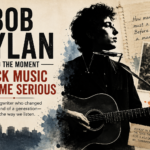
 Rock and roll was never exactly mindless.
That is an important place to begin.
Long before Bob Dylan became one of the most influential figures in popular music, rock and roll had already changed American culture. Chuck Berry was writing sharp, funny songs about teenage life, cars and rebellion. Little Richard turned performance into something explosive. Elvis Presley became a cultural earthquake. Buddy Holly demonstrated the possibilities of the self-contained band. Ray Charles, Fats Domino, Jerry Lee Lewis, Carl Perkins and countless others were expanding the boundaries of popular music.
There was intelligence in the music.
There was creativity.
There was attitude.
But rock and roll was still largely regarded as youth entertainment.
It was music for teenagers.
It was something parents complained about.
It was associated with dancing, rebellion, fashion, cars, romance and youthful independence.
Then Bob Dylan arrived.
Dylan did not invent serious songwriting. He did not invent folk music, protest music or socially conscious popular music. He did not even begin his career as a conventional rock musician.
What he did was change the expectations surrounding popular music.
Suddenly, a young musician could write songs about war, racism, poverty, politics, loneliness, morality, social injustice, history, identity and the strange contradictions of modern life.
And those songs could become popular.
That was revolutionary.
Dylan helped establish the idea that a popular musician could be more than an entertainer.
A songwriter could be an observer.
A singer could be a storyteller.
A rock musician could be a commentator.
A three-minute record could contain an argument.
A popular album could be treated like a serious work of art.
The transformation did not happen overnight. It was part of a larger cultural shift taking place in the early 1960s. But Dylan became one of its most important figures.
He helped turn rock music into something that could demand attention from adults, critics, writers and intellectuals.
He also changed the relationship between the artist and the audience.
Before Dylan, audiences often expected musicians to entertain them.
Dylan increasingly expected audiences to listen to him.
That difference changed everything.
<p/>
The Musical World Bob Dylan Entered
Bob Dylan was born Robert Allen Zimmerman in Duluth, Minnesota, in 1941 and grew up in Hibbing, a small northern Minnesota community.
His early musical interests were broad.
He listened to popular music, country, blues and especially the emerging sound of rock and roll. Like countless teenagers of his generation, he was fascinated by performers such as Elvis Presley and Little Richard.
But Dylan’s musical education eventually moved in a different direction.
He became fascinated by folk music.
Folk music offered something that commercial rock and roll often did not: history.
Folk songs could be passed from one generation to another. They could tell stories about workers, soldiers, immigrants, disasters, relationships and political conflicts. They could preserve the experiences of ordinary people.
The songs were often direct and economical.
The singer did not necessarily need elaborate production.
A voice and an acoustic guitar could be enough.
Dylan discovered that this musical tradition could be incredibly powerful.
He also discovered Woody Guthrie.
Guthrie became one of Dylan’s most important influences.
Guthrie had demonstrated that a musician could write about ordinary people and serious social issues while still reaching a broad audience. His songs were rooted in American history, working-class experience and political observation.
Dylan studied Guthrie intensely.
He learned songs.
He absorbed Guthrie’s vocal mannerisms.
He studied his storytelling.
He began writing his own material.
But Dylan did not simply copy Guthrie.
He absorbed the tradition and began transforming it.
That would become one of the defining characteristics of his career.
Dylan was always looking backward and forward simultaneously.
He drew from old American musical traditions while creating something that sounded contemporary.
<p/>
Greenwich Village and the Folk Revival
Dylan moved to New York City in 1961 and became part of the Greenwich Village folk scene.
This was one of the most important musical environments in America.
The Village was filled with coffeehouses, clubs, musicians, poets, writers and political activists.
Folk music was experiencing a revival.
Young musicians were rediscovering traditional American songs while also writing new material.
Artists such as Joan Baez, Dave Van Ronk, Peter, Paul and Mary and others were becoming important figures in the movement.
Dylan entered this environment as an unknown young musician.
He quickly developed a reputation.
His voice was unusual.
His appearance was distinctive.
His personality was unpredictable.
Most importantly, he could write.
Dylan was not interested in sounding polished in the traditional sense.
His voice could be nasal, rough and deliberately abrasive.
That was part of his appeal.
He sounded like someone who had spent years absorbing American music rather than someone who had been manufactured by a record company.
His songwriting attracted attention because the songs seemed older and newer at the same time.
He could make a song feel like a traditional folk ballad while filling it with contemporary concerns.
He could write in the language of ordinary conversation while introducing ideas that were much more complicated.
His songs began attracting the attention of other musicians.
Eventually, so did the attention of Columbia Records producer John Hammond.
Dylan signed with Columbia and released his first album in 1962.
It was not an immediate commercial success.
But Dylan was only getting started.
The Young Songwriter Who Refused to Stay in One Place
Dylan’s early career developed rapidly.
His second album, The Freewheelin’ Bob Dylan, released in 1963, was a major breakthrough.
This was where the songwriter Dylan began emerging as a cultural force.
The album contained songs that addressed civil rights, war, social inequality, love and generational uncertainty.
The songs were not simply topical.
They were written with a distinctive literary quality.
Dylan’s songwriting was becoming increasingly ambitious.
This mattered because popular music had rarely been treated this way.
There had always been talented lyricists.
Tin Pan Alley had produced generations of sophisticated professional songwriters.
Broadway had produced remarkable writers.
Country music had always contained powerful storytelling.
Folk music had a long tradition of social commentary.
Dylan’s breakthrough came from bringing many of those traditions into the center of contemporary popular music.
He was not merely writing songs.
He was writing arguments, questions and portraits of society.
The distinction became increasingly important.
The Protest Song Becomes Mainstream
The early 1960s were a period of enormous political and social change in the United States.
The civil rights movement was challenging racial segregation.
The Cold War created constant anxiety.
The possibility of nuclear war hung over society.
The Vietnam conflict was becoming increasingly important.
Young Americans were questioning institutions that previous generations had accepted.
Popular music was inevitably affected.
Dylan became associated with protest music.
Songs such as “Blowin’ in the Wind” became important cultural statements.
The song’s power was partly its simplicity.
Instead of delivering a complicated political speech, Dylan asked questions.
That made the song accessible.
Other artists recorded it.
The song reached audiences far beyond the folk scene.
This demonstrated something important:
A song about social issues could become a mainstream hit.
That changed the possibilities for other musicians.
Suddenly, young songwriters could imagine that their music might address the world around them.
They did not have to write exclusively about romance.
They could write about politics.
They could write about civil rights.
They could write about war.
They could write about inequality.
They could write about hypocrisy.
They could write about alienation.
Popular music could have something to say.
The Newport Folk Festival
Dylan’s relationship with the folk world became increasingly complicated.
The folk community had embraced him.
He had become one of its most recognizable young voices.
But Dylan was changing.
He was listening to rock music.
He was fascinated by electric instruments.
He wanted to explore new sounds.
That created tension.
The defining moment came at the Newport Folk Festival in 1965.
Dylan appeared with an electric band.
The reaction was famously divided.
Some members of the audience welcomed the change.
Others were angry.
The performance became one of the most discussed moments in folk and rock history.
Whether every detail of the famous story has been exaggerated over time, the larger significance is clear.
Dylan had crossed a line.
He was moving from the traditional folk world toward electric rock.
And he was doing it publicly.
The decision was enormously important.
Dylan was effectively saying that the boundaries of a musical genre did not determine what he was allowed to do.
He would decide.
That attitude became one of the defining principles of rock music.
Going Electric
Dylan’s move toward electric music changed much more than his own career.
It helped establish the idea that folk songwriting and rock music could exist together.
That combination became enormously influential.
Dylan’s electric recordings combined the directness of rock with the complexity of his songwriting.
Highway 61 Revisited and Bringing It All Back Home represented major developments.
The music was louder.
The arrangements were more aggressive.
The band was more prominent.
But the songwriting remained central.
This was not rock music replacing serious songwriting.
It was serious songwriting entering rock music.
That distinction matters.
Dylan helped create a new model in which the words and ideas of a song could be as important as the riff, rhythm or melody.
Rock musicians increasingly became interested in what they were saying.
The music became a vehicle for ideas.
Like a Rolling Stone and the Expansion of the Rock Single
Then came “Like a Rolling Stone.”
Released in 1965, the song became one of the defining recordings of the decade.
It was unusually long for a hit single.
It was aggressive.
It was confrontational.
It had an enormous sound.
And it was not designed like a conventional pop record.
There was no attempt to make Dylan sound smooth or traditionally commercial.
The vocal performance was almost taunting.
The lyrics were dense and unpredictable.
The organ part gave the recording a distinctive character.
The rhythm section pushed the song forward.
The result sounded like a collision between folk songwriting and electric rock.
It became a major hit.
That was enormously significant.
Radio had traditionally favored relatively short songs.
Record companies worried about commercial formulas.
Dylan demonstrated that audiences could accept something longer, stranger and more demanding.
“Like a Rolling Stone” helped expand the possibilities of the rock single.
The hit record no longer had to fit neatly into a predetermined format.
The Songwriter Becomes the Star
Before Dylan, many successful performers were known primarily for their voices or personalities.
Dylan created a different kind of celebrity.
He became famous because of his writing.
His songs were being covered by other artists.
His words were being analyzed.
His interviews became part of his mythology.
His opinions mattered.
His refusal to behave like a conventional pop star became part of his appeal.
That helped establish the modern singer-songwriter as a major cultural figure.
The songwriter was no longer necessarily hidden behind the performer.
The songwriter could be the star.
This had enormous consequences.
Neil Young.
Joni Mitchell.
Bruce Springsteen.
Leonard Cohen.
Tom Petty.
Patti Smith.
Elvis Costello.
Billy Joel.
Paul Simon.
And countless others would work in a musical world where songwriting itself could be central to an artist’s identity.
Dylan helped create that world.
The Beatles Were Listening
One of the most fascinating parts of Dylan’s story is that his influence did not move in only one direction.
The Beatles were listening to him.
The Beatles had already transformed popular music by the time they encountered Dylan’s work, but they were searching for ways to develop their own songwriting.
Dylan’s influence encouraged them to become more introspective and sophisticated.
The Beatles began exploring subjects beyond simple romance.
Their songs became more personal.
Their arrangements became more adventurous.
The relationship between Dylan and the Beatles was therefore mutually influential.
The Beatles helped push Dylan toward electric rock.
Dylan helped push the Beatles toward more ambitious songwriting.
That exchange accelerated the transformation of popular music.
Two major musical forces were learning from each other.
From Teenage Entertainment to Adult Art
This was perhaps Dylan’s greatest cultural achievement.
He helped change the perception of who popular music was for.
Rock and roll had begun as music strongly associated with teenagers.
Dylan introduced a different possibility.
A rock audience could think.
A rock audience could care about politics.
A rock audience could engage with literature.
A rock audience could listen to a song more than once and discover something new.
That may sound normal today.
It was not normal in the early 1960s.
Popular music was often dismissed by older generations as simplistic entertainment.
Dylan made that dismissal harder to sustain.
His songs demanded attention.
They were filled with unusual images, historical references, social observations and philosophical questions.
Even when listeners disagreed with Dylan, they could not easily dismiss him as merely a pop entertainer.
He was clearly trying to say something.
The Birth of the Rock Lyricist
Dylan changed the expectations surrounding lyrics.
Before him, pop songwriting had certainly produced clever and sophisticated writing.
But Dylan brought a new literary sensibility into the heart of rock music.
His writing was often ambiguous.
It could be surreal.
It could jump between characters and settings.
It could combine historical references with contemporary concerns.
It could be humorous and serious within the same song.
He did not always provide easy answers.
Sometimes he asked questions and left the listener to figure them out.
This was crucial.
Rock songs no longer had to explain themselves completely.
They could be interpreted.
That opened the door for a generation of writers who treated songs as literary works.
Highway 61 Revisited
Highway 61 Revisited was one of the clearest statements of Dylan’s new direction.
The album combined electric blues, rock and Dylan’s increasingly unconventional songwriting.
The sound was loose and energetic.
The lyrics were dense.
The music had a sense of movement and unpredictability.
The album also demonstrated that rock could be an album-length experience rather than merely a collection of singles.
The songs were connected by Dylan’s personality and worldview.
The record felt like a journey through an increasingly strange version of America.
Politics, religion, popular culture, history and personal identity collided.
That combination would become central to the development of album-oriented rock.
Blonde on Blonde and the Double Album
Blonde on Blonde, released in 1966, pushed the idea even further.
It was a sprawling record.
It contained blues, rock, ballads and surreal songwriting.
The album was expansive rather than neatly organized.
Its very scale demonstrated that rock albums could become substantial artistic statements.
The double album would become an important format in the years that followed.
Artists could now imagine using an album to explore a much larger musical world.
Dylan had helped make that possible.
The album became a canvas.
Dylan and the Counterculture
Dylan became associated with the counterculture, although his relationship with it was always complicated.
He was never particularly comfortable being turned into a spokesperson.
Audiences wanted him to explain political issues.
Journalists wanted him to define his beliefs.
Activists wanted him to become a leader.
Dylan often resisted those expectations.
This was another important aspect of his influence.
The rock musician did not necessarily have to be a representative of a movement.
He could be an individual.
He could refuse labels.
He could contradict his audience.
He could change his mind.
That freedom became a major part of rock culture.
Dylan Refuses to Be a Political Prophet
One of the myths surrounding Dylan is that he wanted to become the great political voice of his generation.
The reality was more complicated.
He wrote important protest songs.
He became associated with the civil rights movement.
He performed at major events.
But he increasingly resisted being defined by politics.
This created frustration among some listeners.
They wanted another protest song.
Dylan wanted to move on.
That decision was artistically significant.
He demonstrated that musicians were not obligated to remain frozen in the role that made them famous.
A protest singer could become a rock musician.
A folk singer could become an experimental songwriter.
A political songwriter could write about personal experiences.
An artist could change.
The Importance of Ambiguity
Dylan’s songwriting often refused to give listeners simple answers.
That was part of the point.
Traditional pop songs frequently established a clear emotional situation.
Dylan was more interested in uncertainty.
Characters could be unreliable.
Narrators could be confusing.
Images could have multiple meanings.
Historical references could appear beside surreal scenes.
The listener had to participate.
This changed the relationship between songwriter and audience.
Instead of simply receiving a message, listeners interpreted the work.
Rock music became something audiences could debate.
Different people could hear the same song and reach different conclusions.
That intellectual openness became one of Dylan’s most lasting contributions.
Bringing Literature Into Rock
Dylan’s writing drew from American folk traditions, blues, poetry, novels, newspapers, politics, history and everyday conversation.
He did not write like a traditional pop lyricist.
His songs often felt like compressed stories.
This encouraged other musicians to think about songwriting differently.
A rock song could contain characters.
It could create a setting.
It could use symbolism.
It could tell a story that unfolded across several minutes.
The songwriter could borrow techniques from literature.
That idea became central to later rock.
Artists increasingly treated albums as bodies of writing.
The distinction between poetry and songwriting became less rigid.
Dylan was one of the major reasons why.
Dylan and the Album Revolution
The 1960s saw the album become increasingly important.
Dylan was central to that transformation.
His albums were not simply collections of singles.
They were substantial bodies of work.
The songwriting varied in style and subject, but the records had strong identities.
This helped encourage the idea that listeners should experience an album as a complete statement.
The Beatles were doing something similar from another direction.
The Beach Boys were doing it.
Other artists were following.
By the late 1960s, the album was becoming the dominant format for ambitious rock musicians.
Dylan helped make that possible by demonstrating how much a songwriter could accomplish across an entire record.
Dylan’s Influence on the Rolling Stones
The Rolling Stones were already developing their own identity, but Dylan’s rise reinforced the importance of songwriting within rock.
The Stones eventually became one of the greatest songwriting partnerships in rock history through Mick Jagger and Keith Richards.
Their music remained rooted in blues and rhythm and blues, but their songwriting became increasingly ambitious.
Dylan’s success helped demonstrate that rock bands could take their own writing seriously.
The Rolling Stones did exactly that.
Their careers would become very different from Dylan’s, but they operated within the same expanding artistic environment.
Dylan and the Singer-Songwriter Explosion
The singer-songwriter movement of the 1970s was unimaginable without the groundwork laid during the previous decade.
Artists increasingly wrote and performed their own material.
The songwriter became the center of the musical identity.
Acoustic instruments became associated with personal expression.
Albums became platforms for storytelling.
Artists such as Joni Mitchell, James Taylor, Carole King, Jackson Browne and others developed highly personal styles.
Dylan was not responsible for all of this.
But he helped establish the cultural legitimacy of the songwriter as artist.
Dylan and Bruce Springsteen
Few later American rock musicians illustrate Dylan’s influence more clearly than Bruce Springsteen.
Springsteen developed his own voice, sound and subject matter, but the connection is obvious.
Both artists used rock music to tell stories about American life.
Both wrote about people who felt disconnected from the promises of American society.
Both used detailed characters and locations.
Both understood the power of the album.
Both recognized that rock music could be about more than entertainment.
Springsteen once described Dylan as a major influence, and the impact can be heard throughout his early work.
The comparison is not about imitation.
It is about inheritance.
Dylan helped establish the language that Springsteen would later develop in his own direction.
Dylan and Punk
Dylan’s influence even reaches punk rock.
Punk rejected much of the elaborate musical culture that developed during the late 1960s and early 1970s.
But punk inherited Dylan’s attitude toward songwriting.
Songs could be direct.
They could be confrontational.
They could address social problems.
They could challenge authority.
They did not need to sound polished.
The importance of the songwriter remained.
Punk musicians simply stripped away much of the surrounding production.
Dylan had already demonstrated that a distinctive voice could be more important than technical perfection.
That lesson became central to punk.
Dylan and Alternative Rock
Alternative rock inherited another Dylan principle:
Make the music your own.
Dylan’s refusal to fit comfortably into one category became a model for artists who resisted mainstream expectations.
Alternative musicians frequently valued individuality over polish.
They wrote personal songs.
They experimented with structures.
They rejected conventional pop formulas.
They often treated commercial success with suspicion.
Again, Dylan did not create alternative rock.
But the culture of artistic independence surrounding alternative music owes something to the path he helped establish.
Dylan’s Voice Changed the Rules
One of Dylan’s most important contributions was his voice.
Not because it was traditionally beautiful.
It wasn’t.
His singing was often rough, nasal, conversational and deliberately unpolished.
For decades, popular singers had often been expected to possess impressive voices.
Dylan demonstrated another possibility.
A distinctive voice could be more important than a technically perfect one.
The personality of the singer could become part of the art.
That opened the door for countless artists whose voices might have been rejected under older standards.
Neil Young.
Tom Waits.
Patti Smith.
Lou Reed.
Joe Strummer.
Many punk and alternative singers.
The idea that authenticity could matter more than vocal perfection became increasingly important.
The Guitar as a Songwriting Tool
Dylan’s guitar playing was not primarily about virtuosity.
His acoustic guitar functioned as a songwriting tool.
His playing supported the words.
That was another important shift.
Rock guitar did not always have to be about technical ability.
It could provide rhythm and atmosphere while allowing the songwriter to remain at the center.
Later singer-songwriters adopted similar approaches.
The guitar became an accessible instrument for personal expression.
You did not have to be a virtuoso.
You needed something to say.
Dylan and the Changing Role of the Record Producer
Dylan’s recordings also helped redefine the relationship between artist and producer.
Different producers brought different approaches to his work.
Tom Wilson played an important role during Dylan’s transition toward electric music.
Later, Bob Johnston became a key figure during the period that produced Highway 61 Revisited and Blonde on Blonde.
The producer’s job increasingly became one of shaping the environment around an unpredictable artist.
Dylan’s willingness to experiment required collaborators who could respond quickly.
That relationship between artist and producer became increasingly important throughout rock.
The Highway 61 Philosophy
The importance of Dylan’s electric period can be summed up by a simple idea:
Rock music could be intellectually ambitious without becoming boring.
That was the breakthrough.
Dylan’s music could have complicated ideas while still possessing rhythm, energy and memorable melodies.
He did not have to choose between art and entertainment.
He could combine them.
This became one of the central principles of modern popular music.
The most successful artists could create music that worked on several levels.
You could dance to it.
You could sing along.
You could think about it.
You could analyze it.
You could argue about it.
That was a powerful combination.
Dylan’s Relationship With the Beatles
The relationship between Dylan and the Beatles deserves special attention because it represents one of the most important creative exchanges of the 1960s.
The Beatles were initially focused on energetic pop songwriting.
Dylan was focused on folk, literature and social commentary.
Then they met.
The Beatles began exploring more personal and sophisticated writing.
Dylan became increasingly comfortable with electric rock.
The musical border between folk and rock began disappearing.
This exchange helped create the sound of the late 1960s.
The most influential musicians of the era were no longer operating inside isolated genres.
They were listening to one another.
Ideas moved rapidly.
The result was an extraordinary period of musical development.
The Electric Controversy Was Bigger Than Dylan
The Newport controversy is often presented as a simple story:
Folk fans wanted acoustic music.
Dylan plugged in.
Everyone became angry.
Reality was more complicated.
Folk music itself was changing.
The political movement was changing.
Rock was becoming more sophisticated.
Audiences were becoming more divided over what music should represent.
Dylan’s decision to go electric became a symbol of those larger tensions.
Should music preserve tradition?
Should artists serve a political movement?
Should musicians experiment?
Should audiences have a say in artistic direction?
Those questions remain relevant.
Every time a successful artist changes direction, audiences face the same dilemma.
Do they want the artist to repeat what they already love, or do they allow the artist to evolve?
Dylan chose evolution.
The Artist Versus the Audience
Dylan’s career helped establish a powerful idea:
The artist does not belong to the audience.
Fans may feel connected to an artist.
They may identify with the music.
They may believe they understand what the artist represents.
But the artist remains free to change.
Dylan repeatedly tested that principle.
He changed musical styles.
He changed public personas.
He changed subject matter.
He challenged expectations.
Sometimes audiences followed.
Sometimes they did not.
That willingness to risk alienating fans became part of his artistic identity.
It also became a model for later musicians.
Dylan and the Death of the Disposable Pop Song
Dylan did not eliminate disposable pop music.
There will always be songs designed primarily for immediate entertainment.
But he changed the idea that all popular songs should be disposable.
A song could survive beyond the moment that produced it.
It could be studied.
It could be covered.
It could be reinterpreted.
It could become part of cultural history.
This was an important step toward treating popular music as a permanent art form.
The song was no longer simply something played on the radio for three minutes.
It could become part of the cultural conversation.
Dylan’s Influence on Music Journalism
Music journalism also changed because of Dylan.
A musician who wrote songs about politics, history, literature and social issues required a different kind of coverage.
Journalists began treating musicians as thinkers.
Interviews became important.
Album reviews became more analytical.
Critics began discussing songwriting techniques, cultural references and artistic development.
Rock journalism became its own field.
Dylan was one of the artists who made that possible.
He gave critics something to discuss.
He also gave them something to argue about.
That turned out to be equally valuable.
The Myth of the Serious Rock Star
Dylan helped create the idea of the serious rock musician.
This became both a blessing and a burden.
Rock musicians were increasingly expected to have something important to say.
Albums were expected to have meaning.
Artists were expected to develop.
Performers were expected to have artistic identities.
That raised the cultural status of rock.
But it also created pressure.
Not every song needed to be profound.
Not every musician wanted to be a philosopher.
Yet the expectation remained.
Rock had become serious.
Dylan was one of the people who made it happen.
The 1960s as a Musical Revolution
Dylan’s rise happened alongside one of the most remarkable periods of musical development in modern history.
The Beatles were transforming pop.
The Beach Boys were pushing studio production.
The Rolling Stones were developing blues-based rock.
Motown was producing extraordinary soul music.
James Brown was transforming rhythm.
Jimi Hendrix was reinventing the guitar.
The Doors were bringing psychedelia and theatricality together.
The Velvet Underground were moving rock toward art and experimentation.
Dylan was changing songwriting.
These developments interacted.
Musicians listened to each other.
Ideas crossed genres.
The result was an explosion of creativity.
Dylan was not alone.
But he was one of the people who changed the direction of the explosion.
Why Dylan’s Songs Could Travel
Dylan’s songs were often remarkably adaptable.
Other performers could record them and make them their own.
This was partly because the songwriting was strong enough to survive different arrangements.
It was also because Dylan’s songs often contained universal questions.
A folk singer could perform one.
A rock band could perform one.
A pop singer could reinterpret one.
A country musician could find something useful in the writing.
That adaptability expanded Dylan’s influence far beyond his own recordings.
His songs became part of the vocabulary of popular music.
Dylan and the Idea of Authenticity
Dylan’s career also changed the definition of authenticity.
Authenticity did not necessarily mean sounding polished.
It could mean sounding individual.
It could mean refusing to conform.
It could mean writing your own material.
It could mean following your instincts even when the audience disagreed.
That became particularly important in rock culture.
Authenticity became one of the qualities audiences valued most.
Sometimes that idea became exaggerated or romanticized.
But its influence was enormous.
Dylan’s Long-Term Influence
Dylan’s influence extends across multiple generations.
The 1960s absorbed his songwriting.
The 1970s developed the singer-songwriter tradition.
The 1980s continued his influence through artists who emphasized personal writing.
The 1990s alternative scene embraced his independence and unconventional voice.
The 2000s and beyond continued to produce artists influenced by his approach to songwriting.
His influence also crossed national boundaries.
Musicians around the world studied his work.
His songs were translated.
His records were analyzed.
His approach to songwriting became part of the international language of popular music.
That is a remarkable legacy for an artist who began as a young folk singer in Greenwich Village.
Why Dylan Still Matters
Dylan matters because the basic question he raised has never disappeared:
What can a popular song be?
It can be entertainment.
It can be a love song.
It can be a protest.
It can be a story.
It can be poetry.
It can be a joke.
It can be a political argument.
It can be personal.
It can be confusing.
It can be beautiful.
It can be ugly.
It can be all of those things at once.
Dylan expanded the possibilities.
He made room for more ideas inside popular music.
That is why his influence remains so powerful.
The Moment Rock Music Became Serious
There was no single second when rock music suddenly transformed from entertainment into art.
The change was gradual.
Dylan was one of several artists pushing in that direction.
But if there is a symbolic moment when rock music began demanding to be taken seriously, Dylan’s arrival in the early 1960s is one of the strongest candidates.
He gave rock music a new vocabulary.
He gave musicians permission to write about the world.
He gave audiences permission to listen more carefully.
He gave critics permission to analyze.
He gave record companies a reason to believe that ambitious music could sell.
And he gave young musicians a new model.
You could pick up a guitar and write about something that mattered to you.
You did not have to wait for a professional songwriter.
You did not have to fit a formula.
You did not have to sound perfect.
You needed a voice.
You needed ideas.
You needed something to say.
That was the revolution.
The Lasting Consequence
The most important consequence of Dylan’s career may be the way popular music gradually became a place where artists were allowed to develop identities rather than simply produce hits.
That sounds obvious today.
It wasn’t.
Modern listeners expect artists to have distinctive voices.
They expect musicians to write their own songs.
They expect albums to have themes.
They expect performers to discuss politics and culture.
They expect musicians to evolve.
They expect popular music to contain serious ideas.
Those expectations were not created by Dylan alone.
But Dylan was one of the musicians who made them normal.
He helped destroy the wall between popular entertainment and serious artistic expression.
Once that wall began collapsing, it became much easier for other musicians to cross it.
The Man Who Changed the Question
Bob Dylan did not invent rock music.
He did something arguably more important.
He changed the question.
Before Dylan, one of the central questions surrounding popular music was:
How entertaining is this?
Dylan helped introduce another:
What is this saying?
That shift transformed the culture surrounding rock music.
The Beatles could become more introspective.
The Rolling Stones could become more ambitious.
The Beach Boys could build increasingly elaborate albums.
Jimi Hendrix could turn the electric guitar into an instrument of experimentation.
The Who could create ambitious musical narratives.
Neil Young could write deeply personal songs.
Bruce Springsteen could build entire worlds around American characters.
Punk musicians could use three chords to attack political and cultural assumptions.
Alternative musicians could reject polished commercial formulas.
Singer-songwriters could become major stars.
All of these developments belonged to a musical world in which popular music was allowed to be serious.
Dylan helped create that world.
His influence was not simply about protest songs.
It was not simply about folk music.
It was not simply about going electric.
It was not simply about a few famous albums.
His greatest contribution was changing the status of the songwriter.
The songwriter could be an artist.
The rock musician could be an author.
The album could be literature set to music.
The singer did not have to sound perfect.
The song did not have to provide easy answers.
The audience could be challenged.
The artist could change.
Those ideas became fundamental to modern popular music.
Dylan’s career also demonstrated something else that would become increasingly important: artistic independence comes with consequences.
When he abandoned acoustic folk for electric rock, some fans felt betrayed.
When he refused to remain a political spokesman, some listeners were disappointed.
When he changed musical directions, audiences had to decide whether they were following the artist or simply following the sound they already liked.
Dylan kept moving.
That willingness to move may be his greatest lesson.
Popular music is not supposed to stand still.
The moment an artist discovers a formula, there is always another possibility waiting.
Dylan understood that.
The young man who arrived in New York with an acoustic guitar eventually became one of the most influential songwriters in music history, but his importance goes beyond the songs themselves.
He changed what musicians thought they were allowed to do.
He changed what audiences expected from popular music.
He changed how critics wrote about rock.
He helped transform the album into an artistic medium.
He helped bring political and social ideas into mainstream music.
He helped establish the singer-songwriter as a major cultural figure.
And he helped create a musical environment where a record could be commercially successful while also being intellectually challenging.
That is why the phrase “Bob Dylan and the Moment Rock Music Became Serious” works as more than a catchy headline.
Dylan did not make rock music serious by removing the fun.
He made it serious by proving that the music could contain more.
More ideas.
More questions.
More stories.
More emotion.
More ambiguity.
More ambition.
Rock music could still make people dance.
It could still make people scream.
It could still be loud, rebellious and exciting.
But now it could also make people think.
That combination became one of the defining characteristics of modern popular music.
And once Dylan showed the world what a rock song could contain, there was no going back.
This post has already been read 385 times!