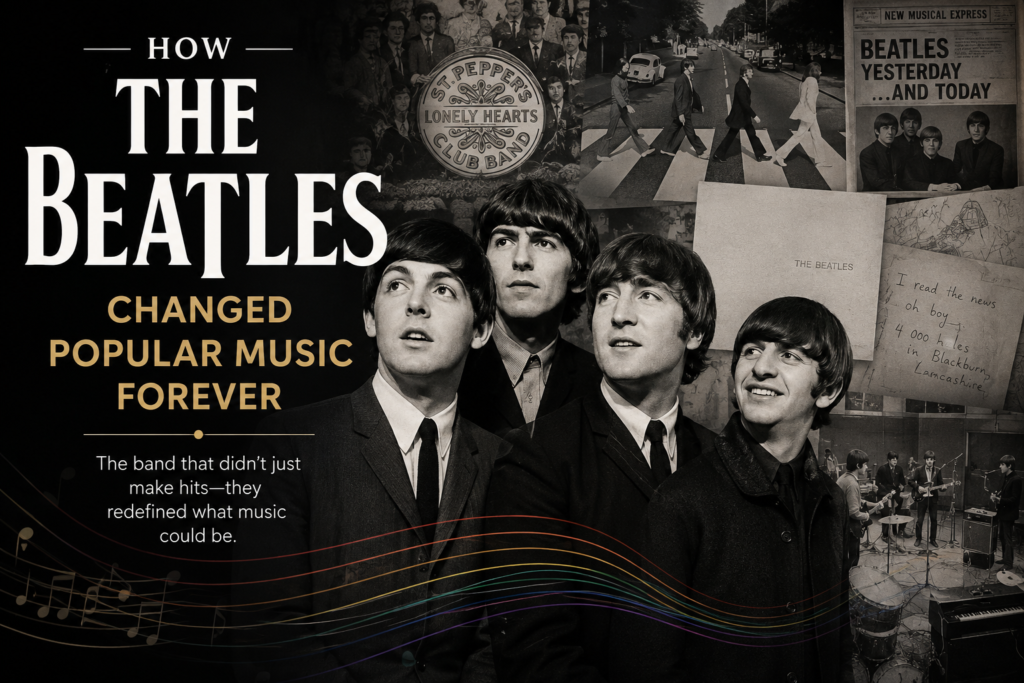
Popular music did not suddenly appear when the Beatles arrived. Rock and roll had already transformed the musical landscape. Elvis Presley had become a cultural phenomenon. Chuck Berry had established the guitar-driven language of rock. Little Richard had demonstrated the explosive possibilities of performance. Buddy Holly had shown how a small band could write and record its own material. Motown was developing an entirely new approach to pop and soul, while artists such as Bob Dylan were beginning to challenge the boundaries between popular entertainment and serious songwriting.
Yet something extraordinary happened when four young musicians from Liverpool became internationally famous.
The Beatles did not invent rock and roll, the album, the music video, the concept album, the recording studio, the singer-songwriter, or the screaming teenage audience. What they did was connect many of those developments, push them forward at remarkable speed, and demonstrate possibilities that the music industry had barely considered.
They changed what a successful band could be.
They changed what a pop song could be.
They changed what an album could mean.
They changed the relationship between musicians and producers.
They changed the recording studio from a place where musicians simply documented performances into an instrument capable of creating sounds that could not necessarily be reproduced onstage.
They changed the expectations placed on songwriters.
They changed fashion, hairstyles, concert culture, television, radio, youth culture and the economics of the recording industry.
Most importantly, they changed the expectations of listeners.
Before the Beatles, popular music was often treated as disposable entertainment aimed primarily at teenagers. After the Beatles, a major rock record could be considered art, cultural commentary, serious songwriting and commercial entertainment all at once.
That transformation is the real story.
The Beatles’ importance cannot be reduced to the enormous number of records they sold or the countless awards they received. Their influence comes from the speed and breadth of their evolution. The band that recorded “Love Me Do” in 1962 was not making the same kind of music as the band that created “A Day in the Life” five years later.
Five years.
That is one of the most astonishing facts about their career.
The Beatles went from playing straightforward rock and pop songs to experimenting with tape manipulation, orchestration, unconventional structures, psychedelic sounds, Indian instrumentation, electronic effects, studio editing and sophisticated harmonic arrangements within a remarkably short period.
And audiences followed them.
That encouraged everyone else to experiment.
The result was a permanent change in popular music.
The Musical World Before the Beatles
Understanding the Beatles requires understanding what popular music looked like before them.
American music dominated much of the international popular culture of the 1950s. Rock and roll had emerged from a combination of rhythm and blues, country, gospel, blues and other traditions. Black American musicians had developed many of the sounds and rhythmic ideas that would become essential to rock, while white performers helped bring those sounds to an enormous mainstream audience.
Elvis Presley became the most famous example of that crossover.
Chuck Berry brought a new vocabulary to the electric guitar and demonstrated how rock could tell stories about teenage life, cars, school and rebellion. Little Richard brought an almost uncontrollable level of energy to the music. Jerry Lee Lewis attacked the piano with the same intensity that guitar heroes would later bring to their instruments.
Buddy Holly offered another crucial development.
His recordings helped establish the idea of the rock band as a self-contained unit. Holly and the Crickets demonstrated a format that future British groups would embrace: lead singer, guitarist, second guitarist, bass and drums, with the musicians functioning as a unified band rather than simply backing a featured vocalist.
The Beatles absorbed all of this.
They were students of American music.
John Lennon, Paul McCartney and George Harrison grew up listening to American rock and roll, rhythm and blues and early pop records. They learned songs by ear. They studied the playing styles of their favorite musicians. They were fascinated with American records because they represented a world that seemed exciting, rebellious and modern.
Liverpool’s location also mattered.
The city’s port exposed its residents to international influences. American records could make their way into British hands through sailors and other connections. Local musicians were hungry for the latest sounds.
Lennon formed the Quarrymen. McCartney joined him. Harrison eventually became part of the group. Their musical partnership developed through countless hours of playing together.
The future Beatles were not polished pop stars at first.
They were working musicians.
They played wherever they could.
Their performances were shaped by the demands of live entertainment. They had to keep audiences interested for long stretches. They learned how to perform without the luxury of carefully controlled studio environments.
Their time in Hamburg, Germany, was particularly important.
[ You can download their 1962 show from The Star Club in Hamburg, Germany here ]
The band played long sets in clubs, sometimes performing for hours at a time. That experience forced them to become tighter, louder and more confident. They expanded their repertoire and developed an identity as a live band.
This period also helped create the chemistry that would become one of the most important forces in popular music.
Lennon, McCartney and Harrison were developing not only as musicians but as songwriters.
That distinction would eventually become enormous.
At the beginning of the 1960s, most major pop performers were not necessarily expected to write their own material. Professional songwriters supplied songs to performers. The record industry had specialized roles: singers sang, musicians played, producers produced and songwriters wrote.
The Beatles would blur those boundaries.
The Arrival of Beatlemania
When the Beatles began achieving success in Britain, the music industry quickly realized that something unusual was happening.
“Love Me Do” reached the British charts in 1962. Their follow-up singles became increasingly successful. Then came “Please Please Me,” “From Me to You” and “She Loves You.”
The excitement surrounding the band was unlike anything most people in the British music business had witnessed.
Young fans screamed.
They waited outside hotels.
They chased the band through airports.
Television appearances became major events.
Newspapers covered the Beatles not simply as musicians but as cultural figures.
The phenomenon became known as Beatlemania.
The Beatles’ personalities were crucial to this.
John was witty and confrontational.
Paul was charming and polished.
George was quieter and more mysterious.
Ringo was funny and approachable.
Together they had an unusual combination of musical credibility and entertainment value.
Their famous manager, Brian Epstein, helped shape their public presentation. Their suits, haircuts and behavior were initially carefully controlled, giving the group a polished appearance that contrasted with the rougher image associated with American rock and roll.
But the Beatles quickly became much more than a British success.
America was the ultimate prize.
British artists had struggled to break through in the American market. The Beatles changed that.
Their appearance on The Ed Sullivan Show in February 1964 became one of the defining moments of twentieth-century popular culture.
Millions of Americans watched.
The band’s arrival helped trigger what became known as the British Invasion.
Suddenly American teenagers were buying records by British groups.
The Rolling Stones followed.
The Animals became successful.
The Kinks emerged.
The Who developed an international audience.
Herman’s Hermits, The Dave Clark Five and many other British acts benefited from the enormous appetite for British music.
The British Invasion was not simply an invasion of performers.
It was an invasion of ideas.
American teenagers began looking toward Britain for musical inspiration. American musicians watched what British groups were doing. American record companies searched for the next big British act.
The Atlantic had become musically irrelevant as a barrier.
That alone was a major change.
The Beatles and the Rise of the Self-Contained Band
One of the Beatles’ most important contributions was helping establish the modern idea of the band as an artistic unit.
They did not create the concept, but they made it extraordinarily successful.
The Beatles wrote songs.
They sang.
They played instruments.
They arranged their material.
They developed a recognizable group personality.
That combination became enormously influential.
Young musicians across the world began forming bands because the Beatles had demonstrated that you did not necessarily need to be a solo singer with professional songwriters behind you.
You could be a guitarist in a band.
You could write your own songs.
You could record them.
You could become famous as a musician rather than simply as a vocalist.
This was a profound change in the economics and culture of popular music.
The Beatles made songwriting part of the identity of the rock musician.
Lennon and McCartney became the most famous songwriting partnership of the era, and their success encouraged countless other musicians to write their own material.
The Rolling Stones began writing more of their own songs.
The Beach Boys, already led by Brian Wilson’s increasingly ambitious writing and arranging, moved further toward artistic independence.
The Byrds developed their own songwriting identity.
Later generations would take the concept even further.
Rock bands of the 1970s increasingly expected their members to write.
Punk bands wrote their own songs.
New wave musicians wrote their own material.
Alternative rock bands did the same.
Independent music was built around the assumption that the artist’s creative identity mattered.
The Beatles helped make that assumption normal.
Lennon and McCartney Changed the Idea of the Pop Song
The songwriting partnership between John Lennon and Paul McCartney was one of the most productive creative relationships in modern music.
Their styles were different.
Lennon often leaned toward directness, introspection, irony and unusual perspectives.
McCartney frequently brought melodic sophistication, emotional warmth and a fascination with traditional pop structures.
Their differences made the partnership stronger.
Early Beatles songs demonstrated an extraordinary understanding of concise pop songwriting.
The melodies were memorable.
The arrangements were economical.
The choruses arrived quickly.
The records had hooks.
But as the band developed, the songwriting became increasingly ambitious.
Songs began incorporating unusual chord changes, unexpected structures, contrasting sections and more sophisticated arrangements.
“Yesterday” demonstrated how emotionally powerful a Beatles song could be with an unusually stripped-down arrangement.
“Norwegian Wood” introduced new textures and an exotic quality.
“Eleanor Rigby” challenged expectations about what a rock band could sound like.
“Tomorrow Never Knows” sounded almost unlike conventional pop music.
“Strawberry Fields Forever” combined studio experimentation with deeply personal songwriting.
“A Day in the Life” demonstrated that a popular song could become something closer to a miniature musical composition.
The Beatles therefore expanded the vocabulary of the pop song without abandoning accessibility.
That balance was one of their greatest strengths.
They could experiment without completely losing the audience.
Listeners might hear something unfamiliar, but they could still find a melody.
That made experimentation commercially viable.
The Album Becomes an Artistic Statement
Perhaps the Beatles’ most important long-term contribution was their role in transforming the album.
Before the Beatles, albums were often collections of songs.
They could be successful and entertaining, but the single was frequently the most important unit of popular music.
Singles were what radio played.
Singles were what teenagers bought.
Singles were what record companies promoted.
Albums could function as collections of additional material surrounding the hits.
The Beatles helped change that.
Their albums increasingly became projects in their own right.
A Hard Day’s Night demonstrated how a band could create an album largely consisting of original songs.
Help! became more sophisticated.
Rubber Soul showed a remarkable leap in songwriting and atmosphere.
Revolver expanded the possibilities even further.
Then came Sgt. Pepper’s Lonely Hearts Club Band.
The album became an event.
It was not simply a collection of songs.
The sequencing mattered.
The cover mattered.
The visual identity mattered.
The concept mattered.
The studio sound mattered.
The album encouraged listeners to sit down and experience the entire record rather than simply search for the hit single.
That was a major cultural shift.
The album increasingly became the primary canvas for rock musicians.
Artists who might previously have been judged primarily on their singles were now expected to create complete albums.
This opened the door for entire generations of ambitious records.
The late 1960s and 1970s produced an explosion of albums designed to be listened to from beginning to end.
The Beatles did not single-handedly create this movement, but they were among its most important catalysts.
The album became something musicians could use to establish a worldview.
That concept remains central to popular music.
Rubber Soul and the Beginning of the Transformation
Rubber Soul, released in 1965, represented a crucial turning point.
The Beatles were still a wildly successful pop group, but the music was becoming more sophisticated.
The album had a different atmosphere from their earlier work.
The songwriting was more mature.
The instrumentation was more varied.
The band was beginning to think beyond the standard three-minute pop format.
The Beatles were also becoming more interested in other musical traditions.
The use of unusual instruments and textures became increasingly important.
Their approach to recording was changing as well.
Rather than simply asking, “How do we perform this song?”
They were increasingly asking:
“What can we make this recording sound like?”
That question would transform their work.
It would also transform the recording industry.
Revolver and the Recording Studio as an Instrument
Revolver, released in 1966, is one of the clearest demonstrations of the Beatles’ transformation.
The record contains songs that range from straightforward pop to psychedelic experimentation, orchestral writing and unusual studio techniques.
The band’s producer, George Martin, became an essential collaborator.
Engineer Geoff Emerick was equally important to the sonic revolution.
The Beatles increasingly treated the recording studio as a creative environment rather than simply a place to capture a live performance.
This sounds obvious today.
At the time, it was revolutionary.
The recording itself became part of the composition.
Microphone placement could change the character of an instrument.
Tape could be manipulated.
Sounds could be reversed.
Tracks could be layered.
Vocal effects could be altered.
Instruments could be recorded in unconventional ways.
The studio could become a laboratory.
“Tomorrow Never Knows” is an especially important example.
The song’s sound was unlike ordinary pop music. Loops, processed sounds and unusual textures created an almost hypnotic atmosphere.
The Beatles were effectively composing with recorded sound.
That idea became foundational to later music.
Progressive rock embraced studio experimentation.
Electronic music developed even further.
Art rock relied heavily on recording techniques.
Disco producers would later build elaborate studio productions.
Hip-hop producers would manipulate recorded material.
Pop producers would use the studio to construct sounds that could never exist as traditional live performances.
Modern electronic pop owes something to this change in thinking.
The Beatles helped establish the idea that the recording itself could be the artwork.
Sgt. Pepper and the Birth of the Modern Album Experience
Sgt. Pepper’s Lonely Hearts Club Band arrived in 1967 and became perhaps the most famous example of the album as an artistic statement.
Its cultural impact went far beyond music.
The cover became iconic.
The elaborate presentation attracted enormous attention.
The record was discussed as a complete experience.
It arrived during a period when youth culture, fashion, politics, art and music were becoming increasingly intertwined.
Sgt. Pepper captured that moment.
The Beatles were no longer simply making songs for teenagers.
They were making music that adults, critics, artists and intellectuals were discussing seriously.
That was an important cultural shift.
Rock music had become something that could be analyzed.
Critics began treating albums as artistic works.
Universities and cultural institutions increasingly recognized popular music as worthy of serious consideration.
The Beatles helped erase the distinction between “popular music” and “important music.”
That distinction never completely disappeared, but it became much less convincing.
Sgt. Pepper also demonstrated the importance of production.
George Martin’s arrangements and the engineering work gave the album an extraordinary sonic identity.
The Beatles were not simply four musicians playing in a room.
The finished record was a collaboration between musicians, producer, engineers, arrangers and technology.
That model became increasingly common.
George Martin and the New Role of the Producer
The Beatles also changed what people expected from a record producer.
George Martin had initially been associated with traditional pop and classical recording.
His collaboration with the Beatles became something much more ambitious.
He helped translate their ideas into recordings.
Sometimes the musicians arrived with relatively simple concepts.
Martin helped develop them.
Sometimes the Beatles brought unusual sounds into the studio.
Martin and the engineers figured out how to make those ideas work.
This helped establish the producer as a creative partner.
Later producers would become major artistic figures.
Phil Spector had already demonstrated the power of production, but the Beatles helped push the idea into another direction.
Producers such as Brian Eno, Quincy Jones, Trevor Horn, Nile Rodgers, Rick Rubin and countless others would eventually become recognized as major creative forces.
Modern pop music often begins with the producer as much as the performer.
That development has roots in the changing studio culture of the 1960s.
The Beatles helped demonstrate that production could fundamentally shape the identity of a song.
The Beatles and Psychedelic Music
The Beatles played an enormous role in bringing psychedelic sounds into mainstream popular music.
Psychedelic music had developed through a broader cultural movement involving experimental rock, folk, blues, Eastern music and avant-garde influences.
The Beatles did not invent psychedelic music.
But when one of the world’s most popular bands embraced psychedelic sounds, those ideas suddenly reached millions of listeners.
“Lucy in the Sky with Diamonds,” “Tomorrow Never Knows,” “Strawberry Fields Forever” and “I Am the Walrus” demonstrated radically different approaches to pop music.
The music became stranger.
The arrangements became less predictable.
The sounds became more surreal.
The Beatles were willing to challenge listeners without completely abandoning melody.
That combination proved enormously influential.
Psychedelic rock exploded.
Pink Floyd developed an increasingly experimental sound.
The Doors combined psychedelic elements with theatrical rock.
Jefferson Airplane explored similar territory.
The Grateful Dead incorporated improvisation and experimentation.
Many British and American groups became more adventurous in the studio.
The Beatles effectively gave mainstream permission for rock musicians to become experimental.
Indian Music and the Expansion of Musical Vocabulary
George Harrison’s interest in Indian music also had a lasting influence.
Harrison became fascinated with the sitar and studied with Ravi Shankar.
The Beatles incorporated Indian instrumentation and musical ideas into their recordings.
“Norwegian Wood” famously featured the sitar, while later Beatles recordings incorporated more extensive Indian influence.
This was important for several reasons.
First, it introduced millions of Western listeners to sounds they might otherwise never have encountered.
Second, it demonstrated that popular music did not have to remain confined to Western rock and pop traditions.
Third, it encouraged musicians to explore world music and unfamiliar instruments.
The influence was enormous.
Rock musicians began experimenting with Eastern sounds.
Interest in Indian music increased among Western audiences.
Musicians increasingly looked outside their own traditions for inspiration.
The Beatles were part of a broader movement toward musical cross-pollination, but their enormous audience amplified the effect.
Their willingness to incorporate outside influences helped establish a principle that remains fundamental to modern music:
Popular music can borrow from almost anywhere.
The Beatles and the Death of the Three-Minute Rule
The Beatles did not completely destroy the three-minute pop song.
They simply proved that audiences could accept more.
Their catalog contains many concise songs, but their later work increasingly demonstrated that a song could be structurally ambitious.
“A Day in the Life” is the obvious example.
It combines contrasting sections, orchestral experimentation and dramatic changes in atmosphere.
Other songs explored unusual structures and arrangements.
This gave later musicians permission to move beyond conventional pop formulas.
Progressive rock emerged soon afterward.
Groups such as Yes, Genesis, King Crimson and Emerson, Lake & Palmer created increasingly elaborate compositions.
Long instrumental sections became acceptable.
Concept albums became common.
Rock musicians began treating their music more like composition.
The Beatles were not the sole cause of progressive rock, but they helped create the cultural environment that made it possible.
Once listeners had accepted the idea that a Beatles album could contain ambitious, unconventional music, other artists could take that idea much further.
The Beatles and the Singer-Songwriter Revolution
The Beatles also helped establish the modern singer-songwriter ideal.
The idea that the person performing a song should also be the person who wrote it became increasingly powerful during the 1960s.
Bob Dylan was already enormously influential in this area.
The Beatles admired Dylan and absorbed elements of his songwriting approach.
That influence helped encourage the Beatles to move beyond simple romantic pop songs.
The subjects became more varied.
The emotional perspectives became more complicated.
Songs could be funny, sad, strange, political, philosophical or deeply personal.
That expansion of subject matter changed expectations.
A pop songwriter could write about loneliness.
A rock musician could write about social issues.
A singer could write about identity.
A band could create songs that were not simply designed to support a dance floor or teenage romance.
The result was the gradual emergence of the rock musician as an author.
That idea remains central to how popular music is evaluated.
The Beatles and Youth Culture
The Beatles’ influence cannot be separated from the changing role of young people in the 1960s.
Teenagers had already become an important consumer group.
Rock and roll had given them music that felt different from the music their parents enjoyed.
The Beatles took that process to another level.
Their fans did not simply buy records.
They copied hairstyles.
They copied clothing.
They discussed the band’s personalities.
They collected photographs and magazines.
They followed television appearances.
The Beatles became part of everyday youth culture.
Then something interesting happened.
The Beatles themselves changed.
As their music became more sophisticated, their audience changed with them.
The band demonstrated that young audiences could handle increasingly ambitious music.
That was an important lesson for the entertainment industry.
Young listeners were not simply consumers of disposable entertainment.
They could become sophisticated audiences.
They could follow artistic development.
They could appreciate experimentation.
That assumption helped shape the enormous youth-oriented music industry that followed.
The Beatles and Fashion
The Beatles’ musical influence is often discussed while their fashion influence is underestimated.
Their early suits and haircuts became instantly recognizable.
The “Beatle haircut” became a cultural phenomenon.
Young men who had previously been expected to maintain conservative hairstyles began wearing their hair longer.
Their clothing became associated with youthful rebellion.
Later, as the Beatles’ music became more experimental, their appearance changed as well.
The psychedelic era brought colorful clothing, unconventional styles and a more adventurous visual identity.
The band became part of the broader transformation in 1960s fashion.
Their influence was international.
The Beatles were not merely musicians.
They were visual symbols.
That would become increasingly important as television and music videos became more central to popular music.
The Beatles and Television
Television was crucial to the Beatles’ rise.
Their appearances transformed television music performances into major cultural events.
The Ed Sullivan Show appearance demonstrated the extraordinary power of television to create shared experiences.
Millions of people could watch the same musical performance simultaneously.
The Beatles also helped push television beyond the simple model of a singer standing in front of a microphone.
Music became increasingly visual.
That development would eventually lead to promotional films, music videos and MTV.
The Beatles created several filmed performances that functioned as early music videos.
“Paperback Writer” and “Rain,” for example, were promoted with filmed performances rather than relying exclusively on conventional television appearances.
Later, their animated film Yellow Submarine created another visual dimension.
Their 1967 television film Magical Mystery Tour was even more experimental.
The Beatles were helping establish the idea that popular music could have a visual language of its own.
That idea would become enormously important in the decades that followed.
The Beatles and the Music Video
Modern music videos owe much to the experimentation of the 1960s.
The Beatles understood that television appearances were increasingly important but that constant live appearances were impractical.
Filming promotional performances allowed the band to reach audiences without physically appearing everywhere.
This concept eventually became standard practice.
Instead of traveling to every television studio, artists could send a video.
That made international promotion easier.
More importantly, the video itself could become part of the artistic presentation.
Music and image became inseparable.
The Beatles were not creating MTV as we know it, but they were helping establish the foundations.
When MTV launched in 1981, the music industry already had decades of experience using filmed performances to promote records.
The Beatles were among the artists who helped establish that tradition.
The Beatles and the Concept Album
The concept album became one of rock music’s defining forms.
Again, the Beatles did not invent the concept album from nothing.
Other artists had experimented with thematic records.
But the Beatles helped make the album a medium in which sequencing, artwork, mood and thematic unity could matter.
Sgt. Pepper became the most famous example.
Later musicians took the concept much further.
The Who created rock operas.
Pink Floyd developed elaborate thematic albums.
David Bowie built characters and narratives into his records.
Genesis created ambitious conceptual works.
Progressive rock embraced the album as an extended artistic statement.
Even punk and alternative musicians eventually used the album to construct broader narratives.
The Beatles helped establish the expectation that an album could be more than a pile of songs.
The Beatles and the Art of Reinvention
One of the Beatles’ greatest contributions was their willingness to change.
Many successful pop artists face a dilemma.
Once they discover a successful formula, the record company often wants them to repeat it.
The Beatles did the opposite.
They continually moved forward.
The progression is remarkable.
Early Beatles records were energetic pop-rock.
Then came increasingly sophisticated songwriting.
Then folk-influenced material.
Then psychedelic experimentation.
Then orchestral and studio experimentation.
Then stripped-down performances.
Then heavier rock.
Then complex arrangements.
The band constantly challenged its own identity.
That created a model for artistic reinvention.
David Bowie became famous for reinventing himself.
Madonna repeatedly changed musical and visual identities.
Prince experimented constantly.
Radiohead transformed its sound across decades.
Artists today are often expected to evolve.
The Beatles helped establish that expectation.
Abbey Road and the Power of the Studio
Abbey Road represented another important stage in the Beatles’ development.
The band was increasingly comfortable treating the studio as an instrument.
The famous medley on Side Two demonstrated how individual songs could be connected into a larger sequence.
The album also showed the band’s extraordinary command of arrangement, harmony and production.
The recording was polished but not sterile.
It combined sophisticated studio techniques with the immediacy of a rock band.
The result influenced generations of musicians.
The studio album became a place where musicians could build something larger than a live performance.
That idea would dominate rock production for decades.
The Beatles and the Collapse of Genre Boundaries
The Beatles refused to stay inside one genre.
They played rock and roll.
They wrote pop.
They explored folk.
They incorporated classical instrumentation.
They experimented with psychedelia.
They used Indian music.
They created hard-rock sounds.
They embraced elements of music hall and traditional British music.
They played with avant-garde ideas.
This genre fluidity became one of their greatest legacies.
Modern music thrives on the same principle.
Hip-hop combines funk, soul, rock, jazz and electronic music.
Pop incorporates R&B, country, rap, rock and dance music.
Electronic artists sample recordings from almost every musical tradition.
Genre boundaries are constantly collapsing.
The Beatles helped demonstrate how creatively productive that could be.
The Beatles and the Guitar Band Explosion
The Beatles inspired an enormous number of people to pick up guitars.
This may sound like a simple cultural effect, but it changed popular music at the grassroots level.
Teenagers who watched the Beatles on television wanted to form bands.
They bought guitars.
They learned chords.
They formed garage bands.
Some of those musicians would eventually become famous.
Others would simply play in local groups.
Either way, the number of people participating in popular music increased dramatically.
The Beatles effectively created a template:
Get a few friends.
Find some instruments.
Learn some songs.
Write your own.
Start a band.
That template would influence rock, punk, alternative music and indie music for generations.
The Beatles and the Garage Band Revolution
The garage-rock explosion in America was closely connected to the British Invasion.
Young musicians saw British groups playing relatively straightforward instruments and realized that they could do something similar.
They did not need orchestras.
They did not need expensive equipment.
They needed guitars, bass, drums and determination.
Garage rock became a powerful grassroots movement.
Some of those bands were rough.
Some were brilliant.
Many were both.
The important thing was that the barrier between audience and performer had become thinner.
The kid in the crowd could become the person onstage.
That is one of rock music’s most enduring ideas.
The Beatles helped make it possible.
The Beatles and Heavy Rock
The Beatles also played a role in the development of heavier rock.
Songs such as “Helter Skelter” demonstrated a rawer, louder side of the band.
The track has frequently been cited as an important precursor to hard rock and heavy metal.
The Beatles were not a heavy-metal band.
But their willingness to push distortion, volume and aggression helped demonstrate that rock could become heavier.
Later bands such as Black Sabbath, Led Zeppelin and Deep Purple took that direction much further.
The Beatles’ influence was not always direct.
Sometimes it was simply a matter of permission.
They demonstrated that popular music could go somewhere new.
Other musicians took the next step.
The Beatles and the Rise of the Rock Critic
As popular music became more ambitious, music criticism changed.
Rock writers began treating albums as serious cultural works.
Publications devoted more space to musicians.
Album reviews became more analytical.
The idea of a “great album” became increasingly important.
This created a feedback loop.
Musicians made ambitious records.
Critics analyzed them.
Audiences discussed them.
Record companies promoted them as major artistic statements.
The Beatles were at the center of this transformation.
Their albums became events that demanded discussion.
The music press increasingly treated rock musicians as artists rather than disposable entertainers.
That change continues today.
The Beatles and the Economics of Popular Music
The Beatles changed the business side of music as well.
Their enormous popularity demonstrated the financial potential of successful recording artists.
Record companies became increasingly interested in developing bands with distinctive identities.
Merchandising expanded.
International touring became more important.
Album sales became increasingly valuable.
The Beatles also gained unusual influence over their creative work.
As their success increased, they had more leverage with their record company.
That leverage mattered.
Successful artists could demand more control over recording decisions.
The balance between performer and record company gradually began shifting.
Modern superstar musicians exercising significant control over their music, image and business interests owe something to the precedent established by artists like the Beatles. It has lead to bands like Phish, who decided artistic integrity was more important than financial backing from a studio and created their own record labels to self publish on their own terms
When the Beatles Stopped Touring
One of the most significant decisions in Beatles history was the decision to stop touring in 1966.
[ You Can Download their Finish Show from Candlestick Part in 1966 Here ]
At first, this might have seemed like a disaster.
The Beatles were the world’s biggest live attraction.
Yet the decision ultimately gave them something extraordinary:
Time.
Time to record.
Time to experiment.
Time to develop songs.
Time to use the studio without worrying about whether the music could be reproduced onstage.
This was a turning point.
The Beatles could now create recordings that were fundamentally studio constructions.
That opened the door to more elaborate production.
It also helped shift the center of popular music from the concert stage to the recording studio.
Rock music would eventually return to massive live performances, but the studio had become equally important.
The Beatles and the Idea of the Recording Artist
Once the Beatles stopped touring, their identity increasingly centered on recordings.
This helped establish the idea of the recording artist.
An artist did not have to constantly perform live to remain culturally important. You can see this in modern artists like Miley Cyrus who decided to stop touring 5 years ago, and now only releases albums she feels are artistically relevant. Which actually lead to her winning her first 2 Grammy Awards, for an album that none of the songs have ever been played live.
The record itself could be the primary artistic product.
That concept became crucial for studio-focused musicians.
It also helped create a distinction between artists who were primarily performers and artists whose recordings were carefully constructed studio works.
Modern pop music often operates almost entirely within this framework.
The finished recording can involve dozens of musicians, producers, programmers and engineers.
The Beatles helped move popular music toward that reality.
The Beatles and the Future of Production
The production techniques pioneered during the Beatles era would eventually become standard.
Multitrack recording became increasingly sophisticated.
Tape editing became normal.
Artificial sound effects became common.
Layering became essential.
Producers gained more control over recordings.
Eventually, digital audio made manipulation even easier.
Today, a producer can alter almost every aspect of a recording.
Vocals can be tuned.
Drums can be programmed.
Instruments can be digitally manipulated.
Entire arrangements can be assembled piece by piece.
The Beatles obviously did not create modern digital production.
But their approach established a crucial philosophical idea:
The recording does not have to be a transparent representation of a live performance.
It can be its own creation.
The Beatles and Sampling Culture
The Beatles lived decades before hip-hop’s sampling revolution, but their approach to recorded sound helped create the conceptual environment in which sampling could flourish.
Once recorded music became something that could be manipulated, chopped, reversed, looped and rearranged, future musicians had an enormous creative playground.
Hip-hop producers would eventually take recordings apart and rebuild them.
Electronic musicians would manipulate samples.
Pop producers would use fragments of old recordings to create new compositions.
The underlying idea is similar:
A recording is not necessarily the final destination.
It can also become raw material.
The Beatles helped establish the recording studio as a place where sound itself could be composed.
That principle became fundamental to modern production.
The Beatles and Hip-Hop
The Beatles’ influence on hip-hop is less obvious than their influence on rock, but it exists.
Hip-hop developed from a different cultural tradition, particularly Black American musical traditions including funk, soul, jazz and rhythm and blues.
Yet hip-hop’s emphasis on recorded sound, studio experimentation, sampling and producer creativity exists within the larger evolution of recorded music.
Beatles recordings have themselves been sampled, referenced and reinterpreted.
More importantly, the Beatles helped contribute to the broader cultural acceptance of the recording as a creative object.
Hip-hop producers would later treat records as instruments. Without this idea there would be no Grand Master Flash. There would be no Sugar Hill Gang. Grand Master Caz would have never existed. Thus, there would be no Hip-hop.
That would have been difficult to imagine when the recording industry was still primarily organized around live performers and professional songwriters.
The Beatles and Music Education
The Beatles also changed what young musicians studied.
Teenagers wanted to learn their songs.
Music stores sold Beatles songbooks.
Guitarists studied George Harrison’s playing.
Bass players studied Paul McCartney.
Drummers studied Ringo Starr.
Songwriters analyzed Lennon and McCartney.
The Beatles therefore became part of informal musical education.
A generation learned harmony, rhythm, arrangement and songwriting through Beatles records.
Their songs were simple enough for beginners to attempt but sophisticated enough to reward advanced musicians.
That combination has helped keep their catalog alive.
A teenager picking up a guitar decades later can still learn a Beatles song.
A professional musician can still discover something new in the arrangement.
Ringo Starr and the Importance of the Drummer
Ringo Starr’s influence is sometimes overlooked because he was not known for flashy technique.
That was precisely the point.
Ringo’s playing emphasized feel, musicality and song structure.
He played for the song.
His drumming became part of the Beatles’ identity without constantly drawing attention to itself.
Later generations of drummers studied his approach. Not realizing just how complicated it really was.
He demonstrated that a drummer did not need to dominate a track to be essential to it.
His parts often helped give Beatles recordings their distinctive character.
The Beatles therefore changed perceptions of every instrument in the rock band, not just guitar and vocals.
Paul McCartney and the Evolution of the Bass
Paul McCartney also transformed expectations of the bass guitar.
Instead of simply providing the lowest rhythmic foundation, his bass lines increasingly became melodic.
They interacted with the vocal melodies.
They created countermelodies.
They added movement.
They sometimes became one of the most memorable parts of the song.
This helped influence later generations of bass players.
Bass became a more visible creative instrument in rock music.
Players such as John Entwistle, Chris Squire, Geddy Lee and countless others pushed the instrument even further.
McCartney demonstrated that the bass could help define a song rather than merely support it.
George Harrison and the Expanding Role of the Guitarist
George Harrison’s development within the Beatles is another important part of the story.
Initially overshadowed by Lennon and McCartney, Harrison became an increasingly confident songwriter.
His compositions eventually became essential parts of the Beatles’ catalog.
He also expanded the musical possibilities available to a rock guitarist through his interest in Indian music and unusual instrumentation.
His slide guitar work, melodic style and use of different textures influenced later guitarists.
Harrison’s story also demonstrated that a successful band could contain multiple strong songwriting voices.
That became increasingly common in rock.
The Beatles and Personal Songwriting
As the Beatles matured, their songwriting became more personal.
The songs increasingly reflected individual experiences, emotions and perspectives.
That development helped normalize vulnerability in popular music.
Rock musicians could write about anxiety.
They could write about loneliness.
They could write about relationships.
They could write about confusion.
They could write about aging and mortality.
The Beatles’ willingness to explore personal subjects contributed to a broader transformation in the emotional range of popular music.
Pop music did not have to be emotionally simplistic.
It could reflect complicated human experiences.
The Beatles and Social Change
The Beatles were not primarily a political band, but their cultural influence overlapped with the major social changes of the 1960s.
Their music became part of a period marked by civil rights struggles, antiwar movements, changing attitudes toward authority, sexual liberation and generational conflict.
Their evolving public image reflected the era.
Early Beatles represented youthful excitement.
Later Beatles represented experimentation and cultural exploration.
Their willingness to change became associated with the changing times.
This is one reason their story remains so closely connected to the 1960s.
They did not create every cultural transformation happening around them.
They became one of its most recognizable musical symbols.
The Beatles and the End of the Old Pop Model
The old model of popular music had become increasingly difficult to maintain.
Record companies could no longer assume that performers would simply sing songs written by professionals.
Musicians wanted creative control.
Bands wanted to write.
Artists wanted to experiment.
Albums became more important.
Producers became more creative.
Listeners became more demanding.
The Beatles were central to that transformation.
The old system did not disappear overnight, but its center of gravity moved.
The modern rock industry was emerging.
Why the Beatles Were Different From Their Peers
Many artists were innovative in the 1960s.
The Beatles were not operating in isolation.
The Beach Boys were making extraordinary recordings.
Bob Dylan was transforming songwriting.
The Rolling Stones were developing a powerful blues-rock identity.
The Who were pushing performance and songwriting.
Jimi Hendrix was revolutionizing the electric guitar.
Motown was producing remarkable music.
James Brown was transforming rhythm.
Jazz musicians had been experimenting for decades.
So why did the Beatles have such an enormous impact?
One answer is scale.
They were incredibly popular.
Another is speed.
They evolved rapidly.
Another is accessibility.
Their music remained melodic even when it became experimental.
Another is versatility.
They could absorb influences from many directions.
And another is timing.
They emerged precisely when technology, youth culture, television, radio and the recording industry were all undergoing major changes.
They were the right band at the right moment.
But they were also extraordinarily talented.
That combination is rare.
Stepping Away From the Stage and the Final Rooftop Concert
The Beatles’ decision to stop touring in 1966 was not simply a temporary break from the road. It marked a fundamental change in the way the band approached music. After years of screaming crowds, exhausting travel schedules and increasingly difficult live performances, the four members had reached a point where touring was becoming more burden than opportunity.
The problem was partly technological. The Beatles had become so popular that their concerts were often played in enormous stadiums, but the available sound systems were nowhere near sophisticated enough to allow tens of thousands of people to hear the band properly. The screaming crowds made it even harder. At many shows, the Beatles could barely hear themselves playing.
The situation became particularly frustrating as their music grew more complicated.
Songs that worked beautifully in a recording studio were increasingly difficult to reproduce onstage. The Beatles were using more sophisticated arrangements, unusual instruments and increasingly elaborate production techniques. Their audience, meanwhile, often wanted to hear the hits rather than carefully listen to the musical details.
The band eventually decided that touring was no longer worth the physical and creative cost.
That decision had enormous consequences.
Instead of spending months traveling from city to city, the Beatles could concentrate on recording. The studio became their primary creative environment. They could experiment without worrying about whether four musicians could reproduce every sound on a concert stage.
This helped make the second half of their career so dramatically different from the first.
Yet the desire to perform live never completely disappeared.
The Beatles returned to the stage in an unusual way in January 1969 when they began filming what became the Let It Be project. The original idea was to document the band writing and rehearsing new material before performing it live.
The sessions were not easy.
Tensions within the group were becoming increasingly obvious. The Beatles had grown into four enormously successful but increasingly independent personalities, each with different musical interests and ideas about the band’s future.
Eventually, the idea of a traditional concert was abandoned.
Instead, the band decided to perform on the roof of Apple Corps headquarters at 3 Savile Row in London.
On January 30, 1969, the Beatles climbed onto the rooftop with Billy Preston and began playing.
It was an extraordinary choice.
There was no stadium.
There was no elaborate stage.
There was no carefully planned tour.
There was simply London below them and a handful of musicians playing together in the open air.
People on nearby streets began stopping to listen. Office workers looked out windows. Traffic slowed. Police eventually arrived because of the noise and crowds.
For a group that had once performed before enormous audiences around the world, the setting was almost absurdly small.
Yet that was part of what made the performance so memorable.
The rooftop concert felt like a return to the basic idea that had started the Beatles’ story: four musicians playing together.
The music was rougher and more spontaneous than many of their later studio recordings. There were imperfections. The wind was cold. The equipment was exposed to the elements. The band had no idea exactly how long the police would allow them to continue.
But the performance had energy.
It also provided a fascinating contrast with the increasingly elaborate studio work that had defined much of the Beatles’ later career.
For years, the Beatles had been pushing popular music away from the limitations of the live stage and toward the possibilities of the recording studio.
Now they were standing on a roof, playing together again.
The rooftop concert became their final public performance as a group.
That fact gives the event an almost symbolic quality.
The Beatles had begun their career playing small clubs in Liverpool and Hamburg, dreaming of becoming a successful touring band. They eventually became the biggest live attraction in the world, performing before enormous crowds. Then they abandoned touring, spent years exploring the studio and finally returned to live performance in one of the strangest venues imaginable.
The rooftop was not a grand farewell concert planned months in advance.
It was something much more spontaneous.
That made it strangely appropriate.
The performance also demonstrated that despite all of the disagreements and changes surrounding the band, the basic musical chemistry between the four members was still there. Lennon, McCartney, Harrison and Starr could still lock into a groove and sound unmistakably like the Beatles.
The rooftop performance therefore represents more than the end of their concerts.
It represents the end of an era in popular music.
The Beatles had started as a live rock and roll band. They became a studio-based creative force that changed the possibilities of recorded music. Their final public performance brought them back to the simplest possible version of themselves: musicians playing together in front of an audience.
There would be no full-scale Beatles tour after that afternoon.
The band would continue recording, and their final album releases would produce some of their most enduring music. But the Beatles as a functioning live act were finished.
The rooftop concert was their last reminder that beneath the mythology, the studio innovations, the massive sales figures and the worldwide fame, the Beatles had always begun with four people who simply wanted to play music together.
That is one reason the rooftop remains such an important moment in their history.
It was not their biggest concert.
It was not their most technically sophisticated performance.
It was not their most polished recording.
But it was their last.
And in a career defined by constant change, the final Beatles concert brought the story almost full circle: four musicians, a few instruments, an unexpected audience and one last performance before they walked back inside.
The Beatles’ Influence on the 1970s
The Beatles’ breakup did not end their influence.
If anything, their impact became easier to see.
The 1970s produced a huge variety of music that built upon Beatles-era developments.
Progressive rock embraced ambitious albums.
Heavy rock became heavier.
Singer-songwriters became major stars.
Punk eventually reacted against the excesses of album-oriented rock.
Glam rock emphasized theatrical presentation.
Funk became increasingly sophisticated.
Disco transformed dance music.
Hard rock became stadium rock.
Across these genres, musicians were working in an environment the Beatles had helped create.
The album mattered.
The band mattered.
Songwriting mattered.
Production mattered.
Artistic identity mattered.
The Beatles’ Influence on Punk
Punk might seem like the opposite of the Beatles.
Punk was raw.
Fast.
Aggressive.
Anti-establishment.
Often deliberately simple.
Yet punk musicians were deeply influenced by the Beatles and other 1960s bands.
The basic idea that a group could write and perform its own songs was fundamental to punk.
The DIY philosophy also benefited from the precedent of the self-contained band.
The Beatles showed that young musicians could create their own musical world.
Punk simply stripped away much of the sophistication that had developed afterward.
In that sense, punk was both a rejection of Beatles-era excess and a continuation of the band’s basic philosophy.
The Beatles’ Influence on New Wave
New wave musicians also absorbed the Beatles’ lessons.
Bands could be melodic without being conventional.
Pop could be intelligent.
Technology could be used creatively.
Visual presentation mattered.
Songwriting could coexist with experimentation.
The result was a generation of bands that combined pop accessibility with adventurous arrangements.
The Beatles’ influence could be heard indirectly in the work of countless new wave artists.
Even when musicians were deliberately trying to sound modern, they were often building on ideas that had become normal because of the Beatles.
The Beatles and the 1980s
The 1980s brought synthesizers, drum machines, MTV and digital technology.
At first glance, this might seem like a completely different world.
Yet the Beatles’ influence remained everywhere.
The emphasis on studio production continued.
The album remained important.
Music videos became central.
Pop stars became visual brands.
Artists experimented with technology.
The Beatles had helped establish all of these ideas decades earlier.
When artists such as Michael Jackson, Prince, Madonna and others became major multimedia stars, they were operating in a cultural environment partly shaped by the Beatles’ example.
The Beatles and the Modern Pop Superstar
The modern pop superstar is expected to do much more than release records.
Artists are brands.
They have visual identities.
They participate in fashion.
They appear on television.
They make videos.
They perform enormous concerts.
They control or influence their business interests.
They create albums with distinctive artistic identities.
The Beatles were among the earliest groups to become true multimedia cultural figures on a global scale.
Their influence helped establish the idea that musicians could become larger than their records.
That model became central to the entertainment industry.
The Beatles in the Digital Age
The Beatles’ music has survived multiple technological revolutions.
Vinyl.
Cassette.
Eight-track.
Compact disc.
Digital downloads.
Streaming.
Each technology changed the way listeners interacted with music.
Yet Beatles recordings remained commercially important.
That longevity demonstrates the strength of the underlying material.
Their songs were not dependent on one format.
They worked when played on a record player.
They worked on cassette.
They worked on CD.
They worked digitally.
They continue to work through streaming services.
That is a remarkable achievement.
Why New Generations Still Discover the Beatles
A major test of artistic importance is whether new generations care.
The Beatles continue to attract young listeners.
Teenagers who were not alive when the band existed discover the music.
That happens because the songs remain accessible.
The melodies remain strong.
The arrangements remain interesting.
The experimentation still sounds inventive.
The personalities remain fascinating.
The history surrounding the band provides an enormous narrative.
But the music itself is what ultimately matters.
Without great songs, nostalgia could only carry the Beatles so far.
Their catalog has survived because the music continues to work. To this day there hasn’t been a Beatles Album which has not entered the Billboard 200 at least once a year.
The Beatles’ Most Important Legacy
It is tempting to identify one Beatles contribution as their greatest.
Was it songwriting?
The album?
Studio experimentation?
The self-contained band?
Psychedelic music?
Music videos?
Youth culture?
The answer is probably all of them together.
The Beatles’ greatest achievement was changing the expectations surrounding popular music.
They demonstrated that commercial music could be ambitious.
They demonstrated that a band could write its own material.
They demonstrated that a recording could be an artistic creation.
They demonstrated that albums could matter.
They demonstrated that musicians could evolve.
They demonstrated that young audiences could appreciate sophisticated music.
They demonstrated that popular music could absorb influences from almost anywhere.
And they demonstrated that success did not have to mean repeating the same formula forever.
The Beatles Did Not Do It Alone
It is important not to turn the Beatles into a mythology in which every major development in popular music somehow originated with four men from Liverpool.
That would diminish the contributions of countless other musicians.
Chuck Berry helped create the language of rock guitar.
Little Richard transformed performance.
Elvis helped popularize rock and roll internationally.
Buddy Holly influenced the modern band format.
Bob Dylan revolutionized songwriting.
The Beach Boys pushed studio production and harmony.
Motown perfected an extraordinary model of pop and soul.
James Brown transformed rhythm.
Jimi Hendrix reinvented the electric guitar.
The Beatles themselves learned from these artists.
Their greatness came partly from their ability to absorb those influences and transform them into something new.
That is an important distinction.
Innovation rarely happens in isolation.
The Beatles were both students and innovators.
The Beatles as a Musical Bridge
The Beatles connected generations.
They connected American rock and roll with British pop.
They connected teenage entertainment with serious artistic expression.
They connected live performance with studio production.
They connected traditional songwriting with experimental composition.
They connected Western pop with international musical influences.
They connected music with television and visual culture.
They connected the single-oriented world of early pop with the album-oriented world that followed.
That bridging role may be the best way to understand their importance.
They stood at the center of a musical transformation.
The Beatles Changed What “Popular Music” Could Mean
Before the Beatles, popular music could certainly be artistic.
There had always been brilliant songwriters, singers, arrangers and performers.
But the cultural status of popular music was different.
The Beatles helped break down the idea that serious art and commercial entertainment had to exist separately.
A record could sell millions and still be artistically ambitious.
A pop song could be catchy and sophisticated.
A rock band could be commercially successful and experimental.
A teenager could love a song without realizing how technically complicated its arrangement was.
That combination became one of the defining characteristics of modern popular music.
The World After the Beatles
The Beatles existed for a relatively short period.
Their recording career lasted less than a decade.
Yet the musical world they left behind was dramatically different from the one they entered.
They helped transform the rock band from a group of performers into an artistic unit.
They helped make songwriting central to the identity of the popular musician.
They helped turn the album into an artistic statement.
They pushed the recording studio toward becoming an instrument.
They introduced experimental sounds to enormous mainstream audiences.
They helped popularize musical influences from outside the traditional Western pop vocabulary.
They contributed to the rise of psychedelic music, progressive rock and album-oriented rock.
They influenced fashion and television.
They helped establish the music video as a promotional and artistic tool.
They encouraged generations of young people to form bands.
They changed how critics talked about popular music.
They changed how record companies thought about successful artists.
They helped demonstrate that musicians could demand greater creative control.
Most importantly, they changed what listeners expected.
That may be the most important legacy of all.
A listener who bought a Beatles record in 1963 could reasonably expect a catchy pop song.
A listener who bought a Beatles record a few years later could expect almost anything.
That expectation became the foundation for decades of musical experimentation.
Artists no longer had to remain trapped inside the sound that had made them successful. They could change. They could take risks. They could make albums instead of collections of singles. They could use the studio creatively. They could borrow from other genres. They could write about subjects that had previously seemed inappropriate for mainstream pop.
The Beatles opened those doors, and once they were open, they were almost impossible to close.
Their influence is therefore much bigger than the list of musicians who have covered Beatles songs or cited them as an inspiration. Their deeper influence can be seen in the structure of modern popular music itself.
When a young band writes its own songs, it is operating in a world the Beatles helped normalize.
When a producer turns a recording studio into an instrument, the Beatles’ legacy is present.
When an artist releases an album designed to be experienced as a complete work, the Beatles’ influence is there.
When a pop star reinvents an image and musical style rather than repeating the same formula, the precedent is there.
When teenagers pick up guitars and form bands because they want to make their own music, the basic Beatles model remains alive.
When critics debate whether a pop album deserves to be considered great art, they are participating in a conversation that the Beatles helped make possible.
And when musicians blend genres, experiment with technology or refuse to fit comfortably into one category, they are continuing a tradition the Beatles embraced throughout their career.
That is why the Beatles remain so important.
It is not simply because they had enormous hits.
It is not simply because they sold extraordinary numbers of records.
It is not simply because millions of people loved them.
Their importance comes from the fact that they changed the rules while the game was still being played.
They entered popular music as a highly successful young rock and roll band.
They left behind a new definition of what a popular music artist could be.
The Beatles did not merely dominate their era.
They helped create the musical world that came afterward.
And that is why, decades after their final recording sessions and more than half a century after their breakup, popular music still exists in a world shaped by the Beatles.
This post has already been read 595 times!