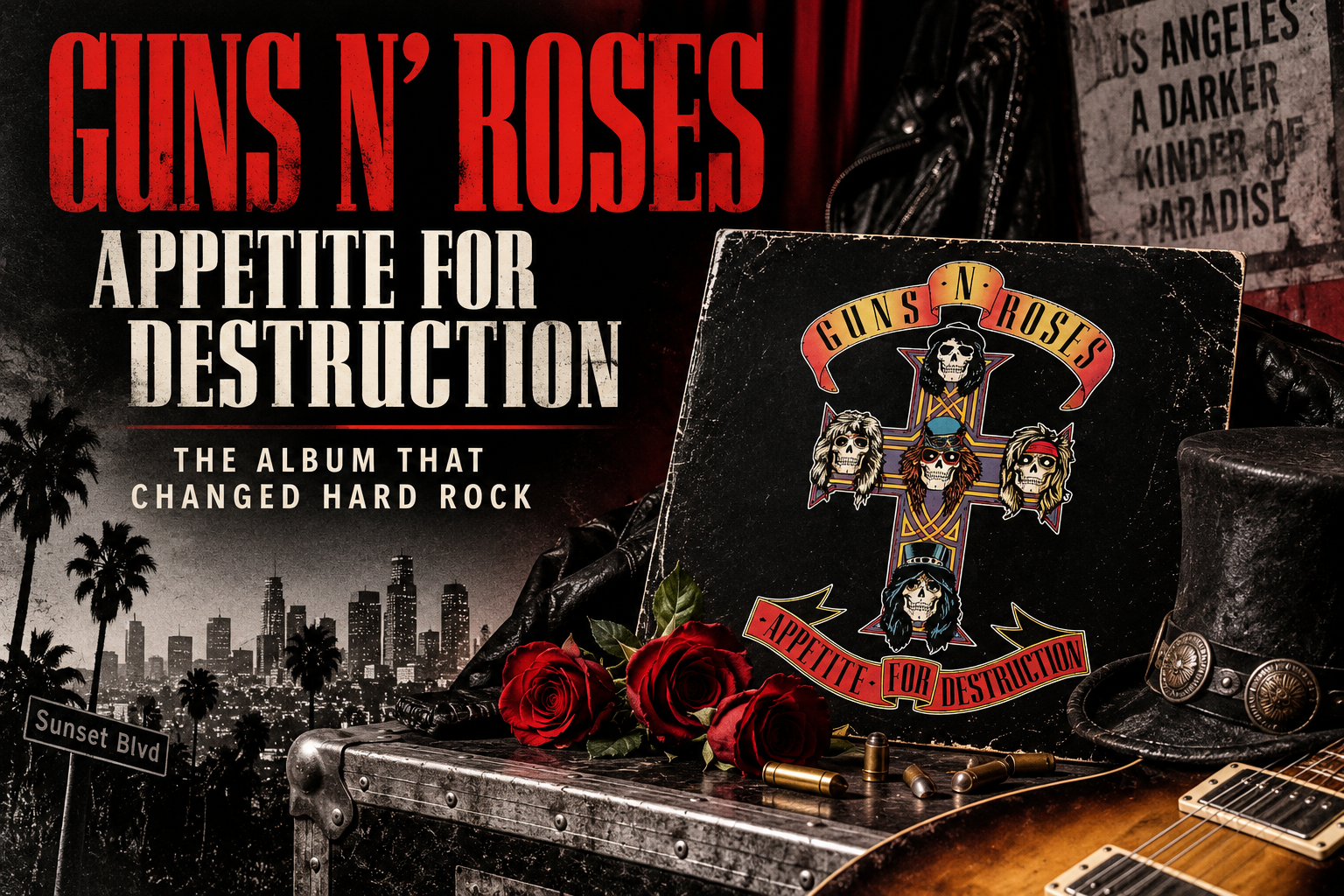
When Guns N’ Roses released Appetite for Destruction in 1987, there was little reason to believe it would become one of the biggest albums in rock history. The band was new, dangerous, and rough around the edges. They did not look particularly polished, and they certainly did not fit neatly into the increasingly commercial version of hard rock that was dominating MTV and radio.
Los Angeles was already full of bands chasing success. The Sunset Strip had become a factory for future rock stars, with groups playing clubs, signing record deals, and hoping to land the next big video. Big hair, flashy clothes, power ballads, and carefully constructed images had become part of the business.
Guns N’ Roses came from the same general environment, but they felt different.
They looked like they had actually slept in the streets they sang about.
Their music combined the swagger of the Rolling Stones, the aggression of punk, the heaviness of metal, and the bluesy instincts of classic hard rock. Their songs were filled with drugs, violence, sex, paranoia, frustration, love, and desperation. The band could write a beautiful melody, but it could also sound like five people starting a fight in a rehearsal room.
That combination made Appetite for Destruction special.
The album was not simply a collection of hard rock songs. It was an arrival. Guns N’ Roses sounded like a band that had absorbed decades of rock music and then dragged it through the streets of 1980s Los Angeles.
More than three decades later, Appetite for Destruction remains one of the defining albums of its era. It produced some of the most famous rock songs ever recorded, turned Guns N’ Roses into international stars, and established a musical standard that countless hard rock bands would spend years trying to match.
Most importantly, it still sounds alive.
The Los Angeles Jungle
To understand Appetite for Destruction, it helps to understand where Guns N’ Roses came from.
The band formed from musicians who had traveled to Los Angeles looking for opportunity. Axl Rose and Izzy Stradlin had arrived from Indiana. Slash had developed his musical identity in Los Angeles. Duff McKagan brought punk and hard rock influences to the group. Steven Adler provided the loose, swinging drumming that helped give the early band its personality.
The classic lineup was unusual because every member brought something different.
Axl Rose had one of the most distinctive voices in rock. He could sing in a relatively low register, then suddenly move into a high, piercing scream that sounded completely unlike most other singers.
Slash was a guitar hero, but he was not a typical 1980s shredder. He could play fast when necessary, but his greatest strength was feel. His guitar playing was rooted in blues and classic rock. His solos sounded melodic rather than mathematical.
Izzy Stradlin was one of the band’s most important songwriters. His rhythm guitar work helped provide the foundation beneath Slash’s leads, and his songwriting instincts contributed heavily to the band’s street-level personality.
Duff McKagan brought an aggressive bass style influenced partly by punk rock. He had played in Seattle’s punk scene before moving to Los Angeles, and that influence helped keep Guns N’ Roses from becoming too slick.
Steven Adler completed the early lineup with a drumming style that was crucial to the band’s sound. Adler did not play like a heavy metal machine. His approach had swing. His drumming helped songs such as “Mr. Brownstone” and “Rocket Queen” move with a groove that separated Guns N’ Roses from many of their contemporaries.
Together, the five musicians created a band with genuine chemistry.
That chemistry can be heard throughout Appetite for Destruction.
A Different Kind of Hard Rock Band
By the middle of the 1980s, hard rock had become increasingly polished.
Bands such as Mötley Crüe, Ratt, Poison, Cinderella, and many others had become major commercial successes. MTV played their videos constantly. Record companies understood the formula. Find a good-looking band, give them memorable songs, create an image, and hope for a hit.
There were excellent bands in the scene, but the industry was beginning to become predictable.
Guns N’ Roses threatened that predictability.
They had the hair.
They had the leather.
They had the guitar solos.
They came from Los Angeles.
On paper, they could have been another Sunset Strip band.
Musically, however, they had more in common with earlier generations of rock.
The Rolling Stones were an obvious influence. So were Aerosmith and AC/DC. Punk bands contributed another important part of the sound. The Sex Pistols and other punk acts demonstrated that music did not need to be polished to be powerful.
Guns N’ Roses combined these influences.
The result was hard rock that sounded both traditional and new.
The band could write a massive radio hook.
Then Axl Rose would scream something that sounded completely unfit for daytime television.
They could play a bluesy guitar solo.
Then Duff would attack the bass with punk energy.
They could create a romantic song.
Then immediately follow it with something about drugs and urban paranoia.
That unpredictability became one of their greatest strengths.
The Album’s Difficult Beginning
It is easy to forget how enormous Appetite for Destruction eventually became.
The album was not an immediate smash.
When it was released in July 1987, Guns N’ Roses were not yet one of the biggest bands in the world. The record needed time.
This is one of the reasons its success story is so remarkable.
The album gradually built momentum.
The band toured.
Fans discovered the music.
Videos eventually increased their exposure.
Radio stations began playing the songs.
Then “Sweet Child o’ Mine” changed everything.
The song became an enormous hit and helped push Appetite for Destruction into another commercial category.
Once people began buying the album, they discovered something unusual.
“Sweet Child o’ Mine” was not representative of the entire record.
It was one of the most accessible songs, but Appetite for Destruction was considerably darker and heavier than its biggest hit suggested.
People who bought the album for the love song received “Welcome to the Jungle.”
They received “Out ta Get Me.”
They received “Mr. Brownstone.”
They received “My Michelle.”
They received “Rocket Queen.”
It was almost like buying a friendly neighborhood cat and discovering it was a tiger.
“Welcome to the Jungle”
The opening track is one of the greatest introductions in rock history.
“Welcome to the Jungle” does not ease the listener into Appetite for Destruction.
It attacks.
The song begins with an ominous atmosphere before Slash’s guitar enters. Then Axl Rose starts singing, and the tension gradually increases.
By the time the chorus arrives, the song has become something else entirely.
The performance is ferocious.
Axl’s voice is central to the song’s power. He moves from controlled menace to full-scale screaming. The vocal sounds dangerous because it feels believable.
Slash’s guitar work provides the perfect counterpoint.
The riffs are heavy but memorable. The song is not dependent on complicated technical tricks. Everything serves the atmosphere.
The lyrics describe the darker side of Los Angeles.
The city could offer opportunity.
It could also destroy people.
Young musicians and dreamers arrived hoping to become stars. Some succeeded. Many did not. Drugs, crime, exploitation, and desperation existed alongside the glamour.
“Welcome to the Jungle” captures that contradiction.
The jungle is exciting.
It is also dangerous.
The song became Guns N’ Roses’ signature opening statement. It told listeners exactly what kind of world they were entering.
There would be no safe space on this album.
“It’s So Easy”
If “Welcome to the Jungle” establishes the danger, “It’s So Easy” establishes the attitude.
The song is aggressive, cynical, and swaggering.
Duff McKagan’s influence is especially noticeable in the track’s punk energy. The rhythm section drives the song forward with very little interest in subtlety.
That is exactly what the song needs.
Axl’s vocal performance is different from “Welcome to the Jungle.” He sounds lower, rougher, and almost conversational at times.
The song demonstrates the band’s range.
Axl Rose is famous for his high voice, but Appetite for Destruction works because he does not use the same approach on every song.
The band understood dynamics.
“It’s So Easy” is not designed to be beautiful.
It is designed to be loud.
“Nightrain”
“Nightrain” is one of the most underrated songs on the album.
The title refers to inexpensive fortified wine, and the song captures the band’s early lifestyle.
The opening guitar work immediately establishes momentum.
The rhythm has a loose feeling.
The band sounds like it is enjoying itself.
This is one of the important differences between Guns N’ Roses and many heavy metal bands of the era.
Guns N’ Roses could be heavy without becoming rigid.
“Nightrain” swings.
The song has energy, but it also has groove.
Slash’s guitar playing is particularly strong. His solos never feel disconnected from the song. He plays like a musician who understands the importance of melody.
“Nightrain” also captures the band’s early identity.
Before the arenas.
Before the millions of albums.
Before the enormous tours.
There was a band struggling to survive and partying far too hard.
“Out ta Get Me”
Paranoia runs through Appetite for Destruction, and “Out ta Get Me” is one of the clearest examples.
The song moves quickly and aggressively.
Axl sounds frustrated and defensive.
The music matches him perfectly.
The band attacks the song with punk-like energy.
Slash and Izzy create a wall of guitar, while Duff and Adler keep everything moving.
“Out ta Get Me” is not one of the album’s famous radio songs.
That does not matter.
Its purpose is different.
The song adds to the album’s personality.
It makes Appetite for Destruction feel like a complete world rather than a collection of singles.
“Mr. Brownstone”
“Mr. Brownstone” is one of the most important songs on the album.
The title refers to heroin, and the song describes addiction with a casual honesty that makes it even more unsettling.
The groove is remarkable.
Steven Adler’s drumming is one of the track’s strongest elements. The rhythm has swing and feel. Duff’s bass works perfectly with the drums.
The guitar parts are equally effective.
Slash and Izzy do not compete.
They complement each other.
This was one of the secrets of Guns N’ Roses.
Slash was the obvious guitar hero, but Izzy’s rhythm guitar was essential. Without that foundation, Slash’s leads would not have had the same impact.
“Mr. Brownstone” also demonstrates the band’s ability to make dark subject matter sound catchy.
The song is fun to listen to.
That is part of the problem.
The groove makes the listener want to move.
The subject is addiction.
That contrast creates tension.
“Paradise City”
“Paradise City” is one of the album’s great achievements.
The song begins with a relatively relaxed guitar figure before gradually becoming something much larger.
By the end, the band is moving at an entirely different speed.
The famous chorus is one of the biggest in rock history.
Almost everyone knows it.
But the song is more sophisticated than its chorus suggests.
The arrangement develops gradually.
The band understands patience.
The final section builds momentum until it becomes a full-speed rock explosion.
Slash’s guitar playing is exceptional throughout.
His lead work provides melody without overwhelming the song.
Axl delivers one of his strongest performances.
The vocal moves between singing and screaming naturally.
“Paradise City” became a concert favorite for obvious reasons.
It has everything.
A memorable chorus.
Great guitar work.
A changing arrangement.
A huge ending.
It is difficult to imagine a better example of Guns N’ Roses at their peak.
“My Michelle”
“My Michelle” is darker and more personal.
The song is based on a real person known to the band, and the lyrics deal with a difficult life involving drugs and family problems.
Musically, the track is hard and aggressive.
The band avoids turning the subject into sentimental melodrama.
Instead, the song moves with a directness that makes it feel more realistic.
Again, Axl’s performance is essential.
He can sound sympathetic and threatening within the same album.
“My Michelle” demonstrates that Guns N’ Roses were willing to write about uncomfortable subjects.
The characters on Appetite for Destruction are rarely living perfect lives.
They are struggling.
They are partying.
They are angry.
They are scared.
The album’s world is not clean.
“Think About You”
“Think About You” is often overshadowed by the larger songs on the album.
It deserves more attention.
The song provides a brief change of mood.
It is more melodic and romantic than much of the record.
The guitars remain energetic, but the overall atmosphere is lighter.
This song demonstrates another important strength.
Guns N’ Roses understood the importance of variety.
If every song had sounded like “Welcome to the Jungle,” the album would have become exhausting.
“Think About You” provides contrast.
That contrast makes the heavier songs hit harder.
“Sweet Child o’ Mine”
“Sweet Child o’ Mine” became Guns N’ Roses’ biggest mainstream hit.
It is also one of the most famous rock songs ever recorded.
The song’s origin is legendary.
Slash’s opening guitar figure reportedly began as a warm-up exercise or joke before becoming the foundation of the song.
Whatever its beginning, the riff became iconic.
The guitar introduction immediately identifies the song.
Few rock riffs are more recognizable.
Axl Rose’s lyrics are notably different from much of Appetite for Destruction.
The song is romantic.
It is sincere.
It is vulnerable.
The contrast between the beautiful melody and Axl’s distinctive voice creates something unique.
The song also demonstrates the band’s songwriting ability.
Guns N’ Roses were often described as dangerous street musicians, but “Sweet Child o’ Mine” is carefully constructed pop songwriting.
The chorus is unforgettable.
The arrangement develops.
Slash’s guitar work remains melodic.
The song builds toward an emotional conclusion.
It became a huge hit because it deserved to be.
The song appealed to people who might not normally listen to hard rock.
That accessibility helped transform the band.
But “Sweet Child o’ Mine” never feels like a compromise.
It still sounds like Guns N’ Roses.
“You’re Crazy”
“You’re Crazy” brings the album back toward aggression.
The song has a raw feeling.
Its guitar riff is direct and effective.
The vocal is full of attitude.
The band later recorded an acoustic version of the song, demonstrating that the composition itself could work in different arrangements.
On Appetite for Destruction, however, “You’re Crazy” is electric and loud.
It helps maintain the album’s balance.
The record constantly moves between different moods.
“Anything Goes”
“Anything Goes” is one of the album’s more overlooked tracks.
It may not have the legendary status of “Paradise City” or “Welcome to the Jungle,” but it fits the album’s overall personality.
The song is loose, sexual, and energetic.
The band sounds comfortable.
The track reflects the band’s early club roots.
You can imagine Guns N’ Roses playing this in a packed Los Angeles club before they became famous.
That authenticity is important.
Even the lesser-known songs on Appetite for Destruction feel connected to the band’s identity.
“Rocket Queen”
The album ends with “Rocket Queen,” and it is an ambitious conclusion.
The song contains multiple personalities.
It begins aggressively.
The rhythm is powerful.
The guitars are heavy.
Then the arrangement changes.
The song becomes more melodic and atmospheric.
This transition is one of the album’s most interesting moments.
“Rocket Queen” demonstrates the band’s willingness to experiment with structure.
A conventional hard rock song might have simply continued at the same intensity.
Guns N’ Roses allowed the song to transform.
The second half has a looser, almost jam-like atmosphere.
Axl’s vocal becomes more emotional.
Slash adds expressive guitar.
The song fades out gradually.
It is an excellent ending because it leaves the listener wanting more.
The Secret Weapon: Slash
Slash became one of the most famous guitarists of his generation.
His image was instantly recognizable.
The top hat.
The curly hair.
The cigarette.
The Les Paul guitar.
But image was only part of the story.
Slash was genuinely exceptional.
During the 1980s, guitar playing had become increasingly technical. Many players competed to perform faster and more complicated solos.
Slash took a different approach.
He could play quickly.
That was never his main point.
His greatest gift was phrasing.
He knew how to make a guitar solo sound like a melody.
He understood the blues.
He understood classic rock.
His solos could be emotional.
The guitar work on Appetite for Destruction is filled with memorable moments.
“Sweet Child o’ Mine.”
“Paradise City.”
“Welcome to the Jungle.”
“Nightrain.”
The album established Slash as a major guitar figure.
More importantly, it demonstrated that guitar heroism did not require endless technical gymnastics.
Sometimes one perfectly chosen note is better than twenty.
Axl Rose: One of Rock’s Most Unusual Voices
Axl Rose remains one of the most distinctive singers in rock history.
His voice was impossible to confuse with anyone else’s.
He had an enormous range.
He could sound vulnerable.
He could sound sarcastic.
He could sound dangerous.
Then he could scream with a level of intensity that few singers could match.
On Appetite for Destruction, Rose uses his voice like another instrument.
He changes his approach depending on the song.
“Sweet Child o’ Mine” requires emotion.
“Welcome to the Jungle” requires menace.
“Mr. Brownstone” requires attitude.
“Paradise City” requires power.
This versatility helps explain why the album remains so interesting.
Axl Rose was not simply a singer delivering lyrics.
He was a character actor.
Every song required a different personality.
The Importance of Izzy Stradlin
Izzy Stradlin is sometimes overlooked because Slash became the band’s obvious guitar superstar and Axl Rose became its dominant public personality.
That is unfortunate.
Izzy was essential.
His songwriting contributions were enormous.
His rhythm guitar provided structure.
His approach was less flashy but equally important.
A great rock band needs balance.
If everyone tries to be the lead guitarist, the music becomes a mess.
Izzy understood the importance of supporting the song.
His guitar parts created the foundation.
His songwriting helped establish the band’s Rolling Stones influence.
Appetite for Destruction would sound significantly different without him.
Duff McKagan and Steven Adler
The rhythm section deserves equal credit.
Duff McKagan’s bass playing gave the band punch.
His punk influences helped make the songs feel faster and more aggressive.
He did not simply follow the guitar riffs.
His bass parts had personality.
Steven Adler’s drumming was equally important.
Adler’s style gave Guns N’ Roses swing.
This is one of the most important aspects of the album.
Many hard rock bands could play loud.
Many could play fast.
Not all of them could groove.
Adler could.
Listen carefully to “Mr. Brownstone.”
The song works because the rhythm section understands feel.
That looseness helped separate Guns N’ Roses from more mechanical metal bands.
Mike Clink and the Production
Producer Mike Clink helped Guns N’ Roses create the sound of Appetite for Destruction.
The production is powerful without becoming overly polished.
This was a difficult balance.
The band needed to sound professional.
The record also needed to preserve the band’s raw energy.
Clink succeeded.
The guitars sound huge.
The rhythm section is clear.
Axl’s vocals dominate when necessary.
The album has the scale of a major commercial release without losing the feeling that the musicians might destroy the studio at any moment.
That balance was essential.
A cleaner production might have removed too much danger.
A rougher production might have limited the album’s commercial appeal.
Appetite for Destruction sounds like a rock band at full volume.
That is exactly what it needed to sound like.
The Album Cover Controversy
The original artwork for Appetite for Destruction created controversy.
The original cover featured artwork by Robert Williams that was considered offensive and disturbing by many people.
The image was eventually replaced on many releases with the now-famous cross design featuring skulls representing the five band members.
The controversy fit Guns N’ Roses’ image.
They were not interested in appearing safe.
The band wanted attention.
Sometimes they received it for the music.
Sometimes they received it for the wrong reasons.
The cross cover eventually became iconic.
For millions of fans, that image immediately means Guns N’ Roses.
Why Appetite for Destruction Was Different
The simplest explanation for the album’s success is that the songs were excellent.
That should not be overlooked.
Marketing can help.
Videos can help.
Radio can help.
But none of those things create classics without strong material.
Appetite for Destruction has multiple songs that could reasonably be considered among the greatest hard rock recordings of the era.
“Welcome to the Jungle.”
“Paradise City.”
“Sweet Child o’ Mine.”
“Nightrain.”
“Mr. Brownstone.”
The album also works as a complete listening experience.
The lesser-known songs are important.
They establish mood.
They provide variety.
They make the album feel like a journey.
The record has aggression.
It has humor.
It has romance.
It has paranoia.
It has addiction.
It has celebration.
Most importantly, it has personality.
The Legacy of Appetite for Destruction
Appetite for Destruction changed Guns N’ Roses’ lives.
The band went from struggling musicians to international superstars.
The album eventually became one of the best-selling records in American history.
Its songs became staples of rock radio.
New generations continue discovering them.
The album also changed hard rock.
For a brief period, Guns N’ Roses became the standard.
Every new hard rock band was compared to them.
Record labels wanted the next Guns N’ Roses.
Musicians wanted Slash-style guitar tones.
Singers attempted Axl-style screams.
Few bands could reproduce the chemistry.
That was the problem.
Guns N’ Roses worked because of the combination.
You could find a great singer.
You could find a great guitarist.
You could find talented musicians.
Putting them together did not guarantee the same result.
The classic lineup had a particular chemistry that could not be manufactured.
The Beginning of the End of Hair Metal
It would be unfair to say Guns N’ Roses single-handedly killed hair metal.
The genre continued successfully after Appetite for Destruction.
Many bands continued selling records.
However, Guns N’ Roses changed the expectations.
They made some other bands appear artificial.
This was partly because Guns N’ Roses looked genuinely dangerous.
They did not appear to be pretending to live the lifestyle.
The songs sounded connected to reality.
The band members had experienced the environment they described.
This authenticity became increasingly valuable.
By the early 1990s, grunge would transform rock music even further.
Nirvana, Pearl Jam, Soundgarden, and Alice in Chains would move popular rock in new directions.
But Guns N’ Roses helped prepare the audience.
They demonstrated that polished commercial rock could still contain danger.
Appetite for Destruction Still Holds Up
The ultimate test of a classic album is time.
Does it still work?
Appetite for Destruction absolutely does.
The production remains powerful.
The guitar playing remains exciting.
Axl Rose’s voice remains unique.
The songs remain memorable.
Most importantly, the band chemistry remains impossible to fake.
Listening to the album today, it is easy to understand why it became successful.
The energy is immediate.
The musicians sound hungry.
That hunger may be the most important part of the album.
Guns N’ Roses had not yet become the massive institution they would eventually become.
They were still fighting.
They still had something to prove.
The title was appropriate.
Appetite for Destruction sounds like a band with an enormous appetite.
They wanted success.
They wanted attention.
They wanted to be the biggest band in the world.
And, for a while, they got very close.
Final Thoughts
Appetite for Destruction is one of those rare albums where the mythology does not overwhelm the music.
The stories surrounding Guns N’ Roses are legendary.
Drugs.
Fights.
Los Angeles.
The Sunset Strip.
The band’s internal conflicts.
Axl Rose’s unpredictable reputation.
Slash’s iconic image.
All of that has become part of rock history.
But strip away the mythology, and the album still works.
That is what makes it great.
Appetite for Destruction contains some of the finest hard rock songs of the 1980s.
It introduced one of the era’s greatest guitarists to the world.
It featured one of rock’s most unusual and powerful singers.
It demonstrated the importance of rhythm and groove in hard rock.
It combined punk aggression with bluesy guitar playing and classic rock songwriting.
It was commercial without sounding manufactured.
It was dangerous without being completely chaotic.
It was polished enough for radio while remaining rough enough to feel real.
That combination is incredibly difficult to achieve.
Many bands have tried.
Very few have succeeded.
Guns N’ Roses captured something special in 1987.
The album arrived at exactly the right moment.
Hard rock was popular but becoming predictable.
The music industry was looking for stars.
MTV was powerful.
Radio could still make songs enormous.
Guns N’ Roses entered that environment and sounded different enough to matter.
Then the songs took over.
“Welcome to the Jungle” became an introduction to the band.
“Sweet Child o’ Mine” became an international hit.
“Paradise City” became a rock radio standard.
The album grew.
The audience grew.
The legend grew.
Today, Appetite for Destruction represents more than the debut of Guns N’ Roses.
It represents a particular moment in rock history when a band could still sound dangerous and become massively popular at the same time.
The album’s influence continues.
Guitarists still learn Slash’s riffs.
Singers still attempt Axl’s vocal lines.
Rock bands still chase the combination of aggression, melody, and groove that Guns N’ Roses captured.
Most of them discover the same thing.
It is harder than it looks.
Because Appetite for Destruction was not great simply because the band was talented.
It was great because five musicians with very different personalities and influences found a way to make those differences work together.
Axl Rose brought the voice.
Slash brought the guitar.
Izzy Stradlin brought the songwriting and rhythm.
Duff McKagan brought the bass and punk attitude.
Steven Adler brought the groove.
Mike Clink helped capture it.
The result was an album that sounded larger than the individual musicians.
That is what great bands do.
They become something bigger together.
Nearly forty years later, Appetite for Destruction remains loud, reckless, melodic, funny, dark, and remarkably alive.
It is not a perfect album because it is polished.
It is great because it feels human.
Sometimes messy.
Sometimes angry.
Sometimes romantic.
Sometimes completely out of control.
Just like rock and roll should be.
This post has already been read 166 times!