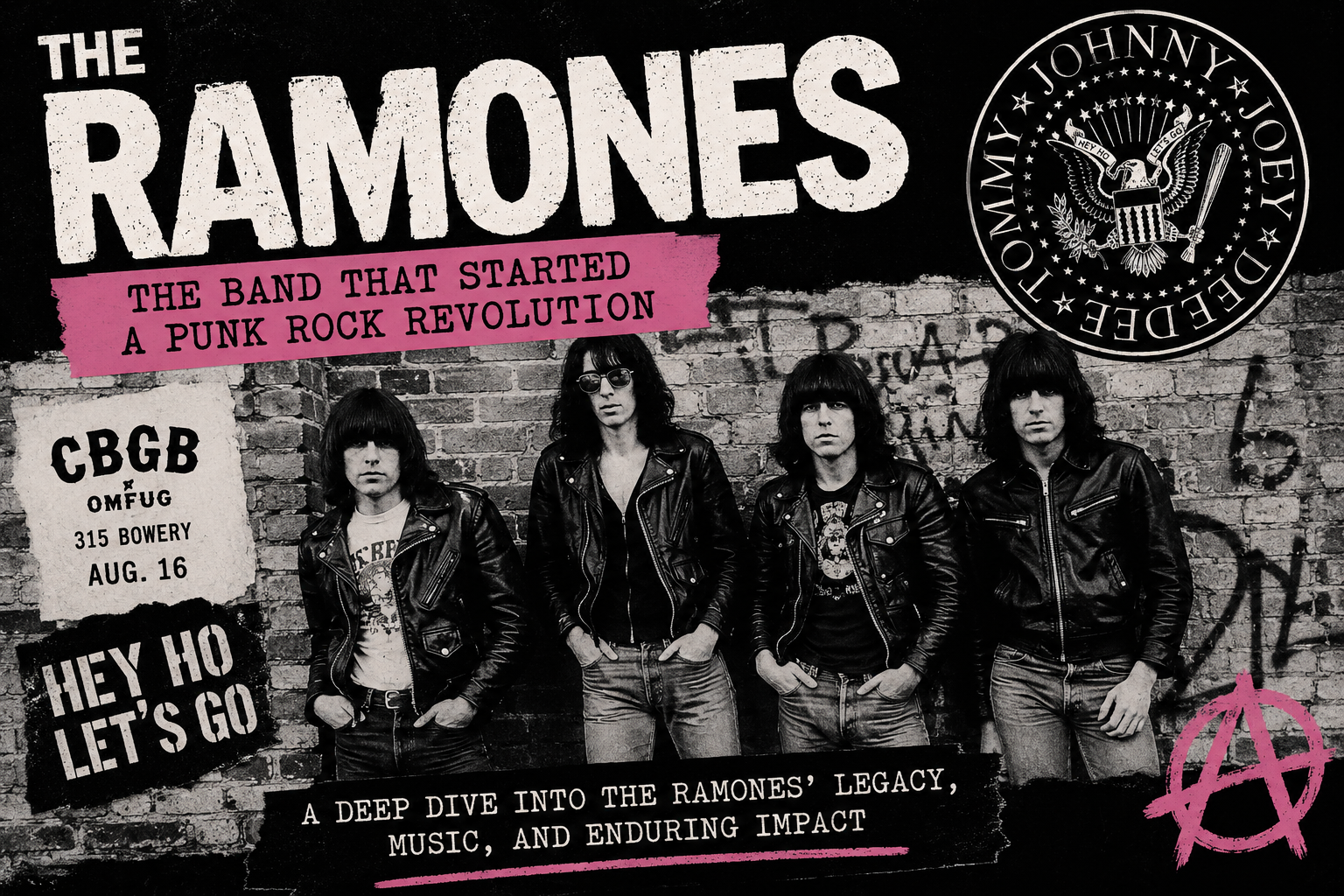
The Ramones did not look like the kind of band that was going to change music forever. They were four guys from Queens with long hair, ripped jeans, leather jackets, sneakers, and a name that sounded more like a family nickname than the title of a future rock institution. Their songs were short. Their records were loud. Their melodies were simple. Their stage names were nearly identical. Their first album barely lasted half an hour.
And yet, the Ramones helped blow open one of the most important doors in rock history.
When the band appeared in the middle of the 1970s, mainstream rock had become increasingly elaborate. Progressive rock groups were making sprawling albums. Arena bands were filling enormous venues with guitar solos, keyboards, elaborate stage productions, and songs that could stretch toward ten minutes. Even many of the biggest hard-rock acts were becoming increasingly polished and technically ambitious.
The Ramones went in exactly the opposite direction.
They wanted the songs to hit fast, make their point, and get out.
That simplicity was deceptive. The Ramones were not untalented musicians who stumbled into a successful gimmick. Their greatest strength was understanding what could be removed from rock music without destroying what made it exciting. They stripped away excess while keeping the most important ingredients: melody, rhythm, attitude, volume, humor, teenage frustration, romance, rebellion, and the unmistakable thrill of a great guitar riff.
The result was revolutionary.
The Ramones became one of the foundational bands of punk rock, even though their music contained far more pop sensibility than the word “punk” sometimes suggests. They loved 1950s rock and roll, girl-group records, bubblegum pop, garage rock, surf music, British Invasion bands, and early American rock. Their music was aggressive, but it was also catchy. Their records could sound primitive, but the songwriting underneath the noise was remarkably disciplined.
That combination became their secret weapon.
The Ramones also became something larger than a successful band. They became an idea. Their look, sound, attitude, album covers, stage presentation, song titles, and refusal to conform created a template that thousands of musicians would follow. Punk bands in New York, London, Los Angeles, and eventually virtually every corner of the world could hear the Ramones and understand that they did not need virtuoso technique, expensive equipment, or a record company-approved image to start a band.
They just needed a few chords, a good song, an amplifier, and the nerve to turn it up.
Queens Before the Ramones
The story of the Ramones begins in Forest Hills, Queens, a long way geographically and culturally from the mythology of the Sunset Strip or the British rock scene.
Jeffrey Hyman, John Cummings, Douglas Colvin, and Thomas Erdelyi came from different backgrounds and initially found their way into music through different routes. They were united less by polished musical training than by a shared fascination with rock music and the feeling that the existing music scene had become too predictable.
The eventual lineup would become Joey Ramone, Johnny Ramone, Dee Dee Ramone, and Tommy Ramone.
Those names became inseparable from the band, but the mythology surrounding them sometimes obscures how unusual the individuals were.
Joey was physically distinctive, with his towering frame and awkward presence, but his voice became one of the most recognizable sounds in rock. He sang with a nasal, vulnerable quality that could make even the band’s most ridiculous songs sound strangely sincere.
Johnny was the band’s guitarist and one of its central organizing forces. His playing was economical, aggressive, and relentlessly consistent. He did not need complicated solos because his rhythm guitar was the engine of the entire band.
Dee Dee was the restless creative force whose bass playing and songwriting helped define the band’s early sound. His lyrics could be funny, bizarre, aggressive, innocent, or all four at once.
Tommy was crucial to turning the band’s raw ideas into an actual musical machine. His understanding of arrangement and production helped the Ramones sound much tighter and more purposeful than their minimalist approach might suggest.
Together, they created a visual and musical identity almost immediately.
The famous matching surnames were inspired by Paul McCartney’s use of the name Paul Ramon during a period when the Beatles were developing their identity. The Ramones adopted the surname collectively, creating one of rock’s most memorable fictional families.
The name was part joke, part concept, and part statement.
They were not trying to present themselves as four individuals with elaborate biographies. They were the Ramones.
That collective identity became part of the band’s power.
The New York Underground
The Ramones emerged at a particularly important moment in New York music.
Manhattan’s downtown scene was developing a new kind of musical culture in clubs and alternative spaces. CBGB became the most famous gathering place, hosting bands that would help redefine American rock. Television, Patti Smith, Blondie, Talking Heads, and the Ramones all became associated with a scene that was dramatically different from mainstream rock.
These bands did not all sound alike.
That point matters because “punk” eventually became a broad category, but the original New York scene was stylistically diverse. Television emphasized intricate guitar interplay. Talking Heads incorporated art-rock and funk influences. Blondie moved between punk, pop, disco, reggae, and other styles. Patti Smith brought poetry and garage-rock energy.
The Ramones were the most direct of the group.
Their songs could be over before the audience had fully processed what had happened.
That was part of the appeal.
The band performed with a level of repetition and discipline that almost looked mechanical. Johnny’s guitar attacked the same basic rhythmic patterns. Dee Dee’s bass locked into the guitar. Tommy’s drumming pushed everything forward. Joey stood behind the microphone and delivered the songs in his distinctive voice.
The effect was less like watching four musicians debate what to play and more like watching a single machine.
The Ramones quickly became one of CBGB’s defining attractions.
Their early shows helped establish an entirely new idea of what a rock concert could be. They did not need a giant stage, expensive lighting, or a complicated set. They could play a tiny club, start a song, finish it, and immediately launch into another.
The speed became part of the experience.
The audience did not have time to get bored.
“Blitzkrieg Bop” Changes Everything
The first Ramones album arrived in 1976.
It was one of those records that seemed almost absurdly simple until its influence became impossible to ignore.
The opening track, “Blitzkrieg Bop,” provided perhaps the most important introduction in the band’s entire catalog.
The song is built around a remarkably basic guitar progression and a chant that became one of the most recognizable audience-participation moments in rock. Its famous call-and-response structure is almost childlike in its simplicity.
That was precisely the point.
The song does not need complexity.
It needs momentum.
The opening guitar immediately establishes the rhythm. The drums arrive with enormous force. Joey begins singing. The chorus arrives almost instantly. The whole thing feels like a rocket being launched.
“Blitzkrieg Bop” became a template for punk songwriting: short verses, an enormous chorus, minimal decoration, and maximum energy.
But beneath the simplicity was an important understanding of pop music.
The Ramones knew how to write hooks.
They knew that repetition was not a weakness. Repetition could be the entire point.
The song’s famous chant turned the audience into part of the performance. It was easy to remember after one listen. It could be shouted by people who had never heard the album before.
That was one of the band’s great innovations.
They made punk communal.
The music could sound aggressive without becoming inaccessible.
The First Album
The self-titled Ramones album remains one of the most important debut records in rock history.
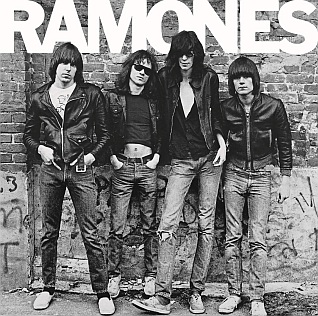 Its cover alone became iconic: the four members standing against a brick wall in leather jackets and jeans, staring toward the camera with varying degrees of seriousness. There was no elaborate concept. No fantasy world. No expensive production spectacle.
Just four guys.
The album’s sound was equally direct.
Songs such as “Blitzkrieg Bop,” “Beat on the Brat,” “Judy Is a Punk,” “I Wanna Be Your Boyfriend,” and “Now I Wanna Sniff Some Glue” demonstrated the remarkable range hidden inside the band’s apparently narrow formula.
“Beat on the Brat” had a strange nursery-rhyme quality beneath the aggression. “Judy Is a Punk” moved at astonishing speed. “I Wanna Be Your Boyfriend” showed that the band could slow down and deliver a genuinely sweet pop song. “Now I Wanna Sniff Some Glue” transformed adolescent boredom into something resembling a miniature punk manifesto.
The entire album lasted less than half an hour.
That runtime was not a limitation.
It was a statement.
The Ramones were saying that rock records did not need to fill every available minute. A song should last as long as its idea needed to last.
If the idea took ninety seconds, the song could be ninety seconds.
The band’s approach also created a strange contradiction.
Their music sounded primitive, but their arrangements were highly controlled.
Every instrument had a job.
The guitar was rarely decorative. The bass did not wander. The drums were direct and powerful. Joey’s vocal melodies were central. The songs were constructed around hooks rather than instrumental displays.
The result sounded spontaneous even when it was carefully organized.
That distinction would become hugely important to punk.
Why the Ramones Were So Different
The Ramones did not invent loud guitars, fast music, simple chord progressions, or short songs.
All of those things existed before them.
What they did was combine those elements into a coherent aesthetic.
They understood that rock and roll could be reduced to its most exciting components without losing its personality.
The band also rejected the growing seriousness of much rock music.
There was humor in the Ramones.
Sometimes the humor was obvious. Sometimes it was buried inside absurd song concepts. Sometimes it came from the contrast between Joey’s earnest delivery and the ridiculous subject matter.
The band could sing about teenage romance, comic-book imagery, horror movies, drugs, boredom, violence, and dysfunctional relationships without treating any of it like a grand philosophical statement.
That irreverence was important.
Rock had spent years becoming increasingly important.
The Ramones reminded everyone that rock could also be fun.
Joey Ramone: The Unlikely Frontman
Joey Ramone became one of the most recognizable frontmen in punk history, but he did not fit the traditional image of a rock star.
He was extremely tall and awkward, with a distinctive physical presence that made him immediately recognizable. He often stood relatively still onstage while the rest of the band attacked the songs around him.
His voice was equally distinctive.
Joey did not sound like a conventional rock singer. He had a nasal, slightly vulnerable quality that could make him sound both tough and innocent.
That voice became essential to the Ramones.
A different singer might have made the songs sound more aggressive. Joey made them sound human.
There was often a sense of vulnerability beneath his delivery.
That helped the band move between comedy and sincerity.
A song could be ridiculous and still feel emotionally real because Joey sounded as if he genuinely believed every word he was singing.
His voice also helped establish the Ramones’ connection to pop music.
He was not trying to overpower the band with vocal theatrics.
He was another part of the melody.
That approach influenced countless punk and alternative singers who realized that they did not need a traditionally powerful voice to become an effective frontman.
Personality mattered more than vocal perfection.
Johnny Ramone: The Machine
If Joey was the face and voice of the Ramones, Johnny was the machine.
His guitar playing was based on relentless rhythm.
He did not need flashy solos because the entire band was built around the guitar’s rhythmic attack.
Johnny played with extraordinary consistency.
That consistency became one of the band’s defining characteristics.
A Ramones song often sounds as though it is moving forward on rails.
Johnny’s guitar provides the track.
There is almost no hesitation.
That was especially important in live performance.
The Ramones were famous for moving quickly from one song to the next. There was little wasted space. Johnny’s playing allowed the band to maintain momentum almost continuously.
His approach also influenced generations of punk guitarists.
You did not need to know fifty chords.
You needed to know the right three or four and play them with conviction.
Johnny’s conservative approach to musicianship was deliberate.
He understood the difference between technical ability and musical effectiveness.
His guitar playing was not designed to impress other guitarists.
It was designed to make people move.
Dee Dee Ramone: The Songwriter Who Couldn’t Sit Still
Dee Dee Ramone brought a different kind of energy.
His bass playing helped define the band’s early attack, but his songwriting became perhaps his greatest contribution.
Dee Dee had an extraordinary ability to turn strange thoughts into memorable songs.
His writing could be funny, crude, surreal, romantic, or deeply troubled.
He also understood the emotional world of alienated young people.
The Ramones frequently wrote from the perspective of people who did not quite fit into normal society.
That made the band’s music especially powerful for teenagers and outsiders.
Dee Dee also had a restless personality that eventually created serious difficulties for the band.
His struggles contributed to his departure from the touring lineup, but his songwriting continued to influence the Ramones.
The band’s catalog would not exist in the same form without him.
His contributions helped make the Ramones more than a three-chord novelty act.
There was genuine songwriting underneath the speed.
Tommy Ramone: The Architect
Tommy Ramone is sometimes overshadowed by the three members who became the band’s most famous public personalities.
That is unfortunate because his contribution was enormous.
Tommy helped shape the band’s early sound and approach.
As drummer and producer, he understood that the Ramones needed to sound raw without sounding sloppy.
That is a difficult balance.
Too much polish would destroy the band’s personality.
Too little discipline would make the songs fall apart.
Tommy helped establish the middle ground.
The drums were powerful but simple. The guitars were loud but clear enough to carry the riffs. The vocals remained prominent. The songs moved rapidly without becoming chaotic.
His production work on the early records was essential to the band’s identity.
The Ramones may have sounded primitive, but they were not accidental.
There was architecture underneath the noise.
The Ramones and Pop Music
One of the biggest misconceptions about punk is that punk was simply the rejection of pop music.
The Ramones prove otherwise.
They loved pop music.
Their songwriting was built around melody.
They admired the Beatles. They loved 1960s girl groups. They understood the power of bubblegum. They borrowed from surf rock and garage rock. They took the basic principles of early rock and accelerated them.
That is why the Ramones have aged differently from many of their contemporaries.
The songs remain catchy.
Strip away the distortion and speed, and many of them are essentially brilliant pop songs.
The band simply delivered those songs through a louder and more aggressive framework.
This is particularly obvious in their romantic material.
“I Wanna Be Your Boyfriend” is a straightforward pop song hiding inside a punk record.
“Rockaway Beach” has a bright, almost carefree quality.
“Do You Remember Rock ‘n’ Roll Radio?” sounds like a celebration of the music that inspired them.
The Ramones were never simply anti-establishment.
They were pro-rock and roll.
That distinction matters.
They were not trying to destroy music.
They were trying to rescue the part of it they loved.
Rocket to Russia
The band’s second album, Rocket to Russia, demonstrated how quickly the Ramones were developing.
The record contained some of their most enduring songs, including “Rockaway Beach,” “Sheena Is a Punk Rocker,” and “Cretin Hop.”
“Rockaway Beach” was especially important because it revealed a lighter side of the band.
The song is fast and loud, but its spirit is sunny.
It sounds like summer.
That contrast became a major part of the Ramones’ appeal.
They could make music that was aggressive without being relentlessly dark.
The band understood that punk could be playful.
Rocket to Russia also showed how comfortable the Ramones had become with their formula.
The songs were still short.
The arrangements were still simple.
But the songwriting had become more sophisticated.
The hooks were stronger.
The melodies were more memorable.
The production had more depth.
The band was refining rather than reinventing.
That would become a recurring characteristic of the Ramones.
They were not interested in dramatic stylistic transformations.
They wanted to become better at being the Ramones.
Road to Ruin
By 1978, the Ramones had already released several albums and toured extensively.
Their fourth album, Road to Ruin, marked another transition.
Tommy Ramone left the touring lineup and was replaced by Marky Ramone.
Marky’s drumming gave the band a slightly different feel.
He could play with the same basic aggression but brought a more traditional rock-drumming background.
The album also showed the band’s interest in expanding its sound without abandoning its identity.
“I Wanna Be Sedated” became one of their defining songs.
The title captured a particular kind of exhaustion and boredom that had always existed underneath the band’s frantic music.
The Ramones were associated with speed, but their characters were often exhausted by the world around them.
They wanted escape.
Sometimes that escape was music.
Sometimes it was romance.
Sometimes it was television, movies, drugs, or simply getting out of town.
That tension between frantic music and emotional exhaustion became one of the band’s most enduring qualities.
Rock ‘n’ Roll High School
The Ramones’ connection to teenage culture became especially clear through “Rock ‘n’ Roll High School.”
The song was essentially a fantasy of rebellion.
School represented authority, routine, boredom, and conformity.
Rock and roll represented freedom.
The Ramones turned that conflict into a simple, infectious song.
It became closely associated with the band and eventually with the broader mythology of punk.
The Ramones understood something important about youth culture.
Teenagers do not necessarily want complicated political theories.
Sometimes they want a song that says their frustration makes sense.
“Rock ‘n’ Roll High School” did exactly that.
It transformed ordinary teenage boredom into something worth shouting about.
End of the Century
The Ramones eventually made one of the strangest decisions of their career by working with legendary producer Phil Spector.
The result was End of the Century.
Spector was famous for enormous, layered productions.
The Ramones were famous for stripped-down speed.
It was an obvious clash of philosophies.
Spector’s production brought a different atmosphere to the band’s music, sometimes emphasizing melody and creating a more polished sound.
The album produced major material, including “Do You Remember Rock ‘n’ Roll Radio?” and the band’s version of “Baby, I Love You.”
The record remains controversial among fans because it represents a version of the Ramones that is less raw than their early work.
Yet it is also important because it demonstrates that the band was never as musically narrow as its reputation suggests.
They could work within a more elaborate production environment.
The results were not always what longtime fans wanted, but the experiment expanded the mythology around the band.
The Clash, Sex Pistols, and the British Connection
The Ramones’ influence became particularly significant in Britain.
British punk developed its own identity, but the Ramones were an important spark.
The Sex Pistols, The Clash, The Damned, and countless other bands absorbed the idea that rock could be faster, simpler, and more immediate.
The Ramones had shown that a band did not need to wait for permission.
This was perhaps their greatest gift.
Punk became a do-it-yourself movement.
The Ramones helped make that possible.
Their music communicated a simple message without needing to say it explicitly:
Start a band.
Learn a few songs.
Get onstage.
Turn up.
That philosophy became more influential than any particular chord progression.
The Ramones and the Birth of Alternative Rock
The Ramones’ influence eventually extended far beyond punk.
Hardcore punk bands adopted their speed.
Pop-punk bands adopted their melodies.
Alternative rock bands adopted their combination of noise and hooks.
College-rock musicians admired their independence.
Grunge musicians inherited their refusal to overcomplicate rock.
Bands from the Offspring to Green Day to Rancid to Bad Religion to countless others carried pieces of the Ramones’ DNA.
The band’s influence also reached musicians who did not sound remotely like them.
That is a sign of genuine influence.
A band does not have to be copied literally to be influential.
Sometimes its greatest impact is giving another musician permission to approach music differently.
The Ramones did that constantly.
Why the Ramones Never Became Superstars
One of the strangest parts of the Ramones story is that they became enormously influential without ever becoming one of America’s biggest commercial rock bands.
Their albums were respected.
Their concerts developed loyal audiences.
Their influence became enormous.
But they never reached the commercial level of bands such as Aerosmith, KISS, or later stadium acts.
That raises an interesting question.
Why?
Part of the answer was the band’s refusal to change.
The very qualities that made them influential also limited their mainstream appeal.
They looked strange.
Their songs were short.
Their sound was aggressive.
Their humor could be abrasive.
Their image was deliberately anti-glamorous.
They did not seem interested in becoming conventional celebrities.
Their music also arrived during a period when radio and record companies were increasingly interested in polished, commercially accessible rock.
The Ramones were accessible in one sense—they wrote incredibly catchy songs—but they did not package those songs in a conventional way.
Their career therefore became a fascinating example of the difference between commercial success and cultural influence.
They did not dominate the charts.
They changed the language of rock.
The Ramones as a Live Band
Seeing the Ramones live was fundamentally different from listening to their albums.
The songs were already fast on record.
Live, they became a continuous rush.
The band famously moved through songs with very little space between them.
There were no extended speeches.
No long instrumental jams.
No elaborate costume changes.
No theatrical storytelling.
Song after song.
That relentless pace became one of the band’s trademarks.
A Ramones concert could feel almost physically exhausting.
The audience knew what was coming, but that did not reduce the excitement.
In fact, the predictability was part of the appeal.
Fans wanted to hear the songs they loved.
The band delivered them at maximum speed.
The simplicity of the setup also made the Ramones accessible to aspiring musicians.
A young person could watch the band and imagine doing the same thing.
That was revolutionary.
The gap between performer and audience became smaller.
The Ramones looked like people who had escaped from the audience and somehow ended up onstage.
The Ramones Look
The Ramones’ visual identity became nearly as influential as their music.
Leather jackets.
Jeans.
Sneakers.
Long hair.
Minimal stage decoration.
No unnecessary glamour.
The look was instantly recognizable.
It was also practical.
The members looked like a gang, but not a conventional rock-star gang.
They looked like four guys from the neighborhood.
That was exactly the point.
The image reinforced the music.
There was no separation between the Ramones’ visual identity and their sound.
Everything was stripped down.
Everything was direct.
The famous logo, modeled in part on the presidential seal concept, became one of the most recognizable images in rock.
The Ramones turned merchandise into another part of their cultural identity.
Their T-shirts eventually became common even among people who had never listened to the band.
That is a strange but important form of cultural success.
The Ramones became an image representing rock rebellion itself.
The Comedy of the Ramones
Humor was essential to the band.
Their songs could be ridiculous without being stupid.
They understood the absurdity of rock and roll.
They also understood that teenage life itself could be absurd.
The band wrote about things that were deliberately juvenile.
They used exaggerated characters.
They borrowed from horror movies, comic books, teenage slang, and pop culture.
That humor prevented the music from becoming overly self-important.
Punk could easily have become another form of rock seriousness.
The Ramones helped keep it fun.
Their comedy also made their music more durable.
A song about something bizarre can become memorable precisely because it is bizarre.
The Ramones knew that.
The Darker Side
The humor sometimes hides how troubled the band’s world could be.
The members dealt with addiction, mental-health struggles, interpersonal conflicts, and difficult personal histories.
The relationship between Johnny and Joey became especially complicated.
The two represented different personalities and eventually developed a famously difficult relationship.
Their disagreements were not merely creative.
They reflected fundamental differences in personality and worldview.
The band’s public image suggested four brothers moving as one.
Reality was far more complicated.
That contrast is part of what makes the Ramones story so compelling.
The fictional family name suggested unity.
The actual band was full of tension.
They continued working together for years despite those difficulties.
That persistence was remarkable.
The Later Years
The 1980s were a difficult period for the Ramones.
Music was changing.
Punk was fragmenting into numerous subgenres.
Hardcore was becoming faster and more extreme.
New wave was becoming more polished.
Alternative rock was developing underground.
Mainstream rock was moving toward huge productions and increasingly elaborate performances.
The Ramones continued making records.
They continued touring.
They continued doing what they had always done.
But the cultural environment around them was changing.
That consistency was both their strength and their limitation.
They were never going to suddenly become a synthesizer-driven new-wave band.
They were the Ramones.
The challenge was keeping that identity relevant.
They managed it better than many bands from their generation.
Their music remained recognizable.
Their live shows continued attracting fans.
New generations discovered them.
The band’s records became reference points for younger musicians.
They were no longer the new kids.
They were becoming an institution.
“Pet Sematary”
One of the most unexpected moments in the band’s later career came with “Pet Sematary.”
Written for the film adaptation of Stephen King’s novel, the song presented a darker and more polished version of the Ramones.
It demonstrated that the band’s basic songwriting approach could survive outside the traditional punk setting.
The song was melodic and atmospheric while still recognizably Ramones.
It became one of the band’s best-known later recordings.
The success of “Pet Sematary” also revealed how much the band’s songwriting had matured.
The early Ramones could create a hook in two minutes.
The later Ramones could build atmosphere around one.
That evolution is sometimes overlooked because their basic sound remained consistent.
The Final Years
The Ramones continued touring into the 1990s.
By then, the band had become something unusual.
They were no longer a young punk band.
They were elder statesmen of a movement they had helped create.
Younger punk bands were selling millions of records.
Alternative rock had become mainstream.
The sound the Ramones helped create was everywhere.
Yet the original band was still touring.
Their final studio album, Adios Amigos, arrived in 1995.
The title was appropriate.
After two decades, the Ramones were finally calling it a career.
Their final concert took place in Los Angeles on August 6, 1996.
The band ended without the kind of grand farewell that might have been expected from such an influential group.
There was no stadium extravaganza.
No elaborate final statement.
Just the Ramones doing what they had always done.
They played.
Then they stopped.
What Happened After the Breakup
The end of the Ramones did not mean the end of the Ramones’ influence.
If anything, their cultural importance grew.
The band’s albums continued selling.
Their shirts became increasingly common.
Their songs appeared in movies, television programs, commercials, sporting events, and video games.
Young musicians discovered them.
Older fans reconsidered them.
The Ramones gradually moved from underground heroes to one of the central reference points in the history of modern rock.
Their influence became so widespread that it could sometimes be invisible.
A punk band with fast songs and power chords might not sound like the Ramones exactly.
But the basic idea probably came from somewhere.
Joey’s Legacy
Joey Ramone died in 2001 after a battle with cancer.
His death was a major loss for the punk community.
Joey had become more than a singer.
He represented the outsider.
His physical awkwardness, distinctive voice, and strange stage presence made him an unlikely rock icon.
That made his success particularly meaningful.
He demonstrated that a rock frontman did not need to look like a traditional movie star.
He could be different.
He could be uncomfortable.
He could be weird.
And people could love him for exactly those qualities.
Joey’s posthumous reputation grew enormously.
He became one of the most beloved figures in punk history.
His image came to represent a more inclusive vision of rock and roll, one in which outsiders could create their own culture rather than asking permission to enter someone else’s.
Dee Dee’s Legacy
Dee Dee Ramone died in 2002.
His songwriting remains central to the band’s legacy.
His ability to combine absurdity, melody, and attitude influenced generations of punk musicians.
He also demonstrated the creative possibilities of limitation.
The Ramones did not have enormous musical palettes.
They did not need them.
Dee Dee could take a small collection of musical ingredients and produce songs that sounded completely different from one another.
That is harder than it looks.
His legacy is particularly strong among songwriters.
The lesson is simple:
You do not need complicated music to create memorable music.
You need memorable ideas.
Johnny’s Legacy
Johnny Ramone died in 2004.
His legacy is perhaps most obvious among guitarists.
The Johnny Ramone approach became a foundational punk guitar style.
Play hard.
Play rhythm.
Do not waste time.
Do not overplay.
Make the riff unforgettable.
His influence can be heard throughout punk, hardcore, pop-punk, and alternative rock.
The simplicity of his playing is precisely why musicians continue studying it.
Anyone can learn a few chords.
Playing those chords with the right attitude is another matter.
Johnny understood attitude.
The Ramones in the Rock and Roll Hall of Fame
The Ramones were inducted into the Rock and Roll Hall of Fame in 2002.
The honor was important because it recognized what had become increasingly obvious: the band’s influence was far larger than its commercial achievements.
They were not simply one punk band among many.
They were one of the foundational groups of modern rock.
Their influence could be measured across multiple generations and genres.
Punk.
Hardcore.
Alternative rock.
Pop-punk.
Garage rock revival.
Indie rock.
Even mainstream pop-rock.
The Ramones were everywhere.
Why Their Songs Still Work
The most impressive thing about the Ramones is how well their songs have survived.
A great deal of music from the 1970s can sound tied to its production era.
The Ramones often sound remarkably immediate.
That is because their music is based on fundamentals.
Rhythm.
Melody.
Guitar.
Drums.
Voice.
Hook.
Those elements do not become obsolete.
The production may sound like the 1970s, but the songwriting does not depend on a particular studio technology.
That gives the music unusual durability.
Put on “Blitzkrieg Bop” today and the basic effect remains obvious.
It makes you want to move.
Put on “Rockaway Beach” and it still sounds like summer.
Put on “I Wanna Be Sedated” and the frustration remains recognizable.
Put on “I Wanna Be Your Boyfriend” and the sweetness survives.
That is the mark of good songwriting.
The Ramones and Simplicity
There is a tendency to confuse simplicity with lack of sophistication.
The Ramones demonstrate why that is a mistake.
Writing a complicated song is not necessarily difficult.
Writing a simple song that people remember for decades can be much harder.
The Ramones mastered compression.
They could take an entire emotional idea and express it in two minutes.
They could establish a character with a single phrase.
They could create a chorus that an audience could learn immediately.
They could turn three chords into an entire musical universe.
That is sophistication disguised as simplicity.
The Ramones’ Place in Punk
Punk rock has always had a complicated relationship with its own history.
Different scenes claim different origins.
Different bands emphasize different influences.
But the Ramones occupy a special position.
They helped define what punk could sound like.
Their formula became foundational:
Fast songs.
Simple chords.
Strong melodies.
Minimal production.
Aggressive rhythm.
Distinctive personality.
DIY spirit.
Humor.
Attitude.
That combination became one of the central languages of punk.
Even bands that rejected the Ramones musically often inherited their philosophy.
The Ramones proved that you could build something powerful with very little.
The International Impact
The Ramones’ influence did not stop in the United States or Britain.
Their music became important throughout Europe, Latin America, Japan, Australia, and beyond.
Part of the reason was linguistic simplicity.
The melodies were immediate.
The rhythms were universal.
The visual image was easy to understand.
A teenager in another country did not need to understand every word to understand what the band represented.
The Ramones were outsiders.
That was universal.
Their music communicated energy without requiring a detailed explanation.
This helped punk become a genuinely international musical culture.
The Ramones and the Do-It-Yourself Revolution
Perhaps the band’s greatest legacy is the idea that music belongs to everyone.
The Ramones did not need permission.
They did not need conservatory training.
They did not need expensive equipment.
They did not need elaborate songwriting credentials.
They simply started playing.
That philosophy became the foundation of countless independent music scenes.
A teenager could hear the Ramones and think:
I can do this.
That thought is powerful.
It can create bands.
It can create record labels.
It can create clubs.
It can create entire musical movements.
The Ramones helped democratize rock.
The Influence on Green Day and Pop-Punk
The connection between the Ramones and later pop-punk is obvious.
Green Day, The Offspring, Blink-182, Rancid, and countless other bands inherited the idea that punk could be fast and melodic simultaneously.
The Ramones had already established that there was no contradiction between aggression and catchy songwriting.
That became one of the defining principles of pop-punk.
The difference was often production scale.
Later bands had bigger budgets, larger recordings, and more polished performances.
But underneath the technology was the same fundamental idea:
Write a great hook.
Play it fast.
Keep the energy high.
Do not overcomplicate it.
That is the Ramones blueprint.
Why They Matter More Than Their Record Sales
If the Ramones had sold ten times as many records, their historical importance would not necessarily be greater.
Their influence already reached enormous proportions.
They changed what musicians thought was possible.
That is more important than sales.
A band can have a massive commercial career and leave relatively little behind.
The Ramones did the opposite.
They left behind a musical language.
They created a vocabulary that other bands could use.
They made fast, melodic, stripped-down rock feel legitimate.
That influence cannot be measured simply by chart positions.
The Ramones as a Cultural Symbol
Eventually, the Ramones became larger than their own discography.
The logo became recognizable.
The leather jackets became iconic.
The name became shorthand for punk.
The image appeared on shirts worn by people who may never have heard an entire Ramones album.
That could be frustrating for hardcore fans, but it also demonstrated how deeply the band had entered popular culture.
The Ramones had become an archetype.
When people imagine punk rock, they often imagine something that looks like the Ramones.
That is a remarkable achievement.
What Made the Four Members Work
The Ramones were not simply four interchangeable musicians.
Their differences created the band’s chemistry.
Joey’s vulnerability balanced Johnny’s rigidity.
Dee Dee’s instability contrasted with Johnny’s discipline.
Tommy’s production instincts helped turn their chaos into structure.
Marky’s drumming later gave the band another powerful foundation.
The personalities frequently clashed.
But those clashes existed inside a remarkably consistent musical framework.
The band’s identity was strong enough to survive lineup changes.
That is another indication of how powerful the original concept was.
The Myth Versus Reality
The Ramones mythology often portrays them as four identical guys who played three-chord songs and changed the world.
That version is entertaining but incomplete.
The real story is much more interesting.
They were ambitious.
They were competitive.
They had disagreements.
They had musical influences far beyond punk.
They cared about pop songwriting.
They made mistakes.
They tried different producers.
They experimented.
They struggled with personal problems.
They sometimes failed to reach the commercial audience they wanted.
They kept touring.
They kept recording.
And they kept being the Ramones.
The mythology works because the underlying reality is even more compelling.
The Essential Songs
A Ramones introduction can begin with “Blitzkrieg Bop,” but stopping there would miss much of what made the band special.
“Beat on the Brat” captures their early absurdity.
“Judy Is a Punk” demonstrates their speed.
“I Wanna Be Your Boyfriend” reveals their pop side.
“Rockaway Beach” shows their summer energy.
“Sheena Is a Punk Rocker” combines melody and attitude perfectly.
“Teenage Lobotomy” captures their darker humor.
“I Wanna Be Sedated” turns exhaustion into a classic singalong.
“Rock ‘n’ Roll High School” distills teenage rebellion.
“Do You Remember Rock ‘n’ Roll Radio?” looks backward while pushing the band forward.
“Pet Sematary” demonstrates the strength of their later songwriting.
Taken together, these songs reveal a band that was far more versatile than the stereotype suggests.
The Albums
The first album remains the purest statement of the band’s original concept.
Rocket to Russia may be the best balance between raw punk energy and polished songwriting.
Road to Ruin shows the band adapting without abandoning its identity.
End of the Century remains an unusual experiment.
Pleasant Dreams, Subterranean Jungle, Too Tough to Die, Animal Boy, and Halfway to Sanity each contain material that demonstrates the band’s remarkable consistency.
Brain Drain includes “Pet Sematary.”
Loco Live captures the band’s live energy.
¡Adios Amigos! serves as a fitting final studio statement.
The catalog is not flawless.
No band’s catalog is.
But the consistency is impressive.
The Ramones produced a huge amount of music without losing their essential identity.
The Final Verdict
The Ramones changed rock music not because they were the most technically accomplished musicians of their generation, but because they understood something that many technically accomplished musicians forgot.
Rock and roll is supposed to move people.
It is supposed to make you want to dance, shout, sing, start a band, fall in love, get angry, escape town, or simply turn the volume higher.
The Ramones understood that instinctively.
They took the excitement of early rock and roll, the melodies of pop, the attitude of garage rock, the energy of New York, and the frustrations of youth and compressed them into songs that could explode in less than three minutes.
That was their genius.
They made limitation feel like freedom.
They made simplicity sound revolutionary.
They made four ordinary-looking guys from Queens into one of the most recognizable bands in music history.
They also gave generations of musicians something more valuable than a formula.
They gave them permission.
Permission to be weird.
Permission to be loud.
Permission to be simple.
Permission to start a band without waiting until they were technically perfect.
Permission to write about stupid things.
Permission to write about serious things.
Permission to have fun.
That may be the greatest legacy of the Ramones.
Their music never needed to pretend to be more complicated than it was.
The songs were short because they had said what they needed to say.
The guitars were loud because guitars are supposed to be loud.
The drums were fast because the music demanded speed.
The melodies were catchy because the band loved pop music.
The jokes were ridiculous because life is ridiculous.
And the whole thing worked because the Ramones understood the most basic truth about rock and roll:
Sometimes all you need is a great riff, a great melody, four people who believe in it, and the courage to hit the first chord.
The Ramones had all four.
More than fifty years after their formation, their influence is still impossible to miss.
Every time a young band plays a fast song with three chords, every time a guitarist decides that rhythm matters more than showing off, every time a singer with an unconventional voice steps onto a stage, every time a teenager hears a Ramones record and thinks, “I could do that,” the band’s legacy continues.
They were never the biggest band in America.
They were never the richest.
They were never the most technically sophisticated.
They did not need to be.
The Ramones accomplished something much rarer.
They changed the possibilities.
They took rock and roll back to basics and discovered that the basics were powerful enough to start a revolution.
That is why the Ramones still matter.
That is why the songs still sound alive.
And that is why four guys from Queens remain one of the most important bands rock and roll ever produced.
This post has already been read 339 times!