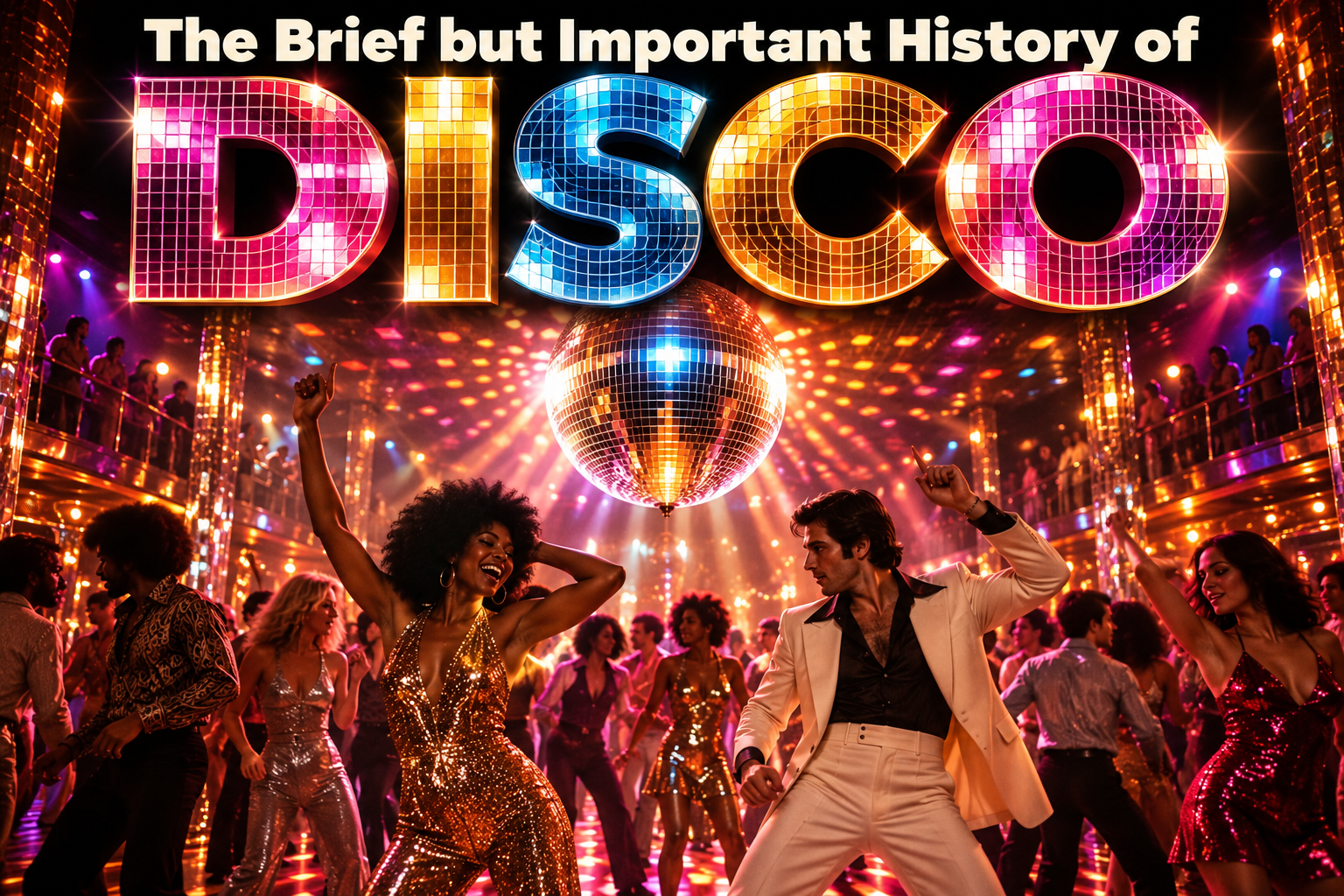
Disco had one of the most dramatic rises and falls in popular music history. For a genre whose period of absolute mainstream dominance lasted only a handful of years, its influence has been enormous. Disco changed the way records were produced, the way DJs worked, the way people danced, the way nightclubs operated, and the way pop music thought about rhythm. It also helped create the conditions for several genres that followed, including house music, dance-pop, electronic dance music, and important parts of modern R&B and hip-hop.
Its history is often reduced to a familiar story. Disco appeared in the 1970s. People wore outrageous clothes. Saturday Night Fever became a massive hit. The Bee Gees dominated radio. Then America suddenly decided it hated disco, culminating in Disco Demolition Night in 1979. The genre supposedly disappeared.
That story is entertaining, but it is also incomplete.
Disco did not simply emerge from nowhere, nor did it disappear after one baseball stadium stunt. Its roots stretched through soul, funk, R&B, Latin music, gospel, European pop, and the club culture of American cities. It developed largely in spaces created by communities that mainstream American culture often ignored: Black people, Latino people, gay people, immigrants, and others looking for places where they could dance, socialize, and temporarily escape the pressures of everyday life.
Disco was a musical style, but it was also a technology story. It was closely connected to the development of the modern DJ, the extended dance record, the twelve-inch single, the remix, and sophisticated studio production. A disco record was often designed not simply to sound good on a radio but to function inside a nightclub. The goal was different. A three-minute pop song might tell a story and end. A dance record needed to maintain energy, create momentum, give dancers time to move, and fit into a larger musical journey controlled by a DJ.
For a brief period, disco became so successful that it overwhelmed the popular music marketplace. Rock bands experimented with disco rhythms. Established singers recorded dance records. Record companies desperately searched for the next dance hit. Television, movies, fashion, advertising, and professional sports absorbed the disco craze. The underground culture that had created disco suddenly found itself transformed into a commercial machine.
That success produced a backlash.
But the backlash did not kill disco’s ideas. Instead, those ideas moved elsewhere. In Chicago, Detroit, New York, and other cities, DJs and producers continued building on disco’s foundations. House music emerged. Garage music developed. Hi-NRG expanded the faster and more electronic side of dance music. Dance-pop eventually brought disco’s sensibilities back to the mainstream in new forms.
Today, it is almost impossible to listen to popular music without hearing some part of disco’s legacy.
The history of disco may have been brief, but it was never small.
Before Disco: The Musical Ingredients
Disco did not begin with a single song.
Like most musical movements, it developed gradually from existing styles. By the late 1960s and early 1970s, American popular music was already full of rhythmic experimentation. Soul music had become more sophisticated. Funk was emphasizing the power of the groove. Latin music was becoming increasingly visible in major American cities. DJs were learning that audiences did not always want to sit and listen to songs. Sometimes they wanted to dance for hours.
Those ideas eventually came together.
One important foundation was soul music. Artists such as James Brown had transformed the relationship between rhythm and popular music. Earlier pop and rock often placed enormous emphasis on melody and chord changes. Brown and other funk pioneers demonstrated that rhythm itself could be the central attraction.
A song did not necessarily need to travel through complicated harmonic territory.
It could stay in one place.
It could repeat.
It could build.
The groove could become the song.
That concept was essential to disco.
Funk also helped establish the importance of the rhythm section. Bass and drums were not merely supporting the singer. They were driving the entire experience. Guitar players developed rhythmic styles that emphasized short, percussive patterns rather than long solos. Horn sections added accents and momentum.
Disco inherited all of this.
Soul and funk, however, were only part of the equation. Philadelphia soul also played a major role.
During the early 1970s, producers associated with the Philadelphia sound were creating records that combined R&B with elaborate orchestration. Strings, horns, polished arrangements, and sophisticated production became central elements of the music. The rhythmic foundation remained connected to soul and funk, but the records had a smoother and more luxurious sound.
That combination would become incredibly important.
Disco eventually connected the raw rhythmic power of funk with the elegance and orchestration of Philadelphia soul.
Songs by artists such as the O’Jays, Harold Melvin & the Blue Notes, the Spinners, and others demonstrated that dance music could be sophisticated without losing its physical energy. Producers and musicians were becoming increasingly skilled at creating records with layers of instruments that worked together as a unified rhythmic machine.
Meanwhile, Latin music contributed another essential ingredient.
New York City had a large and diverse Latin community, and salsa, mambo, boogaloo, and other Latin styles had long influenced the city’s musical culture. Percussion played an especially important role. Congas, bongos, timbales, handclaps, and other rhythmic textures expanded the possibilities available to dance music.
Disco would borrow from these traditions.
The genre was never purely one thing.
It was a meeting point.
European music also became increasingly important. By the 1970s, international pop music was moving more freely across borders. European producers often had different approaches to arrangement and studio production. Classical influences, orchestral music, electronic instruments, and experimental recording techniques were becoming part of the broader popular music landscape.
Eventually, European artists and producers would become major figures in disco itself.
But before disco became a recognizable genre, something else had to happen.
The nightclub had to become a musical laboratory.
The Birth of Modern Club Culture
The story of disco cannot be told without DJs.
Today, the idea of a DJ controlling music at a nightclub seems completely ordinary. DJs are stars. Festivals attract thousands of people to watch them perform. Electronic dance music has created an enormous global industry built around DJs.
During the late 1960s and early 1970s, however, the DJ’s role was still developing.
Nightclubs traditionally relied heavily on live bands. A club might have a singer, a house band, or a combination of performers. Recorded music was played, of course, but the idea that one person could control the musical experience of an entire night by selecting and sequencing records was still evolving.
In certain clubs, particularly in New York City, DJs began experimenting.
The goal was not simply to play popular songs.
The goal was to keep people dancing.
That sounds simple, but it changed everything.
A DJ had to think differently from a radio programmer. Radio stations generally moved from song to song, often interrupted by commercials, announcements, and other programming. The nightclub required continuity.
What record should come next?
How long should the current song continue?
Should the energy rise or fall?
Should the crowd be given something familiar?
Should the DJ introduce something strange?
These questions helped create the modern concept of DJing.
DJs began paying attention to rhythm, tempo, and atmosphere. They discovered that certain records worked exceptionally well on a dance floor, even if those records were not necessarily major radio hits.
A record might have an extended instrumental section.
That was useful.
A song might have a strong drum break.
That was useful too.
A groove might continue for several minutes.
Perfect.
The dance floor became the ultimate test.
If people danced, the record worked.
If the floor emptied, the DJ learned something.
This environment encouraged experimentation.
Records that might have seemed too repetitive for radio could become enormous favorites in clubs. Songs from soul, funk, Latin music, European pop, and other styles could exist together in a DJ’s collection.
The boundaries were flexible.
Eventually, the collection of sounds associated with these clubs began developing a recognizable identity.
That identity would become disco.
The Meaning of the Word “Disco”
The word “disco” came from “discothèque,” a French term connected to places where recorded music was played.
The concept became particularly important because it separated these spaces from traditional dance halls featuring live bands.
A discothèque was built around records.
The music came from speakers.
The person selecting the music could shape the environment.
This was a revolutionary idea for nightlife.
The word eventually entered American culture, where “disco” became a convenient label for the growing dance scene. At first, however, the word did not necessarily describe a strict musical genre.
It described a place.
It described an activity.
It described a culture.
People went to the disco.
They danced to records.
Over time, the music associated with those environments became known as disco music.
This is important because disco was initially defined by function as much as sound.
A record was disco if it worked in the disco.
That definition allowed the genre to remain flexible during its early years.
A soulful record could be played next to a funky record.
A Latin-influenced song could follow a European pop song.
A track featuring strings could work alongside something built almost entirely around percussion.
The common factor was movement.
The music made people dance.
David Mancuso and the Loft
One of the most important figures in the early history of disco culture was David Mancuso.
Mancuso was not simply a DJ in the modern sense. He helped establish a philosophy about what a dance party could be.
His legendary New York gatherings at the Loft became enormously influential.
The Loft was not designed around the conventional nightclub model. It was more private and community-oriented. The emphasis was on music, sound quality, and the experience of dancing.
Mancuso believed that the music itself mattered deeply.
The sound system mattered.
The room mattered.
The people mattered.
This approach may sound obvious today, but it was highly influential.
The Loft helped create a culture in which dancing was the central event. People were not simply sitting at tables while a band performed. They were participating.
The crowd became part of the experience.
Mancuso’s musical selections were also important. He played a wide variety of records, drawing from different genres and eras. His approach demonstrated that a dance floor did not require rigid musical categories.
The right record at the right moment could transform a room.
The Loft also represented an important social development.
Disco culture created spaces where people who might feel unwelcome elsewhere could gather.
This included gay people.
It included Black and Latino communities.
It included people who were tired of conventional nightlife.
The music provided a common language.
The dance floor provided a temporary community.
That social history is central to understanding disco.
Disco was not originally a suburban commercial product.
It was an urban cultural movement.
The Underground Communities That Built Disco
Disco eventually became associated with mainstream celebrities, expensive clothing, giant dance clubs, and Hollywood movies.
Its origins were considerably more complicated.
Many of the earliest disco spaces were connected to communities that existed outside the cultural mainstream.
Gay clubs were especially important.
During the early 1970s, being openly gay could carry serious social consequences. Discrimination was widespread. Gay people often faced hostility from employers, families, religious institutions, police, and the broader public.
Nightclubs could provide rare spaces of relative freedom.
Music and dancing became powerful forms of expression.
On the dance floor, people could dress differently.
They could move differently.
They could socialize openly.
They could create communities.
Black and Latino communities were equally important to the development of disco.
New York City was a diverse and complicated place. Different musical traditions existed close to one another. Communities interacted, borrowed ideas, and created new combinations.
Disco emerged from that environment.
The genre’s history is therefore deeply connected to questions of identity and belonging.
Who gets to enter a club?
Who controls the music?
Whose music is considered respectable?
Whose music is ignored by mainstream radio?
The underground disco scene created opportunities for sounds and artists that might not initially fit traditional commercial categories.
A record could become important because a DJ believed in it.
It did not need to be a major hit first.
In some cases, the club created the hit.
This was another major change.
The dance floor became a form of cultural testing.
DJs became tastemakers.
Dancers became an audience with direct influence over musical trends.
The Four-on-the-Floor Beat
When most people imagine disco, they imagine a particular drum pattern.
Boom.
Boom.
Boom.
Boom.
The bass drum hits steadily on every beat.
This pattern is commonly called “four-on-the-floor.”
It was not invented by disco, but disco made it central to modern dance music.
The consistency of the beat gave dancers something reliable.
A drummer could play variations around it.
Percussion could add complexity.
Bass could move underneath.
Strings and horns could rise above it.
But the pulse remained.
One.
Two.
Three.
Four.
This became one of disco’s most important musical signatures.
The four-on-the-floor beat created physical momentum. Unlike some forms of rock music, which could speed up, slow down, or emphasize different beats, disco generally provided a steady rhythmic foundation.
That consistency made mixing records easier.
It also made dancing easier.
A DJ could transition between songs with similar tempos.
The dance floor could maintain momentum.
The importance of this development cannot be overstated.
Modern house music relies heavily on four-on-the-floor.
Techno frequently uses it.
Electronic dance music uses countless variations of it.
Dance-pop relies on it.
Even rock and pop songs often borrow it when artists want to create a dance-oriented feel.
Disco helped make that pulse one of the dominant rhythms in modern popular music.
Early Disco Records
It is difficult to identify one single “first disco record.”
Music does not usually work that way.
Genres develop gradually, and historians often disagree about exactly where one style ends and another begins.
Several early 1970s recordings, however, helped establish what would become the disco sound.
Artists such as Manu Dibango, Eddie Kendricks, the O’Jays, Barry White, and others released records that contained important elements of disco.
Eddie Kendricks’ “Girl You Need a Change of Mind,” for example, became a major favorite in dance clubs because of its extended groove.
The song was not built like a conventional three-minute pop single.
It gave the rhythm room.
It allowed the groove to develop.
That was increasingly important to DJs.
Barry White and the Love Unlimited Orchestra also helped establish a lush, orchestrated form of dance-oriented soul. White’s productions were rich and dramatic. Strings played an important role. Bass was enormous. Rhythms were powerful.
These records demonstrated that dance music could be sensual and sophisticated.
The O’Jays’ “Love Train” provided another important example of the connection between Philadelphia soul and disco.
The song was joyous and rhythmic, but it also featured the polished production associated with Philadelphia International Records.
Meanwhile, other producers and musicians were experimenting with increasingly dance-focused arrangements.
The transition was happening.
Soul was becoming more rhythmic.
Funk was becoming more polished.
Orchestras were becoming more prominent.
Records were getting longer.
DJs were becoming more influential.
Disco was approaching.
MFSB and the Philadelphia Sound
Philadelphia was one of the most important musical cities of the disco era.
The producers Kenny Gamble and Leon Huff built Philadelphia International Records into a major force during the 1970s. Their work helped establish a sound that combined soul, funk, pop, and elaborate orchestration.
The studio musicians associated with the label became equally important.
MFSB, whose name has been interpreted in several colorful ways over the years, served as an extraordinary group of musicians capable of creating sophisticated arrangements.
Their sound was polished.
Their rhythm sections were precise.
Their orchestration was expansive.
Their influence extended far beyond Philadelphia.
One of their most famous recordings, “TSOP (The Sound of Philadelphia),” became closely associated with the television program Soul Train.
The song was instrumental, energetic, and built around a powerful rhythmic foundation.
It demonstrated something important.
Dance music did not necessarily require a conventional lead vocalist.
The groove could carry the record.
The musicians could become the stars.
Philadelphia productions also helped establish the importance of strings in disco.
Earlier dance music certainly used orchestras, but disco made strings part of the rhythmic experience. Violins were not simply playing slow background melodies.
They could create momentum.
They could rise and fall dramatically.
They could add tension.
They could make a dance record feel enormous.
This combination of orchestral elegance and rhythmic power became one of disco’s defining characteristics.
The Role of the DJ
As disco developed, the DJ became increasingly important.
This was a major shift in popular music.
Traditionally, the performer was the center of attention.
A singer stood on stage.
A guitarist played a solo.
A band performed.
The audience watched.
In a disco, the relationship was different.
The DJ might not perform a traditional song at all.
Instead, the DJ selected the songs.
The DJ controlled the sequence.
The DJ read the crowd.
The DJ created the night.
This required a new set of skills.
A successful DJ needed musical knowledge.
They needed to understand the audience.
They needed to know when to introduce a new sound.
They needed to understand pacing.
Eventually, technical skills became increasingly important.
Beatmatching and mixing allowed DJs to create smoother transitions between records.
Instead of allowing one song to end completely before beginning another, DJs could overlap records.
The beat continued.
The dance floor remained active.
This development transformed the experience of listening to music.
The individual song became part of something larger.
A DJ set could last for hours.
The audience experienced a musical journey.
This idea would eventually become fundamental to club culture around the world.
Disco was therefore not simply responsible for creating famous songs.
It helped create an entirely new form of musical performance.
Tom Moulton and the Remix
If DJs helped define how disco music was played, producers and engineers helped redefine how it was made.
Tom Moulton was one of the most important figures in this development.
Moulton became famous for his work on remixes and extended dance versions.
The concept seems completely normal today.
Almost every major pop artist releases remixes.
Dance tracks often appear in multiple versions.
There may be a radio edit, extended mix, club mix, instrumental version, and remix by another producer.
During the early disco era, however, this was a revolutionary idea.
Traditionally, a record was finished.
The producer recorded the song.
The engineer mixed it.
The record was released.
Moulton helped demonstrate that the existing recording could be transformed.
A song could be extended.
Instrumental sections could be emphasized.
Different parts could be rearranged.
The rhythm could be given more space.
This made the record more useful to DJs.
It also created a new form of creativity.
The remix was not merely an edited version of the original.
It could become its own artistic statement.
Moulton’s work helped establish techniques that would later become standard across popular music.
The modern remix owes a tremendous debt to disco culture.
The Twelve-Inch Single
Another technological and commercial innovation associated with disco was the twelve-inch single.
The standard seven-inch single had limitations.
There was only so much physical space available.
Longer recordings could suffer from reduced sound quality.
Disco DJs wanted something different.
They wanted longer versions.
They wanted louder records.
They wanted powerful bass.
The twelve-inch format helped solve these problems.
The larger surface allowed grooves to be cut more widely. This could improve sound quality and provide greater dynamic range.
More importantly, the format allowed extended versions of songs.
A three-minute single could become a six-minute dance track.
A five-minute song could become ten minutes.
This was ideal for clubs.
The twelve-inch single became a defining object of disco culture.
DJs collected them.
Record stores stocked special dance versions.
Promotional copies circulated through clubs.
A record might become famous among DJs before the general public even knew it existed.
The format also changed the economics of music.
Record companies began recognizing the commercial value of the dance market.
Special versions could be produced specifically for clubs.
DJs became important promotional figures.
The dance floor became part of the music industry’s marketing system.
The twelve-inch single would survive long after disco’s mainstream peak.
It became essential to house, techno, hip-hop, and other forms of dance music.
Another piece of disco’s legacy had become permanent.
Donna Summer and the Rise of Disco Stardom
If one artist represents the international expansion of disco during the 1970s, Donna Summer is one of the strongest candidates.
Summer became one of the defining voices of the genre.
Her music combined American soul traditions with European electronic experimentation and sophisticated studio production.
Working with producers Giorgio Moroder and Pete Bellotte, Summer created records that sounded different from much of the American music around her.
One of the most important was “Love to Love You Baby.”
The recording was sensual, extended, and deliberately designed for the dance floor.
Its length was significant.
The album version ran far longer than a conventional pop single.
The record demonstrated that there was a growing audience for extended dance music.
Summer quickly became a major star.
But her importance went beyond commercial success.
Her recordings showed how disco could become international.
The music was no longer limited to one city or one community.
Disco was becoming global.
Summer’s collaborations with Moroder would become even more historically significant.
Giorgio Moroder and the Electronic Future
Giorgio Moroder was one of the most influential producers in the history of popular music.
His work with Donna Summer helped push disco toward the electronic future.
“ I Feel Love,” released in 1977, remains one of the most important dance records ever made.
The song sounded startlingly futuristic.
Instead of relying primarily on a traditional band and orchestration, Moroder built much of the arrangement around electronic synthesizers and sequenced patterns.
The result was hypnotic.
The rhythm repeated.
Electronic sounds pulsed.
Donna Summer’s voice floated above the machinery.
The record seemed to point toward a musical world that had not fully arrived yet.
That world would include synth-pop.
It would include electronic dance music.
It would include techno.
It would include house.
“I Feel Love” demonstrated that electronic instruments could create music that was not cold or academic.
They could make people dance.
The influence was enormous.
Musicians across Europe and America recognized that something new had happened.
The future of dance music had suddenly become visible.
Moroder’s importance therefore extends far beyond disco.
He helped build the bridge between disco and electronic music.
KC and the Sunshine Band
While Donna Summer and Giorgio Moroder explored increasingly sophisticated and electronic sounds, other artists demonstrated disco’s connection to funk and pop.
KC and the Sunshine Band became one of the most successful groups associated with the genre.
Their music was immediate.
The rhythms were strong.
The hooks were memorable.
The songs were designed for movement.
Hits such as “Get Down Tonight,” “That’s the Way (I Like It),” and “Shake Your Booty” became major parts of the disco era.
KC and the Sunshine Band represented the accessible side of disco.
Their songs could work in a nightclub.
They could also work on the radio.
They could be played at parties.
They could become sports arena music.
Their success helped move disco from underground clubs toward the mainstream.
The group’s music also demonstrated disco’s connection to celebration.
Not every disco song was experimental or dramatic.
Sometimes the point was simply to have fun.
That was an important part of the genre’s appeal.
The Rise of the Disco Orchestra
As disco became increasingly popular, the orchestra became one of its most recognizable features.
Strings were everywhere.
Horn sections became larger.
Arrangements became more ambitious.
The rhythm section remained essential, but producers increasingly treated the studio like an instrument.
A disco recording could contain dozens of musicians.
Violins could play sweeping patterns.
Cellos could add depth.
Horns could punctuate the beat.
Guitars could provide rhythmic scratches.
Bass could remain locked to the drums.
Percussion could add additional layers.
The combination created an enormous sound.
The Salsoul Orchestra became one of the important groups associated with this approach.
Salsoul Records itself became a major force in dance music, releasing recordings that connected Latin influences, soul, funk, and disco.
The orchestra demonstrated the possibilities of large-scale dance production.
Disco was becoming increasingly sophisticated.
The arrangements required skilled musicians.
The recordings required talented engineers.
The productions required careful planning.
This contradicts the stereotype that disco was simplistic music.
Some disco songs were simple.
Many were not.
The genre contained an extraordinary amount of musical craftsmanship.
The Sound of the Dance Floor
One of disco’s greatest innovations was its understanding of space.
A pop song can fill every second with something.
A singer can constantly perform.
A guitarist can constantly play.
Disco often understood the value of restraint.
A groove could repeat.
The bass could stay in a pattern.
The drums could remain steady.
A guitar could play a small rhythmic figure.
Then something could change.
A string section might enter.
A horn might punctuate the beat.
The singer might return.
The arrangement could build gradually.
This approach created anticipation.
Dancers could settle into the rhythm.
They could learn the musical structure.
The repetition became physical.
A listener did not merely hear the beat.
They experienced it.
This was particularly important in a loud club.
The sound system amplified the bass.
The kick drum could be felt.
The rhythm moved through the room.
Disco production therefore had a physical purpose.
It was not simply about creating an interesting recording for headphones.
The record had to work in a specific environment.
That environment shaped the music.
Disco and Fashion
It is impossible to separate disco completely from fashion.
During the genre’s mainstream peak, disco became associated with a highly visible style.
Platform shoes.
Polyester.
Bell-bottoms.
Sequins.
Bright colors.
Open shirts.
Jumpsuits.
Gold chains.
Large hairstyles.
The fashion could be extravagant.
But disco fashion was not simply a joke.
Clothing was part of the culture.
Nightclubs provided spaces where people could experiment with identity and appearance.
Someone who dressed conservatively during the day could become someone else at night.
The disco became a stage.
The dancers were performers.
This was especially important in gay club culture, where fashion could become a form of personal expression.
Disco fashion also reflected the broader trends of the 1970s.
The decade was full of experimentation.
Traditional boundaries were being challenged.
Clothing became more colorful and expressive.
Disco pushed these trends further.
When the genre became commercially successful, the fashion industry noticed.
Disco style moved into department stores.
Suddenly, people who had never entered an underground club could buy the clothes associated with the culture.
This was both a sign of success and a warning.
The underground was becoming a commodity.
Studio 54 and the Commercial Image of Disco
No nightclub became more famous as a symbol of mainstream disco than Studio 54.
Located in New York City, Studio 54 became associated with celebrities, fashion, wealth, excess, and exclusivity.
The club attracted famous musicians, actors, models, athletes, and social figures.
Its reputation became legendary.
For many people, Studio 54 became disco.
This image, however, represented only one part of the larger culture.
Disco existed long before Studio 54.
It existed in smaller clubs.
It existed in community spaces.
It existed in underground parties.
The celebrity culture surrounding Studio 54 helped transform disco into a national obsession, but it also distorted public understanding of the genre.
Suddenly, disco was associated with velvet ropes and famous people.
The music became part of an expensive lifestyle.
The mainstream media loved the story.
The nightclub became a spectacle.
Studio 54’s owners, Steve Rubell and Ian Schrager, understood the power of exclusivity.
Not everyone could enter.
Being turned away became part of the mythology.
This was very different from the community-oriented philosophy of places such as the Loft.
The transformation illustrates what happened to disco as a whole.
A movement created in relatively underground environments became a massive commercial phenomenon.
Success changed the culture.
Disco Reaches the Radio
During the middle and late 1970s, disco became impossible to avoid.
Radio stations began playing more dance music.
Record companies signed disco artists.
Established musicians experimented with disco rhythms.
The charts filled with dance records.
For a brief period, disco was not simply one genre among many.
It became one of the dominant forces in American popular culture.
This created enormous opportunities.
Artists who might previously have been limited to R&B audiences could reach pop listeners.
Dance records crossed racial and cultural boundaries.
International artists found American audiences.
Producers became stars.
At the same time, record companies began chasing trends.
Once the industry recognized that disco could generate huge profits, everyone wanted a piece of the market.
This led to a familiar problem.
Too much of something can create fatigue.
Record labels released enormous numbers of dance-oriented records.
Some were excellent.
Some were obviously attempts to copy successful songs.
The word “disco” was eventually attached to almost anything with a dance beat.
That commercial overexposure would contribute to the eventual backlash.
But before the backlash arrived, disco had one more enormous cultural explosion.
Saturday Night Fever Changes Everything
Released in 1977, Saturday Night Fever became one of the defining cultural events of the disco era.
The film starred John Travolta as Tony Manero, a young working-class man from Brooklyn whose life revolved heavily around the local disco.
The movie was not simply a celebration of partying.
It included serious themes involving class, family, relationships, ambition, and frustration.
But popular culture remembered the dancing.
Travolta’s white suit became iconic.
The image of him walking down the street became instantly recognizable.
The dance floor became a cinematic stage.
The soundtrack became even more important.
Featuring major songs by the Bee Gees and other artists, the Saturday Night Fever soundtrack became one of the biggest-selling albums in history.
The Bee Gees became inseparable from the mainstream image of disco.
Their falsetto vocals, sophisticated harmonies, and dance-oriented productions dominated radio.
Songs such as “Stayin’ Alive,” “Night Fever,” and “More Than a Woman” became cultural landmarks.
Saturday Night Fever did something extraordinary.
It made disco accessible to millions of people who had never participated in the original club culture.
America could now experience disco through a movie theater.
People could buy the soundtrack.
They could imitate the clothing.
They could learn the dances.
They could visit local clubs.
The commercial explosion was enormous.
But the film also helped narrow the public’s understanding of disco.
For many Americans, disco became the Bee Gees.
It became Travolta.
It became white suits.
It became a particular visual style.
The broader musical and cultural history was increasingly forgotten.
The Bee Gees and the Mainstream Disco Explosion
The Bee Gees were not originally a disco group.
They had already enjoyed a successful career before the disco era.
This is another reminder that disco was flexible.
Artists did not necessarily begin their careers inside the genre.
They could adapt.
They could experiment.
They could follow new musical directions.
The Bee Gees’ collaboration with producer Arif Mardin and others helped transform their sound during the mid-1970s.
Their falsetto vocals became one of their most recognizable characteristics.
The rhythms became increasingly dance-oriented.
The results were extraordinary.
“Jive Talkin’” became an important early indication of their new direction.
Then Saturday Night Fever pushed them into another universe.
Their success was so enormous that the Bee Gees became symbols of the entire disco era.
That was both good and bad.
The group’s records were popular because they were excellent pop songs.
The melodies were strong.
The harmonies were sophisticated.
The productions were carefully constructed.
But their dominance eventually created backlash.
People who were tired of disco often became tired of hearing the Bee Gees.
The fact that they were so successful made them convenient targets.
Nevertheless, their contribution to disco remains significant.
They demonstrated that dance music could combine rhythmic energy with complex songwriting.
Their influence continues to appear throughout modern pop.
Chic and the Art of the Groove
If the Bee Gees represented disco’s massive commercial popularity, Chic represented some of its greatest musical sophistication.
Founded by guitarist Nile Rodgers and bassist Bernard Edwards, Chic created a sound built around precision, rhythm, and style.
Rodgers developed one of the most recognizable guitar approaches in popular music.
His playing was rhythmic and percussive.
Instead of dominating the song with traditional rock riffs, he created patterns that locked into the groove.
Bernard Edwards’ bass playing was equally important.
His bass lines moved with remarkable creativity while remaining perfectly connected to the rhythm section.
Together, they created something extraordinary.
Chic’s songs were elegant without being fragile.
They were funky without being messy.
They were danceable without sacrificing musicianship.
“Dance, Dance, Dance (Yowsah, Yowsah, Yowsah),” “Le Freak,” and “Good Times” became major hits.
“Good Times” would prove especially important.
Its bass line became one of the most influential grooves in popular music.
The Sugarhill Gang used it as the foundation for “Rapper’s Delight,” one of the earliest major hip-hop hits.
This connection demonstrates something important.
Disco and hip-hop were not isolated worlds.
Both emerged from the same broader urban environment.
Both relied on DJs.
Both understood the power of rhythm.
Both would eventually influence each other.
Chic’s importance extends far beyond the disco era.
Nile Rodgers became one of the most successful producers and collaborators in popular music history.
His rhythmic ideas continued appearing in new generations of dance and pop music.
Sister Sledge and Disco as Celebration
Chic’s production talents also helped create one of disco’s most enduring songs: Sister Sledge’s “We Are Family.”
The song became more than a club record.
It became a celebration of unity.
Its message could apply to biological families, communities, teams, and groups of friends.
The record’s popularity demonstrated another important strength of disco.
Disco could be communal.
People danced together.
They sang together.
They experienced the music collectively.
“ We Are Family” became particularly famous when associated with the Pittsburgh Pirates baseball team during their successful 1979 season.
This showed how deeply disco had entered mainstream American culture.
A genre that had developed largely in urban clubs was now connected to professional sports.
The journey had been remarkably fast.
Village People and the Construction of Disco Images
The Village People became one of the most visually recognizable acts associated with disco.
Their costumes were impossible to ignore.
The group featured exaggerated masculine archetypes.
The policeman.
The construction worker.
The cowboy.
The soldier.
The biker.
The Native American character.
The visual presentation was theatrical and playful.
Songs such as “Y.M.C.A.,” “Macho Man,” and “In the Navy” became enormous hits.
“Y.M.C.A.” in particular became one of the most famous dance songs in history.
The choreography was simple.
The chorus was memorable.
Audiences could participate.
The Village People demonstrated how disco could operate on multiple levels.
The music could be fun and accessible to mainstream audiences while also containing references and meanings connected to gay culture.
As disco became more commercial, however, some of that complexity was lost on the general public.
Millions of people enjoyed the songs without understanding their cultural origins.
That was part of disco’s strange journey.
The underground became mainstream.
The mainstream consumed it.
Sometimes it understood the context.
Sometimes it did not.
Gloria Gaynor and “I Will Survive”
Few disco songs have had a longer cultural life than Gloria Gaynor’s “I Will Survive.”
The song became an international hit, but its influence eventually extended far beyond the disco era.
Its message of independence and resilience allowed it to become meaningful to many different audiences.
The song has been associated with empowerment, personal recovery, LGBTQ+ communities, and countless moments of celebration.
Musically, “I Will Survive” demonstrates the dramatic side of disco.
The song begins with an instantly recognizable piano figure.
The arrangement builds.
The rhythm enters.
The vocal becomes increasingly powerful.
The structure creates a sense of emotional momentum.
Disco was sometimes criticized as shallow party music.
“I Will Survive” makes that criticism difficult to maintain.
The genre could handle emotion.
It could tell stories.
It could create drama.
The dance floor did not require the absence of meaning.
Sometimes dancing was the way people processed meaning.
Disco Around the World
Although disco became strongly associated with the United States, it was an international phenomenon.
European artists and producers played crucial roles.
France contributed important artists and ideas.
Italy developed its own dance music traditions.
Germany became particularly important through electronic experimentation.
The United Kingdom embraced disco while also developing punk and new wave.
Disco influenced musicians around the world.
In Europe, electronic instruments became increasingly important.
Synthesizers could create sounds impossible to produce with traditional instruments.
Drum machines would eventually create new forms of rhythm.
Sequencers allowed musicians to repeat patterns with extraordinary precision.
Disco became a meeting point between American rhythmic traditions and European electronic experimentation.
This international exchange helped shape the future.
Without disco, the development of global electronic dance music would have looked very different.
Punk, Rock, and Disco
One of the most interesting aspects of the disco era was the relationship between disco and rock.
The two genres were often presented as enemies.
In reality, the relationship was more complicated.
Some rock musicians openly disliked disco.
Rock critics frequently attacked the genre.
Disco was accused of being repetitive, commercial, shallow, and artificial.
At the same time, rock musicians borrowed from disco.
The Rolling Stones recorded “Miss You.”
Rod Stewart recorded “Da Ya Think I’m Sexy?”
KISS released “I Was Made for Lovin’ You.”
Other artists experimented with dance rhythms.
This happened because disco was commercially powerful.
But it also happened because the groove was appealing.
Musicians could criticize disco while recognizing that its rhythmic ideas worked.
This tension reveals something important about the backlash.
The conflict was never simply musical.
It involved identity.
Rock fans often saw themselves as part of a different cultural tradition.
Rock emphasized guitars.
Bands.
Live performance.
Individual expression.
Disco emphasized DJs.
Dance floors.
Producers.
Studios.
Collective movement.
These differences created cultural friction.
But the genres were never completely separate.
Music rarely respects the boundaries created by fans.
The Commercial Saturation of Disco
By 1978 and 1979, disco was everywhere.
That was the problem.
Record companies began releasing enormous quantities of disco music.
Artists who had no particular connection to the genre suddenly recorded dance songs.
Movies and television programs borrowed disco imagery.
Advertisers used disco music.
Children’s products incorporated disco themes.
There were disco novelty records.
Disco versions of existing songs.
Disco albums designed primarily to chase a trend.
The marketplace became saturated.
This was not entirely disco’s fault.
The music industry has always followed successful trends.
When something makes money, companies want more of it.
The same thing had happened with rock and roll.
It had happened with folk music.
It would happen with hip-hop.
It would happen with grunge.
It would happen with electronic dance music.
Commercial success often creates imitation.
Eventually, audiences become tired.
The more disco was marketed as a lifestyle, the more people began rejecting it.
But commercial saturation was only part of the story.
The Disco Backlash
The anti-disco movement of the late 1970s remains one of the most controversial chapters in American music history.
At the simplest level, some people genuinely disliked disco.
Musical preferences are subjective.
People who loved hard rock might not enjoy dance music.
Some listeners were tired of hearing the same style everywhere.
Some believed the record industry had abandoned rock.
Those explanations are reasonable.
But they are not sufficient.
The backlash often contained cultural tensions involving race, sexuality, masculinity, and identity.
Disco was strongly associated with Black artists.
It was strongly associated with gay culture.
It was associated with urban nightlife.
It challenged certain traditional ideas about masculinity.
Dancing was central.
Fashion was expressive.
Men could wear clothing that did not resemble traditional rock uniforms.
These cultural differences made disco an easy target.
Some anti-disco rhetoric was simply about music.
Some was not.
The famous “Disco Sucks” movement became a broad cultural reaction.
People burned disco records.
Radio stations changed formats.
Rock fans celebrated the rejection of dance music.
The movement eventually reached its most famous moment.
Disco Demolition Night
On July 12, 1979, Disco Demolition Night took place at Comiskey Park in Chicago.
The event was organized as part of a promotion involving a baseball doubleheader between the Chicago White Sox and the Detroit Tigers.
Fans were encouraged to bring disco records to the stadium.
The records were collected and intended to be destroyed between games.
Radio personality Steve Dahl, a prominent opponent of disco, became closely associated with the event.
The promotion attracted an enormous crowd.
Things did not go as planned.
The records were placed inside a container and exploded.
The explosion and the surrounding excitement caused fans to rush onto the field.
The situation became chaotic.
The field was damaged.
The second game could not be played normally.
The event became one of the most famous promotional disasters in sports history.
It also became a symbol.
For many years, the story was told simply as a hilarious example of America rejecting disco.
The reality was more complicated.
The crowd was overwhelmingly associated with a rock-oriented audience.
Many disco records destroyed that night came from artists whose music was connected to Black and LGBTQ+ culture.
The symbolism therefore became uncomfortable.
Was this simply a musical protest?
Or was something else happening?
Historians and cultural critics have debated the issue extensively.
It would be simplistic to claim that every person at Disco Demolition Night was motivated by racism or homophobia.
That cannot be known.
Many people were probably there because they disliked disco or enjoyed the spectacle.
However, it would also be simplistic to ignore the cultural context.
The anti-disco movement emerged during a period when disco had become associated with communities outside traditional rock culture.
The reaction often targeted more than a beat.
Disco Demolition Night remains important because it revealed how intensely people could react to popular music.
The destruction of records became symbolic.
Music had become a cultural battlefield.
This post has already been read 238 times!