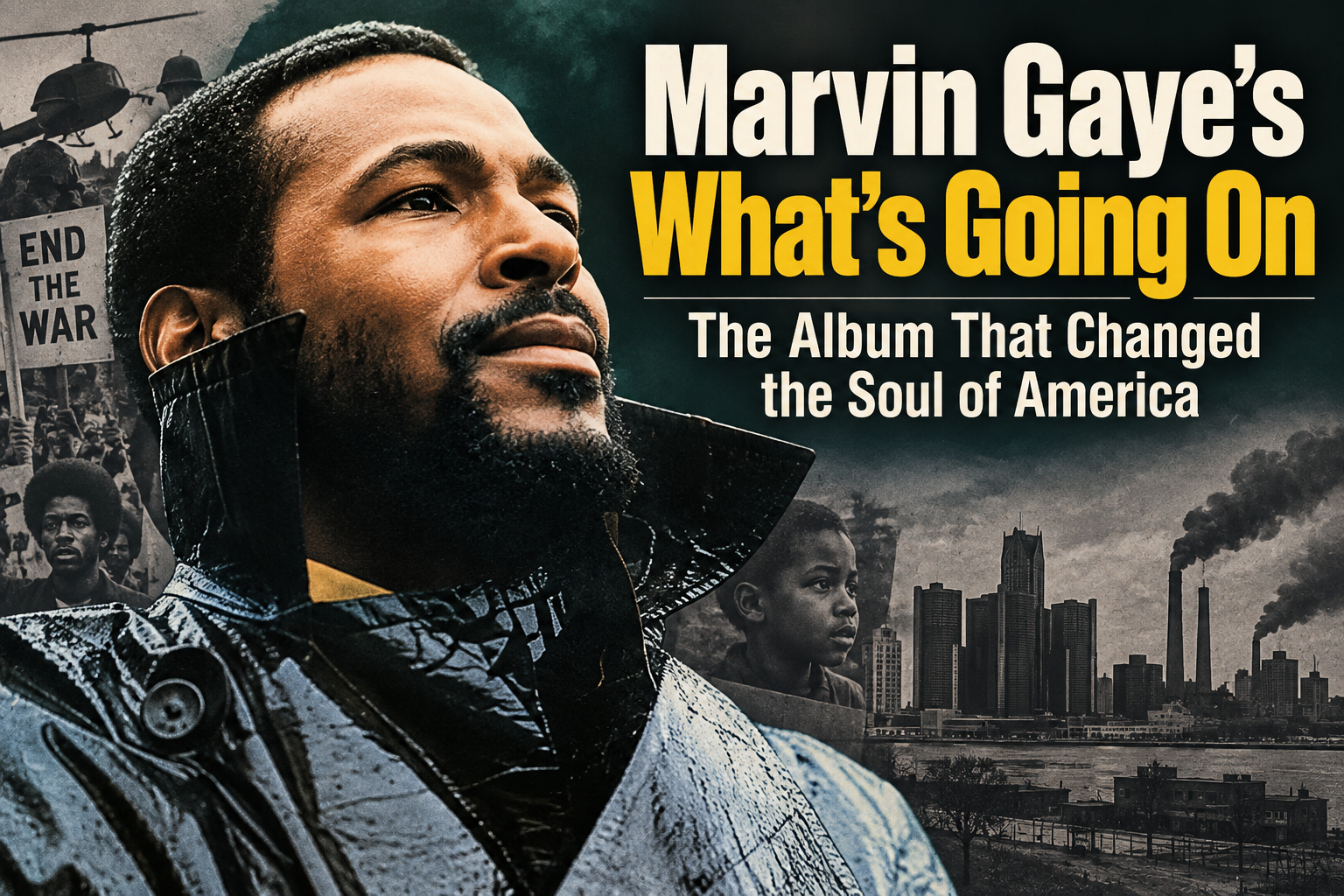
There are great albums, there are important albums, and then there are albums that permanently change the expectations placed on an entire genre. Marvin Gaye’s What’s Going On belongs in that last category.
Released by Motown’s Tamla label on May 21, 1971, What’s Going On arrived at a moment when American society was deeply divided. The Vietnam War was still raging. The civil rights movement had entered a more complicated and often more dangerous period. Poverty and racial inequality remained deeply entrenched. Cities were struggling with unrest, pollution was becoming an increasingly visible concern, and a generation that had grown up believing in postwar American prosperity was confronting a very different reality.
Yet the remarkable thing about What’s Going On is that Marvin Gaye did not respond to all of this with an angry, guitar-driven protest record.
He responded with beauty.
That decision is the key to understanding the album.
Gaye could have made something harsh. He could have made something confrontational. Instead, he created a record filled with warm vocals, flowing arrangements, jazz-influenced harmonies, strings, percussion, layered voices and some of the most sophisticated production Motown had ever released.
The album was political without sounding like a political lecture.
It was spiritual without becoming preachy.
It was deeply personal without becoming self-absorbed.
And it was musically adventurous without abandoning the soul audience that had made Gaye one of Motown’s biggest stars.
More than five decades later, What’s Going On remains extraordinary because it still feels like a conversation rather than a speech. Marvin Gaye isn’t standing above the listener telling them what to believe. He is standing beside them, looking at the world and asking the same question they are.
What’s going on?
Album Overview
Before What’s Going On, Marvin Gaye was already one of the biggest stars in American music.
During the 1960s, he had helped define the Motown sound through a remarkable run of singles and collaborations. He had recorded romantic material, dance music, duets with Tammi Terrell, and some of the most successful soul singles of the era.
But Gaye’s personal and artistic world had become increasingly complicated.
The death of Tammi Terrell in 1970 had devastated him. His brother Frankie had returned from military service in Vietnam with stories that deeply affected Marvin. At the same time, Gaye was becoming increasingly uncomfortable with the direction of the world around him.
The idea for the title song originally came from Renaldo “Obie” Benson of the Four Tops, who had been inspired after witnessing police violence against antiwar protesters in Berkeley. Benson and songwriter Al Cleveland eventually brought the song to Gaye, who transformed it into something much more personal.
There was just one enormous problem.
Motown did not want him to record it.
Berry Gordy had built Motown into one of the most successful record companies in the world by understanding what audiences wanted. Marvin Gaye was one of the company’s most valuable artists, and the idea of suddenly having him release a socially conscious record represented a significant departure from the formula.
Gaye refused to simply accept that decision.
He pushed for the song to be released, and eventually the record company relented. The single became a major success, reaching No. 2 on the Billboard Hot 100.
That success gave Gaye the opportunity to expand the idea into an entire album.
And What’s Going On became something much larger than a collection of songs.
It became a continuous musical experience.
The original album contains nine tracks, beginning with the title track and moving through themes of returning home, drug addiction, poverty, spirituality, environmental damage and life in struggling urban communities. The final song brings the record to a conclusion that feels less like an ending than the closing of a circle.
The songs flow into one another, creating the feeling of a single extended statement.
That was an important development for Motown.
The company had built its reputation on singles.
Gaye was essentially saying that he had something bigger to say.
The Sound of What’s Going On
The first thing that strikes you about What’s Going On is how beautiful it sounds.
That might seem like an obvious observation, but it is central to the album’s power.
The subject matter is often grim.
The music isn’t.
Gaye surrounds his voice with layers of sound that are warm, fluid and almost hypnotic. The arrangements combine soul, jazz, gospel, pop, funk and orchestral music without making the record feel cluttered.
The instrumentation is particularly impressive.
Motown’s legendary Funk Brothers were heavily involved in the sessions, while David Van dePitte handled the orchestral arrangements and conducted the strings and other large-scale instrumental sections. Gaye was also credited as the producer, marking an important step toward greater artistic control for him.
The musicianship is exceptional.
Bass lines move underneath the songs with subtlety rather than simply driving them forward. Percussion creates a gentle pulse. Saxophones appear almost conversationally. Strings provide emotional weight without overwhelming the rhythm section.
And then there are Gaye’s vocals.
This may be the best-sung album of his career.
He doesn’t simply sing the songs.
He inhabits them.
Gaye’s voice moves from smooth and intimate to pleading and almost conversational. His famous multi-layered vocal approach gives the record the sensation of several versions of Marvin Gaye thinking out loud at the same time.
The effect is remarkable.
There is no single Marvin Gaye on What’s Going On.
There are several.
The romantic Marvin.
The frightened Marvin.
The spiritual Marvin.
The angry Marvin.
The hopeful Marvin.
The exhausted Marvin.
And the Marvin who simply wants to understand what is happening around him.
Songwriting
The songwriting is where What’s Going On becomes much more than a collection of socially conscious soul songs.
The album is built around observation.
Gaye is not presenting simple answers.
He is describing a society that appears increasingly disconnected from itself.
The title track establishes the central question, and the following songs expand the perspective.
“What’s Happening Brother” shifts the focus toward the experience of someone returning from war and discovering that home has changed.
“Flyin’ High (In the Friendly Sky)” moves into addiction and escapism.
“Save the Children” turns toward the future.
“God Is Love” brings spirituality into the conversation.
“Mercy Mercy Me (The Ecology)” expands the record’s concerns to the natural environment.
“Inner City Blues (Make Me Wanna Holler)” brings the album back down to the economic and social realities of urban America.
The sequence is extremely important.
The album moves outward and inward at the same time.
It begins with a broad question about society, then moves through individuals, families, communities, religion, the environment and economics.
The effect is almost cinematic.
There is a world outside.
There is a person inside it.
And the two are constantly affecting one another.
That is why the record still feels contemporary.
It doesn’t depend on one particular political event.
It deals with recurring human problems.
War.
Poverty.
Addiction.
Racial tension.
Environmental destruction.
Faith.
Fear.
Hope.
Alienation.
These issues did not disappear after 1971.
“What’s Going On”
The title track is one of the most important recordings in popular music history.
What makes it unusual is how gentle it is.
The subject matter could easily have produced an aggressive record.
Instead, Gaye creates something almost soothing.
The famous opening saxophone part immediately establishes the atmosphere. The percussion and bass create a relaxed groove, while Gaye’s vocals float above the arrangement.
The record invites the listener in.
That was an inspired choice.
Gaye understood that anger can make people defensive.
Compassion can make people listen.
The song isn’t really demanding that the listener take a political position.
It is asking the listener to recognize suffering.
That difference is crucial.
The title itself is a question.
Not a declaration.
Not a command.
A question.
And because there is no simple answer, the album can continue asking it for the next thirty-five minutes.
“What’s Happening Brother”
The second track changes the perspective.
Instead of simply looking at society from a distance, the album begins to consider the experience of someone coming home.
That makes the Vietnam War personal.
Gaye’s brother Frankie had served in Vietnam, and his experiences influenced Marvin’s thinking during the creation of the album.
The song isn’t really about battlefield heroics.
It is about disorientation.
What happens when someone leaves one world and returns to another?
What happens when the country they fought for doesn’t look the way they remember it?
That emotional idea gives the album a human center.
The war isn’t merely something happening overseas.
It has consequences for families.
It changes people.
And it changes the communities to which they return.
“Flyin’ High (In the Friendly Sky)”
This is one of the album’s darker moments.
The song examines drug use and escapism, but Gaye doesn’t turn the subject into a simplistic morality tale.
Instead, the song feels almost dreamlike.
That musical approach is important.
The character isn’t simply making bad decisions.
He is trying to escape something.
The beautiful arrangement contrasts with the darkness of the subject.
That contradiction runs throughout What’s Going On.
Gaye repeatedly puts painful subjects inside beautiful music.
The listener is drawn in by the sound and then forced to confront what the song is actually about.
“Save the Children”
“Save the Children” broadens the album’s perspective again.
Now the concern is the future.
The song asks listeners to consider what kind of world they are leaving behind.
That idea gives the album a generational quality.
Gaye wasn’t simply worried about his own life.
He was worried about what was coming next.
The song also demonstrates how effectively Gaye blended social commentary with gospel and soul traditions.
There is a spiritual urgency to the performance.
The message is serious, but the music remains inviting.
“God Is Love”
The spiritual center of the album arrives with “God Is Love.”
This is an important moment because it prevents What’s Going On from becoming purely political.
Gaye’s concerns aren’t limited to government policy or social conditions.
He is wrestling with morality.
What does humanity owe one another?
What does faith mean in a world filled with suffering?
Can compassion actually change anything?
Gaye doesn’t attempt to separate spirituality from social responsibility.
For him, the two are connected.
That relationship between gospel and social consciousness is deeply rooted in African-American musical history.
Gaye was taking that tradition and bringing it into the world of early-1970s soul.
“Mercy Mercy Me (The Ecology)”
One of the album’s most remarkable achievements is how early Gaye was addressing environmental concerns in mainstream popular music.
“Mercy Mercy Me (The Ecology)” examines pollution and environmental destruction at a time when environmentalism was still becoming a major part of public consciousness.
The song sounds gorgeous.
That is almost cruelly appropriate.
The music is lush and peaceful while the subject matter describes a planet being damaged.
Gaye’s approach helped demonstrate that environmental concerns belonged in popular music.
The Library of Congress has specifically identified the song as an early example of environmental messaging in mainstream pop music.
More importantly, Gaye doesn’t treat nature as a separate political issue.
It is another part of the larger question.
What are human beings doing to the world around them?
The same compassion Gaye applies to people is extended to the planet.
“Right On”
“Right On” is one of the album’s most musically adventurous tracks.
It stretches the record toward jazz and Latin influences while maintaining its soul foundation.
The song feels more open-ended than the tracks surrounding it.
That looseness is part of its appeal.
Gaye wasn’t interested in making every song fit neatly into a radio format.
He wanted the album to breathe.
The rhythm section is especially important here.
The groove feels alive rather than mechanically precise.
The musicians sound like they are listening to one another.
That quality is one of the album’s greatest strengths.
“Wholy Holy”
“Wholy Holy” returns to the spiritual dimension of the record.
But by this point, the listener has traveled through war, addiction, poverty, environmental destruction and social division.
The song therefore feels different from a conventional religious performance.
It is almost a plea.
The spirituality of What’s Going On is not about escaping the world.
It is about finding a way to live in it.
That distinction matters.
Gaye isn’t suggesting that faith allows people to ignore suffering.
He is suggesting that compassion and spiritual connection may be necessary responses to it.
“Inner City Blues (Make Me Wanna Holler)”
The album closes with one of its most powerful songs.
“Inner City Blues” brings the listener back to economic reality.
The song examines poverty, taxation, unemployment, urban hardship and frustration.
Musically, it is one of the album’s most memorable grooves.
The bass and percussion create a sense of movement while Gaye’s voice carries the weight of the subject.
It is an unusual way to end an album.
There is no grand resolution.
The problems remain.
The question remains.
The world has not suddenly become better because the record has reached its final track.
That is precisely why the ending works.
What’s Going On isn’t a fantasy.
It is an observation.
And the observation remains unresolved.
Production
The production may be the album’s greatest technical achievement.
Gaye had to fight for the ability to make the record the way he wanted.
That struggle with Motown was important because the company had historically maintained considerable control over its artists’ recordings. Gaye’s success with the title single helped demonstrate that his instincts were commercially viable.
The album was recorded primarily in Detroit, with additional work in Los Angeles. The sessions involved Motown’s legendary musicians and elaborate arrangements by David Van dePitte.
What makes the production special is the balance.
There is enough instrumentation to make the album feel expansive.
But there is enough space to keep Gaye’s voice at the center.
Nothing feels unnecessarily flashy.
The musicians are serving the songs.
The strings are emotional rather than decorative.
The percussion is rhythmic rather than overwhelming.
The backing vocals create atmosphere.
The saxophones add personality.
And Gaye’s voice holds everything together.
It is an incredibly sophisticated production without sounding sterile.
Performance
Marvin Gaye’s performance is extraordinary because he refuses to oversell the material.
He could have screamed every line.
He could have turned the album into a series of dramatic declarations.
Instead, he often sounds almost conversational.
That makes the emotional peaks more effective.
When Gaye becomes more intense, the listener notices.
When he pulls back, the listener moves closer.
His vocal layering is particularly impressive.
Multiple Gaye vocals interact throughout the record, sometimes answering one another and sometimes creating a kind of internal dialogue.
The technique was not simply a studio trick.
It fit the album’s themes.
Marvin Gaye was questioning himself as much as he was questioning society.
The multiple voices suggest different parts of the same person trying to understand the same world.
Standout Tracks
“What’s Going On”
The centerpiece remains nearly perfect.
It is musically sophisticated, emotionally accessible and historically important without feeling like a museum piece.
“Mercy Mercy Me (The Ecology)”
The environmental message remains striking, but the song works because it is also simply beautiful soul music.
“Inner City Blues (Make Me Wanna Holler)”
A brilliant closer with a groove that contrasts sharply with the weight of its subject matter.
“What’s Happening Brother”
A deeply human perspective on returning home after war.
“Right On”
The album’s most adventurous musical performance and a great example of Gaye’s expanding artistic ambitions.
Weak Points
There really aren’t many.
If anything, What’s Going On can occasionally feel almost too carefully constructed.
The album’s constant beauty can soften some of the harsher realities it describes.
There are also moments when Gaye’s idealism feels somewhat naïve compared with the complexity of the problems he was confronting.
But those aren’t really flaws in the conventional sense.
They are part of what makes the album interesting.
Gaye wasn’t trying to write a political manifesto.
He was trying to understand the world.
And understanding is necessarily incomplete.
The album is therefore strongest when viewed as a conversation rather than a definitive statement.
Legacy
The legacy of What’s Going On is enormous.
The Library of Congress added the album to the National Recording Registry in 2003, recognizing its cultural, historical and artistic significance.
Its importance extends beyond soul music.
The album helped establish the idea that a major pop artist could create an entire album around social and political themes without sacrificing musical accessibility.
It also helped push Motown toward the album-oriented era of the 1970s.
Before this period, Motown was famously built around singles.
What’s Going On demonstrated that the album itself could be the artistic statement.
That change would become increasingly important throughout the decade.
Artists across soul, funk, rock, jazz and R&B would increasingly use albums to explore subjects that were too complicated to fit into a three-minute single.
Gaye helped open that door.
The album also influenced generations of socially conscious musicians.
Its influence can be heard in soul, R&B, hip-hop and popular music whenever artists use music to examine social conditions without abandoning melody.
Perhaps most impressive is how many of the album’s themes remain recognizable.
War continues.
Economic inequality continues.
Environmental concerns continue.
Addiction continues.
Racial tensions continue.
People continue to return home from wars and struggle to reconnect with civilian life.
And musicians continue asking what is happening to the world.
Final Thoughts
What’s Going On is one of those albums that can be difficult to review because its importance is so widely established.
It is easy to simply call it a masterpiece and move on.
But that doesn’t really explain why it works.
The album works because Marvin Gaye found the perfect musical language for what he wanted to say.
He didn’t make angry music about an angry world.
He made compassionate music about an angry world.
That distinction made all the difference.
The arrangements are beautiful.
The performances are exceptional.
The songwriting is ambitious.
The production is sophisticated.
And Gaye’s voice has rarely sounded more emotionally connected to its material.
Most importantly, the album feels human.
Gaye is not presenting himself as someone who has figured everything out.
He sounds like someone looking around, seeing suffering, confusion and division, and trying to understand it.
That makes the record timeless.
The world of 1971 is not the world of today, but the fundamental questions remain.
What happens when people stop listening to one another?
What happens when economic hardship becomes normal?
What happens when war follows people home?
What happens when the environment is treated as disposable?
What happens when communities lose hope?
And perhaps the most important question of all:
What can we do about it?
Marvin Gaye never pretends he has an easy answer.
Instead, he gives us thirty-five minutes of music that makes us stop and think about the question.
That’s why What’s Going On isn’t merely one of Motown’s greatest albums.
It is one of the defining albums of the twentieth century.
It transformed Marvin Gaye from a superstar into an artist with almost unlimited creative possibilities. It helped redefine what a Motown album could be. It demonstrated that social commentary could be commercially successful without being musically abrasive. And it established a model for generations of artists who wanted their records to say something about the world beyond the recording studio.
More than fifty years later, the record still sounds remarkably alive.
It doesn’t feel like a history lesson.
It feels like a conversation that never ended.
And perhaps that is the ultimate achievement of What’s Going On.
Marvin Gaye asked the question in 1971.
The fact that we are still listening for the answer is why the album remains essential.
Final Score: 10/10
This post has already been read 181 times!