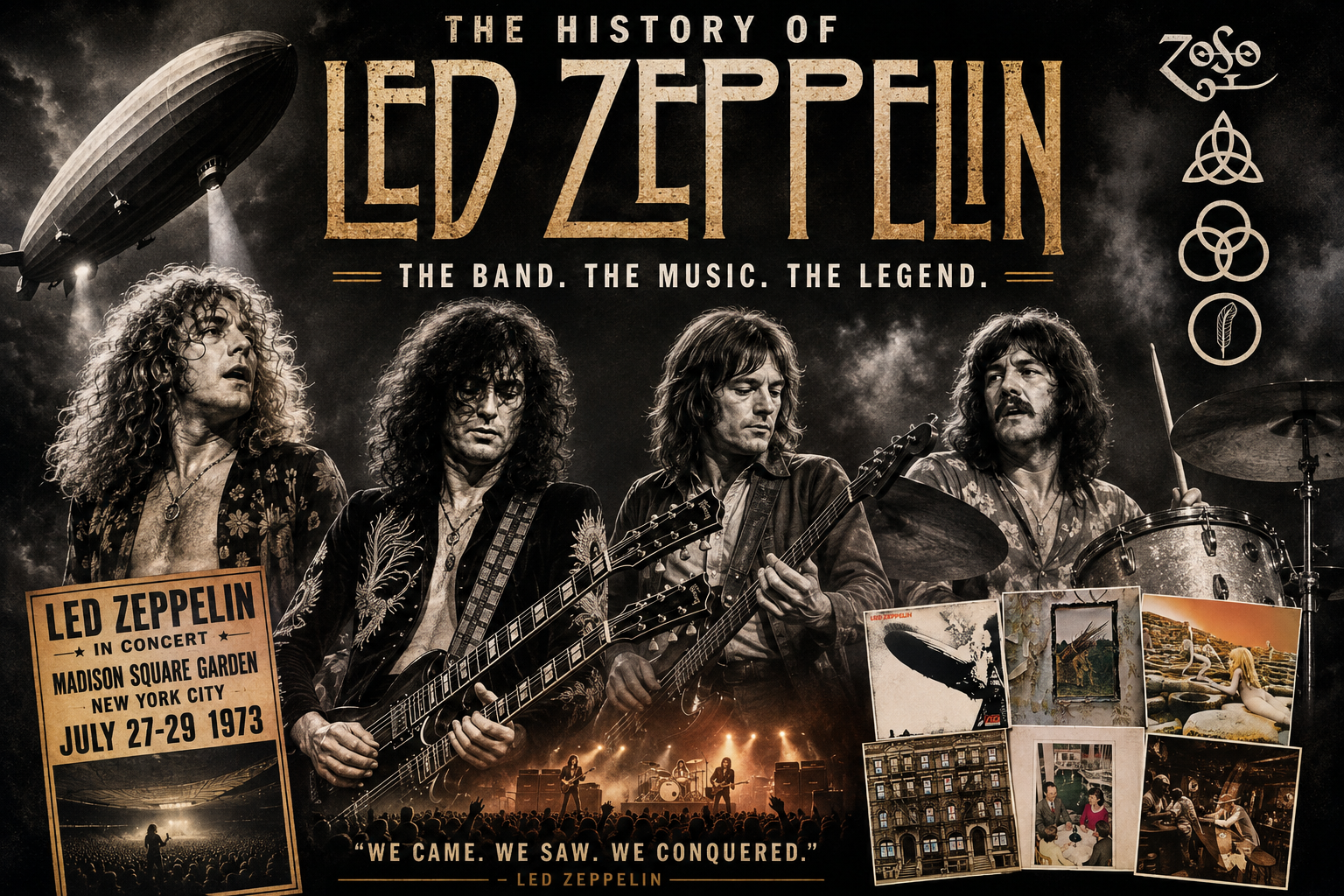
 Led Zeppelin’s story is one of the most remarkable in rock music.
It begins with a guitarist whose previous band was falling apart, a young singer with an extraordinary voice, a bass player who was already a respected multi-instrumentalist, and a drummer who would become one of the most famous musicians in the history of rock.
Together, they created something that had barely existed before: a band capable of combining the power of hard rock with blues, folk, psychedelia, progressive experimentation, Eastern influences and an almost obsessive attention to sound.
They became one of the biggest bands in the world without behaving like a conventional pop act. They rarely released singles in America. They didn’t build their career around television appearances. They weren’t interested in producing a constant stream of radio-friendly material. Their albums were events, and their concerts became legendary.
Led Zeppelin also became one of the most mythologized bands ever.
There were stories about massive hotel bills, bizarre backstage behavior, occult rumors, excess, enormous touring spectacles and the band’s almost complete separation from ordinary rock-star expectations. Some of those stories were exaggerated. Some were true. Some were somewhere in between.
Behind all the mythology, though, was an extraordinarily talented band.
Jimmy Page, Robert Plant, John Paul Jones and John Bonham were not simply four musicians who happened to become famous together. They had complementary strengths that allowed them to create a sound that none of them could have produced alone.
Their career lasted only about twelve years.
In that relatively short period, they changed rock music forever.
Jimmy Page Before Led Zeppelin
The story of Led Zeppelin really begins with Jimmy Page.
Before he became one of the defining guitarists of the 1970s, Page was one of Britain’s most in-demand session musicians. As a teenager and young adult, he played on recordings by numerous artists and became part of the incredibly busy London studio scene.
That experience was enormously important.
Page learned how records were actually constructed. He understood microphones, arrangements, overdubbing and studio experimentation. He wasn’t merely a guitarist who knew how to play riffs. He understood recording as an instrument.
Eventually, Page joined the Yardbirds.
The Yardbirds had already been one of Britain’s most important rock bands. Eric Clapton had played with them. Jeff Beck had played with them. Page eventually became part of the group as well.
When the Yardbirds began collapsing in 1968, Page was left with a problem.
He still had touring commitments.
He still had a name to maintain.
And he needed a new band.
The solution would become Led Zeppelin.
Finding Robert Plant
Page began looking for musicians who could help him build a new version of the Yardbirds.
The search led him to Robert Plant.
Plant was young, relatively unknown and possessed a voice that seemed almost impossibly powerful.
He had been performing with various groups in the Midlands and had developed a reputation as an exciting singer. When Page heard him, he recognized something immediately.
Plant had the voice.
But Page also discovered something else.
Plant had an enormous interest in blues and American music.
That mattered.
Page wasn’t looking for a singer who simply wanted to scream over guitar solos. He wanted someone who understood the music’s roots.
Plant also recommended another musician: drummer John Bonham.
Bonham was already known as a powerful and explosive drummer, and Plant knew him from the Birmingham music scene.
There was still one piece missing.
John Paul Jones.
John Paul Jones Completes the Puzzle
John Paul Jones was already an accomplished musician when Page approached him.
Like Page, Jones had extensive session experience. He was a bassist, keyboard player and arranger who understood music on a much broader level than simply playing bass lines.
His musicianship became one of Led Zeppelin’s secret weapons.
People often focus on Page, Plant and Bonham, but Jones was the stabilizing force in the band.
He could play bass.
He could play keyboards.
He could arrange.
He could contribute ideas.
He could make complicated musical concepts work.
The four musicians were dramatically different.
Page was the architect.
Plant was the frontman.
Bonham was the powerhouse.
Jones was the multi-instrumentalist and musical organizer.
Together, they had everything they needed.
The New Yardbirds
The band’s earliest incarnation was known as the New Yardbirds.
They fulfilled some existing Yardbirds commitments before completely transforming into something new.
The name Led Zeppelin eventually emerged.
The exact origin of the name has been told in several versions, but the idea was connected to a joke involving the possibility of the musicians forming a supergroup that would “go over like a lead balloon.”
Whatever the exact details, the name stuck.
And it was perfect.
It sounded heavy.
It sounded strange.
It sounded memorable.
It also had absolutely nothing to do with the polite image of a traditional British pop group.
Led Zeppelin was ready to begin.
The First Album
Led Zeppelin recorded its debut album in 1968 and released it in early 1969.
The album immediately demonstrated what made the group different.
There were heavy blues numbers.
There were acoustic passages.
There were dramatic arrangements.
There was Page’s guitar.
There was Plant’s voice.
There was Bonham’s thunderous drumming.
And there was Jones quietly holding the whole thing together.
The album wasn’t simply heavy.
That distinction is important.
Led Zeppelin’s music contained dynamics.
They could go from enormous guitar riffs to delicate acoustic passages.
They could sound threatening one moment and beautiful the next.
That contrast became one of their defining characteristics.
Songs such as “Good Times Bad Times,” “Dazed and Confused,” “Communication Breakdown” and “How Many More Times” established the basic vocabulary.
But the band was just getting started.
Led Zeppelin II
The second album arrived later in 1969.
This was where the band truly exploded.
Led Zeppelin II was more focused, more aggressive and more confident.
The opening track, “Whole Lotta Love,” immediately established the album’s attitude.
The riff is almost ridiculously simple.
That’s part of its brilliance.
Page created a guitar figure that sounds enormous without being musically complicated.
Bonham’s drumming gives it physical weight.
Jones locks everything together.
Plant’s voice cuts through the middle.
Then the band completely loses its mind during the psychedelic middle section.
That was Led Zeppelin.
They could take a basic blues-rock framework and turn it into something much stranger.
“Whole Lotta Love” became one of their signature songs and eventually one of the most recognizable rock songs ever recorded.
The album also contained “Heartbreaker,” “Ramble On,” “The Lemon Song” and “Bring It on Home.”
Led Zeppelin had arrived.
The Rise of the Live Band
The records were important.
The concerts were something else.
Led Zeppelin became one of the greatest live bands of their generation.
The sheer volume was part of it, but volume alone doesn’t explain their reputation.
The band could stretch songs far beyond their studio versions.
Page could improvise.
Plant could interact with the audience.
Bonham could launch into extended drum sections.
Jones could move between bass and keyboards.
The concerts became unpredictable.
That was important because the audience wasn’t simply hearing the albums.
They were hearing the band reinvent the songs.
A performance of “Dazed and Confused” could become an extended improvisational journey.
“Whole Lotta Love” could be transformed into a medley.
“How Many More Times” could stretch into something completely different.
Led Zeppelin understood that a concert should be an experience rather than a reproduction of a record.
Led Zeppelin III
After the intensity of the first two albums, Led Zeppelin made an unexpected move.
They became quieter.
Led Zeppelin III arrived in 1970 and surprised some listeners with its emphasis on acoustic music.
“Immigrant Song” opened the album with one of the band’s most aggressive performances, but the record quickly moved into more unusual territory.
“Friends.”
“Celebration Day.”
“Since I’ve Been Loving You.”
“Gallows Pole.”
“Tangerine.”
“That’s the Way.”
“Bron-Y-Aur Stomp.”
The album revealed just how broad the band’s musical interests really were.
The acoustic material wasn’t a side project.
It was part of the band’s identity.
Page and Plant were deeply interested in folk music, particularly British folk traditions.
The band could move between heavy blues and acoustic folk without treating either style as a novelty.
That versatility would become increasingly important.
The Cottage in Wales
During this period, Page and Plant spent time at Bron-Yr-Aur, a remote cottage in Wales.
The environment influenced their songwriting.
Away from the noise of touring and recording studios, they developed some of the band’s most intimate material.
“That’s the Way” emerged from this period.
So did “Bron-Yr-Aur Stomp.”
The contrast between these songs and the heavier material demonstrated that Led Zeppelin wasn’t simply a hard-rock band.
They were developing their own musical universe.
Led Zeppelin IV
Then came the album that changed everything.
Released in 1971, the fourth album didn’t have a conventional title.
It became known as Led Zeppelin IV.
The album contained some of the most famous songs in rock history.
“Black Dog.”
“Rock and Roll.”
“The Battle of Evermore.”
“Stairway to Heaven.”
“Misty Mountain Hop.”
“Four Sticks.”
“Going to California.”
“When the Levee Breaks.”
It’s difficult to overstate how influential this record became.
“Stairway to Heaven” in particular became one of the defining songs of classic rock.
The song starts quietly.
Acoustic guitar.
Recorder-like textures.
Plant’s voice.
Then the arrangement gradually expands.
The final section becomes enormous.
Page’s guitar solo is one of the most famous in rock history.
But what makes the song remarkable is its structure.
It doesn’t simply repeat a verse and chorus.
It evolves.
The music grows.
The emotional intensity increases.
The song essentially takes the listener on a journey.
“Stairway to Heaven”
“Stairway to Heaven” became the song people associated with Led Zeppelin.
Ironically, the band never released it as a conventional single in the United States.
Radio stations played it anyway.
For generations of young guitarists, learning the opening chords became a rite of passage.
The song also became the subject of endless debate.
Was it progressive rock?
Hard rock?
Folk rock?
Something else entirely?
The answer is all of them.
That’s what makes it quintessential Led Zeppelin.
They refused to stay inside one genre.
The Mystique Begins
As Led Zeppelin became more famous, the mythology surrounding them became almost as large as the music.
The band was notorious for avoiding excessive media exposure.
They didn’t constantly explain themselves.
They didn’t give the public a carefully managed personal narrative.
That created mystery.
The less they explained, the more people speculated.
Their giant tours became legendary.
Their hotel behavior became legendary.
Their wealth became legendary.
The stories surrounding the band grew increasingly outrageous.
Some were accurate.
Some were embellished.
Some were almost certainly invented.
But the mythology became part of Led Zeppelin’s identity.
Houses of the Holy
The next album was Houses of the Holy, released in 1973.
It showed the band becoming even more adventurous.
“The Song Remains the Same” opens the album with explosive energy.
“The Rain Song” moves into orchestral beauty.
“Over the Hills and Far Away” combines acoustic and electric textures.
“Dancing Days” is lighter and more melodic.
“No Quarter” is darker and more atmospheric.
“The Ocean” closes the album with swagger.
The record demonstrated that Led Zeppelin wasn’t interested in simply repeating Led Zeppelin IV.
They were expanding.
The Song Remains the Same
The band’s next major project was a live concert film and soundtrack.
The Song Remains the Same documented Led Zeppelin’s 1973 performances at Madison Square Garden.
The film became part concert documentary, part mythology.
Each member was given a kind of fantasy sequence.
Page appears in mystical imagery.
Plant is presented as a medieval hero.
Bonham is portrayed as something like a wandering warrior.
The entire thing captures the band’s enormous sense of theatricality.
It also demonstrates just how important spectacle had become to Led Zeppelin.
They were no longer simply a band playing clubs.
They were an institution.
Physical Graffiti
In 1975, Led Zeppelin released Physical Graffiti.
It was enormous.
A double album.
Multiple styles.
Songs recorded across several years.
New material mixed with older recordings.
It could have been a disaster.
Instead, it became one of their greatest achievements.
“Custard Pie.”
“The Rover.”
“In My Time of Dying.”
“Houses of the Holy.”
“Trampled Under Foot.”
“Kashmir.”
“Ten Years Gone.”
“The Wanton Song.”
“Boogie with Stu.”
“Black Country Woman.”
“Sick Again.”
The album demonstrated everything Led Zeppelin could do.
Hard rock.
Blues.
Funk.
Folk.
Acoustic music.
Experimental arrangements.
And then there was “Kashmir.”
“Kashmir”
“Kashmir” may be the ultimate Led Zeppelin song.
It doesn’t sound like ordinary blues-rock.
The guitar riff is hypnotic.
The orchestration is enormous.
Bonham’s drums have a strange, deliberate power.
Plant sings with authority rather than simply screaming.
The song feels almost cinematic.
It is difficult to imagine another band of the era producing something quite like it.
“Kashmir” also demonstrates the importance of John Paul Jones.
The arrangement is much bigger than a typical four-piece rock performance.
Strings and brass-like textures expand the sound.
Jones’ keyboard and arrangement work helped turn the song into something almost orchestral.
It is one of the clearest examples of the four members working together rather than simply showcasing their individual talents.
Led Zeppelin Becomes a Machine
At this point, Led Zeppelin was enormous.
Their albums sold in extraordinary numbers.
Their concerts were major events.
Their reputation was larger than life.
They had become one of the biggest bands in the world without following the normal rules of pop success.
They weren’t releasing constant singles.
They weren’t appearing on television every week.
They weren’t trying to make themselves universally accessible.
They let the albums and concerts speak.
That independence was part of their appeal.
The Problem With Success
The larger Led Zeppelin became, the more difficult their lifestyle became.
The band was constantly traveling.
They were surrounded by enormous entourages.
Their hotels became temporary headquarters.
Their lives became increasingly detached from ordinary reality.
That kind of environment can be intoxicating.
It can also become destructive.
The band’s legendary excesses were not simply amusing stories.
There was a darker side to the lifestyle.
The pressure of fame, constant touring, substance use and personal chaos would eventually begin to take a toll.
Presence
In 1976, Led Zeppelin released Presence.
The circumstances surrounding the album were difficult.
Robert Plant had suffered a serious car accident in 1975.
He was dealing with significant injuries and was not physically capable of performing at his previous level.
Yet the band went into the studio.
Presence is a strange album.
It is more stripped down than Physical Graffiti.
There are fewer keyboards.
There are fewer acoustic detours.
The guitar dominates.
“Achilles Last Stand” is the centerpiece.
It’s enormous, complicated and relentless.
The album feels like a band trying to prove something to itself.
It isn’t as immediately accessible as Led Zeppelin IV or Physical Graffiti.
But its intensity is remarkable.
The Accident Changes Everything
Plant’s accident changed the band’s plans.
Touring became difficult.
The band couldn’t simply return to the road as though nothing had happened.
Then came another blow.
Plant’s young son, Karac, died in 1977.
The loss devastated him.
It also devastated the band.
Led Zeppelin’s future became uncertain.
Plant understandably needed time away.
The band eventually returned to work, but the emotional landscape had changed.
In Through the Out Door
Led Zeppelin’s final studio album arrived in 1979.
In Through the Out Door was different from what came before.
John Paul Jones had a larger role.
Keyboards became more prominent.
The songwriting moved in a more melodic direction.
“All My Love” was one of the album’s most emotional songs, reflecting Plant’s personal loss.
“Fool in the Rain” demonstrated the band’s willingness to experiment with rhythm.
“Carouselambra” was expansive and strange.
“I’m Gonna Crawl” returned to a more traditional emotional blues approach.
The album was commercially successful.
But Led Zeppelin was no longer the same band that had produced Led Zeppelin II.
That wasn’t necessarily a bad thing.
They were evolving.
The Death of John Bonham
Then came the tragedy that ended everything.
On September 25, 1980, John Bonham died.
He was only 32.
Bonham had been drinking heavily during rehearsals for the band’s planned return to touring.
He was found dead at Page’s house.
The cause was alcohol-related pulmonary asphyxiation.
The band was devastated.
Bonham wasn’t simply their drummer.
He was a fundamental part of their sound.
Led Zeppelin’s music depended on his enormous physical power and distinctive sense of rhythm.
There was no obvious replacement.
More importantly, the remaining members didn’t believe Led Zeppelin could continue without him.
In December 1980, they announced that the band was finished.
Coda
Led Zeppelin still had unreleased material.
In 1982, Coda was released.
It wasn’t a conventional studio album.
It consisted largely of recordings from earlier sessions.
But it gave fans additional material from the band’s history.
Songs like “We’re Gonna Groove,” “Poor Tom,” “Darlene” and “Wearing and Tearing” showed different sides of the band.
Coda wasn’t intended to create a new era.
It was a final collection.
The final piece of the catalog.
The Legacy
Led Zeppelin’s influence is enormous.
Hard rock changed because of them.
Heavy metal developed partly from the musical vocabulary they helped establish.
Their approach to guitar riffs influenced generations of musicians.
Bonham’s drumming became a standard against which rock drummers were measured.
Plant’s vocal style influenced countless singers.
Jones demonstrated the importance of arrangement and musicianship within a rock band.
Page showed what a guitarist could accomplish not only with an instrument but also in the studio.
But perhaps their greatest influence was conceptual.
Led Zeppelin demonstrated that a rock band didn’t need to choose between heaviness and sophistication.
They could be both.
They could play a crushing riff and then follow it with an acoustic folk song.
They could write a blues number and then create something as strange as “Kashmir.”
They could make a radio-friendly song without becoming a singles band.
They could produce massive albums that demanded to be listened to as complete experiences.
The Members After Zeppelin
After Led Zeppelin ended, the four members followed different paths.
Robert Plant built a successful solo career and continued exploring different musical styles.
He worked with artists from different traditions and refused to simply recreate Led Zeppelin.
Jimmy Page remained associated with Led Zeppelin and released solo and collaborative material.
John Paul Jones pursued a wide variety of projects and continued demonstrating his versatility as a musician and arranger.
John Bonham’s death meant his legacy became inseparable from Led Zeppelin.
His son Jason later became a successful drummer and participated in major Led Zeppelin reunions.
The 1985 Live Aid Reunion
The remaining members reunited in 1985 for Live Aid.
The performance was heavily criticized.
There were technical problems.
Phil Collins and Tony Thompson were involved on drums.
The band had not rehearsed sufficiently.
It wasn’t representative of what Led Zeppelin had been.
But the reunion demonstrated something important.
People still cared.
Massively.
Even after several years apart, Led Zeppelin remained one of the most important names in rock.
The 2007 Reunion
The real reunion came decades later.
In 2007, Jimmy Page, Robert Plant and John Paul Jones reunited with Jason Bonham for a tribute concert for Ahmet Ertegun.
The performance took place at London’s O2 Arena.
It became one of the most anticipated rock concerts in history.
The band was tight.
The performance was powerful.
The musicians demonstrated that the chemistry had not completely disappeared.
It also raised the inevitable question:
Would Led Zeppelin tour again?
The answer was no.
Plant resisted the idea of a full-scale reunion.
And perhaps that was the right decision.
Why They Never Needed a Reunion Tour
A major Led Zeppelin reunion tour would have been enormous.
It would have sold out stadiums.
It would have generated an incredible amount of money.
But it might also have changed the band’s legacy.
Led Zeppelin ended because John Bonham died.
They didn’t break up because they became irrelevant.
They didn’t limp into retirement.
They didn’t spend twenty years making increasingly mediocre albums.
They stopped at the top.
That matters.
Their discography is relatively compact.
There are no embarrassing late-career records that need to be explained away.
There is no decade-long period of diminishing returns.
The story has an ending.
And sometimes that is better.
The Four Members Were Greater Together
The temptation with a band like Led Zeppelin is to discuss each member individually.
Page was a great guitarist.
Plant was a great singer.
Bonham was a great drummer.
Jones was a great musician.
But the magic wasn’t simply the sum of those talents.
It was the interaction.
Page could write a riff, and Bonham would transform it rhythmically.
Plant could take the melody and make it dramatic.
Jones could add an arrangement that changed the entire texture.
That’s why Led Zeppelin sounded different from four talented musicians playing together.
They sounded like a single organism.
Jimmy Page’s Genius
Page’s importance goes beyond guitar playing.
He was the band’s musical architect.
He understood how to create contrast.
He understood recording.
He understood arrangement.
He knew when to let the band sound enormous and when to strip everything down.
His guitar tone became iconic.
His use of acoustic and electric guitars gave Led Zeppelin tremendous variety.
And his willingness to experiment helped prevent the band from becoming repetitive.
Robert Plant’s Voice
Plant became one of rock’s defining singers.
His voice could be delicate.
It could be aggressive.
It could be sensual.
It could sound almost supernatural.
But his real contribution was his understanding of phrasing.
He didn’t simply sing over the music.
He reacted to it.
His vocal lines often feel as though they’re part of the rhythm section.
That was particularly important because Led Zeppelin’s music was so dynamic.
Plant had to be able to move from whispers to screams.
He could.
John Paul Jones’ Importance
Jones is sometimes the forgotten member.
He shouldn’t be.
Without Jones, Led Zeppelin would not have been nearly as musically sophisticated.
He was the arranger.
The multi-instrumentalist.
The person capable of connecting Page’s guitar ideas with the larger musical structure.
His keyboard work became increasingly important.
His bass playing was powerful but often subtle.
He rarely demanded attention.
That’s exactly why he was so valuable.
John Bonham’s Revolution
Bonham changed rock drumming.
His sound was enormous.
But his greatest strength wasn’t simply power.
It was feel.
He could play behind the beat.
He could create grooves that were heavy without being stiff.
He understood funk.
He understood blues.
He understood swing.
He could play with enormous force while remaining musical.
That’s why his influence extends beyond hard rock.
Drummers across rock, metal and funk have studied Bonham.
His work remains a reference point.
Why Led Zeppelin Still Sounds Modern
One reason Led Zeppelin has survived so well is that their music doesn’t feel trapped in one production era.
Yes, some recordings have the sonic fingerprints of the late 1960s and 1970s.
But the performances are so strong that the songs remain alive.
The riffs still work.
The drums still hit.
The vocals still have personality.
The arrangements still surprise.
And the band’s willingness to combine styles means their catalog doesn’t become repetitive.
You can listen to Led Zeppelin for hours without hearing the same formula over and over.
The Blues Question
Led Zeppelin’s relationship with the blues has been debated for decades.
The band drew heavily from American blues traditions.
Some early songs were adaptations of existing blues material.
Questions about songwriting credits and appropriation have followed the band throughout its history.
Those issues are worth acknowledging.
But they don’t erase what Led Zeppelin did with those influences.
They transformed them.
They combined blues structures with British folk, hard rock, psychedelic experimentation and their own songwriting.
The result became something new.
That process is part of how popular music evolves.
The Myth Versus the Music
Led Zeppelin became surrounded by so much mythology that it’s easy to forget how good the actual records are.
The hotel stories.
The groupies.
The rumors.
The occult speculation.
The enormous houses.
The private jets.
The legendary parties.
All of that became part of the story.
But none of it explains why people still listen to “Black Dog.”
None of it explains why “Kashmir” still sounds enormous.
None of it explains why Bonham’s drums on “When the Levee Breaks” became one of the most sampled drum sounds in history.
The music is the reason.
The mythology simply made the story more colorful.
The Greatest Hard Rock Band?
Arguments about the greatest rock band are ultimately subjective.
The Beatles changed popular music.
The Rolling Stones created an enduring blues-rock model.
Pink Floyd transformed album-oriented rock.
Black Sabbath helped establish heavy metal.
The Who changed the possibilities of the live rock show.
But Led Zeppelin occupies a unique position.
They combined almost everything.
The blues.
Folk.
Hard rock.
Progressive ideas.
Acoustic music.
Orchestration.
Improvisation.
Studio experimentation.
And they did it while maintaining a level of musical power that few bands could match.
The Final Chapter
Led Zeppelin’s career was remarkably short.
The first album arrived in 1969.
The band ended in 1980.
That’s only eleven years of recorded existence.
In those eleven years, they released eight studio albums, toured extensively and became one of the biggest bands on Earth.
Then it was over.
No planned farewell tour.
No final stadium spectacle.
No attempt to replace Bonham.
They simply stopped.
The remaining members knew that John Bonham couldn’t be replaced.
Without him, Led Zeppelin wasn’t Led Zeppelin.
That decision preserved something important.
The band remained complete in the public imagination.
The Enduring Power of Led Zeppelin
More than four decades after the band’s end, Led Zeppelin remains enormous.
Their albums continue to be discovered by new generations.
Their songs remain staples of rock radio.
Their riffs are still played by young guitarists.
Their drum parts are still studied.
Their performances continue to circulate.
Their influence can be heard in hard rock, heavy metal, alternative rock, blues rock and countless other genres.
But their greatest achievement may be that they made rock music feel limitless.
They didn’t believe a rock band had to stay within one sound.
A song could begin with an acoustic guitar and end with an enormous electric solo.
A blues riff could become something psychedelic.
A folk melody could sit next to a heavy rock song.
A drummer could sound like an entire percussion section.
A bassist could become an arranger.
A singer could sound like a bluesman, a folk singer and a rock star within the same album.
That freedom became Led Zeppelin’s defining characteristic.
The Four Men Who Changed Rock
Jimmy Page, Robert Plant, John Paul Jones and John Bonham created something that nobody could have predicted.
They weren’t simply a heavier version of the Yardbirds.
They weren’t simply a blues band.
They weren’t simply a hard-rock band.
They weren’t simply a progressive band.
They were Led Zeppelin.
And that was enough.
Their story contains extraordinary success, personal tragedy, musical experimentation, excess, reinvention and finally an abrupt ending.
They reached a level of fame that few bands have ever experienced.
They also demonstrated the danger that comes with living at that level.
Yet when all the stories are stripped away, the central achievement remains incredibly simple.
Four musicians got together and made records that changed the way rock music sounded.
Page created some of the most recognizable guitar work in history.
Plant gave the music its voice.
Jones provided the musical architecture.
Bonham supplied the thunder.
Together, they created a sound that remains instantly recognizable.
That’s why Led Zeppelin’s history is more than the story of a famous rock band.
It’s the story of a band that expanded the possibilities of what rock music could be.
They could be loud without being simple.
They could be complicated without being boring.
They could be delicate without losing their power.
They could experiment without losing their audience.
They could draw from the past while creating something that sounded completely new.
And they could do all of it with four musicians who, individually, were extraordinary and, collectively, were almost impossible to stop.
Led Zeppelin’s career ended in 1980.
The music never did.
That’s the real legacy.
The band is gone.
The records remain.
And every time those opening guitar notes of “Good Times Bad Times” hit, Bonham’s drums explode into “When the Levee Breaks,” Plant’s voice rises over “Immigrant Song,” or the opening acoustic guitar of “Stairway to Heaven” fills a room, the same thing becomes obvious all over again:
Led Zeppelin wasn’t simply one of the biggest bands of the 1970s.
They were one of the bands that defined what rock music could be.
This post has already been read 353 times!