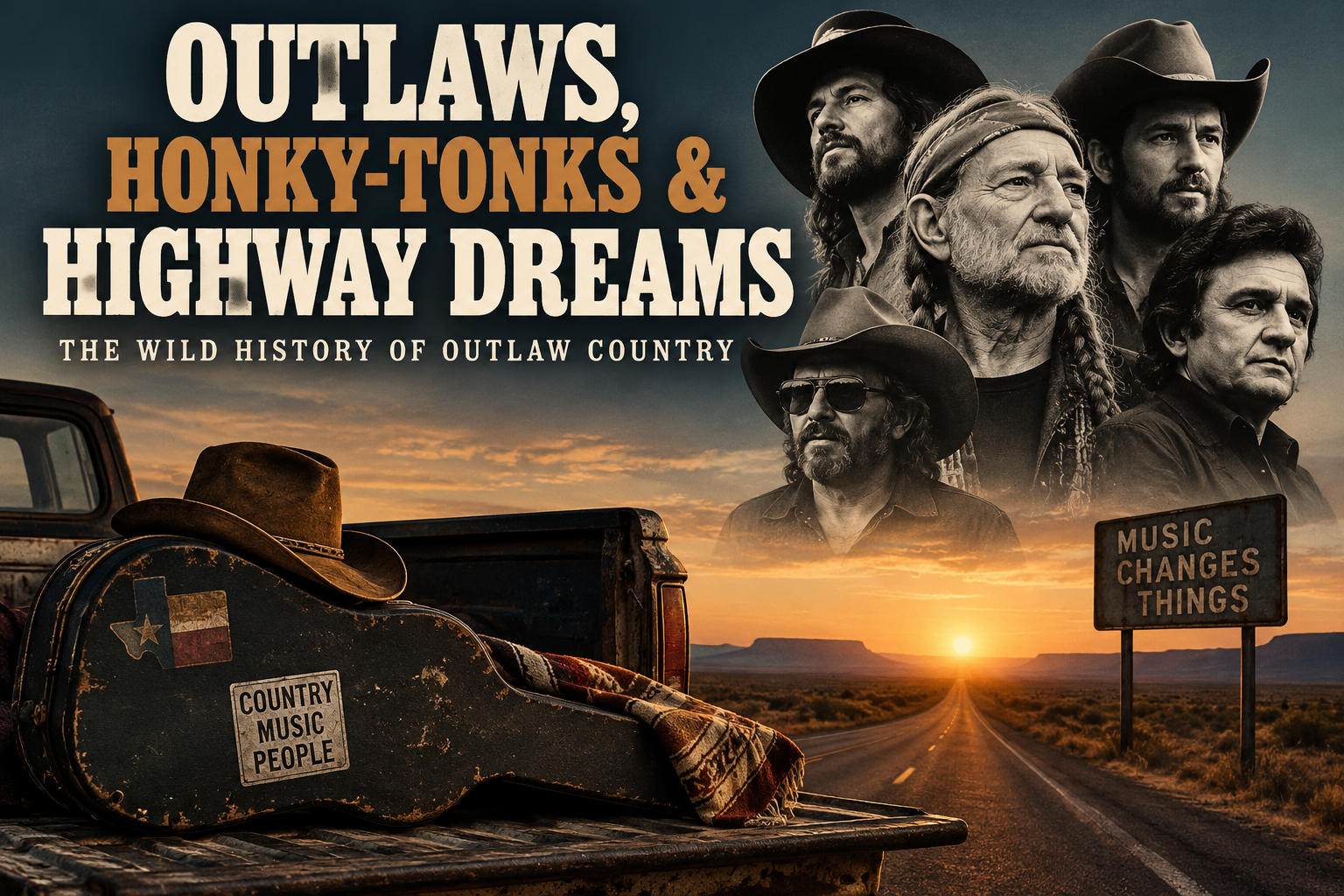
Outlaw Country is one of the most important movements in the history of American music because it changed what country music could look like, sound like, and represent. It was rebellious without necessarily being revolutionary, rough around the edges without abandoning tradition, and fiercely independent while still becoming commercially successful. Most importantly, Outlaw Country gave country musicians permission to become the architects of their own careers.
The movement emerged in the late 1960s and exploded during the 1970s, largely as a reaction against the polished Nashville sound that dominated mainstream country music. The Nashville establishment had developed a highly controlled recording system. Producers, record executives, songwriters, studio musicians, arrangers, and managers often determined how records were made and what artists were expected to sound like. The results could be smooth, professional, and enormously successful, but many artists increasingly felt that the music had become disconnected from the rougher traditions that had originally made country music so compelling.
Outlaw Country pushed in the opposite direction.
The music embraced imperfections. It favored musicians who wanted creative control over their records. It welcomed rock influences, blues, folk, honky-tonk, Western swing, psychedelic music, and the rougher sounds coming out of Texas. Its singers often sounded lived-in rather than polished. The songs dealt with drinking, prison, broken relationships, highways, loneliness, work, independence, rebellion, and life outside respectable society.
The word “outlaw” was particularly appropriate because many of the movement’s leading figures had spent years fighting the country music business itself.
Willie Nelson had already established himself as a successful Nashville songwriter before becoming an icon of the movement. Waylon Jennings had experienced the limitations of the Nashville recording system firsthand. David Allan Coe built his entire public identity around rebellion. Jessi Colter brought a distinctive female voice to a movement that was often dominated by men. Johnny Cash had been challenging Nashville conventions for years before the Outlaw movement gave his rebellious image a new context.
Then there was Merle Haggard, whose music complicated the entire idea of what an outlaw was. Haggard could write about prison, working-class life, patriotism, loneliness, and social change without fitting neatly into the counterculture. His songs demonstrated that rebellion in country music did not always mean rejecting traditional American values.
The movement also had a geographical identity. Nashville remained the center of the country music industry, but Austin, Texas, became the spiritual home of the Outlaw sound. Musicians gathered in Texas clubs and honky-tonks where country, rock, blues, and Western swing could coexist. Artists such as Willie Nelson, Waylon Jennings, Doug Sahm, Jerry Jeff Walker, Billy Joe Shaver, Townes Van Zandt, Guy Clark, and Steve Earle helped create a musical culture that valued individuality over conformity.
Outlaw Country eventually became too successful to remain truly “outside” the system. The very industry that the movement challenged learned how to market rebellion. Record companies discovered that cowboy hats, denim, long hair, motorcycles, and anti-establishment imagery could sell records. Outlaw Country became a brand as well as a musical philosophy.
Yet the original idea never disappeared.
Its influence can be heard in alt-country, Americana, Southern rock, red dirt country, roots rock, country punk, and modern artists who reject Nashville formulas in favor of personal songwriting and independent production.
The history of Outlaw Country is therefore more than the story of Willie Nelson and Waylon Jennings. It is the story of musicians repeatedly pushing against the boundaries of an industry that wanted to define them.
The Roots of Rebellion in Country Music
The story of Outlaw Country begins long before anyone used the term.
Country music itself was born from a mixture of traditions that were anything but uniform. Appalachian ballads, folk songs, blues, fiddle music, gospel, Western music, and Southern string-band traditions all contributed to the development of what became country music.
Early country musicians were often working people playing music for working people. The distinction between performer and audience could be relatively small. A musician might perform at a dance, a church, a radio station, a barn dance, or a honky-tonk. The music did not need to sound sophisticated.
It needed to sound real.
Jimmie Rodgers became one of country music’s first major stars in the 1920s. His songs mixed blues, folk, railroad imagery, and Southern storytelling. The Carter Family established another major branch of the genre, emphasizing traditional songs, family harmonies, and acoustic instrumentation.
As country music developed through the 1930s and 1940s, performers such as Hank Williams, Ernest Tubb, Bob Wills, Lefty Frizzell, and others expanded the possibilities.
Hank Williams in particular established a model that would become central to later Outlaw Country: the singer-songwriter whose personality was inseparable from the songs.
Williams did not sound like a distant entertainer. His records sounded personal, direct, and vulnerable. He sang about drinking, heartbreak, loneliness, faith, temptation, and personal failure. His characters were flawed people.
That tradition would eventually become one of the foundations of Outlaw Country.
Another important influence was honky-tonk.
Honky-tonk country developed around bars and dance halls, particularly in Texas and Oklahoma. The music was harder-edged than the smoother country styles that would later dominate Nashville. Steel guitar, fiddle, electric guitar, bass, and drums created a driving sound that reflected the nightlife of working-class America.
Ernest Tubb and Lefty Frizzell were enormously important to this tradition. Their music provided a blueprint for generations of artists who wanted country music to retain its grit.
Western swing added another ingredient.
Bob Wills and His Texas Playboys demonstrated that country music could absorb jazz, blues, swing, and dance-band influences without losing its identity. The Texas musical tradition would become especially important when Austin later became the center of the Outlaw movement.
Country music had always contained rebellious elements.
The difference was that the Nashville industry eventually became increasingly organized around controlling those elements.
The Rise of the Nashville Sound
Nashville became the center of the country music business after World War II.
The Grand Ole Opry had already made Nashville a major country music destination, and the growth of record labels, publishing companies, studios, and radio transformed the city into the industry’s headquarters.
During the 1950s and 1960s, Nashville producers increasingly developed a polished recording style designed to appeal to a broader audience.
The result became known as the Nashville Sound.
The Nashville Sound often featured lush arrangements, background singers, sophisticated studio musicians, and smooth production. Country records could now compete with pop music on mainstream radio.
Artists such as Patsy Cline, Jim Reeves, Eddy Arnold, and later Glen Campbell demonstrated how successful this approach could be.
There was nothing inherently wrong with polished country music. It produced some of the most beautiful recordings in the genre’s history.
The problem for certain artists was creative control.
The Nashville recording system frequently involved producers and executives making important decisions about arrangements, musicians, material, and presentation. The system was efficient and commercially successful, but artists who wanted to experiment could find themselves fighting against established procedures.
This tension became increasingly important as the 1960s progressed.
Rock music had transformed popular music.
Bob Dylan had demonstrated the power of the singer-songwriter. The Beatles had changed studio recording. The Rolling Stones had revived blues and roots music for a younger generation. Folk music had become politically and culturally important. Psychedelic rock encouraged musicians to experiment with sound.
Country musicians were listening.
They were also watching audiences change.
A new generation of country performers did not necessarily want to choose between country music and rock music. They wanted to incorporate elements of both.
Nashville did not always know what to do with them.
Willie Nelson Before Outlaw Country
Willie Nelson’s story is central to the development of Outlaw Country because he experienced the Nashville system from the inside.
Before Willie Nelson became the long-haired, bandana-wearing icon associated with Austin, he was a successful Nashville songwriter.
He wrote songs that became major hits for other performers.
“Crazy,” recorded by Patsy Cline, became one of the most famous country songs ever written. “Hello Walls,” recorded by Faron Young, was another major success. Nelson demonstrated that he had an extraordinary ability to write songs that were emotionally direct but structurally sophisticated.
Yet Nelson struggled to fit comfortably into the Nashville recording system.
His own records did not always sound like the records he imagined in his head.
Nelson wanted something looser.
He wanted jazz influences. He wanted unusual phrasing. He wanted guitar solos that did not necessarily follow Nashville conventions. He wanted to record songs without having every rough edge polished away.
His frustration eventually became a major reason he moved away from Nashville.
Texas offered something different.
Nelson returned to Texas and discovered an audience that was much more receptive to his approach. Austin’s music scene was developing into a place where country musicians, rock musicians, hippies, blues players, folk singers, and traditional honky-tonk performers could share stages.
The environment suited Nelson perfectly.
He began performing in a way that emphasized individuality rather than conformity.
The look changed too.
The neatly groomed Nashville songwriter gave way to the long-haired Texas performer.
Willie was becoming Willie.
Waylon Jennings and the Nashville Problem
Waylon Jennings followed a similar path, although his musical background was different.
Jennings had worked as a musician and radio personality before becoming a successful recording artist. He was also part of Buddy Holly’s circle in the late 1950s and played bass for Holly’s band.
That connection was hugely important.
Buddy Holly represented a new generation of musicians who wanted greater control over their music. Holly played a major role in the development of rock and roll, and his influence could be heard in Jennings’ willingness to experiment.
Jennings eventually moved into country music and became a successful recording artist.
But he had problems with the Nashville system.
One of the biggest frustrations involved studio musicians.
Jennings wanted to use his own musicians, but Nashville producers often preferred the professional session players who had become the industry’s standard.
For Jennings, this was more than a minor disagreement.
The musicians around an artist could define the sound.
Jennings wanted his records to feel like the music he was performing onstage.
He wanted his own band.
He wanted to decide how the songs were arranged.
He wanted the ability to record in a way that felt natural rather than manufactured.
His battles with record executives became legendary.
Jennings was not simply demanding artistic freedom for himself. He represented a larger shift in the relationship between country musicians and the industry.
Artists were beginning to ask a simple question:
Why should the people making the records have less control over the music than the people signing the contracts?
That question would help define Outlaw Country.
Austin Becomes the Center of the Movement
Austin, Texas, became the ideal environment for the emerging Outlaw Country movement.
The city already had deep roots in country and Western music, but its growing counterculture scene introduced new possibilities.
The Armadillo World Headquarters became one of the most famous venues associated with the movement.
The Armadillo was not simply a country club.
Rock bands played there. Country musicians played there. Blues artists played there. Hippies attended. Cowboys attended. College students attended.
The boundaries were deliberately blurry.
Willie Nelson became the central figure in this new Austin culture.
His annual Fourth of July Picnic became an important event, bringing together country musicians and audiences who might not have traditionally occupied the same musical space.
Austin allowed Willie to stop worrying about whether he fit into Nashville.
Instead, he created his own world.
That world included artists such as Townes Van Zandt, Guy Clark, Steve Fromholz, Billy Joe Shaver, Jerry Jeff Walker, Michael Martin Murphey, and Doug Sahm.
These musicians were not identical.
That was the point.
Austin did not have a single sound.
It had an attitude.
Country music could be weird. It could be political. It could be psychedelic. It could be acoustic. It could be loud. It could be traditional.
The city became a place where musicians could be themselves.
The Red Headed Stranger Changes Everything
Willie Nelson’s move toward creative independence reached a crucial point with Red Headed Stranger in 1975.
The album was radically different from much of mainstream country music at the time.
It was sparse.
The arrangements were restrained. Nelson’s voice was intimate and conversational. His guitar playing was distinctive. The songs were allowed to breathe.
The album told a story involving a mysterious preacher-like figure moving through a troubled world.
It did not sound like a typical Nashville production.
That was precisely why it worked.
The success of Red Headed Stranger proved that audiences were willing to embrace music that did not follow the established formula.
The album became one of the defining statements of Outlaw Country.
It also helped transform Willie Nelson from respected songwriter into a major cultural figure.
The commercial success mattered because it changed the argument.
Record executives could no longer easily say that artistic independence was commercially dangerous.
Willie had demonstrated the opposite.
The public wanted authenticity.
Waylon Jennings and Dreaming My Dreams
Waylon Jennings’ career reached a similar breakthrough during the same period.
Albums such as Honky Tonk Heroes and Dreaming My Dreams became landmarks.
Honky Tonk Heroes, released in 1973, was especially important because it centered heavily on the songwriting of Billy Joe Shaver.
Shaver was one of the great songwriters associated with the movement.
His writing was direct, plainspoken, and emotionally brutal.
Waylon recognized that Shaver’s songs did not need elaborate production to work.
The songs themselves were powerful.
Jennings’ approach emphasized his band and his own musical personality.
His records sounded like records made by a musician rather than records assembled by a production department.
That distinction became fundamental to the Outlaw philosophy.
Billy Joe Shaver: The Songwriter Behind the Rebels
Billy Joe Shaver deserves enormous credit in the history of Outlaw Country.
He was not as commercially famous as Willie Nelson or Waylon Jennings, but his songwriting helped define the movement.
Shaver’s songs captured the lives of drifters, workers, lovers, losers, and people who never quite fit into respectable society.
He wrote with an economy that made complicated emotions sound simple.
Waylon Jennings recorded many of his songs, bringing Shaver’s writing to a huge audience.
Shaver represented another important aspect of Outlaw Country: the songwriter did not have to be a polished celebrity.
The movement valued characters.
It valued people who had lived enough life to have something to say.
Shaver looked and sounded like someone who had actually experienced the stories in his songs.
That quality became part of the mythology.
Townes Van Zandt and the Dark Side of Outlaw Country
Townes Van Zandt represented the more literary and tragic side of the Texas movement.
His songwriting was often darker than the commercial country music of the period.
Songs such as “Pancho and Lefty,” “If I Needed You,” and “Waiting Around to Die” demonstrated an extraordinary ability to create characters and emotional landscapes.
Van Zandt was not really an Outlaw Country star in the commercial sense.
His importance was cultural.
He showed that country songwriting could be as sophisticated and emotionally complex as any form of American literature.
His songs dealt with loneliness, death, love, wandering, addiction, violence, and existential despair.
The beauty of his writing often contrasted with the bleakness of his subjects.
“Pancho and Lefty” eventually became a major country hit when Willie Nelson and Merle Haggard recorded it together.
That recording helped introduce Van Zandt’s songwriting to an enormous audience.
It also demonstrated something important about Outlaw Country.
The movement was not simply about rebellious personalities.
It was about great songs.
Merle Haggard: An Outlaw Without the Label
Merle Haggard presents one of the most interesting contradictions in the history of Outlaw Country.
Haggard was deeply associated with traditional country music.
He was also a former inmate who had experienced prison firsthand.
His songs often centered on working-class life, economic hardship, patriotism, alienation, and personal struggle.
Songs such as “Mama Tried” and “Sing Me Back Home” demonstrated his ability to transform personal experiences into universal country stories.
Haggard’s relationship with the counterculture was complicated.
He did not necessarily share the politics of the hippie movement that surrounded Austin’s emerging scene.
Yet his music was rebellious in another sense.
He wrote from outside polite society.
He wrote about prisoners, truck drivers, workers, drifters, and people who felt forgotten.
His famous song “Okie from Muskogee” became associated with the conservative side of the cultural divide, although Haggard later explained that the song was more complicated and satirical than many listeners assumed.
Haggard’s importance to Outlaw Country was therefore not based on whether he embraced the movement’s politics.
It was based on authenticity.
He wrote about people he understood.
He sang from experience.
And he refused to fit neatly into someone else’s definition.
Johnny Cash and the Original Rebel
Johnny Cash had already been an outlaw figure long before the phrase Outlaw Country became popular.
Cash’s black clothing, deep voice, prison imagery, and songs about outsiders had made him one of country music’s most recognizable rebels.
His famous performances at Folsom Prison and San Quentin helped establish his connection to prisoners and people living outside conventional society.
Cash also repeatedly challenged the Nashville establishment.
He recorded unusual material. He crossed genre boundaries. He collaborated with rock musicians and folk artists. He appeared on television in formats that brought country music to audiences beyond the traditional country market.
Cash’s relationship with Outlaw Country was therefore complicated.
He was a predecessor rather than a product of the movement.
The younger Outlaw artists inherited much from him.
They saw that a country artist could be successful without behaving like a traditional Nashville star.
Cash had already demonstrated that authenticity could become commercially powerful.
The Outlaw Image
The word “outlaw” became increasingly important during the 1970s.
Part of the reason was musical.
Part of it was marketing.
The artists associated with the movement increasingly looked different from the clean-cut Nashville performers who had dominated country music.
Long hair became common.
Beards became common.
Denim became common.
Cowboy hats became more rugged.
The image was less polished and more connected to Texas, motorcycles, bars, highways, and working-class culture.
Willie Nelson’s braids eventually became one of the most recognizable hairstyles in American music.
Waylon Jennings’ beard and black hat became equally recognizable.
David Allan Coe cultivated an especially extreme outlaw persona.
The visual identity helped sell the movement.
That created an interesting contradiction.
The artists were rebelling against the Nashville machine, but the music industry quickly realized that rebellion itself could be packaged and sold.
Outlaw became a category.
Record stores needed a place to put the records.
Radio stations needed a description.
Magazines needed a story.
The industry needed a marketable identity.
The rebellion had become a product.
David Allan Coe
David Allan Coe was perhaps the most unpredictable figure associated with Outlaw Country.
His biography became part of his music.
Coe had spent time in prison and built a reputation for outrageous behavior and provocative material.
His songwriting could be sentimental, funny, offensive, disturbing, and deeply personal.
He was an outsider even among outsiders.
Songs such as “You Never Even Called Me by My Name” became famous for playing with the conventions of country music itself.
Coe’s career demonstrated the limits of the Outlaw label.
If Willie Nelson represented artistic independence and Waylon Jennings represented musicians’ rights, Coe represented complete rejection of respectability.
His music was designed to provoke.
That made him an important part of the movement’s mythology, even when his work was difficult to fit into mainstream country.
Jessi Colter and the Women of Outlaw Country
The Outlaw movement is often remembered as a male-dominated world.
That is misleading.
Jessi Colter was one of its most important artists.
Colter’s music brought a different emotional perspective to the movement.
Her voice was distinctive, and her songwriting and performances showed that the Outlaw approach was not limited to male characters singing about bars, prisons, and highways.
She was also married to Waylon Jennings, and the two became one of country music’s most recognizable couples.
Her success demonstrated that the movement could accommodate different kinds of voices.
Other women connected to the broader movement and its surrounding country culture included Emmylou Harris, Linda Ronstadt, and Bonnie Raitt, although each had distinct musical identities and should not simply be categorized as Outlaw artists.
The broader point is that the 1970s roots movement was opening doors between country, rock, folk, and Americana.
Women benefited from that loosening of boundaries as well.
The Highway Becomes a Character
One of the defining themes of Outlaw Country was movement.
The highway became a recurring character.
Trains, trucks, motorcycles, bars, motels, small towns, and open roads appeared constantly.
This was partly inherited from older country music.
Hank Williams had sung about travel and loneliness.
Jimmie Rodgers had built songs around railroads.
Truck-driving country had its own long tradition.
But Outlaw Country gave these themes new cultural meaning.
The highway represented freedom.
It represented escape from institutions.
It represented the ability to leave.
That appealed to a generation increasingly skeptical of authority.
The road could be dangerous and lonely, but it was also liberating.
This is one reason Willie Nelson’s “On the Road Again” became such an enduring part of the movement’s mythology.
For musicians who had spent years fighting record companies, touring represented independence.
The road was where the artist could be in control.
The Outlaw Country Album Becomes an Event
One of the major changes caused by the movement was the growing importance of albums.
Traditional country music had historically been heavily oriented toward singles.
Radio was enormously important, and many listeners knew artists through individual songs.
Outlaw artists increasingly emphasized albums as complete artistic statements.
Willie Nelson’s Red Headed Stranger is a perfect example.
Waylon Jennings’ albums similarly developed a recognizable sound and personality.
The album format allowed musicians to explore themes, sequencing, instrumentation, and longer musical ideas.
This brought country music closer to the album-oriented world of rock.
It also allowed artists to build identities that could not be reduced to one hit single.
The result was a new kind of country star.
The artist was becoming the brand.
The Outlaws Join Forces
One of the most important commercial moments of the movement came when Willie Nelson and Waylon Jennings began working together as a duo and eventually became central figures in the “outlaw” marketing campaign.
Their collaborations made sense musically.
Willie’s relaxed phrasing contrasted beautifully with Waylon’s tougher delivery.
They sounded like friends rather than performers competing for attention.
The success of their collaborations demonstrated that the movement had genuine commercial power.
The “Outlaws” compilation released in 1976 became a landmark moment.
Its title effectively turned a previously rebellious concept into an official marketing category.
Willie Nelson, Waylon Jennings, Jessi Colter, and Tompall Glaser were prominently associated with the project.
The album was a major commercial success.
Country music had discovered its anti-establishment superstars.
The irony was impossible to miss.
The Nashville industry was now making money selling musicians who were famous for rejecting Nashville.
Wanted! The Outlaws
The success of Wanted! The Outlaws in 1976 transformed the movement.
The album became one of the biggest-selling country albums ever recorded at the time.
Its cover art looked like a wanted poster.
The artists appeared as wanted criminals.
The imagery was simple, immediately recognizable, and enormously effective.
Suddenly the Outlaw identity was everywhere.
Willie Nelson and Waylon Jennings became household names.
The movement had crossed over from an underground cultural phenomenon into mainstream entertainment.
This was both a triumph and a problem.
The artists had won.
But the rebellion had also been absorbed by the industry.
The very system they had challenged was now selling the rebellion back to the public.
Still, the success could not be dismissed.
Country musicians had demonstrated that creative freedom and commercial success did not have to be opposites.
The Importance of the Drifting Cowboy
The Outlaw image was also rooted in an older American archetype: the wandering cowboy.
The cowboy had long represented independence, toughness, self-reliance, and freedom.
Outlaw Country modernized that character.
The cowboy became a musician.
The horse became a tour bus.
The cattle trail became the highway.
The campfire became the honky-tonk.
The cowboy’s independence became the artist’s refusal to surrender creative control.
This connection helped Outlaw Country appeal to listeners beyond Texas.
The movement was modern, but its imagery was deeply traditional.
That combination became one of its greatest strengths.
Country Music Meets Rock
The Outlaw movement helped break down the wall between country and rock.
Willie Nelson could share stages with rock musicians.
Waylon Jennings’ music incorporated elements of Southern rock.
Doug Sahm moved effortlessly between country, rock, blues, and Tejano music.
The Texas scene encouraged musicians to stop worrying about genre boundaries.
This was particularly important because country music and rock had developed partly from the same roots.
Rockabilly had already demonstrated the relationship.
Artists such as Elvis Presley, Carl Perkins, Jerry Lee Lewis, and Johnny Cash had blurred the lines during the 1950s.
The Outlaw movement revived that spirit.
A country musician did not have to choose between electric guitar and fiddle.
A song could contain steel guitar and rock drums.
A singer could wear a cowboy hat and still appeal to rock audiences.
This musical flexibility became one of the movement’s most enduring contributions.
The Southern Rock Connection
Outlaw Country also overlapped heavily with Southern rock.
Groups such as the Allman Brothers Band and Lynyrd Skynyrd operated in a broader Southern musical culture that valued blues, country, rock, and boogie.
The audiences overlapped.
The musicians overlapped.
The themes overlapped.
Southern rock was generally heavier and more guitar-driven, while Outlaw Country remained more connected to country songwriting and honky-tonk traditions.
But the two movements shared a rebellious attitude.
Both rejected overly polished music.
Both emphasized musicianship.
Both celebrated regional identity.
Both appealed to listeners who wanted music that felt rooted in real places and real people.
This relationship would later become important to the development of alternative country and Americana.
The Decline of the Original Outlaw Era
The classic Outlaw Country period reached its commercial peak in the late 1970s.
Then the musical landscape began changing.
Disco was becoming huge.
Pop music was increasingly dominant.
Country music itself was changing.
The Urban Cowboy phenomenon of the early 1980s brought country music into mainstream pop culture in a new way.
The movie Urban Cowboy became a massive cultural phenomenon.
Country bars, cowboy hats, boots, mechanical bulls, and country fashion suddenly became mainstream.
At first glance, this looked like another victory for the Outlaw aesthetic.
But the underlying music industry was becoming increasingly polished.
The 1980s saw the rise of country-pop crossover stars and slicker production.
The rough edges of the 1970s were being smoothed away.
Artists who had once been rebellious were now established stars.
Willie Nelson remained successful.
Waylon Jennings continued making important music.
But the movement was no longer a single unified force.
The term “Outlaw Country” began to describe an attitude more than a specific musical movement.
Willie Nelson Survives Every Trend
Willie Nelson’s career demonstrates why the Outlaw philosophy mattered beyond the 1970s.
He continued experimenting.
He recorded traditional country.
He recorded gospel.
He recorded standards.
He worked with country artists, rock musicians, jazz musicians, and performers from outside the genre.
His ability to move between styles became one of his defining characteristics.
He also remained one of the most recognizable advocates for artistic independence in American music.
Willie did not need to chase every musical trend.
He had created a musical universe of his own.
That may be the ultimate success of Outlaw Country.
The artist no longer had to fit the genre.
The genre could fit the artist.
Waylon Jennings’ Later Career
Waylon Jennings continued to have major success after the peak of the Outlaw era.
His recordings remained influential, and his collaborations with Willie Nelson kept the outlaw identity alive.
Jennings also became increasingly reflective about his career.
His autobiography helped establish the mythology surrounding the movement.
The story was no longer simply about rebellious musicians.
It had become part of country music history.
Jennings eventually experienced health problems and died in 2002.
His legacy, however, continued to grow.
Modern country musicians frequently cite him as a major influence.
His greatest contribution may have been proving that a country artist could demand creative control and still become a major star.
The 1980s: A New Country Establishment
The 1980s created a strange situation.
Outlaw Country had challenged the establishment.
Then the establishment changed.
Country music became increasingly sophisticated and commercially powerful.
Artists such as George Strait brought a traditionalist response to the pop-country trends.
Randy Travis helped lead the neotraditional movement later in the decade.
Dwight Yoakam revived honky-tonk and Bakersfield influences.
Steve Earle emerged with a tougher roots-oriented sound.
The musical rebellion was continuing, but it no longer needed to use the Outlaw label.
This was important.
Outlaw Country had succeeded so thoroughly that its ideas had spread throughout the genre.
Artists could demand more control.
They could record traditional songs.
They could mix rock and country.
They could write their own material.
The rebellion had become normal.
Steve Earle and the New Outlaws
Steve Earle emerged in the 1980s as one of the most important heirs to the Outlaw tradition.
His music was rougher and more rock-oriented than much of mainstream Nashville.
Earle’s songwriting was influenced by Guy Clark, Townes Van Zandt, Bruce Springsteen, and traditional country music.
His breakthrough album Guitar Town in 1986 was a major statement.
It sounded contemporary without abandoning country music’s roots.
Earle became an important bridge between the original Outlaws and the alternative country movement that would emerge in the 1990s.
His songs often dealt with addiction, working-class life, prison, relationships, violence, politics, and social issues.
He was not interested in being a polished Nashville product.
That was exactly the point.
Dwight Yoakam and the Bakersfield Connection
Dwight Yoakam became another important link between Outlaw Country and later alternative country.
His music drew heavily from Bakersfield country, particularly Buck Owens and Don Rich, while incorporating rock energy.
Yoakam’s style was energetic, sharp, and unapologetically rooted in traditional country.
He also brought a distinctive visual identity.
His tight jeans, cowboy hat, and rockabilly-inspired appearance helped establish a new version of the rebellious country star.
Yoakam demonstrated that country music could be traditional without becoming conservative in its musical approach.
The past could be rebellious.
That idea became central to alternative country.
The Emergence of Alt-Country
The 1990s saw the rise of alternative country.
This movement took many of the principles associated with Outlaw Country and applied them to a new generation.
Artists wanted country music without the commercial formulas of mainstream Nashville.
Bands such as Uncle Tupelo helped create a sound that mixed country, punk, folk, and rock.
The genre eventually included groups and artists such as Whiskeytown, Son Volt, Lucinda Williams, Drive-By Truckers, Old 97’s, and many others.
The musical world had changed.
Independent record labels were becoming increasingly important.
College radio gave alternative country musicians an audience.
Music fans who liked rock but wanted traditional American songwriting found a home in the new scene.
Outlaw Country had found a new life.
The Birth of Americana
Americana eventually became one of the most useful descriptions for music descended from Outlaw Country.
The term encompasses country, folk, roots rock, blues, bluegrass, and other American traditions.
It does not require artists to sound like mainstream country.
That flexibility reflects the original Outlaw philosophy.
An Americana musician can record an acoustic ballad on one album and a rock song on another.
They can use steel guitar, banjo, electric guitar, piano, fiddle, or synthesizers.
The important thing is not strict genre conformity.
It is roots and authenticity.
That is essentially the philosophy Willie Nelson and Waylon Jennings were fighting for decades earlier.
The Red Dirt Movement
Another major descendant of Outlaw Country emerged in Oklahoma and Texas.
Red Dirt country developed around artists who blended country, rock, folk, and regional influences.
The movement was strongly associated with independent venues, college towns, bars, and a culture outside Nashville.
Artists such as Steve Earle, Stoney LaRue, Cross Canadian Ragweed, Cody Canada, and later numerous Texas and Oklahoma performers helped develop the broader scene.
Red Dirt music demonstrated that country music did not need Nashville to define it.
Texas and Oklahoma could create their own musical ecosystems.
That idea was one of the original foundations of Outlaw Country.
The Texas Country Explosion
Texas eventually developed a massive independent country ecosystem.
Artists could build large followings without becoming mainstream Nashville stars.
They could tour Texas, Oklahoma, Colorado, and surrounding states and develop audiences directly.
This was an important evolution of the Outlaw philosophy.
The original Outlaws had fought for creative control.
The new Texas country musicians also fought for control of their careers.
Independent touring, independent labels, regional radio, and direct relationships with audiences allowed musicians to build sustainable careers outside the traditional system.
The technology changed.
The philosophy did not.
Sturgill Simpson and the Modern Outlaw Spirit
Sturgill Simpson became one of the most important modern artists associated with the rebellious side of country music.
His music openly rejected the idea that country had to sound a certain way.
He could make traditional country songs, psychedelic country music, rock records, and experimental projects.
His album Metamodern Sounds in Country Music became a major statement because it sounded deeply rooted in country tradition while pushing the genre into unusual territory.
Simpson’s approach echoed Willie Nelson’s central idea:
Country music is not a set of rules.
It is a language.
That distinction is crucial.
Tyler Childers and the Return to Storytelling
Tyler Childers represents another modern continuation of the tradition.
His music draws from Appalachian country, bluegrass, folk, and roots music.
His songs often focus on working-class characters and personal relationships.
He became successful without fitting neatly into mainstream Nashville’s conventional mold.
That is significant because it demonstrates how much the industry has changed.
An artist can now reach a huge audience through touring, streaming, social media, independent promotion, and word of mouth.
The old Nashville gatekeepers have less control than they once did.
The Outlaw philosophy benefited enormously from this transformation.
Chris Stapleton and the Mainstreaming of Roots Music
Chris Stapleton’s enormous success demonstrated that a roots-oriented country sound could become mainstream without being completely transformed into pop.
Stapleton’s background as a songwriter and performer gave him credibility among country audiences.
His powerful voice, blues influences, Southern rock connections, and traditional songwriting appealed to listeners who wanted something different from highly polished contemporary country.
His success also demonstrated how much the audience had changed.
Country fans were willing to embrace music that sounded rougher and more soulful.
The mainstream had moved closer to the Outlaw philosophy.
Jason Isbell and the Songwriter Tradition
Jason Isbell represents another major branch of the Outlaw legacy.
His songwriting is deeply rooted in Southern storytelling but also incorporates rock, folk, and Americana.
His songs explore addiction, relationships, family, aging, working-class life, and personal failure.
The emphasis is on character and emotional truth.
That places him directly in the lineage of Townes Van Zandt, Guy Clark, Billy Joe Shaver, and Steve Earle.
Isbell also demonstrates the importance of musicianship.
The Outlaw movement never rejected musical skill.
It rejected the idea that technical polish should matter more than emotional authenticity.
The Drive-By Truckers and Southern Identity
The Drive-By Truckers took the Outlaw concept into Southern rock territory.
Their music combines country, punk, blues, and Southern rock while examining the complicated history of the American South.
They are an excellent example of how the Outlaw tradition evolved.
The original Outlaws often focused on individual rebellion.
Modern roots artists increasingly examine the social and historical forces surrounding those individuals.
The result is a broader form of storytelling.
The outlaw is no longer simply the guy leaving town with a bottle of whiskey.
He might be a worker struggling with economic change.
He might be a woman trying to escape an abusive relationship.
He might be a veteran dealing with trauma.
He might be someone confronting the history of his hometown.
The characters have become more complicated.
Outlaw Country and Punk
The relationship between country music and punk became increasingly important during the 1980s and 1990s.
Punk musicians often admired country music because of its direct songwriting and outsider identity.
Country musicians admired punk’s independence and refusal to follow commercial rules.
This produced hybrid styles such as cowpunk and country punk.
Artists and bands combined distorted guitars with country instrumentation.
The result could be fast, loud, sarcastic, and deeply rooted in American roots music.
The connection makes perfect sense.
Punk and Outlaw Country share a fundamental idea:
Do it yourself.
Record your own music.
Play your own shows.
Say what you want.
Ignore the gatekeepers.
That philosophy remains one of the most powerful connections between the two genres.
Outlaw Country and Women in the Modern Era
Modern roots music has also expanded the role of women within the outlaw tradition.
Artists such as Lucinda Williams, Gillian Welch, Margo Price, Brandi Carlile, and others have demonstrated that the independent country tradition is not limited to male perspectives.
Margo Price in particular has embraced the image and attitude of the rebellious country artist while writing songs about personal struggles, family, politics, and the music industry.
Lucinda Williams brought an intensely personal songwriting style that connects country, folk, blues, and rock.
Gillian Welch and David Rawlings revived traditional American acoustic music while presenting it in a modern context.
The Outlaw philosophy has become increasingly inclusive.
The essential requirement is no longer a specific appearance or lifestyle.
It is artistic independence.
The Changing Meaning of “Outlaw”
The word itself has evolved.
In the 1970s, “outlaw” suggested musicians who were fighting Nashville’s establishment.
Today, it can mean almost anything outside mainstream country conventions.
An artist might be called outlaw because they play traditional honky-tonk.
Another might earn the label because they mix country with punk.
Another might reject commercial songwriting formulas.
Another might release music independently.
Another might simply refuse to fit into the expected image of a country star.
This broader meaning has made the term less precise.
But it has also kept the idea alive.
The Outlaw movement was never really about committing crimes.
It was about refusing to surrender artistic identity.
The Business Revolution
Perhaps the most important long-term effect of Outlaw Country was its impact on the music business.
Artists learned that they could negotiate.
They could demand control over musicians.
They could choose songs.
They could influence production.
They could create their own labels.
They could record outside Nashville.
They could build audiences through touring.
These ideas spread far beyond country music.
Rock musicians, folk musicians, and independent artists adopted similar approaches.
The artist became more powerful.
The producer was no longer automatically the boss.
The record company could still have enormous influence, but artists increasingly understood that creative control was something worth fighting for.
The Role of Independent Labels
Independent labels became especially important in the decades following the original Outlaw movement.
Small labels could take risks that major companies were unwilling to take.
They could release music that did not fit radio formulas.
They could focus on regional scenes.
They could support artists with smaller but more dedicated audiences.
This model eventually became even more powerful with the arrival of digital distribution.
A musician no longer needed a major record label to physically manufacture and distribute records.
The technological revolution completed a process that the Outlaws had started culturally.
Streaming and the New Outlaw
Streaming has changed the economics of country music again.
A modern musician can release music directly to an audience.
Social media allows artists to build followings without depending entirely on traditional radio.
Touring remains crucial.
Merchandise remains important.
But the gatekeepers have changed.
That means the basic argument behind Outlaw Country remains relevant.
Artists still want control.
They still want ownership.
They still want to make music that reflects who they are.
The tools are different.
The battle is similar.
Outlaw Country Was Never Just About Nashville
It would be easy to reduce the movement to a simple story:
Nashville was bad.
Austin was good.
Willie and Waylon rebelled.
Everyone lived happily ever after.
The reality was much more complicated.
Nashville produced extraordinary music during the same period.
The musicians associated with the Nashville establishment were often among the greatest players in American music.
The issue was not musical quality.
It was control.
Outlaw Country did not destroy Nashville.
It forced Nashville to adapt.
The industry eventually realized that artists wanted more freedom.
That change benefited country music as a whole.
Why the Music Still Works
The durability of Outlaw Country comes down to the songs.
The fashion changes.
The hairstyles change.
The record industry changes.
The technology changes.
The audience changes.
Great songs survive.
“Me and Paul.”
“Luckenbach, Texas.”
“Whiskey River.”
“Are You Sure Hank Done It This Way.”
“On the Road Again.”
“Pancho and Lefty.”
“Mammas Don’t Let Your Babies Grow Up to Be Cowboys.”
“Bob Wills Is Still the King.”
These songs remain compelling because they capture personalities and experiences.
They are not simply products of a particular decade.
They are stories.
And country music has always been strongest when it tells stories.
The Importance of Imperfection
One of Outlaw Country’s most lasting contributions was its acceptance of imperfection.
Mainstream pop production increasingly pursued technical perfection.
Outlaw artists often wanted the opposite.
A cracked vocal could make a performance more believable.
A loose guitar part could make a recording feel alive.
A slightly rough arrangement could communicate personality.
This does not mean Outlaw records were badly produced.
Many were extremely well produced.
The difference was that production served the artist rather than replacing the artist.
That distinction continues to matter today.
The Outlaw Sound
There is no single Outlaw Country sound.
That is one of the reasons defining the genre can be difficult.
Willie Nelson’s music is different from Waylon Jennings’.
Waylon is different from David Allan Coe.
Billy Joe Shaver is different from Townes Van Zandt.
Merle Haggard is different from all of them.
Yet certain characteristics recur.
Strong songwriting is essential.
Honky-tonk influences are common.
Electric guitar is frequently important.
Steel guitar appears often.
Drums tend to have more punch than traditional Nashville arrangements.
Vocals are usually less polished.
Rock, blues, folk, and Western influences are common.
But none of these elements are mandatory.
The true common denominator is independence.
Outlaw Country’s Relationship With Tradition
The word “outlaw” might suggest rejecting tradition.
In reality, Outlaw Country was deeply traditional.
Its artists loved Hank Williams.
They loved Lefty Frizzell.
They loved Ernest Tubb.
They loved Bob Wills.
They loved old honky-tonks.
They loved traditional songwriting.
They simply wanted to interpret those traditions on their own terms.
That is one of the most fascinating contradictions in the movement.
The rebels were often traditionalists.
They were rebelling in order to preserve something they believed was being lost.
They wanted country music to remain human.
Willie Nelson’s Greatest Contribution
Willie Nelson’s greatest contribution may not have been any particular song or album.
It was the example he set.
He demonstrated that an artist could walk away from the traditional center of the music industry and create something more personal.
He moved to Texas.
He changed his sound.
He changed his appearance.
He changed his audience.
He changed his approach to recording.
Then he became more successful than many people expected.
That story became inspirational to generations of musicians.
The lesson was simple:
You do not necessarily have to change yourself to fit the business.
Sometimes you can change the business by refusing to change yourself.
Waylon Jennings’ Greatest Contribution
Waylon Jennings made the same argument from a different direction.
He fought for control over his recordings.
He insisted on working with musicians he trusted.
He wanted his records to reflect his live sound.
He believed the artist should have a major voice in the production process.
That attitude helped change the relationship between country musicians and record companies.
Jennings’ legacy therefore extends beyond his songs.
He helped establish the idea that country musicians could be producers of their own artistic identity.
The Outlaw Legacy in 2026
More than half a century after the movement began, the Outlaw philosophy remains deeply embedded in American music.
Country music is now more fragmented than ever.
Mainstream country can sound like pop, rock, hip-hop, R&B, or traditional honky-tonk.
Independent country scenes exist across Texas, Oklahoma, Tennessee, Kentucky, California, Colorado, and beyond.
Americana has become an established category.
Red Dirt has its own ecosystem.
Alt-country continues to evolve.
Roots rock remains strong.
Traditional honky-tonk continues to attract younger musicians.
And artists continue to record music that exists somewhere outside the mainstream.
That is the ultimate legacy of Outlaw Country.
It made the idea of musical independence permanent.
The Movement’s Greatest Irony
There is an unavoidable irony at the center of Outlaw Country.
The movement became successful.
Its stars became rich.
Its records sold millions.
Its clothing became fashionable.
Its imagery became commercially valuable.
Its rebellious attitude became something record companies could advertise.
In other words, the Outlaws became part of the establishment they had challenged.
But that does not mean the rebellion failed.
Quite the opposite.
The fact that the establishment had to absorb the movement proved how powerful it had become.
The music industry could imitate the appearance of rebellion.
It could not completely manufacture the experience that produced it.
Willie Nelson’s life could not be invented by a marketing department.
Waylon Jennings’ fights with record executives were real.
Billy Joe Shaver’s life was real.
Townes Van Zandt’s struggles were real.
Merle Haggard’s experiences were real.
The authenticity came before the marketing.
The Outlaw Spirit Beyond Country Music
The influence of Outlaw Country extends far beyond country music.
Rock musicians adopted its storytelling.
Punk musicians adopted its independence.
Americana musicians adopted its roots.
Singer-songwriters adopted its emphasis on personal experience.
Even modern hip-hop shares certain similarities with the Outlaw philosophy.
Independent artists in virtually every genre now talk about owning their masters, controlling their image, producing their own music, and avoiding traditional gatekeepers.
The technology is different.
The language is different.
But the principle is remarkably similar.
Artists want control over their art.
That was one of the central battles of Outlaw Country.
A Movement Built on Characters
Another reason Outlaw Country remains memorable is that its leading figures were unforgettable characters.
Willie Nelson looked like nobody else.
Waylon Jennings sounded like nobody else.
David Allan Coe cultivated an image that was almost impossible to separate from his music.
Townes Van Zandt became legendary for his tragic songwriting and complicated life.
Billy Joe Shaver looked and sounded like the characters he wrote about.
Merle Haggard carried his own complicated history into every song.
These were not interchangeable country singers.
They were personalities.
The movement benefited from that individuality.
Nobody needed to be the next Willie Nelson.
They could be themselves.
That is perhaps the most important lesson the movement offered.
What Outlaw Country Really Changed
Outlaw Country changed country music in several fundamental ways.
It changed who controlled recordings.
It expanded the role of the artist.
It made albums more important.
It connected country music with rock and other genres.
It elevated independent songwriting.
It created a major musical identity outside Nashville.
It demonstrated that regional scenes could influence the national industry.
It gave country music a rebellious image.
It helped establish Austin as a major musical city.
It inspired later generations of independent musicians.
And it permanently weakened the idea that country music had to follow one formula.
The genre became larger because its boundaries became less rigid.
Conclusion
Outlaw Country began as a rebellion against control.
Musicians wanted to choose their own songs.
They wanted to work with their own bands.
They wanted to record their own way.
They wanted to sound like themselves.
What started as frustration with the Nashville recording system eventually became one of the most influential movements in American music.
Willie Nelson became its most recognizable symbol, transforming himself from a successful Nashville songwriter into an independent Texas icon. Waylon Jennings became its other great standard-bearer, fighting for control over his recordings and proving that a country musician could operate on his own terms. Merle Haggard brought the perspective of the working class and the prisoner. Johnny Cash provided an earlier model for the rebellious country artist. Billy Joe Shaver and Townes Van Zandt demonstrated the extraordinary power of songwriting. Jessi Colter showed that the movement could include distinctive female voices. David Allan Coe pushed the idea of rebellion toward its most extreme limits.
Austin gave the movement a home.
Nashville gave it an opponent.
The highways gave it an image.
And the songs gave it staying power.
The greatest achievement of Outlaw Country was not that it created a new genre. In many ways, the music remained deeply connected to older country traditions. Its achievement was that it changed the relationship between the musician and the music industry.
Country artists no longer had to accept the idea that someone else automatically knew what was best for their music.
That change spread.
It influenced roots rock, Americana, alt-country, red dirt, country punk, Southern rock, and countless independent artists.
The movement also changed the meaning of authenticity in popular music.
Authenticity does not necessarily mean sounding old-fashioned.
It does not require wearing a cowboy hat.
It does not require growing long hair.
It does not require living on a tour bus or singing about prison.
Authenticity means having something of your own to say and refusing to let an industry erase the personality from it.
That is why Willie Nelson can record a traditional country ballad, a jazz standard, a reggae-influenced song, or a rock tune and still sound unmistakably like Willie Nelson.
That is why Waylon Jennings’ records still sound like Waylon Jennings.
That is why Townes Van Zandt’s songs continue to be recorded by new generations.
That is why Billy Joe Shaver’s writing remains so influential.
That is why artists such as Steve Earle, Lucinda Williams, Jason Isbell, Sturgill Simpson, Tyler Childers, Margo Price, and countless others can make music outside the conventional Nashville formula and still find enormous audiences.
The Outlaws won.
They did not win by destroying Nashville.
They won by making Nashville less powerful.
They proved that there was an audience for musicians who sounded different.
They proved that a country record could be commercially successful without being completely polished.
They proved that regional music could become national music.
They proved that a songwriter could become a star.
They proved that a musician could fight for creative control.
Most importantly, they proved that country music could contain contradictions.
It could be traditional and rebellious.
It could be rough and beautiful.
It could be conservative and countercultural.
It could belong to Texas and Tennessee at the same time.
It could be played by cowboys, hippies, prisoners, truck drivers, rock musicians, folk singers, barroom musicians, and professional songwriters.
That contradiction is at the heart of American country music.
Outlaw Country did not invent the rebel in country music.
The rebel had always been there.
What Willie Nelson, Waylon Jennings, Merle Haggard, Johnny Cash, and the generation around them did was bring that rebel to the front of the stage.
They gave him a microphone.
They gave him a guitar.
They gave him creative control.
And then they turned up the volume.
The music that followed changed country music forever.
This post has already been read 171 times!