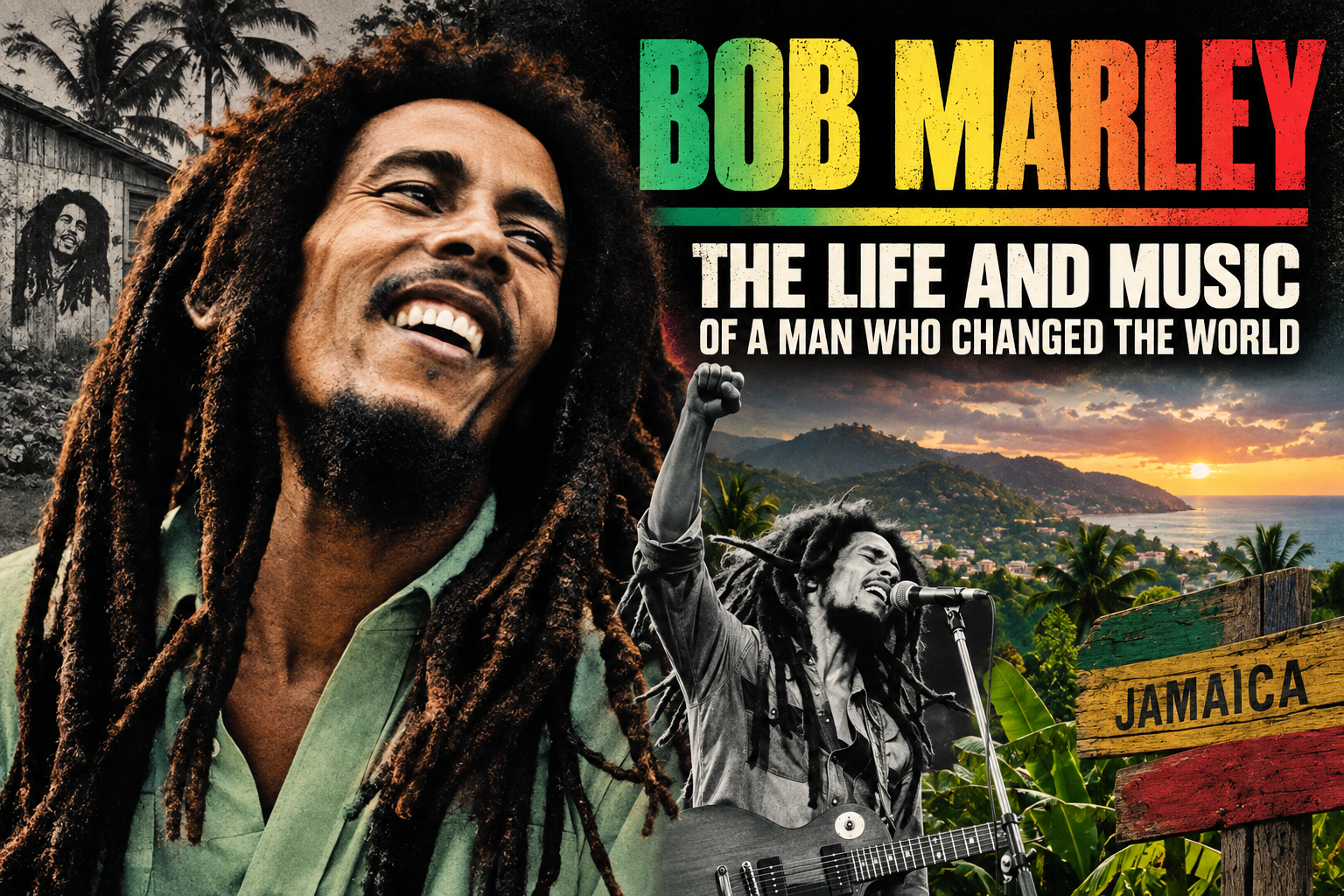
Bob Marley remains one of the most recognizable and influential musicians in history. His face has become an international symbol, appearing on posters, T-shirts, murals, album covers, flags, and walls from Jamaica to Japan. His music is played in tiny beach bars, massive sports stadiums, college dorm rooms, political rallies, family gatherings, and record stores all over the world. Songs recorded decades ago continue to reach new audiences, while albums he made during his lifetime remain among the most important records in popular music.
Yet reducing Bob Marley to a collection of famous songs, dreadlocks, and colorful imagery misses the point.
Marley was a songwriter, singer, guitarist, bandleader, producer, political figure, spiritual messenger, and international ambassador for Jamaican music. He emerged from a small and difficult community in Jamaica and helped take ska, rocksteady, and reggae from a regional musical movement to a worldwide phenomenon. Along the way, he created songs about love, poverty, faith, freedom, oppression, revolution, Africa, Jamaica, family, and survival.
His story was not simple.
Bob Marley grew up poor. He faced questions about race and identity. He struggled to establish himself in the music business. He experienced commercial failures, financial problems, personal conflicts, political violence, and serious illness. He also became famous on a scale that few Jamaican artists had ever experienced. By the time of his death in 1981, Marley had become much more than a successful musician. He was one of the most important cultural figures of the twentieth century.
The remarkable thing is that his influence has continued to grow.
Many artists become less relevant as the era that produced them fades away. Marley has experienced the opposite. His audience has expanded across generations. People who were not alive when he performed continue to discover his music. His songs have been covered by rock bands, pop stars, rappers, punk musicians, folk singers, and reggae artists. His ideas continue to appear in discussions about social justice, colonialism, African identity, peace, and political freedom.
At the center of everything, however, was the music.
Bob Marley could write a simple love song that sounded timeless. He could write about political oppression without turning a song into a lecture. He could make deeply spiritual music that still sounded immediate and accessible. He could combine Jamaican rhythms with elements of American soul, rock, blues, and pop. He understood melody. He understood groove. He understood the importance of a great band.
And perhaps most importantly, he understood how to communicate.
Bob Marley sang about Jamaica, but his music reached people everywhere because the emotions were universal. A person living in Kingston could recognize the reality in his songs. So could someone in London, New York, Lagos, Tokyo, or Paris. His music came from a specific place and culture, yet it traveled across borders with remarkable ease.
This is the story of Bob Marley: his childhood, his rise with the Wailers, his transformation into an international superstar, his political and spiritual beliefs, the creation of his greatest albums, and the legacy of music that continues to change lives.
Growing Up in Jamaica
Robert Nesta Marley was born on February 6, 1945, in Nine Mile, a rural community in Saint Ann Parish, Jamaica.
His background was complicated from the beginning.
His mother, Cedella Booker, was Jamaican and Black. His father, Norval Marley, was a white Jamaican of English ancestry who worked in various capacities, including as an overseer. Norval was considerably older than Cedella, and he was largely absent from Bob’s life.
This background affected Marley throughout his childhood.
Jamaica was a society deeply shaped by colonialism, race, and class. Marley did not fit comfortably into the simple racial categories that many people expected. He was mixed-race, poor, and raised primarily by his mother. His father was white but did not provide a conventional family life. Marley grew up with questions surrounding identity that would remain important throughout his life.
His relationship with his father was especially distant. Norval Marley died when Bob was still young, leaving little opportunity for a meaningful father-son relationship. Bob Marley was therefore raised largely within the world of his mother and the Jamaican communities around him.
Nine Mile was rural and isolated compared with Kingston.
The Jamaica of Marley’s childhood was still under British colonial rule. The island would not gain independence until 1962. Economic opportunities were limited for many people, particularly those living in rural communities. Poverty was a daily reality.
At the same time, Jamaica possessed an incredibly rich musical culture.
Music was everywhere. Traditional Jamaican styles mixed with African influences, religious music, mento, American rhythm and blues, jazz, and other sounds arriving through records and radio broadcasts. Young Bob Marley absorbed this environment long before he became a professional musician.
Eventually, Marley and his mother moved to Kingston.
That move changed everything.
Kingston was the center of Jamaican music, business, politics, and culture. It was also a difficult place. Marley lived in Trenchtown, a poor neighborhood that would later become legendary because of its connection to Jamaican music.
Trenchtown was not simply a musical paradise.
It was a place where poverty, unemployment, overcrowding, and violence could shape everyday life. But it was also filled with creativity. Music became a form of entertainment, communication, identity, and escape.
The streets and yards of Trenchtown helped create Bob Marley.
He encountered singers, musicians, producers, sound systems, and young people obsessed with American rhythm and blues. In Jamaica during the late 1950s and early 1960s, imported American music was enormously popular. Records by artists such as Fats Domino, Ray Charles, Curtis Mayfield, and other American performers influenced Jamaican musicians.
Local artists began adapting those sounds.
Out of that process came ska.
And Bob Marley was about to become part of the generation that would transform Jamaican popular music forever.
The Birth of the Wailers
As a teenager in Kingston, Bob Marley met Neville Livingston, who would later become known as Bunny Wailer. The two developed a close friendship based largely on their shared interest in music.
Another important figure entered the story soon afterward: Peter Tosh.
Tosh was different from Marley in personality and style. He was outspoken, intense, and fiercely independent. Where Marley could often be diplomatic and charismatic, Tosh was known for his directness. The differences between the men would later become important, but during their early years they shared a common goal.
They wanted to make music.
The young singers were influenced by the vocal groups popular in American rhythm and blues. Harmony singing was a major part of their early style. They admired groups that combined strong lead vocals with tightly arranged background harmonies.
They also learned from Joe Higgs, an important Jamaican singer and musician who helped teach and mentor young performers.
The group went through several names and lineup changes before becoming known as the Wailers.
The name was appropriate.
They were young musicians trying to make themselves heard in a crowded and competitive music scene. They were not yet international stars. They were simply singers trying to get noticed.
Their breakthrough came with “Simmer Down” in 1963.
The song became a major hit in Jamaica.
“Simmer Down” reflected the energetic sound of early ska. Ska was fast, lively, danceable, and built around an emphasis on the offbeat. It was music designed for movement. Jamaican audiences loved it.
The Wailers quickly became part of the country’s growing music industry.
This early period is sometimes overlooked because the later reggae recordings became so famous. But it was essential to Marley’s development.
He was learning how records were made.
He was learning how to sing in a group.
He was learning how to write songs.
He was learning about producers and record labels.
He was also learning the hard realities of the music business.
The Jamaican recording industry of the 1960s could be difficult for young artists. Contracts were often informal. Artists did not always receive the money or ownership they expected. Producers held enormous power. Musicians frequently recorded quickly and moved from one producer to another.
The Wailers worked with several important figures in Jamaican music.
Their sound changed as Jamaican music changed.
Ska eventually slowed down.
The frantic rhythms of the early 1960s gradually evolved into a smoother style known as rocksteady. Rocksteady placed greater emphasis on bass and vocal harmony. The tempo was slower, allowing singers and musicians more room to develop melodies and grooves.
The Wailers adapted.
Then Jamaican music changed again.
By the end of the 1960s, reggae was beginning to emerge.
And reggae would become the musical language most closely associated with Bob Marley.
From Ska to Rocksteady to Reggae
One of the most fascinating things about Bob Marley’s career is that he did not simply appear as a fully formed reggae superstar.
His music evolved alongside Jamaican popular music.
During the ska years, the Wailers were a vocal group influenced by American rhythm and blues. Their recordings were energetic and youthful. They were part of a rapidly developing local scene.
Rocksteady changed the musical landscape.
The slower rhythms allowed bass lines to become more prominent. Vocal performances became smoother and more expressive. Harmony groups flourished.
Then reggae arrived.
The exact development of reggae involved many musicians and producers, making it impossible to credit one person with inventing the style. It developed through experimentation. Jamaican musicians changed the rhythm, slowed certain elements, emphasized the bass, and created a distinctive relationship between drums and guitar.
Reggae’s rhythmic identity became one of its most recognizable characteristics.
The guitar often emphasized the offbeat. The bass became powerful and melodic. The drums created patterns that differed from conventional American rock and pop rhythms.
The result was music that could feel relaxed while remaining incredibly powerful.
Reggae could move slowly without losing intensity.
That quality suited Bob Marley.
His songwriting began developing greater depth. The music was no longer simply about teenage romance and dance crazes. Marley and the Wailers began exploring more serious subjects.
Jamaica itself was changing.
The country had gained independence from Britain in 1962, but independence did not immediately solve the economic and social problems facing ordinary people. Poverty continued. Political divisions remained. Questions surrounding Black identity and Jamaica’s relationship with Africa became increasingly important.
At the same time, the Rastafari movement was growing in cultural influence.
Bob Marley would eventually become one of the world’s most famous followers of Rastafari.
But that transformation took time.
Rastafari and Spiritual Transformation
Rastafari was far more than an image or fashion associated with dreadlocks.
It was a religious, cultural, and political movement that developed in Jamaica during the 1930s. Rastafari incorporated biblical interpretation, African identity, resistance to oppression, and the belief in the spiritual significance of Ethiopia and Emperor Haile Selassie I.
For many Rastafarians, Africa represented more than a geographical location. It represented a spiritual homeland and a connection to ancestry that had been damaged by slavery and colonialism.
The movement challenged the values of colonial society.
Rastafarians often used the term “Babylon” to describe oppressive political and economic systems. Babylon represented corruption, injustice, and structures of power that kept people oppressed.
Rastafari also placed importance on natural living, spiritual consciousness, and a rejection of certain aspects of Western society.
In Jamaica, Rastafarians were frequently marginalized and discriminated against.
They were sometimes treated as outsiders.
Their appearance and beliefs made them targets.
For Bob Marley, Rastafari became central to his worldview.
It influenced his music, language, appearance, politics, and understanding of history.
Marley’s dreadlocks became one of his most recognizable physical features. But the hair was not simply a marketing decision. It had religious significance.
His lyrics increasingly reflected Rastafarian concepts.
Africa became a recurring subject.
Freedom became a recurring subject.
Oppression became a recurring subject.
Spirituality became a recurring subject.
Yet Marley possessed an unusual ability to communicate Rastafarian ideas to people who were not Rastafarians.
A listener did not need to understand every religious reference to feel the power of the music.
That was one of his greatest strengths.
He could write songs with multiple levels of meaning.
Someone could enjoy the rhythm.
Someone else could focus on the melody.
Another listener could study the political message.
Another could find spiritual meaning.
The same song could function differently for different people.
As Marley became more committed to Rastafari, his music became more ambitious.
The Wailers were changing.
And soon they would begin the journey that would take them far beyond Jamaica.
The Early Struggles of the Wailers
Success did not come quickly.
The Wailers had hits in Jamaica, but international success was another matter entirely.
Jamaican music was not yet a major commercial force around the world. British and American audiences were largely unfamiliar with most Jamaican artists.
The Wailers experimented with different business arrangements.
They created their own label and attempted to gain greater control over their recordings. Marley also spent time outside Jamaica, including periods in the United States, where he worked ordinary jobs.
The image of Bob Marley as an international superstar can make these periods difficult to imagine.
But before the fame, there were struggles.
There were financial problems.
There were unsuccessful records.
There were disagreements.
There was uncertainty.
The Wailers continued recording, developing their sound, and searching for opportunities.
One important relationship developed with producer Lee “Scratch” Perry.
Perry was one of the most innovative figures in Jamaican music. His approach to production was unconventional, creative, and often experimental.
Working with Perry helped push the Wailers in a new direction.
The recordings they made during this period became important to the development of their sound. Songs were given more space. The rhythms became heavier. The bass became increasingly important.
Peter Tosh and Bunny Wailer were also becoming stronger songwriters and performers.
The Wailers were not simply Bob Marley with a backing group.
At this point, they were a genuine creative partnership.
Each member brought something different.
Peter Tosh brought intensity, political anger, and a powerful voice.
Bunny Wailer brought deep spirituality, distinctive vocal harmonies, and a strong connection to traditional Jamaican culture.
Bob Marley brought charisma, songwriting ability, and an increasingly remarkable talent for connecting with audiences.
Together, they created something special.
But the next stage required an international connection.
That opportunity arrived through Island Records.
Chris Blackwell and Island Records
Chris Blackwell and Island Records played an important role in bringing Bob Marley and the Wailers to an international audience.
Blackwell understood Jamaican music, but he also understood the British and American markets.
This combination was important.
Instead of presenting the Wailers strictly as a Jamaican singles act, Island Records saw the potential for something bigger.
The goal was to develop the Wailers as an album-oriented band.
This was a major shift.
Rock music in the late 1960s and early 1970s had increasingly become focused on albums. Artists were expected to create complete artistic statements rather than simply release individual singles.
Bob Marley and the Wailers were given the opportunity to work in that environment.
The result was Catch a Fire, released in 1973.
The album was a landmark.
It introduced many international listeners to the Wailers in a new way. The music retained its Jamaican identity but was presented with a production style designed to compete in the international rock market.
The album’s packaging was also memorable.
It was designed to look like a Zippo lighter, demonstrating that Island Records was thinking carefully about presentation and marketing.
More importantly, the music was excellent.
Catch a Fire featured songs including “Concrete Jungle,” “Slave Driver,” and “Stir It Up.”
The album demonstrated the range of the Wailers.
They could make political music.
They could make love songs.
They could create dark and intense music.
They could play with the power of a rock band while maintaining the rhythmic foundation of reggae.
“Concrete Jungle” was particularly important.
The song captured the experience of urban hardship and alienation. Its title became an effective metaphor for life in difficult environments.
“Slave Driver” confronted the historical reality of slavery and its continuing consequences.
“Stir It Up” showed another side of Marley. It was romantic, melodic, and accessible.
The album did not make the Wailers instant superstars.
But it opened a door.
Later in 1973, they released Burnin’.
That album included some of the most important songs of Marley’s career.
Two in particular would become international classics: “Get Up, Stand Up” and “I Shot the Sheriff.”
“Get Up, Stand Up,” co-written by Marley and Peter Tosh, became one of the defining protest songs of the reggae era.
The message was direct.
People should recognize their rights and refuse to accept oppression.
The song was powerful because it was simple.
It did not require complicated language.
Its rhythm made it memorable.
Its message made it urgent.
“I Shot the Sheriff” became even more internationally famous after Eric Clapton recorded a successful version.
Clapton’s cover introduced the song to a massive rock audience.
Suddenly, many people who had never heard Bob Marley were becoming aware of his songwriting.
The Wailers were on the verge of something enormous.
But the original group was beginning to break apart.
Peter Tosh and Bunny Wailer Leave
After Burnin’, Peter Tosh and Bunny Wailer left the group.
Their departures marked the end of the original Wailers as a three-man vocal partnership.
The reasons were complicated.
International touring was demanding.
The group’s growing relationship with the international music industry created new pressures.
There were also differences in personality and artistic direction.
Bunny Wailer was particularly uncomfortable with some aspects of the international touring lifestyle. He preferred Jamaica and maintained a strong connection to Rastafarian traditions.
Peter Tosh wanted to pursue his own musical vision.
Both men would go on to have important solo careers.
Peter Tosh became one of reggae’s most outspoken political voices. Albums such as Legalize It established him as a major artist in his own right.
Bunny Wailer created a highly respected solo career built around spirituality, traditional reggae, and Jamaican culture.
Their departures were significant.
But Bob Marley continued.
The group would now be known as Bob Marley and the Wailers.
The name change reflected reality.
Marley was becoming the central figure.
Yet the band around him remained crucial.
One of the most important developments was the increasing involvement of the I-Threes.
The I-Threes consisted of Rita Marley, Judy Mowatt, and Marcia Griffiths.
Their vocal harmonies became an essential part of the Bob Marley and the Wailers sound.
Rita Marley was Bob’s wife and a musician in her own right.
Marcia Griffiths was already an important Jamaican singer.
Judy Mowatt brought another distinctive voice to the group.
Together, they created powerful background vocals that softened and expanded the sound.
The new version of the Wailers also featured exceptional musicians.
The rhythm section became increasingly important.
Bass player Aston “Family Man” Barrett was one of the greatest musicians in reggae history. His bass lines were melodic, heavy, and essential to the band’s sound.
His brother Carlton Barrett played drums.
Together, the Barrett brothers helped create the rhythmic foundation behind many of Bob Marley’s greatest recordings.
The new Wailers were not simply backing musicians.
They were one of the finest bands in the world.
And with this lineup, Bob Marley would create the records that transformed him into an international superstar.
Natty Dread and the Rise of a Superstar
Released in 1974, Natty Dread marked the beginning of a new era.
The album was the first major release after Peter Tosh and Bunny Wailer left.
Some people may have wondered whether Marley could continue without his longtime partners.
The answer was immediate.
He could.
Natty Dread was a major artistic achievement.
The album contained “Lively Up Yourself,” “Them Belly Full (But We Hungry),” “Rebel Music (3 O’Clock Road Block),” and “No Woman, No Cry.”
These songs demonstrated Marley’s growing confidence as a songwriter.
“No Woman, No Cry” became one of his most beloved songs.
Its warmth and emotional power made it especially effective in concert.
The famous live version recorded at London’s Lyceum Theatre helped turn the song into an international classic.
The song showed Marley’s ability to transform personal memory into something universal.
It looked backward toward difficult times while maintaining a sense of resilience.
That combination was central to Marley’s music.
He acknowledged suffering.
But he rarely surrendered to hopelessness.
“Rebel Music” was more aggressive.
“Them Belly Full (But We Hungry)” addressed poverty and social inequality.
These songs made it clear that Marley was becoming a political artist in the broadest sense.
He was not interested in politics merely as party competition.
He was interested in the condition of ordinary people.
Who had power?
Who lacked power?
Who was hungry?
Who was oppressed?
Who benefited from the system?
These questions appeared repeatedly in his music.
Marley’s popularity was also growing in Europe.
He was becoming a powerful live performer.
On stage, Marley possessed an extraordinary combination of qualities.
He could be charismatic without seeming overly polished.
He could dance with remarkable energy.
He could appear relaxed and intense at the same time.
He could communicate with a huge audience while making the performance feel personal.
The concerts became central to his reputation.
Bob Marley was not simply a studio artist.
His music came alive on stage.
And the live performances helped spread reggae around the world.
Live! and the Power of the Concert Stage
The 1975 album Live! captured Bob Marley and the Wailers performing at London’s Lyceum Theatre.
It remains one of the most important live albums in reggae history.
The record demonstrated how powerful the band could be in front of an audience.
Studio recordings could capture the songs.
Live performances could transform them.
The rhythms became more immediate.
The audience became part of the experience.
Marley’s voice carried urgency and emotion.
“No Woman, No Cry” became especially important through the live version.
The performance showed why Marley was becoming an international star.
There was something almost communal about his concerts.
People did not simply watch.
They participated.
The music encouraged singing, dancing, reflection, and emotional release.
Reggae’s rhythms created a physical connection.
The political and spiritual messages created an intellectual and emotional connection.
Marley understood how to control a stage.
He was not a traditional rock frontman.
His movements were different.
His relationship to rhythm was different.
His vocal delivery was different.
But audiences accustomed to rock concerts quickly understood his power.
The Wailers could stand beside major rock bands and compete.
This was important.
During the 1970s, rock was the dominant international youth music.
For reggae to become a major global force, artists needed to reach audiences accustomed to electric guitars, large venues, and album-oriented music.
Bob Marley and the Wailers accomplished that.
They did not become a rock band.
They remained a reggae band.
But they demonstrated that reggae could command the same stages.
The next few years would take Marley to an even higher level.
Rastaman Vibration and America
Released in 1976, Rastaman Vibration became an important breakthrough in the United States.
The album reached the American charts and helped establish Marley as more than a cult figure among reggae fans.
The title itself emphasized Marley’s Rastafarian identity.
The music reflected his spiritual and political concerns.
Songs such as “Positive Vibration” carried messages of optimism.
“Roots, Rock, Reggae” celebrated the music itself.
“War” became one of Marley’s most powerful political statements.
The words of “War” were adapted from a speech by Ethiopian Emperor Haile Selassie I.
The song addressed racism and inequality with extraordinary force.
Its message was unmistakable.
As long as systems of racial inequality continued, the possibility of conflict remained.
The song’s power came partly from the seriousness of the subject and partly from the music.
Marley did not need elaborate arrangements.
The rhythm created momentum.
The vocal delivery created urgency.
“War” became a statement that transcended the Jamaican context.
It spoke to struggles taking place throughout the world.
This was increasingly true of Marley’s work.
His music was rooted in Jamaica and Rastafari, but his audience was expanding.
African listeners embraced him.
European listeners embraced him.
American listeners embraced him.
His growing fame also brought greater attention to his personal life.
Bob Marley was married to Rita Marley.
Their relationship was important but complicated.
Marley had numerous relationships with other women and fathered children with several partners.
His personal life did not always match the idealized image that would later develop around him.
Like many famous musicians, Marley was a complicated human being.
He was not perfect.
He could be difficult.
He could be distant.
He could make decisions that hurt people close to him.
The myth of Bob Marley as a permanently peaceful and uncomplicated saint does not tell the whole story.
His life contained contradictions.
That does not diminish his music.
If anything, it makes his story more human.
Marley was a man trying to navigate fame, family, religion, politics, and personal ambition while carrying the expectations of millions of people.
Those pressures would become even more intense during one of the most dangerous periods of his life.
Jamaica, Politics, and Violence
The Jamaica of the 1970s was politically divided.
The country’s two major political parties, the People’s National Party and the Jamaica Labour Party, competed fiercely for power.
Political violence became increasingly serious.
Communities could become associated with particular political groups.
Gang activity and political loyalties sometimes overlapped.
The atmosphere could be extremely dangerous.
Bob Marley was not a conventional politician.
He did not simply belong to one political party and campaign for it.
However, his enormous popularity made him politically significant whether he wanted that role or not.
In 1976, Marley planned to perform at a concert intended to promote peace.
The event became controversial because it took place close to a national election.
Some people believed the concert could benefit Prime Minister Michael Manley and the People’s National Party.
Marley insisted that his intentions were about peace rather than partisan politics.
But in a tense political environment, perception mattered.
Then violence came directly to Marley’s home.
On December 3, 1976, gunmen attacked Marley and several people around him.
Bob Marley was wounded.
Rita Marley was wounded.
Manager Don Taylor was seriously injured.
Others were also hurt.
The attack shocked Jamaica and the international music world.
Marley survived.
Remarkably, only two days later, he performed at the Smile Jamaica concert.
The decision became one of the defining moments of his career.
Marley appeared on stage despite having recently been shot.
When asked why he performed, his attitude reflected his belief that the people responsible for creating problems did not take time off, so he should not stop trying to do good.
Whether viewed as bravery, determination, or something close to recklessness, the performance strengthened his legend.
Shortly afterward, Marley left Jamaica.
He would spend significant time in London.
That move led to one of the most productive periods of his career.
London and the Creation of Exodus
Bob Marley’s time in London was enormously important.
He was physically separated from the immediate danger of Jamaica.
He was surrounded by a growing international audience.
He was also living in one of the world’s most important musical cities.
London during the mid-1970s was undergoing major cultural changes.
Rock music was evolving.
Punk was emerging.
Black British music was becoming increasingly important.
Jamaican culture had a major presence in the city.
Marley found himself at the center of an expanding international movement.
In 1977, he released Exodus.
The album is widely considered one of his greatest achievements.
It contained a remarkable collection of songs, including “Natural Mystic,” “Exodus,” “Jamming,” “Waiting in Vain,” “Three Little Birds,” and “One Love/People Get Ready.”
The album demonstrated the full range of Marley’s abilities.
“Natural Mystic” opened the record with atmosphere and mystery.
The song suggested unseen forces moving through history.
It created a sense of anticipation before the album fully developed.
“Exodus” became a powerful statement of movement and liberation.
The title had religious and political significance.
The idea of an exodus could refer to escape from oppression, a journey toward freedom, and the search for a spiritual homeland.
“Jamming” was more celebratory.
The song captured the joy of music and community.
“Waiting in Vain” was one of Marley’s most beautiful love songs.
It demonstrated his ability to create romantic music without losing his distinctive identity.
“Three Little Birds” became one of the most universally loved songs in his catalog.
Its message of reassurance has connected with listeners for generations.
The song is simple, memorable, and emotionally effective.
“One Love/People Get Ready” became perhaps the ultimate expression of Marley’s global appeal.
The song called for unity.
Its message was broad enough to reach almost anyone.
The album was successful internationally and helped establish Marley as a major global artist.
Exodus also demonstrated the importance of sequencing.
The album moved between political statements, spiritual ideas, love songs, and celebrations.
It felt like a complete work.
This was one of the reasons Marley became so important.
He understood albums.
He did not simply collect songs.
His best records had shape.
They had emotional variety.
They created worlds.
Exodus was not just an album of reggae songs.
It was an artistic statement about movement, faith, love, struggle, and hope.
For many listeners, it remains the finest album Bob Marley ever made.
But Marley was not finished.
In some ways, his greatest period was still continuing.
This post has already been read 284 times!