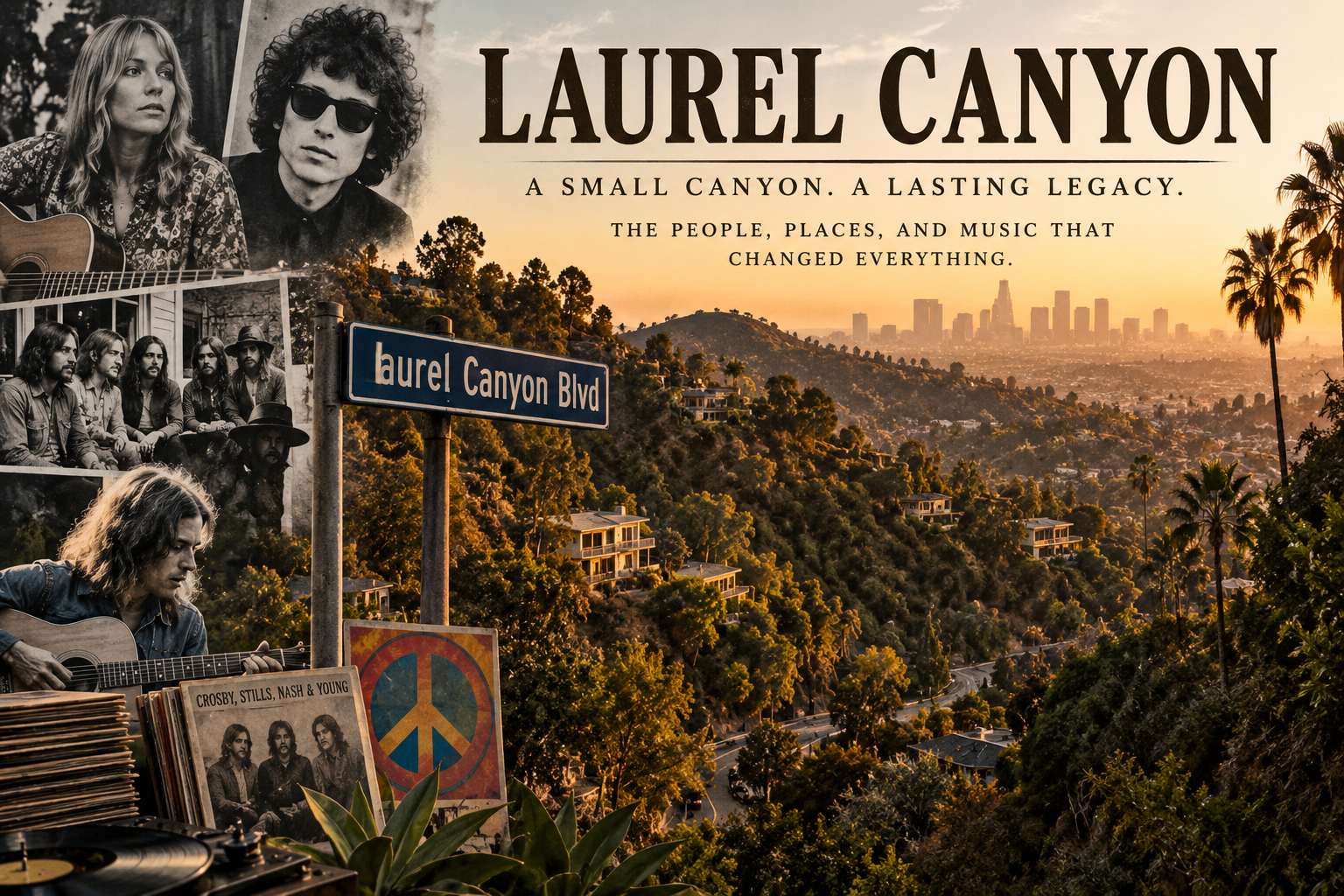
There are plenty of places that can claim to have played an important role in music history. Liverpool had the Cavern Club. Memphis had Beale Street and Sun Studio. Nashville had Music Row. Detroit had Hitsville U.S.A. New Orleans had its jazz clubs, San Francisco had Haight-Ashbury, and New York had Greenwich Village, the Brill Building, CBGB, and countless other places where musicians crossed paths and musical movements were born.
Los Angeles had Laurel Canyon.
Located in the Hollywood Hills just north of Sunset Boulevard, Laurel Canyon was never officially designated as a musical capital. It wasn’t a record label, a famous concert hall, or a recording studio. It was a winding residential canyon filled with modest houses, cabins, hillside bungalows, dirt roads, trees, and spectacular views of Los Angeles. Yet during the 1960s and early 1970s, it became one of the most important creative communities in popular music.
The musicians who lived there or spent substantial time there represented a remarkable cross-section of American and Canadian music. Joni Mitchell, David Crosby, Stephen Stills, Graham Nash, Neil Young, Glenn Frey, Don Henley, Jackson Browne, Linda Ronstadt, Carole King, James Taylor, Mama Cass Elliot, The Byrds, The Mamas & the Papas, Buffalo Springfield, The Eagles, Alice Cooper, and countless other musicians, producers, songwriters, session players, and industry figures passed through the canyon’s houses and parties.
What made Laurel Canyon important wasn’t simply the number of famous people who lived there. It was the way those people interacted.
Musicians borrowed instruments from each other. Songwriters traded ideas. Singers harmonized in living rooms. Bands formed and dissolved. Former members of one group joined another. Romantic relationships overlapped with professional ones. A guitarist might end up playing on a friend’s record in the afternoon and attending a party with another future bandmate that night. A singer who had been part of one of the decade’s biggest groups might suddenly be writing songs for someone else. A casual gathering could turn into an informal audition, a songwriting session, or the beginning of a new band.
The result was a musical ecosystem unlike almost anything that had existed before.
Laurel Canyon helped create a distinctly Californian sound: acoustic guitars, close vocal harmonies, country influences, folk songwriting, rock rhythms, electric guitars, sophisticated studio production, and an unmistakable sense of place. It was music that could sound intimate and expansive at the same time. It could be politically aware without always being confrontational. It could be deeply personal while still speaking to an entire generation.
Most importantly, Laurel Canyon helped demonstrate that rock music could grow beyond the simple three-minute single.
The musicians associated with the canyon increasingly treated songwriting as serious artistic expression. They wrote about relationships, loneliness, politics, nature, fame, drugs, aging, disillusionment, freedom, and the complicated reality of life in modern America. Their records became albums rather than collections of singles. Their voices became as important as their instruments. Their personal lives increasingly became part of their artistic identities.
Laurel Canyon wasn’t responsible for all of this by itself. The British Invasion, Greenwich Village folk music, Nashville country, rhythm and blues, psychedelic rock, Motown, soul, jazz, and the political upheaval of the 1960s all contributed to the transformation of popular music.
But Laurel Canyon became a place where many of those influences collided.
Its story begins long before Crosby, Stills & Nash, the Eagles, or Joni Mitchell arrived.
The Canyon Before the Musicians
Laurel Canyon’s history goes back much further than the music scene that eventually made it famous.
The canyon itself is part of the Santa Monica Mountains, a series of hills that separate much of Los Angeles from the San Fernando Valley. Before Los Angeles became the sprawling metropolis it is today, the area was far more rugged and isolated. Native peoples inhabited the broader region for centuries before Spanish settlement and the eventual expansion of Los Angeles.
The canyon’s geography would become central to its future identity.
Unlike the flat streets of central Los Angeles, Laurel Canyon is steep, winding, irregular, and heavily shaped by the surrounding hills. Houses are scattered along narrow roads and tucked into the landscape. Even today, driving through the canyon feels different from moving through the rest of Los Angeles.
That physical separation helped create an unusual community.
Laurel Canyon was close to Hollywood, but it didn’t feel completely like Hollywood.
That distinction mattered.
Hollywood represented the entertainment business in its most organized and commercial form. Studios, agents, producers, movie stars, record companies, and executives operated within a highly structured system. Laurel Canyon, by contrast, developed a reputation for being informal and bohemian.
Artists could live there without completely separating themselves from the entertainment industry.
They were close enough to work in Hollywood while still feeling removed from it.
That combination eventually proved ideal for musicians.
The canyon began attracting artists and creative people well before the rock explosion of the 1960s. Writers, actors, painters, musicians, and other unconventional residents were drawn to its relatively inexpensive housing and secluded atmosphere.
The neighborhood had an almost contradictory character.
It was isolated without being remote.
It was rural-looking without being far from the city.
It was close to Hollywood without being entirely absorbed by Hollywood.
That made it an ideal environment for a generation that wanted to participate in popular culture while questioning many of its assumptions.
The Hollywood Connection
To understand why Laurel Canyon became such an important musical center, it helps to understand Los Angeles itself.
By the early 1960s, Los Angeles had become one of the most important centers of the American recording industry.
Hollywood already had an enormous entertainment infrastructure. Recording studios were everywhere. Session musicians were plentiful. Record companies had offices throughout the city. Television created additional employment for musicians. Film composers needed orchestras and instrumentalists. Nightclubs provided places for performers to work.
Los Angeles was becoming a city where a musician could make a living in multiple ways.
A guitarist could play rock concerts at night, record sessions during the day, work on television music, and participate in film projects.
This professional infrastructure became especially important to the Laurel Canyon scene.
The canyon’s musicians weren’t isolated amateurs making music in the woods.
They were plugged directly into the most sophisticated entertainment industry in America.
They could experiment at home and then take those ideas into professional studios.
The boundary between living room and recording studio became surprisingly thin.
A song might begin with a guitar and a notebook at someone’s house, develop through conversations with other musicians, and eventually become a million-selling record recorded by some of the best session players in the world.
This relationship between informal creativity and professional recording would define the Laurel Canyon sound.
Folk Music Arrives in Los Angeles
One of the most important ingredients in the Laurel Canyon musical identity was folk music.
During the late 1950s and early 1960s, folk music was experiencing a major revival in the United States.
The movement drew from traditional American music, Appalachian ballads, blues, country, gospel, labor songs, and protest music. Artists such as Woody Guthrie had established a tradition of socially conscious songwriting, while performers such as Pete Seeger helped bring folk music into the mainstream.
The Kingston Trio, Peter, Paul and Mary, Joan Baez, Bob Dylan, and many others demonstrated that acoustic instruments and strong songwriting could compete with the increasingly dominant world of electric pop.
Los Angeles became part of that movement.
The city’s folk clubs gave young musicians places to perform and meet one another.
One of the most important groups to emerge from this environment was The Byrds.
The Byrds were crucial because they connected two worlds that had previously seemed somewhat separate.
They took folk songwriting and acoustic-style vocal harmonies and combined them with electric rock instrumentation.
The result was something new.
When The Byrds transformed Bob Dylan’s “Mr. Tambourine Man” into a jangling electric single, they helped establish the sound that would become folk-rock.
The song’s success was enormous.
It demonstrated that sophisticated songwriting and rock instrumentation could coexist.
The Byrds also helped establish several musicians who would become central figures in the Laurel Canyon story.
David Crosby was one of them.
David Crosby and the Birth of a Community
David Crosby’s role in the Laurel Canyon story was much larger than his work with The Byrds.
He was a connector.
Crosby had a personality that encouraged musicians to gather around him. He was outspoken, eccentric, musically adventurous, and deeply interested in harmony.
The Byrds gave him a platform, but his departure from the group ultimately opened the door to something much larger.
Crosby became part of a growing Los Angeles community of musicians who were increasingly interested in writing songs that didn’t fit neatly into the existing pop formulas.
He spent time with Stephen Stills, Graham Nash, Joni Mitchell, Neil Young, and others.
These relationships would produce some of the most important music of the era.
Crosby’s home became one of the legendary gathering points.
There was something unusual about the way musicians in this community interacted.
They weren’t simply competing for record contracts.
They were listening to one another.
They were helping each other.
They were dating each other.
They were forming bands with each other.
And sometimes they were breaking up bands and then forming new ones with the same musicians.
The resulting musical network was incredibly dense.
The same names kept appearing on different albums and in different groups.
That interconnectedness became one of the defining characteristics of Laurel Canyon.
The Mamas & the Papas
Another major piece of the story came from The Mamas & the Papas.
The group brought together John Phillips, Michelle Phillips, Denny Doherty, and Cass Elliot.
Their sound was based heavily on vocal harmony, but their music was more sophisticated than traditional folk.
The group combined folk, pop, rock, and elements of sunshine-soaked California production into a sound that immediately stood apart from much of the mid-1960s pop landscape.
Their breakthrough came with “California Dreamin’.”
The song became one of the defining recordings of the decade.
Its success was especially significant because it helped create an idealized image of California that would become central to the culture surrounding Laurel Canyon.
California was no longer simply a geographic location.
It became an idea.
It represented warmth, freedom, youth, reinvention, and escape.
But there was a fascinating contradiction.
“California Dreamin'” was essentially a song about wanting to be somewhere else.
The California dream could be beautiful, but it could also be elusive.
That tension would eventually appear throughout Laurel Canyon songwriting.
The musicians were living in one of the most glamorous places on earth, yet many of their songs were about loneliness, heartbreak, uncertainty, and alienation.
Cass Elliot and the Social Side of Laurel Canyon
Cass Elliot became one of the most recognizable personalities associated with the scene.
Her voice was powerful, warm, and immediately identifiable.
But her importance to Laurel Canyon wasn’t limited to her recording career.
She was also a social center.
Her home became one of the places where musicians and artists gathered.
This was crucial because Laurel Canyon wasn’t simply a collection of individual stars.
It was a community.
Parties mattered.
Dinner mattered.
Informal jam sessions mattered.
Friendships mattered.
A musician could encounter another musician socially long before working with them professionally.
The famous Laurel Canyon parties have become legendary, sometimes to the point that mythology has blurred the exact details.
But the larger truth is clear.
The musicians really did spend an extraordinary amount of time together.
They lived close to one another.
They attended one another’s shows.
They dated.
They collaborated.
They listened to each other’s unfinished songs.
That level of interaction created an environment where musical ideas could spread extremely quickly.
Buffalo Springfield
If The Byrds helped establish folk-rock and The Mamas & the Papas helped establish the California vocal sound, Buffalo Springfield represented another crucial development.
The group included Stephen Stills and Neil Young, two musicians who would become major figures in their own right.
Buffalo Springfield’s music combined folk songwriting, rock instrumentation, country influences, and increasingly sophisticated arrangements.
The group was never easy to categorize.
Their best-known song, “For What It’s Worth,” became associated with the political and social turmoil of the late 1960s.
The song is particularly interesting because it demonstrates the changing relationship between music and politics.
It wasn’t a traditional protest song in the style of earlier folk music.
Instead, it captured an atmosphere.
It was about tension.
It was about people sensing that something was wrong.
It was about crowds, authority, fear, and uncertainty.
The song became closely associated with the counterculture even though its original inspiration was a specific confrontation on the Sunset Strip.
This was another example of Los Angeles feeding directly into the music being created around Laurel Canyon.
The city itself was becoming part of the songs.
The Sunset Strip and the Changing Culture
Los Angeles in the mid-1960s was experiencing a cultural transformation.
The Sunset Strip became a center for young people.
Teenagers and young adults gathered at clubs to see bands.
Clubs became increasingly important launching pads for rock musicians.
The police response to youth gatherings became increasingly controversial.
The Sunset Strip protests of 1966 became an important cultural flashpoint.
For musicians, the lesson was clear.
The youth culture was no longer simply consuming popular music.
It was becoming a cultural force.
Young people were questioning authority, challenging social norms, experimenting with drugs, exploring new forms of sexuality, protesting the Vietnam War, and rejecting many of the assumptions held by their parents.
Music became one of the primary ways that generation expressed those changes.
Laurel Canyon was located directly above the action.
That geographic proximity was significant.
Musicians could live in the hills and still be minutes away from the clubs, studios, and streets where the counterculture was taking shape.
The canyon provided a retreat from the chaos while remaining connected to it.
Joni Mitchell Arrives
No discussion of Laurel Canyon is complete without Joni Mitchell.
Her arrival helped transform the neighborhood’s musical identity.
Mitchell was already an accomplished songwriter, but Los Angeles gave her access to an extraordinary network of musicians.
She became friends with David Crosby and many others.
Her songwriting was different from much of the folk music surrounding her.
Her songs were intensely personal.
She wrote about relationships with an unusual degree of emotional honesty.
She also wrote about the contradictions of modern life.
Her songs could be intimate, poetic, observational, political, and philosophical within the same album.
Mitchell’s presence raised the artistic expectations of the entire community.
Songwriting didn’t have to be about producing another hit single.
A song could function almost like a short story.
It could contain multiple perspectives.
It could shift moods.
It could reveal uncomfortable truths.
Mitchell also helped popularize a more sophisticated approach to harmony and composition.
Her tunings were often unconventional.
Her chord structures could be complex.
Her melodies could move unpredictably.
Yet the songs remained emotionally accessible.
That combination would become one of the most influential elements of the Laurel Canyon tradition.
David Crosby Hears Joni Mitchell
David Crosby played an important role in helping Mitchell gain wider recognition.
He was fascinated by her songwriting and eventually helped bring her music to a larger audience.
Their friendship illustrates how Laurel Canyon functioned.
A musician didn’t necessarily need a powerful record executive to discover them.
Another musician could become the person who opened the door.
Crosby recognized Mitchell’s talent.
Other musicians recognized Crosby’s talent.
Everyone was listening.
The community effectively created its own informal talent network.
This was one of the reasons so many important artists emerged from the same small geographic area.
The Creation of Crosby, Stills & Nash
Perhaps the most famous musical gathering to emerge from Laurel Canyon was the formation of Crosby, Stills & Nash.
The group brought together three musicians who had already achieved considerable success elsewhere.
David Crosby had been in The Byrds.
Stephen Stills had been in Buffalo Springfield.
Graham Nash had been part of The Hollies.
Their backgrounds were different, but their voices fit together almost perfectly.
The harmonies were extraordinary.
The group didn’t sound like three singers simply singing the same melody.
Their voices occupied different musical spaces.
The result was lush, complex, and immediately recognizable.
The band’s self-titled debut album became one of the defining records of the late 1960s.
It demonstrated that acoustic guitars and vocal harmonies could be commercially powerful without sacrificing sophistication.
The album also established a new model for the rock group.
The musicians didn’t need to sound aggressive.
They didn’t need to rely on blues-based riffs.
They could build songs around acoustic guitars, layered vocals, unusual chord progressions, and thoughtful lyrics.
This became one of the foundations of the California sound.
Woodstock Changes Everything
Crosby, Stills & Nash became even more important when Neil Young joined them.
Their appearance at Woodstock in 1969 became legendary.
The festival represented the culmination of many of the cultural forces that had been building throughout the decade.
Hundreds of thousands of people gathered for music, but Woodstock became more than a concert.
It became a symbol.
Crosby, Stills, Nash & Young represented the new California musical establishment almost perfectly.
They were connected to folk music, rock music, political activism, and the counterculture.
Their harmonies were beautiful, but the songs could be angry.
Their acoustic guitars suggested intimacy, while their cultural impact was enormous.
Woodstock helped turn the Laurel Canyon style into a national phenomenon.
The Sound of the Canyon
What exactly was the Laurel Canyon sound?
That’s difficult to answer because there wasn’t one single sound.
But several characteristics appeared repeatedly.
Acoustic guitars were central.
Vocal harmonies were extremely important.
Country influences became increasingly obvious.
Songwriting became more personal.
Production became more sophisticated.
Rock instrumentation remained present but was often less aggressive than the music coming from other scenes.
The musicians frequently incorporated piano, pedal steel guitar, mandolin, strings, percussion, and other instruments.
There was also a fascination with space.
Records were allowed to breathe.
Instead of filling every moment with sound, producers often allowed acoustic instruments and vocals to remain exposed.
This created an intimate feeling.
The listener could almost imagine sitting in the room with the musicians.
That intimacy became one of the defining characteristics of the singer-songwriter movement.
The Singer-Songwriter Revolution
Laurel Canyon was closely associated with the rise of the singer-songwriter.
The idea itself wasn’t new.
Songwriters had always performed their own material.
But during the late 1960s and early 1970s, the singer-songwriter became a dominant figure in popular music.
The songwriter’s personality became part of the record.
Albums felt autobiographical.
Artists wrote about their own experiences rather than simply interpreting songs written by professional songwriters.
This represented a major change in the relationship between performer and audience.
The singer wasn’t simply an entertainer.
The singer was an author.
Joni Mitchell became one of the strongest examples.
James Taylor became another.
Jackson Browne would follow.
Carole King would become one of the most commercially successful.
The Eagles would eventually combine the singer-songwriter tradition with country-rock and album-oriented rock.
Together, these artists helped redefine what mainstream popular music could sound like.
James Taylor
James Taylor’s connection to the Laurel Canyon scene was especially important.
Taylor had already struggled with personal problems before establishing himself as a major artist, but his songwriting fit perfectly into the emerging California environment.
His music was quiet.
It was vulnerable.
His guitar playing was understated but distinctive.
His voice sounded conversational rather than theatrical.
Taylor’s success demonstrated that audiences were willing to listen closely to songs that didn’t depend on a huge chorus or aggressive production.
His recordings helped establish a more relaxed style of popular music.
That style would eventually become enormously influential.
The singer-songwriter aesthetic moved from the margins into the center of the music business.
Carole King
Carole King had already been one of the most successful professional songwriters in American pop before becoming a recording artist.
Her songwriting partnership with Gerry Goffin had produced a remarkable series of hits.
But her transformation from songwriter to performer was equally important.
Her album “Tapestry” became one of the defining records of the early 1970s.
King’s music was emotionally direct, melodic, sophisticated, and accessible.
Her success showed that a songwriter didn’t have to hide behind the performer.
The person who wrote the song could become the star.
That idea had enormous consequences.
The record industry increasingly embraced singer-songwriters.
Albums became more important.
Listeners became interested in the personalities behind the songs.
The personal and professional worlds of musicians became increasingly intertwined.
Jackson Browne
Jackson Browne became another major figure in the Laurel Canyon tradition.
His songwriting was reflective and detailed.
He wrote about relationships, ambition, travel, adulthood, and the complicated emotional consequences of chasing a dream.
His early albums helped establish the serious singer-songwriter style that would dominate portions of the 1970s.
Browne also represented the more politically conscious side of the Los Angeles music community.
His songs could move from intimate personal stories to broader social concerns.
He became one of the artists who demonstrated that commercial success and social awareness weren’t necessarily opposites.
The Eagles
The Eagles emerged from the same general Los Angeles ecosystem, but their sound represented an evolution.
Glenn Frey and Don Henley became central figures in the group.
The Eagles combined rock, country, folk, blues, and polished studio production.
Their music was deeply rooted in Southern California but increasingly sophisticated and commercially ambitious.
The Eagles represented what happened when the Laurel Canyon aesthetic became fully integrated into mainstream rock.
Their harmonies were beautiful.
Their guitars were carefully arranged.
Their songs were accessible.
But the production was increasingly elaborate.
The group helped establish country-rock as a major commercial force.
Eventually, they would become one of the most successful American bands in history.
Their success also demonstrated the longevity of the California sound.
What had begun in informal gatherings among folk and rock musicians had become major-label arena music.
The Rise of Country-Rock
Country music was always part of American rock.
Elvis Presley, Buddy Holly, The Everly Brothers, and countless other early rockers had incorporated country influences.
But Laurel Canyon musicians helped create a more sophisticated country-rock hybrid.
The Eagles were the most commercially successful example.
But the influence extended much further.
Gram Parsons became particularly important.
Parsons had already been involved with The Byrds, where he helped push the group toward country music.
His work with The Flying Burrito Brothers helped establish a more radical fusion of country and rock.
Parsons believed the boundaries between genres were artificial.
He wanted country music to reach a younger audience while preserving its emotional depth.
His influence would eventually extend to artists such as the Rolling Stones, Emmylou Harris, and later generations of alternative-country musicians.
Laurel Canyon became one of the places where this musical cross-pollination flourished.
Gram Parsons and the Cosmic American Music Idea
Gram Parsons was fascinated by the possibilities created when country, rock, folk, soul, and other American traditions were combined.
He referred to his vision as “Cosmic American Music.”
The concept fit naturally into the broader Laurel Canyon environment.
The musicians there were rarely interested in respecting strict genre boundaries.
A folk musician could love country.
A rock guitarist could play pedal steel.
A singer could move between pop and country.
A songwriter could borrow from blues, jazz, and traditional music.
This openness became one of the scene’s greatest strengths.
It also anticipated the genre-fluid approach that would become common decades later.
Linda Ronstadt
Linda Ronstadt became one of the most successful singers to emerge from the Los Angeles scene.
Her career demonstrated just how flexible the Laurel Canyon musical environment could be.
She could sing rock.
She could sing country.
She could sing pop.
She could perform traditional Mexican music.
She could interpret standards.
She could move between musical worlds without losing her identity.
Ronstadt’s success was enormous.
She also became an important bridge between the Los Angeles rock community and country music.
Her bands featured musicians who would later become major stars.
Members of her touring and recording groups included people who would go on to form or join some of the most successful bands of the 1970s.
The network continued to reproduce itself.
Musicians worked together, learned from each other, and eventually created new projects.
The Formation of the Eagles Through the Laurel Canyon Network
The Eagles provide perhaps the clearest example of the Laurel Canyon network effect.
Glenn Frey was connected to the Los Angeles singer-songwriter world.
Don Henley brought experience from Texas and the group Shiloh.
Bernie Leadon had strong connections to country-rock and had played with The Flying Burrito Brothers and other musicians.
Randy Meisner had already worked in several important Los Angeles bands.
The group didn’t appear out of nowhere.
They emerged from an existing musical network.
That network had been developing for years.
When the Eagles became successful, they effectively represented the culmination of many different strands of the Laurel Canyon scene.
Folk harmonies.
Country instrumentation.
Rock rhythm sections.
Singer-songwriter storytelling.
Los Angeles studio production.
All of those elements came together.
The Studio Musicians Behind the Sound
One of the most overlooked parts of the Laurel Canyon story is the role of session musicians.
The famous singers and bands received most of the attention, but Los Angeles had an extraordinary group of professional studio players.
These musicians could walk into a studio and immediately understand what a song needed.
They played on records by dozens of artists.
The same musicians might appear on albums by Joni Mitchell, James Taylor, Carole King, Linda Ronstadt, The Beach Boys, and countless others.
Their technical skill helped make the Laurel Canyon sound possible.
The records could sound relaxed and spontaneous while actually requiring extraordinary precision.
The musicians knew how to create subtle arrangements.
They understood when to play and when not to play.
They could make acoustic instruments sound warm and electric instruments sound restrained.
This professionalism was another major difference between the Los Angeles scene and some other countercultural music communities.
The music might have been created in a bohemian environment, but the recordings were often extremely polished.
The Wrecking Crew
The Wrecking Crew became legendary for their work on Los Angeles recordings.
This loose collection of elite session musicians played on an enormous number of major records during the 1960s and 1970s.
Their contributions extended well beyond Laurel Canyon, but their work was essential to the Los Angeles sound.
The musicians could play virtually anything.
They moved effortlessly between pop, rock, folk, country, television, and film.
Their professionalism allowed producers to experiment.
A songwriter could bring a basic demo into the studio and suddenly have access to musicians capable of turning it into a sophisticated arrangement.
This helped Los Angeles become one of the world’s most important recording centers.
The Beach Boys and the California Sound
The Beach Boys were not technically a Laurel Canyon band, but they were essential to understanding the cultural environment.
Their music had already established an idealized image of California.
Surfing.
Cars.
Youth.
Romance.
Sunshine.
Freedom.
But Brian Wilson’s increasingly ambitious music moved far beyond simple surf rock.
Albums such as “Pet Sounds” demonstrated that California pop could become extraordinarily sophisticated.
The Beach Boys also influenced the Laurel Canyon musicians.
Their harmonies were a major part of the broader California musical vocabulary.
The connection between The Beach Boys and the Laurel Canyon scene was not simply geographic.
It was artistic.
California musicians were developing a distinctive approach to harmony, arrangement, and production.
The Contradictions of the California Dream
The image of Laurel Canyon has sometimes been reduced to sunshine, acoustic guitars, beautiful people, and endless parties.
The reality was considerably darker.
The musicians were living through one of the most turbulent periods in American history.
The Vietnam War was escalating.
Political assassinations shocked the country.
The civil rights movement faced violence.
The Cold War remained a constant threat.
The counterculture was expanding.
Drug use was becoming increasingly widespread.
The music reflected all of these contradictions.
Songs from the period could sound beautiful while describing loneliness, fear, political violence, addiction, or the collapse of relationships.
That contrast became one of Laurel Canyon’s most compelling characteristics.
The music was often gorgeous.
The stories weren’t always happy.
Drugs and the Counterculture
Drugs were deeply intertwined with the broader 1960s counterculture.
Psychedelics had already influenced musicians in San Francisco and elsewhere.
Los Angeles developed its own drug culture.
Marijuana and LSD were widely associated with the counterculture.
Other drugs would become increasingly common as the decade progressed.
The musicians’ experimentation influenced some of their music.
But it also caused significant personal damage.
The romantic image of endless parties and psychedelic freedom often concealed serious addiction and instability.
Some musicians died young.
Others struggled with substance abuse for decades.
Relationships collapsed.
Bands broke up.
Careers were interrupted.
The mythology tends to emphasize the glamorous side.
The reality included considerable tragedy.
The Manson Murders and the End of Innocence
One of the darkest events associated with Los Angeles in 1969 was the Manson murders.
The crimes did not take place in Laurel Canyon itself, and it is important not to suggest that the canyon’s musicians were directly responsible for or centrally involved in the crimes.
But the murders became part of the cultural atmosphere surrounding Los Angeles.
They shattered the idea that the California counterculture was simply a harmless community of musicians, artists, and hippies.
The city suddenly seemed much darker.
The late 1960s were coming to an end.
The optimism of Woodstock was increasingly giving way to disillusionment.
The music changed accordingly.
The Altamont Effect
The Altamont concert in December 1969 also became a symbol of the end of the 1960s idealism.
The event, organized by the Rolling Stones, ended in violence and the death of a concertgoer.
The contrast with Woodstock was striking.
Woodstock had become a symbol of peace and communal idealism.
Altamont suggested that the counterculture had a darker side.
Musicians and audiences were entering a new decade.
The utopian dreams of the 1960s were becoming harder to maintain.
Laurel Canyon’s music began reflecting that shift.
From Idealism to Disillusionment
The early 1970s sounded different from the late 1960s.
The music became more introspective.
The political anger remained, but it was often accompanied by exhaustion.
The singer-songwriter movement flourished because audiences were interested in intimate stories.
People wanted songs about relationships.
They wanted songs about loneliness.
They wanted songs about growing older.
They wanted songs that acknowledged uncertainty.
Joni Mitchell’s work became increasingly complex.
Jackson Browne explored adulthood and ambition.
The Eagles wrote about the darker side of the California lifestyle.
Neil Young moved between political songs, country music, hard rock, and deeply personal material.
The canyon’s music was evolving with the country around it.
Neil Young
Neil Young’s career is one of the best examples of how unpredictable the Laurel Canyon generation could be.
He could be gentle and acoustic one moment and ferocious the next.
He could record country music, folk, rock, blues, experimental music, and political songs.
His relationship with Buffalo Springfield, Crosby, Stills, Nash & Young, and his solo career demonstrated the fluidity of the era.
Young never completely fit the polished California sound.
That was part of his appeal.
He could embrace the community while resisting its conventions.
His music became increasingly concerned with politics, environmental issues, technology, relationships, and American identity.
His career demonstrated that the Laurel Canyon philosophy wasn’t necessarily about creating one particular genre.
It was about artistic freedom.
The Importance of Harmony
If there is one musical characteristic that consistently connects many Laurel Canyon artists, it is harmony.
Three-part vocal harmony became almost a signature.
Crosby, Stills & Nash were the obvious example.
The Mamas & the Papas were another.
The Eagles would continue the tradition.
The Byrds established much of the foundation.
Harmony gave the music an emotional quality that differed from the blues-rock explosion happening elsewhere.
Instead of emphasizing individual virtuosity, the arrangements often emphasized the interaction between voices.
This created a communal feeling.
Even when the lyrics were deeply personal, the sound suggested connection.
That may have been one reason the music connected so strongly with listeners.
The Role of Acoustic Guitar
The acoustic guitar was another defining instrument.
It was inexpensive.
It was portable.
It could be played anywhere.
Most importantly, it fit the singer-songwriter approach perfectly.
A musician could sit in a living room with an acoustic guitar and write an entire song.
That simplicity encouraged collaboration.
A songwriter didn’t need a full band.
The song could be tested immediately.
Friends could listen.
Harmony ideas could be added.
A melody could be changed.
The song could evolve before ever reaching a recording studio.
This helped make songwriting a social activity.
The Importance of the Album
Laurel Canyon also contributed to the rise of the album as an artistic form.
The 1950s and early 1960s music industry had been dominated by singles.
Albums existed, but they weren’t always the central creative statement.
That changed dramatically during the late 1960s.
Artists began thinking about albums as complete experiences.
The singer-songwriter movement was particularly suited to this.
An album could contain a series of related emotional themes.
It could explore different aspects of a relationship.
It could move between quiet and loud songs.
It could create a larger portrait of the artist.
The listener was no longer simply buying a hit.
They were buying a world.
“Blue” and the Personal Album
Joni Mitchell’s “Blue” is one of the clearest examples.
The album is intensely personal.
Its songs deal with relationships, travel, loneliness, independence, and emotional vulnerability.
The arrangements are often remarkably sparse.
The effect is almost confessional.
The album demonstrated that emotional honesty could itself be a major selling point.
It didn’t need a conventional rock band.
It didn’t need massive production.
The songwriting was enough.
“Blue” would eventually become one of the most respected albums in popular music history.
Its influence extends far beyond Laurel Canyon.
Generations of singer-songwriters learned from Mitchell’s willingness to expose personal experiences in song.
“After the Gold Rush”
Neil Young’s “After the Gold Rush” provided another example of the increasingly ambitious songwriting emerging from the California community.
The album moved between personal material, political concerns, country influences, and rock.
It didn’t fit neatly into one genre.
That was precisely the point.
Young and his peers were increasingly uninterested in genre boundaries.
They wanted to use whatever musical language suited the song.
This freedom became one of the most important legacies of the era.
“Tapestry”
Carole King’s “Tapestry” represented another side of the movement.
Where Mitchell’s music could be experimental and introspective, King was often direct and melodic.
Her songs were accessible without being simplistic.
The album became one of the biggest-selling records of its era.
It proved that mature songwriting could become mainstream pop.
The success of “Tapestry” helped cement the singer-songwriter as a central force in popular music.
“Hotel California”
The Eagles’ “Hotel California” later became one of the defining albums associated with Southern California.
The title song in particular transformed the California dream into something darker.
The image of paradise had become complicated.
Success had a price.
Fame had consequences.
Luxury could become a trap.
The song’s mysterious atmosphere captured a cultural shift that had been developing since the late 1960s.
The California dream was still attractive.
But musicians increasingly recognized its darker side.
“Hotel California” turned that contradiction into one of the most famous songs in rock history.
Laurel Canyon and Women in Rock
Women were absolutely central to the Laurel Canyon scene.
Joni Mitchell and Carole King are the most obvious examples, but the broader story includes Cass Elliot, Linda Ronstadt, Bonnie Raitt, Judee Sill, Emmylou Harris, and many others connected to the Los Angeles musical community.
Their contributions were particularly important because the rock industry was still overwhelmingly male-dominated.
Women musicians often faced expectations that they should primarily be singers rather than instrumentalists, writers, producers, or bandleaders.
The Laurel Canyon singer-songwriter environment provided some room to challenge those assumptions.
Mitchell became a composer, guitarist, producer, and songwriter whose musical ambitions exceeded conventional pop expectations.
King became one of the most successful singer-songwriters of her generation.
Ronstadt became one of the most versatile singers in American popular music.
Their success helped demonstrate that women could control the artistic direction of their careers.
Judee Sill
Judee Sill remains one of the lesser-known but highly respected figures from the period.
Her music combined folk songwriting with sophisticated harmonic structures and classical influences.
She never achieved the commercial success of Mitchell or King, but her work has become increasingly admired.
Sill represents an important part of the Laurel Canyon story because she demonstrates that the community’s artistic significance cannot be measured only by record sales.
There was an enormous amount of experimentation happening around the mainstream successes.
Some of the most interesting music remained relatively obscure.
The Recording Studio as a Creative Instrument
Los Angeles also helped transform the recording studio itself.
During the 1960s and early 1970s, recording technology was advancing rapidly.
Multitrack recording allowed musicians to layer instruments and voices.
Engineers became creative partners.
Producers became increasingly important.
The studio was no longer simply a place where a band documented a live performance.
It became an instrument.
Laurel Canyon’s musicians benefited enormously from this.
They could create intimate recordings with enormous sonic detail.
Vocal harmonies could be layered.
Acoustic guitars could be doubled.
Percussion could be carefully positioned.
Electric guitars could be used for texture rather than simply volume.
The result was a refined studio sound that still felt personal.
The Los Angeles Lifestyle Becomes Part of the Music
The lifestyle of Southern California became part of the mythology.
Houses in the hills.
Convertibles.
Sunset Boulevard.
Record studios.
Parties.
Beaches.
Hollywood.
Freeways.
The Pacific Ocean.
Desert landscapes.
California’s natural beauty.
All of these elements appeared indirectly or directly in the music.
The songs created a sonic geography.
Listeners who had never visited Los Angeles could imagine what it felt like.
That may be one of the most remarkable achievements of the Laurel Canyon musicians.
They turned a neighborhood and its surrounding culture into a musical atmosphere.
Laurel Canyon Versus San Francisco
It is useful to compare Laurel Canyon with San Francisco.
San Francisco’s counterculture was often associated with psychedelic rock, extended improvisation, political activism, and the Haight-Ashbury scene.
Bands such as the Grateful Dead, Jefferson Airplane, Big Brother and the Holding Company, and Quicksilver Messenger Service became symbols of that world.
Laurel Canyon was generally quieter.
The music tended to be more song-oriented.
Harmony mattered more.
Acoustic instruments were more prominent.
The focus was often on songwriting rather than extended improvisation.
But the two scenes overlapped.
Musicians traveled between cities.
Records circulated everywhere.
The same counterculture influenced both.
The difference was largely one of emphasis.
San Francisco encouraged the psychedelic jam.
Laurel Canyon encouraged the carefully crafted song.
Neither was better.
They represented different branches of the same cultural transformation.
Laurel Canyon and New York
New York’s Greenwich Village represented another major influence.
The folk revival had strong roots there.
Bob Dylan had emerged from the Village.
Joan Baez and countless other folk musicians performed there.
The Village emphasized traditional folk, political songwriting, poetry, and acoustic performance.
Laurel Canyon took many of those ingredients and blended them with the West Coast recording industry.
That combination was crucial.
The songs were rooted in folk traditions but could be produced with the resources of Hollywood.
The result was a more polished form of folk-rock and singer-songwriter music.
The Mythology of Laurel Canyon
Over the decades, Laurel Canyon has become almost mythical.
Stories about legendary parties, famous houses, romantic relationships, and musical collaborations have been repeated so often that it can be difficult to separate history from mythology.
There is some danger in romanticizing the neighborhood.
The scene wasn’t one giant happy family.
Musicians argued.
Relationships ended badly.
Bands broke up.
Egos clashed.
Drug addiction caused enormous damage.
Some musicians struggled financially despite the apparent glamour.
Others became extremely wealthy.
Some careers lasted decades.
Others ended abruptly.
The mythology is compelling because the reality was already extraordinary.
It doesn’t need exaggeration.
The Women, Relationships, and Complicated Personal Lives
The personal relationships among Laurel Canyon musicians were often intertwined with their creative lives.
People dated within the same community.
Breakups became songs.
Friendships influenced collaborations.
Romantic relationships sometimes resulted in musical partnerships.
This contributed to the intensely personal quality of the music.
Listeners were often hearing artists write about people they knew.
The community’s small size meant that everyone understood the context.
A song could have an entirely different emotional meaning to the person who inspired it.
This made the music both intimate and sometimes uncomfortable.
The personal became public.
That was part of the price of becoming a famous singer-songwriter.
The Rise of Rock Stardom
The musicians of Laurel Canyon eventually became extremely successful.
This created a fundamental contradiction.
The counterculture had originally rejected corporate America.
But the musicians were now signing major record contracts.
They were appearing on television.
They were playing enormous concert venues.
They were becoming wealthy.
The underground was becoming mainstream.
The music industry had discovered that audiences would pay enormous amounts of money for the sound of the counterculture.
The transformation was inevitable.
But it changed the community.
From Cabins to Mansions
The physical environment changed as the musicians became successful.
The modest houses and cabins that had attracted artists became increasingly valuable.
Los Angeles real estate prices rose.
The canyon became famous.
Fame itself changed the neighborhood.
The musicians who had moved there because it was inexpensive and secluded had helped make it desirable.
Success was slowly destroying the conditions that had created the scene.
This pattern would repeat in other artistic communities.
Once a neighborhood becomes famous for creativity, the fame can eventually make it too expensive or commercial for the next generation of artists.
The End of the Classic Era
There wasn’t one specific day when Laurel Canyon’s musical golden age ended.
Instead, the scene gradually changed.
The early 1970s brought new musical trends.
Hard rock became heavier.
Punk was emerging.
Disco was developing.
Progressive rock became increasingly elaborate.
Funk and soul continued to evolve.
The music industry became more corporate.
FM radio became increasingly influential.
The album-rock audience expanded.
The musicians associated with Laurel Canyon remained successful, but they were no longer part of one unified cultural moment.
They had become established stars.
The community became a legacy rather than a new movement.
The Birth of Album-Oriented Rock
One of Laurel Canyon’s most important long-term effects was the development of album-oriented rock.
FM radio increasingly played longer album tracks rather than focusing exclusively on singles.
This allowed artists to develop more sophisticated music.
The singer-songwriter generation benefited enormously.
An album could be a major cultural statement.
The Eagles, Joni Mitchell, Jackson Browne, Neil Young, and many others thrived in this environment.
The album became the primary artistic product.
This would remain true for several decades.
The Laurel Canyon Influence on the 1970s
The 1970s became, in many ways, the decade of Laurel Canyon’s influence.
Singer-songwriters dominated radio.
Soft rock became enormously popular.
Country-rock moved into the mainstream.
Three-part harmonies became common.
Acoustic guitars were everywhere.
Records became more polished.
The personal song became a standard form.
Artists such as Fleetwood Mac would eventually bring many of these ideas to an even larger audience.
The California sound became a dominant force in American popular music.
Fleetwood Mac and the Expanded California Network
Fleetwood Mac’s history began in Britain, but the group’s most famous lineup and sound became deeply connected to California.
When Lindsey Buckingham and Stevie Nicks joined the band, they brought with them a songwriting style rooted in the California singer-songwriter tradition.
Their relationship drama became part of the band’s creative identity.
The group’s self-titled 1975 album and “Rumours” would become enormous successes.
Although Fleetwood Mac was not a Laurel Canyon band in the strict sense, their success demonstrates how far the California musical philosophy had spread.
The personal became artistic.
Relationships became songs.
The studio became an instrument.
The album became a world.
Those were all Laurel Canyon ideas.
The Influence on Soft Rock
Soft rock is sometimes dismissed because of its enormous commercial success.
But the genre was built on many of the musical ideas developed during the Laurel Canyon era.
Strong songwriting.
Acoustic instruments.
Vocal harmonies.
Polished production.
Personal lyrics.
Country influences.
Relaxed rhythms.
The music was designed for radio but could still sound sophisticated.
Artists such as America, Bread, Seals and Crofts, Poco, and later countless others drew from this tradition.
The influence was everywhere.
The Connection to Adult Contemporary Music
The Laurel Canyon aesthetic also helped establish adult contemporary music.
The basic idea was that rock musicians could mature alongside their audience.
Listeners who had discovered folk-rock and the counterculture in the 1960s could continue buying records in the 1970s.
They didn’t necessarily want psychedelic music anymore.
They wanted sophisticated songwriting.
They wanted beautiful melodies.
They wanted songs about relationships, family, adulthood, and changing lives.
Laurel Canyon provided the musical vocabulary for that transition.
The Punk Reaction
Ironically, Laurel Canyon’s success eventually helped inspire a reaction.
By the late 1970s, punk musicians rejected the polished sound of mainstream rock.
Punk emphasized simplicity, aggression, speed, and authenticity.
The highly produced California singer-songwriter records represented almost everything punk wanted to escape.
But even punk musicians inherited something from Laurel Canyon.
They inherited the idea that the songwriter’s personal voice mattered.
They inherited the concept of the album as artistic expression.
They inherited the idea that musicians could create their own musical communities outside established institutions.
The styles were completely different.
The underlying independence was similar.
The Alternative Country Connection
The influence of Laurel Canyon became particularly obvious decades later in alternative country.
Artists who blended rock, country, folk, and Americana drew heavily from the music of the late 1960s and early 1970s.
The work of Gram Parsons became especially important.
His insistence that country and rock could coexist became a foundational idea for Americana.
Later artists would revisit the sound of The Byrds’ country experiments, The Flying Burrito Brothers, Neil Young, Linda Ronstadt, and the Eagles.
The result was a musical tradition that continued long after the original Laurel Canyon community had disappeared.
Indie Folk and the Return to Intimacy
The rise of indie folk in the 2000s and 2010s also revived many Laurel Canyon ideas.
Artists increasingly returned to acoustic instruments.
Vocal harmonies became important again.
Minimal production became fashionable.
Personal songwriting returned to the center.
Musicians began recording in homes rather than expensive studios.
The technology had changed, but the basic philosophy was familiar.
Write a good song.
Create an intimate recording.
Let the personality of the performer come through.
Build a community around the music.
The same ideas that had flourished in Laurel Canyon decades earlier were appearing again.
The Home Recording Revolution
There is an interesting connection between Laurel Canyon and modern home recording.
The original musicians were able to write songs at home and then take them into professional studios.
Modern musicians can often record the entire project at home.
The technology has changed enormously.
But the basic creative process remains similar.
A guitarist sits in a room.
A melody develops.
A friend adds harmony.
Another musician contributes an instrument.
A rough demo becomes a finished recording.
The physical geography is no longer as important.
The community can exist online.
Yet the Laurel Canyon model of creative collaboration remains remarkably relevant.
Social Media and the New Laurel Canyon
In some ways, modern music communities have recreated Laurel Canyon digitally.
Musicians can meet through social media.
Songwriters can collaborate remotely.
Producers can exchange files across continents.
A singer in Los Angeles can work with a guitarist in Nashville and a drummer in London.
The geographic concentration that once made Laurel Canyon special is no longer necessary.
But that doesn’t make the physical community irrelevant.
If anything, the history of Laurel Canyon demonstrates how powerful proximity can be.
When talented people live near one another, spontaneous collaboration becomes much easier.
A text message is useful.
Walking across the street with a guitar is different.
Why Laurel Canyon Mattered So Much
The simplest explanation for Laurel Canyon’s importance is that it created a concentrated network of extraordinary musicians at exactly the moment American popular music was changing.
The timing was perfect.
Rock had already become commercially dominant.
The folk revival had established songwriting as an important cultural form.
The counterculture was demanding new forms of expression.
Recording technology was becoming more sophisticated.
The album was becoming more important.
Los Angeles had a huge professional music industry.
And a group of highly talented musicians happened to live close together.
Each factor amplified the others.
The musicians gave one another ideas.
The studios gave those ideas professional form.
The record companies distributed the music nationally.
Radio exposed millions of listeners to it.
The audience transformed the music into a cultural movement.
Laurel Canyon as a Musical Family Tree
One of the best ways to understand the scene is as a giant family tree.
The Byrds produced David Crosby and helped connect him to the wider community.
Buffalo Springfield produced Stephen Stills and Neil Young.
The Hollies connected Graham Nash to the Los Angeles world.
Crosby, Stills & Nash became Crosby, Stills, Nash & Young.
Gram Parsons connected country-rock to the Los Angeles scene.
Linda Ronstadt’s bands became incubators for future stars.
Glenn Frey and Don Henley became the Eagles.
Joni Mitchell influenced generations of singer-songwriters.
James Taylor helped popularize the intimate acoustic style.
Carole King demonstrated the commercial power of the singer-songwriter.
Jackson Browne expanded the tradition.
The network continued through decades of musical history.
Very few places have produced such a complicated web of connections.
The Legacy of The Byrds
The Byrds’ legacy is enormous.
They helped establish folk-rock.
They popularized jangling electric guitar.
They introduced Bob Dylan’s songwriting to a rock audience.
They explored psychedelic music.
They embraced country music.
They influenced The Beatles and The Rolling Stones.
They helped launch the careers of major musicians.
And they became an important part of the foundation upon which Laurel Canyon was built.
Without The Byrds, the later Los Angeles musical community would probably have sounded very different.
The Legacy of Crosby, Stills, Nash & Young
Crosby, Stills, Nash & Young demonstrated the power of harmony and songwriting.
Their music became associated with the political and cultural upheaval of the era.
They also established the supergroup as a major concept in rock.
Each member brought an existing audience.
Together, they created something larger.
Their influence extended into folk-rock, country-rock, singer-songwriter music, and political rock.
Their harmonies remain immediately recognizable.
The Legacy of Joni Mitchell
Joni Mitchell may have had the broadest artistic influence of anyone associated with the Laurel Canyon scene.
She influenced songwriting.
She influenced guitar playing.
She influenced jazz-rock.
She influenced vocalists.
She influenced women in popular music.
She influenced the idea that an album could be an intensely personal artistic statement.
Her willingness to change musical direction also became important.
She didn’t remain trapped in the sound that initially made her successful.
She moved toward jazz.
She experimented with unusual musicians.
She challenged her audience.
That willingness to evolve became a model for serious artists.
The Legacy of the Eagles
The Eagles took the Laurel Canyon sound into the stadium era.
They demonstrated that country-rock could become enormously successful.
They helped define Southern California rock.
Their harmonies became instantly recognizable.
Their songwriting became increasingly sophisticated.
And their albums became cultural landmarks.
Their music also helped establish a template for polished American rock that would dominate radio throughout the 1970s and beyond.
The Legacy of Linda Ronstadt
Linda Ronstadt’s legacy may be even more diverse.
She demonstrated that a singer could move between genres without losing credibility.
Rock.
Country.
Pop.
Traditional Mexican music.
Standards.
Opera.
Her career also demonstrated the possibilities available to a vocalist who refused to be confined to one musical identity.
That versatility became increasingly common among later artists.
The Legacy of Laurel Canyon Songwriting
Perhaps the most important legacy isn’t a particular band or album.
It is songwriting itself.
Laurel Canyon helped elevate the songwriter to celebrity status.
Listeners wanted to know who wrote the song.
They wanted to know what inspired it.
They wanted to understand the artist’s life.
That relationship between songwriter and listener remains central to popular music.
Today’s singer-songwriters inherit that tradition.
When an artist writes directly about heartbreak, family, anxiety, ambition, loneliness, or identity, they are participating in a tradition that Laurel Canyon helped bring into the mainstream.
The Dark Side of the Legacy
It is also important to remember what the scene cost.
Some musicians died young.
Some battled addiction.
Some relationships ended painfully.
Some artists never received the recognition they deserved.
The music industry exploited the community’s creativity.
The counterculture became commercialized.
The neighborhood itself became a symbol of wealth and celebrity.
The dream wasn’t perfect.
But perhaps that is why the music remains compelling.
It contains contradictions.
The records can be beautiful without pretending that life was beautiful all the time.
Laurel Canyon Today
Modern Laurel Canyon is still a residential neighborhood.
The houses remain.
The roads still wind through the hills.
Some locations connected with famous musicians have become part of music history.
But the neighborhood is no longer the same creative center it was during the 1960s and early 1970s.
Los Angeles has changed.
The music industry has changed.
Recording technology has changed.
Housing costs have changed.
Musicians can live almost anywhere and create professional recordings.
There is no single neighborhood where the entire American music industry gathers.
That may be impossible now.
But the memory of Laurel Canyon remains powerful.
Why the Story Still Fascinates People
The Laurel Canyon story combines almost everything people find fascinating about music history.
Famous musicians.
Great songs.
Romantic relationships.
Friendships.
Rivalries.
Drugs.
Parties.
Creative collaboration.
Beautiful houses.
Los Angeles.
Counterculture.
Fame.
Tragedy.
And, most importantly, extraordinary music.
The story also offers a rare example of what happens when a large number of highly talented people interact during a period of enormous cultural change.
The music they created wasn’t produced in isolation.
It was shaped by conversations.
It was shaped by friendships.
It was shaped by competition.
It was shaped by love affairs.
It was shaped by heartbreak.
It was shaped by the political environment.
It was shaped by California itself.
The Importance of Place
Music history is often told through individual artists.
But place matters.
Liverpool mattered to The Beatles.
Detroit mattered to Motown.
Memphis mattered to Sun Records.
New Orleans mattered to jazz.
Nashville mattered to country music.
San Francisco mattered to psychedelic rock.
And Los Angeles mattered to the singer-songwriter and country-rock revolution.
Laurel Canyon gave that Los Angeles story a physical center.
The neighborhood created a sense of community.
It allowed musicians to be close to the city without being completely absorbed by it.
It provided privacy while still being connected to Hollywood.
Most importantly, it gave musicians a place to gather.
That gathering changed music.
The Laurel Canyon Sound Was Really a Way of Thinking
Trying to define Laurel Canyon purely by musical characteristics misses something important.
The scene wasn’t just about acoustic guitars and harmonies.
It was about artistic freedom.
Musicians didn’t feel obligated to remain in one genre.
They could move from folk to rock.
From rock to country.
From country to pop.
From pop to jazz.
They could experiment.
They could write personal songs.
They could challenge conventions.
They could collaborate with musicians who had completely different backgrounds.
The resulting music was diverse because the philosophy was diverse.
From Community to Influence
The original community eventually disappeared, but its influence didn’t.
That’s the key distinction.
Laurel Canyon didn’t need to remain a functioning musical neighborhood to remain important.
Its ideas had already escaped.
They were on records.
They were on radio stations.
They were in record collections.
They were in the songwriting styles of younger musicians.
They were in country-rock.
They were in soft rock.
They were in adult contemporary.
They were in Americana.
They were in indie folk.
They were in modern singer-songwriter music.
The canyon had exported its musical philosophy to the rest of the world.
The Greatest Laurel Canyon Records
Any list of essential Laurel Canyon-related albums would be subjective, but several records capture different sides of the movement.
The Byrds’ “Mr. Tambourine Man” established folk-rock’s commercial potential.
The Mamas & the Papas’ recordings captured California’s harmony-driven pop sound.
Buffalo Springfield’s work connected folk-rock with political and social tension.
Crosby, Stills & Nash’s debut established the power of three-part harmony.
Crosby, Stills, Nash & Young’s “Déjà Vu” expanded that sound into something more ambitious.
Joni Mitchell’s “Blue” redefined the personal singer-songwriter album.
Carole King’s “Tapestry” demonstrated the enormous commercial potential of mature songwriting.
James Taylor’s “Sweet Baby James” helped define the intimate acoustic style.
Jackson Browne’s early albums established a sophisticated Los Angeles songwriting tradition.
Linda Ronstadt’s records demonstrated the possibilities of genre-hopping.
The Eagles’ early albums brought country-rock into the mainstream.
“Hotel California” transformed the California dream into something darker and more complicated.
Together, these records form a musical map of the canyon.
The Songs That Defined the Era
The same can be said for individual songs.
“California Dreamin'” captured the mythology of California.
“Mr. Tambourine Man” helped establish folk-rock.
“For What It’s Worth” became a symbol of political unrest.
“Suite: Judy Blue Eyes” showcased extraordinary vocal harmony.
“Woodstock” became one of the era’s defining cultural songs.
“Both Sides, Now” demonstrated the emotional sophistication of Mitchell’s songwriting.
“Fire and Rain” captured the vulnerability of the singer-songwriter movement.
“It’s Too Late” showed how personal songwriting could become mainstream pop.
“Take It Easy” established the Eagles’ country-rock formula.
“Hotel California” turned the California dream into a cautionary tale.
These songs are not identical.
That’s the point.
The Laurel Canyon legacy is diverse.
What Laurel Canyon Changed About Popular Music
Before this era, the music industry often separated performers, songwriters, and producers.
The Laurel Canyon generation blurred those lines.
Artists increasingly wrote their own songs.
They became involved in production.
They selected their musicians.
They shaped their albums.
They became the creative directors of their own careers.
This was a major shift in popular music.
The artist was no longer simply the person standing in front of the microphone.
The artist became the author.
That idea is now so common that it can be easy to forget how revolutionary it once was.
The Emotional Honesty Revolution
Perhaps Laurel Canyon’s greatest contribution was emotional honesty.
The songs didn’t always have easy answers.
They admitted uncertainty.
They talked about failed relationships.
They acknowledged loneliness.
They explored personal mistakes.
They discussed political anxiety.
They questioned the idea of success.
They allowed vulnerability.
That vulnerability connected deeply with listeners.
The musicians weren’t pretending to have everything figured out.
They were documenting the process of figuring it out.
That remains one of the strongest qualities of the music.
The Influence on Modern Songwriters
Modern singer-songwriters owe a huge debt to the Laurel Canyon generation.
Artists working in folk, indie rock, Americana, alternative country, pop, and adult contemporary music continue to use the vocabulary established during this period.
Acoustic guitar remains a primary songwriting tool.
Harmony remains important.
Personal storytelling remains central.
Albums remain opportunities for artists to create larger narratives.
Genre boundaries remain increasingly fluid.
And collaboration remains essential.
Even artists who have never visited California can be influenced by the music created there more than half a century ago.
Laurel Canyon as an Idea
Ultimately, Laurel Canyon became more than a neighborhood.
It became an idea.
The idea was that talented people could gather together, exchange ideas, and create something greater than what any individual could produce alone.
It was the idea that a songwriter could become a star.
It was the idea that rock music could be beautiful without being weak.
It was the idea that country and rock could coexist.
It was the idea that personal experiences could become universal songs.
It was the idea that albums could be works of art.
It was the idea that musicians could ignore genre boundaries.
And it was the idea that community could create innovation.
Those ideas survived long after the original scene disappeared.
Conclusion
Laurel Canyon’s place in music history isn’t based on one band, one record, or one legendary party.
Its importance comes from the extraordinary concentration of talent that developed there during a crucial period in American cultural history.
The canyon became a meeting point for musicians who had already been influenced by folk, country, rock, blues, pop, gospel, jazz, and traditional American music. They brought those influences together in living rooms, houses, clubs, recording studios, and rehearsal spaces.
The Byrds helped establish folk-rock.
The Mamas & the Papas helped define California vocal harmony.
Buffalo Springfield connected rock with the political tensions of the era.
David Crosby became one of the community’s great connectors.
Stephen Stills and Neil Young carried the Buffalo Springfield tradition into new forms.
Graham Nash brought another dimension of vocal harmony.
Joni Mitchell transformed songwriting into something intensely personal and musically adventurous.
James Taylor helped make quiet acoustic music commercially powerful.
Carole King demonstrated that the songwriter could become the star.
Jackson Browne brought mature storytelling to rock.
Linda Ronstadt proved that an artist could move effortlessly between musical traditions.
Gram Parsons helped build the bridge between country and rock.
The Eagles transformed that entire tradition into one of the biggest sounds of the 1970s.
And behind all of them was a remarkable network of producers, engineers, session musicians, club owners, record executives, friends, lovers, and fellow artists.
The neighborhood itself was important, but the people mattered more.
They created a community where musical ideas could move rapidly from one person to another.
A guitar part heard at one house might appear on another musician’s record.
A harmony idea could become part of a new band.
A breakup could become a song.
A friendship could become a collaboration.
A casual jam could eventually become a classic album.
That constant exchange was the real magic of Laurel Canyon.
The music also captured a complicated moment in American history.
The optimism of the early 1960s gradually collided with war, political violence, social upheaval, drug abuse, commercialism, and the realities of adulthood. The songs evolved accordingly.
The California dream remained attractive, but the musicians increasingly questioned what it meant.
Paradise could be beautiful and lonely.
Fame could be exhilarating and destructive.
Freedom could be liberating and frightening.
Love could be inspiring and painful.
Success could be satisfying and empty.
Those contradictions gave the music depth.
Laurel Canyon also helped permanently change the relationship between musicians and their audiences.
The singer-songwriter became a central figure.
The personal album became a major artistic form.
The songwriter became a celebrity.
The recording studio became an instrument.
Genre boundaries became less important.
Vocal harmony became a major part of rock music.
Country and rock moved closer together.
Acoustic instruments returned to the center of popular music.
And the album became something more than a container for hit singles.
It became a statement.
Those changes didn’t disappear when the original Laurel Canyon community faded.
They became part of the basic language of popular music.
Every time a singer sits down with an acoustic guitar and writes a deeply personal song, there is a little Laurel Canyon in the process.
Every time three voices blend into a complicated harmony, there is a little Laurel Canyon.
Every time a rock band incorporates country instrumentation without worrying about whether the combination is technically correct, there is a little Laurel Canyon.
Every time an artist records an album designed to tell a larger story rather than simply produce singles, there is a little Laurel Canyon.
And every time musicians gather informally, trade ideas, collaborate, and inspire one another, the basic spirit of the canyon lives again.
The original neighborhood was small.
Its influence was enormous.
Laurel Canyon didn’t invent folk-rock, country-rock, singer-songwriters, harmony-based rock, or the California sound by itself. Those traditions had many roots, and countless musicians outside Los Angeles contributed to their development.
What Laurel Canyon did was bring many of those ingredients together at exactly the right moment.
It became a crossroads.
A crossroads between folk and rock.
Between country and pop.
Between counterculture and commercial music.
Between acoustic intimacy and sophisticated studio production.
Between personal songwriting and mass entertainment.
Between the idealism of the 1960s and the more complicated reality of the 1970s.
That is why Laurel Canyon remains such an important chapter in music history.
It wasn’t simply a place where famous musicians happened to live.
It was a place where musicians influenced one another.
And that influence changed what popular music could be.
The hills above Los Angeles produced more than a collection of classic songs.
They produced a musical philosophy.
Write your own songs.
Tell the truth as you understand it.
Experiment.
Collaborate.
Ignore the boundaries between genres.
Make the album matter.
And never underestimate what can happen when talented people get together in the same neighborhood.
That is the real legacy of Laurel Canyon.
This post has already been read 218 times!