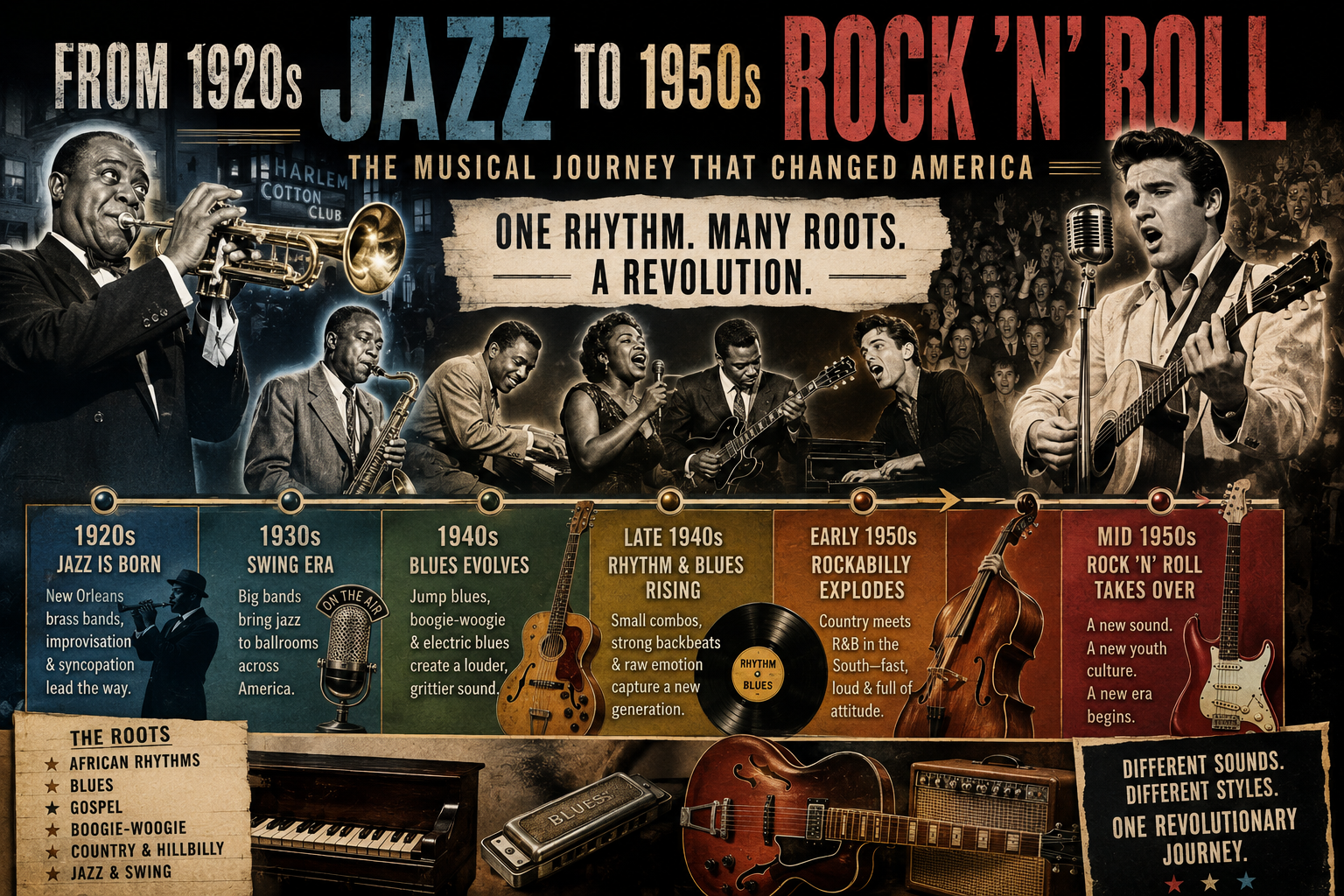
The story of rock and roll does not begin in the 1950s.
It doesn’t really begin in the 1940s either.
To understand why a young Elvis Presley could walk into a recording studio in Memphis in 1954 and make music that sounded radically different from the pop music his parents had grown up with, you have to go back much further. You have to go back to the 1920s, when jazz was becoming America’s most exciting new music.
That doesn’t mean rock and roll was simply “jazz with guitars.” It wasn’t. Rock and roll came from several musical traditions colliding over a period of decades. Blues, gospel, country, spirituals, boogie-woogie, rhythm and blues, jump blues, swing, jazz and even Tin Pan Alley pop all contributed pieces of the puzzle.
But jazz was one of the most important parts of that puzzle.
The connection becomes especially clear when you follow the evolution of rhythm.
The jazz musicians of the 1920s and 1930s changed the way popular music moved. They emphasized syncopation, backbeats, improvisation, horn arrangements, walking bass lines and increasingly powerful rhythm sections. Big-band swing turned dancing into a central part of American popular culture. Jump blues then stripped some of that sound down, increased the emphasis on the rhythm section and made the music louder, shorter and more physical.
By the 1940s, musicians were already making records that sound remarkably close to what would later be called rock and roll.
Then came rhythm and blues.
Then came electric guitars.
Then came independent record labels.
Then came radio DJs who ignored the traditional barriers between Black and white audiences.
Then came teenagers with money in their pockets.
By 1955, the ingredients had been sitting in the kitchen for decades.
Rock and roll was the meal.
The fascinating part is that nobody sat down one afternoon and invented it.
It evolved.
And if you follow the path backward from Bill Haley, Chuck Berry, Little Richard, Fats Domino, Jerry Lee Lewis and Elvis Presley, you eventually find yourself in the jazz clubs of 1920s America.
1. The America That Created Jazz
Jazz emerged from a complicated mixture of African American musical traditions, European musical structures and the unique cultural environment of the United States.
New Orleans was particularly important.
The city had a distinctive mixture of African, Caribbean, French, Spanish and American influences. It was a place where different musical traditions constantly interacted.
African American musicians were drawing from spirituals, work songs, blues, ragtime and dance music.
Brass bands were everywhere.
Parades were everywhere.
Funeral processions could become musical events.
Dance halls created demand for energetic performers.
The result was a musical environment where musicians were encouraged to improvise and adapt.
That improvisational spirit became one of jazz’s defining characteristics.
But jazz was not born fully formed.
It evolved from earlier forms.
Ragtime had already demonstrated that syncopated rhythms could become enormously popular. Scott Joplin and other ragtime composers had brought complex rhythmic patterns into mainstream American entertainment.
The blues provided another crucial ingredient.
Blues musicians emphasized emotional expression, repeated harmonic structures and rhythms that could be flexible rather than rigid.
Jazz combined elements of all of this and pushed them further.
The result was music that felt alive.
And that quality would eventually become one of rock and roll’s defining characteristics.
2. Louis Armstrong Changes Everything
If one musician represents the transformation of early jazz into a major American art form, it is Louis Armstrong.
Armstrong was not the only important jazz musician of the 1920s, but his influence was enormous.
He changed the role of the individual musician.
Early jazz had often emphasized collective improvisation, with several instruments playing simultaneously around a melody.
Armstrong demonstrated the power of the individual soloist.
His trumpet playing was melodic, rhythmic and incredibly expressive.
His phrasing influenced generations of singers and instrumentalists.
But Armstrong’s importance to rock and roll goes beyond trumpet technique.
He helped establish the idea that popular music could revolve around personality.
The musician could become the star.
The instrumental performance could become as memorable as the song.
That concept would eventually become central to rock music.
Rock and roll stars weren’t simply interchangeable entertainers.
Chuck Berry had a recognizable guitar style.
Little Richard had a recognizable vocal personality.
Elvis Presley had a recognizable physical presence.
Jerry Lee Lewis had a recognizable piano style.
That tradition of the larger-than-life individual performer has roots in jazz.
Armstrong was one of the people who helped create it.
3. Jazz Makes Rhythm More Important
The most important connection between jazz and rock and roll may be rhythm.
Jazz musicians were obsessed with rhythm.
They experimented with syncopation.
They played around the beat.
They emphasized unexpected accents.
They interacted with bass and drums in ways that made the rhythm section increasingly important.
This mattered enormously.
Traditional popular music had often been driven by melody.
Jazz increasingly made the groove itself part of the attraction.
You could dance to it.
You could feel it.
You could hear the musicians responding to each other.
Rock and roll inherited that philosophy.
By the 1950s, the rhythm section was no longer simply supporting the singer.
The rhythm section was driving the entire record.
Drums became louder.
Bass became more prominent.
Guitars became more aggressive.
Piano became more percussive.
The beat became the center of attention.
That transformation had been developing for decades.
4. Swing Takes Jazz to the Masses
During the 1930s, jazz underwent another enormous transformation.
The big band became the dominant format.
Duke Ellington.
Count Basie.
Benny Goodman.
Glenn Miller.
Artie Shaw.
These bands turned jazz into mass entertainment.
Swing music filled ballrooms.
People danced to it.
Radio broadcast it across the country.
Records spread it even further.
The scale was enormous.
Jazz was no longer simply a musical culture centered around individual clubs.
It had become a national phenomenon.
And swing introduced millions of Americans to music based around a strong, danceable rhythmic pulse.
That mattered enormously to the eventual development of rock and roll.
Rock and roll was not designed for sitting quietly in a concert hall.
It was dance music.
Its roots were in music that encouraged physical movement.
Swing had already demonstrated the commercial power of rhythm-driven dance music.
5. The Rhythm Section Gets Louder
Big bands also created an important technological problem.
How do you make a rhythm section heard underneath a huge brass and reed section?
The answer was amplification.
Electric instruments began appearing more frequently.
Guitarists experimented with amplification.
Bass players needed more volume.
Microphones improved.
Drummers became increasingly important.
The technology of jazz gradually made it possible for smaller groups to produce enormous amounts of sound.
This would become essential to rock and roll.
A small rock band could eventually create the sonic impact of a much larger ensemble because electric amplification allowed guitars, bass and vocals to dominate.
The modern rock band was becoming technically possible.
6. The Blues Was Always There
Jazz cannot be separated from the blues.
The blues was one of the foundational elements of early jazz, and it continued evolving independently.
As jazz became increasingly sophisticated, blues musicians continued developing their own traditions.
Urban blues became especially important.
African American musicians moved from rural Southern communities to cities such as Chicago, Detroit and Memphis.
The Great Migration transformed American culture.
Musicians brought Southern musical traditions with them.
But city life changed the music.
The sound became louder.
The arrangements became more electric.
The audiences became larger.
The rhythm sections became more prominent.
Chicago blues eventually became one of the great engines driving popular music toward rock.
Muddy Waters, Howlin’ Wolf, Willie Dixon and other musicians established an electric blues sound that would later influence virtually every major rock guitarist.
But before that happened, another style was already bridging the gap.
7. Boogie-Woogie
Boogie-woogie is one of the most important missing links in the history of rock and roll.
The style developed from blues and barrelhouse piano traditions.
Its defining characteristic was the repeated, driving bass pattern in the pianist’s left hand.
The right hand could play riffs, variations and rhythmic figures over the top.
The effect was hypnotic.
It was repetitive.
It was danceable.
And it was fast.
Boogie-woogie essentially turned the piano into a rhythm section.
Pianists such as Meade Lux Lewis, Albert Ammons and Pete Johnson helped popularize the style.
By the late 1930s and early 1940s, boogie-woogie was everywhere.
The style influenced swing musicians.
It influenced country musicians.
It influenced blues musicians.
And eventually it became a direct ingredient in rock and roll.
Listen to early rock piano and you can hear the connection immediately.
Jerry Lee Lewis didn’t invent the idea of hammering a rhythm on the piano.
He inherited it.
Little Richard inherited it.
Fats Domino inherited it.
The boogie-woogie piano tradition helped teach rock and roll how to move.
8. Jump Blues
If boogie-woogie was one bridge, jump blues was another.
Jump blues emerged from the swing and blues traditions during the 1930s and 1940s.
The big bands were being simplified.
Instead of ten or fifteen musicians, smaller groups could create a similar rhythmic impact with saxophone, piano, bass, drums and guitar.
The music was louder.
Shorter.
More direct.
And heavily focused on rhythm.
Louis Jordan became one of the most important figures in this development.
His Tympany Five was not a giant orchestra.
It was a compact, energetic group.
Jordan’s music combined jazz sophistication, blues vocabulary and a strong dance beat.
His records were enormously influential.
They sounded like music designed for a jukebox.
And that was exactly what rock and roll would become.
9. Louis Jordan Is a Missing Link
Louis Jordan deserves enormous credit in any history of rock and roll.
He was a saxophonist.
He was a singer.
He was a bandleader.
He was a showman.
And he understood popular music.
His records were short.
They were catchy.
They had strong rhythms.
They featured saxophone prominently.
They mixed humor with blues and jazz.
They were designed to make people move.
If someone played you a Louis Jordan recording without telling you when it was made, you might be surprised to learn that some of his most influential records came more than a decade before the rock and roll explosion.
Jordan helped establish the blueprint for the small-group rhythm-and-blues record.
That blueprint would eventually be used by countless rock and roll performers.
10. The Saxophone Becomes a Rock Instrument
When people think of rock and roll, they often imagine electric guitar.
But early rock and roll was frequently dominated by saxophone.
That is a direct inheritance from jazz and jump blues.
The saxophone could scream.
It could honk.
It could growl.
It could play rhythmic riffs.
It could take solos.
It could cut through a loud rhythm section.
That made it perfect for early rhythm and blues.
Big Joe Turner, Wynonie Harris, Joe Liggins and many others helped develop this sound.
The saxophone was not merely decoration.
It was often the most aggressive instrument in the band.
Before the electric guitar completely took over the role, the saxophone was one of the primary weapons of early rock and roll.
11. Gospel Enters the Story
The history becomes more complicated when gospel enters the picture.
Rock and roll wasn’t simply secular jazz and blues.
Gospel was hugely important.
African American gospel singers developed powerful vocal styles based on call-and-response, emotional intensity, repetition and rhythmic emphasis.
Those techniques influenced rhythm and blues singers.
They also influenced rock singers.
Little Richard was deeply connected to gospel.
Ray Charles combined gospel phrasing with secular music.
Elvis absorbed gospel music from the churches he attended and heard growing up.
Jerry Lee Lewis also had deep connections to Southern gospel traditions.
The emotional intensity of rock and roll vocals owes a great deal to gospel.
That is why the music could sound almost explosive even when the chord progression was simple.
The singer wasn’t simply delivering a melody.
The singer was performing.
12. Call and Response
One of the most important African American musical traditions to enter rock and roll was call and response.
The basic concept is simple.
One voice or instrument makes a statement.
Another responds.
The technique has deep roots in African musical traditions and became central to African American religious and secular music.
Jazz musicians used it.
Blues musicians used it.
Gospel musicians used it.
Rhythm and blues musicians used it.
Rock and roll musicians used it constantly.
You can hear call-and-response between a singer and backing vocals.
Between a singer and guitar.
Between the rhythm section and horns.
Between a band and an audience.
It creates energy.
It makes music feel interactive.
That sense of conversation became part of the language of rock.
13. World War II Changes American Music
World War II had a massive impact on the American music industry.
Large touring bands became more difficult and expensive to maintain.
Many musicians were drafted.
Travel became complicated.
Economics changed.
Smaller groups became more practical.
That helped accelerate the rise of smaller rhythm-and-blues bands.
A five-piece group could travel more easily than a twenty-piece orchestra.
The smaller bands could also make louder, more focused records.
This helped push popular music toward the format that would eventually define rock and roll.
A singer.
Guitar.
Bass.
Drums.
Maybe piano.
Maybe saxophone.
That was enough.
14. The Rise of Rhythm and Blues
The term rhythm and blues became widely used in the 1940s.
It was a marketing category, but it represented a real musical development.
Black popular music was becoming increasingly urban and amplified.
The rhythm was stronger.
The performances were more energetic.
The arrangements were more direct.
The records were increasingly designed for jukeboxes and radio.
Artists such as Wynonie Harris, Roy Brown, Ruth Brown, Big Joe Turner and many others helped establish the sound.
This is where the word “rock” begins appearing more frequently in descriptions of the music.
The music industry was moving toward a new category.
It wasn’t jazz.
It wasn’t traditional blues.
It wasn’t gospel.
It wasn’t country.
It was something increasingly distinct.
15. “Rocking” Was Already a Musical Idea
The phrase “rock and roll” did not suddenly appear in 1955.
Words involving “rock” had been used in African American music for decades.
The terms could have religious, sexual or rhythmic meanings depending on context.
Radio personalities eventually began using “rock and roll” as a way of describing energetic rhythm and blues music.
Alan Freed became particularly important.
As a radio DJ in Cleveland and later New York, Freed promoted Black rhythm and blues records to increasingly broad audiences.
He helped popularize the term.
But he did not invent the music.
The music was already there.
He helped give it a name and a market.
16. The Jukebox Changes Everything
The jukebox was one of the most important technologies in the development of rock and roll.
A jukebox didn’t care what a record label thought was respectable.
It didn’t care about race.
It didn’t care about traditional pop music conventions.
If people wanted to hear a record, they played it.
Bars, diners, restaurants and clubs became places where young people could hear music outside their parents’ preferences.
The jukebox helped turn rhythm and blues into youth culture.
That was a huge development.
Music was becoming less dependent on the tastes of older adults.
Teenagers were developing their own musical identity.
Rock and roll would become the soundtrack of that rebellion.
This post has already been read 704 times!