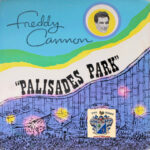
 Some songs don’t just play—they move. They spin, shout, laugh, and practically leap out of the speakers with a sense of motion you can feel in your chest. “Palisades Park” by Freddy Cannon is one of those songs. It doesn’t simply describe a place—it puts you there, right in the middle of the noise, the lights, and the thrill of a summer day at an amusement park.
Released in 1962, “Palisades Park” arrived at a time when rock and roll was still young, still discovering how to capture everyday experiences and turn them into something larger than life. And that’s exactly what this song does. It transforms a simple outing into a vivid, energetic snapshot of American youth culture at its most carefree.
More than sixty years later, it still feels like a ride that never quite stops.
A Song That Starts at Full Speed
From the very first seconds, “Palisades Park” doesn’t ease you in—it launches forward.
The pounding piano, the driving rhythm, and the unmistakable sense of urgency create an immediate burst of energy. There’s no slow build, no gradual introduction. It’s as if the song begins in the middle of the action, already in motion.
That momentum never lets up.
The arrangement is tightly packed but never overwhelming. Every element—the piano, the horns, the percussion—works together to create a sound that feels both chaotic and perfectly controlled. It’s loud, it’s bold, and it’s impossible to ignore.
This is rock and roll at its most direct: immediate, physical, and designed to make you move.
The Sound of an Amusement Park in Motion
What makes “Palisades Park” truly special is how vividly it captures its setting.
You don’t just hear about the park—you experience it. The song is filled with sonic details that mimic the environment: the crashing sounds of rides, the bustling energy of crowds, the constant sense of movement.
The production plays a huge role in this.
The piano, in particular, drives the song forward like the engine of a rollercoaster. It’s relentless, pushing the rhythm along with a kind of joyful intensity. The horns add bursts of excitement, like sudden drops or sharp turns on a ride.
Everything feels kinetic.
It’s not just a song about a place—it’s a song that recreates the feeling of being there.
Freddy Cannon’s Vocal Energy
Freddy Cannon’s vocal performance is perfectly matched to the song’s energy.
He doesn’t just sing—he shouts, calls, and exclaims. There’s a raw enthusiasm in his delivery, a sense that he’s not just describing the experience but living it in real time.
His voice carries a kind of youthful excitement that feels completely genuine. There’s no irony, no distance. It’s pure, unfiltered fun.
At times, his delivery borders on chaotic, but that’s part of the charm. It mirrors the environment he’s describing—loud, unpredictable, and full of life.
This isn’t a polished, restrained performance. It’s a burst of energy, captured in real time.
Lyrics: A Day at the Park, Line by Line
Lyrically, “Palisades Park” is simple—but incredibly effective.
The song takes you through a series of moments, each one painting a picture of life at the amusement park. From riding attractions to meeting a girl, it’s a sequence of snapshots that come together to form a complete experience.
There’s no deep narrative or complex metaphor.
Instead, the power comes from the details.
Each line adds another piece to the puzzle, another glimpse into the world of the park. And because the song moves so quickly, these moments blur together, creating a sense of continuous motion.
It’s less about telling a story and more about capturing a feeling—the excitement, the spontaneity, the sense that anything can happen.
A Snapshot of Early 1960s Youth Culture
“Palisades Park” isn’t just a song about a place—it’s a reflection of a moment in time.
In the early 1960s, amusement parks were a central part of youth culture. They were places of freedom, excitement, and social connection—a break from the routines of everyday life.
The song captures that perfectly.
There’s a sense of innocence to it, a feeling of carefree enjoyment that defines the era. It’s about simple pleasures: rides, music, and the thrill of meeting someone new.
At the same time, it reflects the growing influence of rock and roll as a cultural force. This was music that spoke directly to young people, that captured their experiences in a way that felt immediate and authentic.
“Palisades Park” sits right at that intersection.
The Role of Novelty—and Why It Works
On the surface, “Palisades Park” might seem like a novelty song.
It’s built around a specific setting, filled with playful details, and driven by a sense of fun. But what sets it apart is how well it executes that concept.
The song doesn’t rely on gimmicks alone.
Instead, it combines its novelty elements with strong musicianship and a clear sense of purpose. The energy, the arrangement, and the performance all work together to create something that feels cohesive and intentional.
That’s why it lasts.
It’s not just a fun idea—it’s a well-crafted song that happens to be fun.
A Song That Feels Like Summer
There’s a seasonal quality to “Palisades Park.”
It feels like summer—hot, bright, and full of possibility. Even if you’ve never been to an amusement park like the one described, the song taps into a universal feeling of carefree enjoyment.
It’s the sound of a day with no responsibilities, where the only goal is to have as much fun as possible.
That sense of escapism is part of what makes the song so appealing.
It offers a brief break from reality, a chance to step into a world where everything is louder, faster, and more exciting.
The Legacy of a High-Energy Classic
Over the years, “Palisades Park” has remained one of Freddy Cannon’s most recognizable songs—and for good reason.
It captures a specific moment in music history, but it also transcends it. The energy, the excitement, and the sense of movement still feel fresh, even decades later.
It’s the kind of song that doesn’t age in the traditional sense.
Because it’s not tied to a complex idea or a specific trend, it remains accessible. Anyone can listen to it and immediately understand what it’s about—and more importantly, how it feels.
Why It Still Works Today
In today’s music landscape, where production can often be layered and intricate, “Palisades Park” stands out for its simplicity and directness.
It doesn’t overthink things.
It delivers exactly what it promises: a burst of energy, a vivid setting, and a sense of fun that’s impossible to fake.
That honesty is part of its enduring appeal.
It reminds us that music doesn’t always need to be complex or deeply introspective to be effective. Sometimes, all it needs to do is capture a moment—and do it well.
Final Thoughts: A Ride That Never Ends
“Palisades Park” is more than just a song—it’s an experience.
It’s the sound of laughter, motion, and excitement, all packed into a few minutes of pure rock and roll energy. It doesn’t slow down, it doesn’t hold back, and it doesn’t try to be anything other than what it is.
And that’s exactly why it works.
Decades after its release, it still feels like stepping onto a ride that’s already in motion—fast, loud, and just a little bit wild.
You don’t analyze it.
You just hold on and enjoy the ride.
This post has already been read 64500 times!