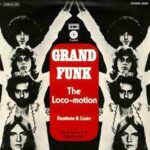
 Few songs in pop history have traveled through as many musical eras as “The Loco-Motion.” Originally a cheerful dance song from the early 1960s, it has been reinvented multiple times by artists across different genres. One of the most memorable versions arrived in 1974, when American rock band Grand Funk Railroad transformed the tune into a driving, high-energy rock hit.
The group’s version of “The Loco-Motion” became a massive success, reaching No. 1 on the Billboard Hot 100 and introducing the classic dance song to a new generation of listeners. By adding crunchy guitars, powerful drums, and arena-rock enthusiasm, Grand Funk Railroad gave the track a completely new personality.
The result was one of the band’s biggest hits and one of the most successful cover songs of the 1970s.
The Original Song
Before Grand Funk Railroad recorded “The Loco-Motion,” the song had already made history.
It was originally written in 1962 by legendary songwriting duo Gerry Goffin and Carole King, two of the most influential composers of the early rock and roll era. At the time, the pair were writing hit songs for the famous Brill Building music scene in New York City.
The song was first recorded by singer Little Eva, who happened to be working as a babysitter for Goffin and King. According to music lore, Eva Boyd (Little Eva’s real name) demonstrated a dance she had been doing at parties. The writers liked the idea and built a song around it.
The result was “The Loco-Motion,” a cheerful pop tune that encouraged listeners to follow along with a simple dance.
The single became a huge success, reaching No. 1 on the Billboard Hot 100 in 1962. Its catchy melody and easy-to-follow dance instructions helped it become one of the defining novelty hits of the early 1960s.
But the song’s journey was far from over.
Enter Grand Funk Railroad
By the time Grand Funk Railroad decided to record “The Loco-Motion,” they were already one of the biggest rock bands in America.
Formed in 1969 in Flint, Michigan, the group—consisting of Mark Farner, Don Brewer, and Mel Schacher—built their reputation on loud, bluesy rock songs that appealed strongly to live audiences. Their early albums, including Closer to Home and Survival, made them a major force in the arena-rock movement of the early 1970s.
Although critics sometimes dismissed the band, fans loved their straightforward, high-energy sound. Grand Funk’s concerts frequently sold out massive venues across the United States.
By 1974, however, the band was looking to reinvent themselves slightly.
They brought in producer Todd Rundgren, a respected musician and studio wizard known for his polished production style. Rundgren encouraged the band to experiment with different ideas and revisit older songs.
One of those ideas was recording a rock version of “The Loco-Motion.”
Reinventing a Classic
At first glance, “The Loco-Motion” might have seemed like an unusual choice for a hard-rock band.
The original version was lighthearted and playful, built around soft pop instrumentation and dance-friendly rhythms. Grand Funk Railroad approached the song from a completely different perspective.
Instead of treating it like a novelty dance tune, they turned it into a full-throttle rock track.
The new arrangement featured distorted electric guitars, pounding drums, and a much heavier rhythm section. The tempo was faster, the energy was higher, and the sound was unmistakably rock.
Mark Farner’s vocals added a gritty edge that contrasted sharply with the sweetness of the original recording.
Yet despite these changes, the song’s core melody remained intact.
Listeners could still recognize the familiar hook and chorus—but now it came wrapped in a powerful rock groove.
The Signature Guitar Intro
One of the most memorable elements of Grand Funk Railroad’s version is its opening guitar riff.
Instead of the gentle introduction heard in earlier versions, the 1974 recording begins with a bold electric guitar line that immediately signals the song’s transformation.
This riff grabs the listener’s attention and sets the tone for the entire track. It establishes the band’s heavier sound while still leaving room for the familiar melody that follows.
The combination of rock instrumentation and pop songwriting proved incredibly effective.
The track feels both nostalgic and modern at the same time.
A Dance Song for the Rock Era
Despite its harder edge, the lyrics of “The Loco-Motion” remained essentially unchanged.
The song still invites listeners to join in a dance that resembles the motion of a train. The instructions are simple and playful:
“Come on baby, do the Loco-Motion…”
These lines retained the spirit of the original while gaining a new level of excitement thanks to the band’s energetic performance.
The result was something unique: a dance song built for the rock era.
Instead of teenagers dancing in living rooms as they might have in 1962, listeners in the 1970s were more likely to hear the song blasting through arena speakers or car radios.
The dance itself may have been simple, but the music now had the power of a rock anthem.
Chart-Topping Success
When Grand Funk Railroad released their version of “The Loco-Motion” in 1974 as part of the album Shinin’ On, the song quickly climbed the charts.
By May of that year, it had reached No. 1 on the Billboard Hot 100, becoming the band’s second chart-topping single.
This achievement placed “The Loco-Motion” in rare company. Very few songs have reached No. 1 in multiple decades with different artists.
The success of the track also introduced the song to younger listeners who may not have been familiar with the original Little Eva version.
For Grand Funk Railroad, the hit reaffirmed their status as one of the biggest rock bands of the era.
A Unique Place in Pop History
“The Loco-Motion” holds a unique place in music history because it has repeatedly found new life through reinterpretation.
After the success of Little Eva and Grand Funk Railroad, the song would later return to the charts once again when Kylie Minogue recorded a dance-pop version in 1987.
That recording also became a major international hit.
Few songs have successfully crossed so many genres and decades.
The reason for this enduring appeal lies in the strength of the songwriting. Goffin and King created a melody and chorus so catchy that they can adapt to almost any musical style.
From early 1960s pop to 1970s rock to 1980s dance-pop, “The Loco-Motion” has proven remarkably flexible.
Grand Funk’s Legacy
For Grand Funk Railroad, the song remains one of the highlights of their long career.
Although the band was already known for hits like “We’re an American Band” and “Some Kind of Wonderful,” their version of “The Loco-Motion” demonstrated their ability to reinterpret classic material in a fresh way.
It also showed how rock music in the 1970s could absorb influences from earlier pop traditions while adding its own energy and intensity.
The band’s success helped pave the way for other rock groups to explore covers and reinterpretations of classic songs.
Why the Song Still Works
Even today, Grand Funk Railroad’s version of “The Loco-Motion” remains a favorite on classic rock radio.
The reason is simple: the song is fun.
The driving rhythm, catchy melody, and energetic performance make it nearly impossible not to tap your foot along with the beat.
It’s the kind of track that brings together generations of listeners.
Older fans may remember the original dance craze of the 1960s, while younger audiences appreciate the powerful rock arrangement.
Few songs manage to bridge those kinds of musical gaps so effortlessly.
A Timeless Musical Journey
In the grand history of popular music, “The Loco-Motion” stands as one of the most successful examples of a song reinventing itself across decades.
Grand Funk Railroad’s 1974 version played a major role in that journey. By transforming a lighthearted pop tune into a driving rock anthem, they introduced the song to a whole new audience and ensured its place in music history.
The track proved that great songs are flexible—they can adapt to new styles, new sounds, and new generations of listeners.
And whenever the familiar chorus begins to play, listeners are reminded that some musical ideas never go out of style.
All it takes is a good groove, a catchy melody, and the invitation to join the ride.
Come on, baby—do the Loco-Motion.
This post has already been read 926 times!